

Views: 7
Table of Contents
- 1 The One Guide That Ties Everything Together
- 2 Stage 1 — Understanding What Mutual Divorce Actually Requires
- 3 Stage 2 — Deciding If Mutual Divorce Is Even the Right Fit
- 4 Stage 3 — Preparing Documents Before You File
- 5 Stage 4 — Settling Alimony, Maintenance, and Financial Terms
- 6 Stage 5 — Settling Child Custody, If Children Are Involved
- 7 Stage 6 — Drafting the Settlement Agreement
- 8 Stage 7 — Filing the Petition
- 9 Stage 8 — The First Motion
- 10 Stage 9 — The Cooling-Off Period, and Whether It Can Be Skipped
- 11 Stage 10 — If Either Spouse Changes Their Mind
- 12 Stage 11 — The Second Motion and Final Decree
- 13 Putting the Whole Timeline Together
- 14 Common Mistakes to Avoid
- 15 FAQs
- 16 Why Choose Quick Divorce
- 17 Get Expert Mutual Divorce Legal Assistance
The One Guide That Ties Everything Together
Mutual Divorce in India is a legal process through which a husband and wife mutually agree to end their marriage without lengthy disputes or court battles. Governed by Section 13B of the Hindu Marriage Act, 1955, mutual divorce allows both spouses to dissolve their marriage peacefully when they have been living separately and believe that reconciliation is no longer possible.
Compared to a contested divorce, this process is generally faster, less stressful, and more cost-effective. Matters such as child custody, alimony, maintenance, and property division are usually settled through mutual consent before filing the petition. As awareness of legal rights and online legal services continues to grow in 2026, mutual divorce has become one of the most preferred options for couples seeking an amicable and dignified separation.
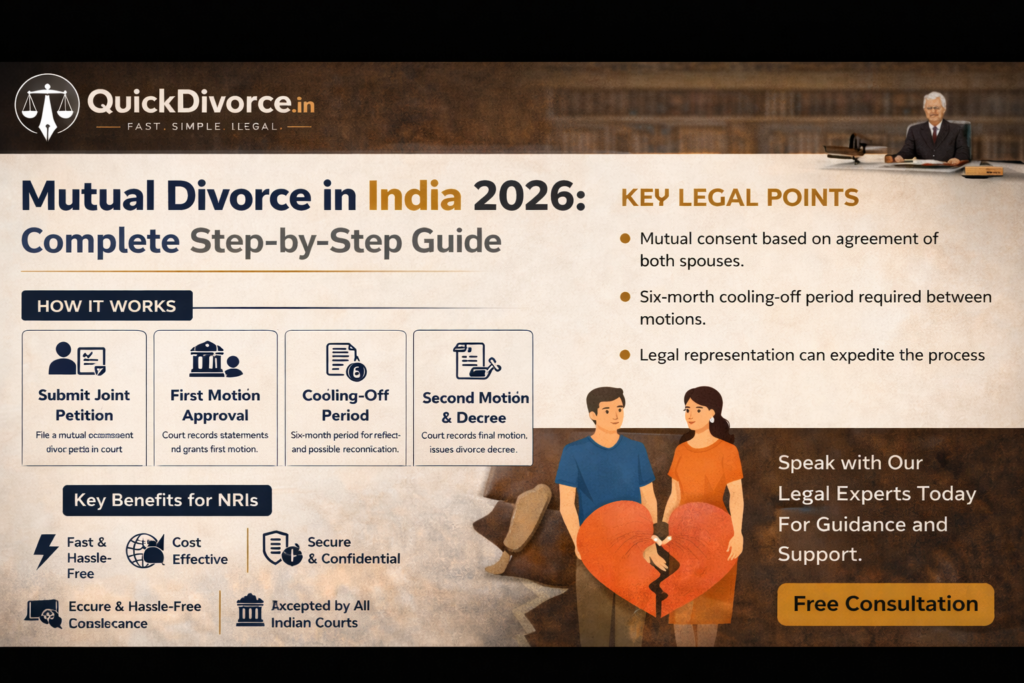
Mutual divorce is, on paper, the simplest legal path out of a marriage in India — both spouses agree, both spouses sign, the court confirms it twice, six months apart (or sooner, with waiver), and a decree is passed. In practice, it raises a dozen specific questions, each deserving its own detailed answer, which is exactly why we have built out dedicated guides on each piece of this process.
This page is the map. It walks through the entire mutual divorce journey, stage by stage, and at each stage links you to the full, detailed guide covering that specific part in depth.
Stage 1 — Understanding What Mutual Divorce Actually Requires
Mutual consent divorce is governed primarily by Section 13B of the Hindu Marriage Act, 1955, with similar provisions available under the Special Marriage Act, 1954 and the Indian Divorce Act, 1869 for couples belonging to different legal frameworks. This type of divorce is based on the principle that when both spouses have mutually decided that their marriage has irretrievably broken down and there is no realistic possibility of reconciliation, they may jointly approach the court to seek dissolution of their marriage.
To qualify for mutual divorce, both spouses must generally have been living separately for at least one year before filing the petition. It is important to understand that “living separately” does not necessarily mean residing in different houses. Courts have recognized that a couple may be considered to be living separately even while residing under the same roof if they are no longer performing marital obligations and have effectively ended their marital relationship.
📖 Read in full detail: Mutual Divorce Grounds Under Hindu Marriage Act Explained
📖 Choosing between this and the alternative path: Mutual Divorce vs Contested Divorce in India: Key Differences
Stage 2 — Deciding If Mutual Divorce Is Even the Right Fit
Before filing anything, it’s worth being honest about whether court involvement can genuinely be minimized, and what cannot be avoided no matter how much both spouses agree. While mutual divorce is often viewed as the quickest and least stressful way to legally end a marriage, it is not suitable for every situation. The success of a mutual divorce depends largely on the willingness of both spouses to cooperate, communicate openly, and reach fair agreements on all important issues.
One of the first questions couples should ask themselves is whether they are genuinely in agreement about ending the marriage. Mutual divorce requires continuous consent from both parties throughout the legal process. If one spouse is uncertain, unwilling to participate, or likely to withdraw consent later, a mutual divorce petition may face delays or even fail altogether. Therefore, both individuals should carefully evaluate their intentions before proceeding.
📖 Read in full detail: Mutual Divorce Without Going to Court in India: Is It Possible?
Stage 3 — Preparing Documents Before You File
Nothing slows a mutual divorce down more than realizing mid-process that a document is missing, expired, or was never gathered in the first place. Proper preparation of documents is one of the most important steps in ensuring a smooth and efficient divorce process. Before filing the mutual divorce petition, both spouses should collect all necessary paperwork and verify that the information provided is accurate and up to date.
Commonly required documents include the marriage certificate, identity proofs such as Aadhaar Card, PAN Card, Passport, or Voter ID, address proofs, passport-sized photographs, and proof of separation if available. In cases involving children, documents relating to custody arrangements, educational expenses, and maintenance agreements may also be required. Similarly, if alimony or property settlement has been agreed upon, supporting financial and property-related documents should be kept ready.
📖 Read in full detail: Documents Required for Mutual Divorce in India: Full Checklist
Stage 4 — Settling Alimony, Maintenance, and Financial Terms
This is almost always the part that takes the longest to negotiate, and the part most likely to cause future disputes if left vague. Before filing for mutual divorce, both spouses should clearly agree on all financial matters, including alimony, maintenance, child support, property division, investments, loans, and any other shared financial responsibilities.
The settlement terms should be fair, practical, and documented in writing to avoid misunderstandings later. Courts generally prefer clear and comprehensive agreements that protect the interests of both parties. A well-drafted financial settlement can significantly reduce the risk of future legal conflicts after the divorce is finalized.
📖 Read in full detail: Mutual Divorce and Alimony: What Can You Claim?
📖 If maintenance is later not paid: How to Enforce Maintenance Orders After Divorce in India
Stage 5 — Settling Child Custody, If Children Are Involved
Custody terms in a mutual divorce are negotiated between the parents rather than imposed by a judge after trial, but courts still review these terms to ensure they genuinely serve the child’s welfare. Parents should discuss and agree upon important aspects such as physical custody, visitation rights, education expenses, healthcare responsibilities, holidays, and other matters affecting the child’s daily life. The primary consideration is always the best interests of the child, not the preferences of either parent.
A clear and detailed custody arrangement helps provide stability and minimizes future conflicts between the parents. When both parties cooperate and prioritize the child’s well-being, the court is more likely to approve the proposed arrangement and facilitate a smoother divorce process.
📖 If custody or visitation breaks down later: How to Get Visitation Rights When Denied Access to Child in India
Stage 6 — Drafting the Settlement Agreement
Every financial term, every custody detail, every property division — all of it needs to be captured in writing, specifically and enforceably, before it ever reaches court. A settlement agreement serves as the foundation of a mutual divorce petition and reflects the complete understanding between the spouses.
It should clearly mention alimony, maintenance, child custody arrangements, visitation rights, division of assets, liabilities, and any other mutually agreed terms. Vague or incomplete clauses can create confusion and lead to disputes in the future. A properly drafted agreement helps the court understand the settlement, protects the rights of both parties, and ensures a smoother and legally secure divorce process.
📖 Read in full detail: Mutual Divorce Settlement Agreement: How to Draft It in India
Stage 7 — Filing the Petition
Once documents and the settlement are ready, the joint petition is drafted and filed before the Family Court having jurisdiction. This petition contains essential details about the marriage, the period of separation, the reasons for seeking divorce by mutual consent, and the terms agreed upon by both spouses. Along with the petition, supporting documents and the settlement agreement are submitted to the court for review.
Both parties are generally required to appear before the court and confirm that they are filing the petition voluntarily and without any pressure or coercion. Accurate drafting and proper filing are crucial, as errors or missing information can result in delays and additional court procedures during the mutual divorce process.
📖 Read in full detail: How to File Mutual Divorce Petition in India: Step-by-Step
Stage 8 — The First Motion
Both spouses appear before the judge, statements are recorded confirming genuine consent, and the First Motion is passed — the first of two mandatory court appearances in a mutual divorce case. During this stage, the court verifies that both parties have voluntarily decided to dissolve their marriage and that there has been no coercion, fraud, or undue influence involved.
The judge may ask questions regarding the marriage, period of separation, settlement terms, child custody arrangements, and financial agreements to ensure that both spouses fully understand the consequences of their decision. Once satisfied that the consent is genuine and all legal requirements have been met, the court records the statements and allows the matter to proceed to the next stage of the mutual divorce process.
📖 Read in full detail: Mutual Divorce Process in India: What Happens After the First Motion?
Stage 9 — The Cooling-Off Period, and Whether It Can Be Skipped
This single decision — whether to seek a waiver of the standard six-month wait — has the biggest impact on your overall timeline of anything in this entire process. The cooling-off period is intended to give spouses an opportunity to reconsider their decision and explore the possibility of reconciliation before the marriage is legally dissolved. However, in certain circumstances, courts may waive this waiting period if it is clear that the marriage has irretrievably broken down and there is no chance of the parties resuming cohabitation.
When deciding whether to request a waiver, factors such as the length of separation, settlement of all disputes, and the overall facts of the case are carefully considered. If the court grants the waiver, the divorce process may conclude significantly faster. If not, the parties must wait until the prescribed period expires before proceeding to the final stage of the mutual divorce proceedings.
Stage 10 — If Either Spouse Changes Their Mind
Consent in mutual divorce must remain genuine all the way through to the Second Motion. If one party withdraws it, the case cannot proceed as mutual divorce at all.
📖 Read in full detail: Can One Party Withdraw from Mutual Divorce in India?
Stage 11 — The Second Motion and Final Decree
Both spouses reaffirm their consent one final time, and the court passes the decree of divorce — the legal moment the marriage actually ends. During the Second Motion hearing, both parties are required to appear before the Family Court and confirm that they still wish to proceed with the divorce. The court reviews the settlement agreement, child custody arrangements, maintenance terms, and other relevant documents to ensure that all conditions have been satisfied.
The judge also verifies that the consent of both spouses remains voluntary and has not been withdrawn since the First Motion. Once the court is satisfied that all legal requirements have been fulfilled and there are no outstanding issues, it grants the final decree of divorce. This decree officially dissolves the marriage and serves as the legal proof of divorce. After obtaining the certified copy of the decree, both individuals are legally recognized as divorced and are free to move forward independently.
📖 (Covered within) Mutual Divorce Process in India: What Happens After the First Motion?
Putting the Whole Timeline Together
How long does all of this actually take, from your very first document to the certified decree in hand? The answer depends on several factors, including how quickly both spouses reach a settlement, the completeness of the documentation, court scheduling, and whether the cooling-off period is waived. In an ideal situation where all documents are prepared, disputes have been resolved, and the court grants a waiver of the waiting period, a mutual divorce may be completed within a relatively short timeframe. However, if additional negotiations are required or the cooling-off period applies, the process can take considerably longer.
The key to a faster mutual divorce is preparation. Couples who finalize financial settlements, child custody arrangements, and property-related issues before filing the petition usually experience fewer delays. Working with experienced legal professionals, ensuring accurate documentation, and responding promptly to court requirements can further streamline the process. While every case is unique, careful planning and mutual cooperation remain the most important factors in achieving a smooth and efficient divorce process from start to finish.
📖 Read in full detail: How Long Does Mutual Divorce Take in India? Timeline Explained
Common Mistakes to Avoid
Many couples face delays because of incomplete documentation, unclear settlement terms, or misunderstandings regarding financial arrangements. Seeking proper legal guidance and ensuring that all agreements are clearly documented can help avoid unnecessary complications during the divorce process.
FAQs
1. What is mutual divorce in India?
Mutual divorce is a legal process where both husband and wife jointly agree to dissolve their marriage and file a petition before the family court seeking divorce by mutual consent.
2. What are the eligibility requirements for mutual divorce?
Generally, the spouses must have been living separately, mutually agree that they cannot live together as husband and wife, and consent to end the marriage voluntarily.
3. How long does a mutual divorce take in India in 2026?
The duration varies depending on the case and court procedures. In many cases, mutual divorce is significantly faster than contested divorce, especially when all documents and settlements are in order.
4. Is it necessary to hire a lawyer for mutual divorce?
While legal representation may not always be mandatory, consulting an experienced divorce lawyer helps ensure proper documentation, legal compliance, and protection of your rights.
5. Can child custody be decided through mutual divorce?
Yes. Parents can mutually agree on child custody, visitation rights, education expenses, and maintenance arrangements, which are then presented before the court for approval.
6. Can one spouse withdraw consent after filing a mutual divorce petition?
Yes. Mutual consent must continue until the final decree is granted. If either spouse withdraws consent before the final order, the mutual divorce petition may not proceed further.
Why Choose Quick Divorce
Quick Divorce provides professional legal assistance for mutual and contested divorce cases across India. Our experienced legal team ensures a smooth, transparent, and hassle-free process while guiding you through every step of your case. From document preparation and legal consultation to court proceedings, we focus on saving your time, reducing stress, and protecting your legal rights. With affordable services, expert support, and a client-first approach, Quick Divorce is committed to helping individuals achieve a faster and more convenient resolution to their matrimonial disputes.
We handle every stage above as one coordinated process, not eleven separate problems — from your first consultation through settlement drafting, filing, both court motions, and final decree collection.
Book your free consultation today: 📞 Call / WhatsApp: 8595439395 🌐 Website: www.quickdivorce.in
Get Expert Mutual Divorce Legal Assistance
🟡 QuickDivorce.in provides complete mutual divorce services — petition drafting, settlement negotiation and drafting, first and second motion representation, waiver applications, NRI video conferencing appearances, and post-decree implementation support across all jurisdictions in India.
🟡Visit LegalTax.in for other Legal and Trademark related services as 👉 Money Recovery Cases
👉 Property Disputes 👉 Business & Licence Registrations
🟡Visit Business24hub for IT services
👉 Mutual Consent Divorce at QuickDivorce.in 👉 Contested Divorce Filing 👉 Child Custody and Maintenance 👉 Matrimonial Property Settlement 👉 NRI Divorce Services 👉 Alimony and Maintenance
🟡 Protect Your Rights 👉 Domestic Violence Legal Support at QuickDivorce.in 👉 Stridhan Recovery
📞 Call Now: +91 8595439395 🕐 Free Consultation: Monday to Saturday, 10 AM to 6 PM

Adv. Manish Kashyap is a Family Law & Divorce Lawyer with extensive experience in Mutual & Contested Divorce, NRI Divorce, Child Custody, Alimony, Domestic Violence, Judicial Separation, and Family Court matters, providing professional legal guidance to clients.

