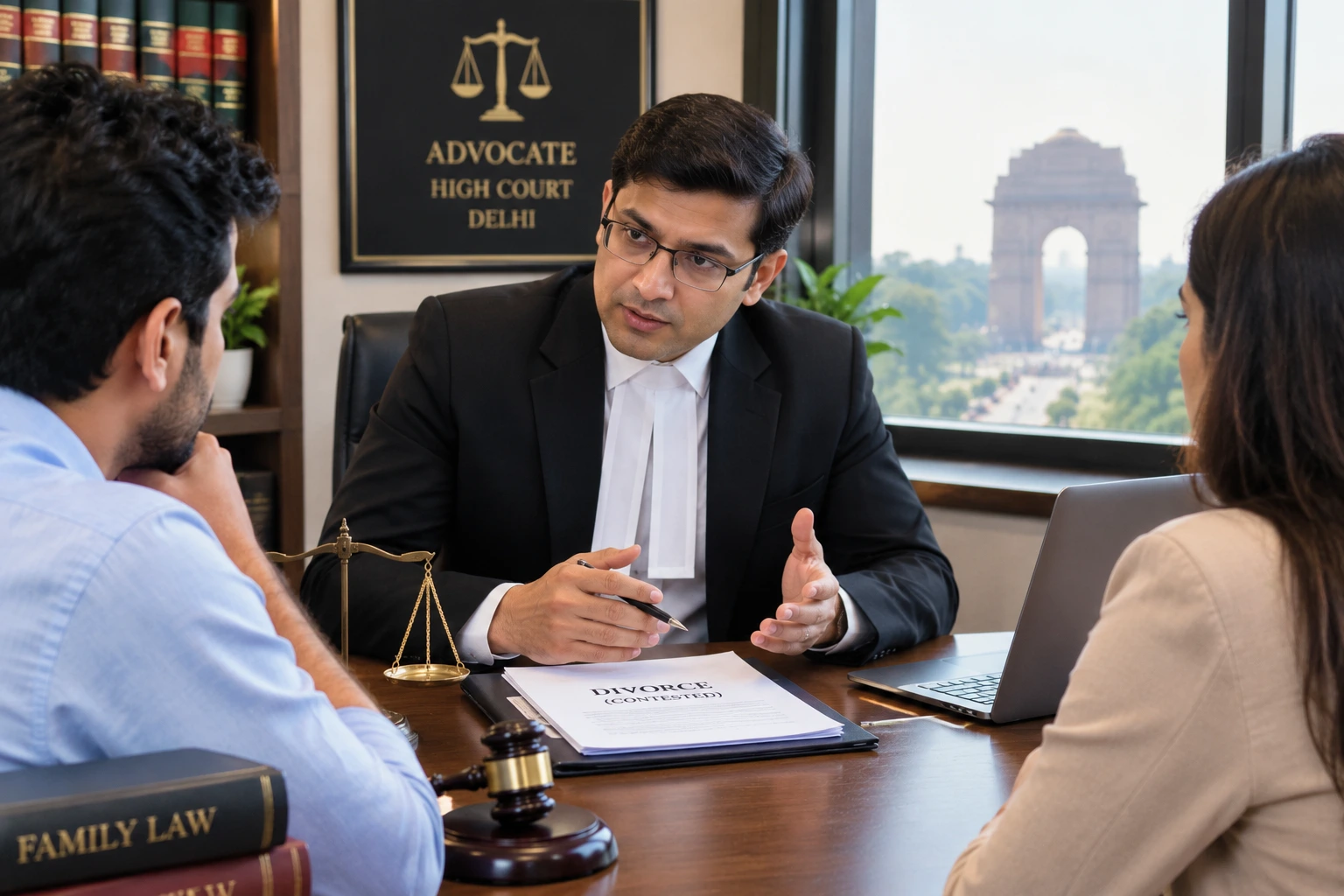
Divorce advocate in Delhi holding a case file
Divorce Law Firm at Dwarka Court, Delhi

Trusted Divorce Lawyer in Delhi for Mutual & Contested Divorce

QuickDivorce.in is a Delhi law firm at Dwarka Court focused on divorce. Our advocates handle mutual consent and contested divorce, child custody, alimony and maintenance, and NRI divorce. You get clear advice, careful drafting and steady representation, from the first consultation to the final decree.


90+ Successful Cases
Happy client 1 Happy client 2 Happy client 3

Mutual Consent Divorce

Contested Divorce

Child Custody & Visitation

Alimony & Maintenance

Experienced divorce advocate in Delhi icon

Experienced Divorce Advocate

Our advocate has practised at Dwarka Court for over 12 years and handles divorce and family matters with clear guidance and careful drafting.

Meet Your Advocate

Client-first approach icon

Client-First Approach

Every marriage and every separation is different. We explain each step in simple language, keep your matter confidential and stay with you until the divorce is decided.

Our Divorce Services

Clear and organised divorce process icon

Clear & Organised Process

From petition drafting and filing to hearings and the final decree, we manage the paperwork so you can focus on your life.

See How It Works

Advocate at a Delhi law firm guiding a client through a divorce
90+
Successful Cases

Our Dwarka Court advocates combine preparation, court experience and honest communication in every divorce we take.

About QuickDivorce

A Delhi Divorce Law Firm You Can Approach With Confidence

Our mission is to give people in Delhi honest, practical help with divorce and the issues that come with it, such as custody, alimony and settlement. We handle documentation, filings and court appearances so you can decide with clarity.

We want to be the divorce law firm in Delhi that people trust first at a difficult time, known for straight advice, realistic timelines and steady communication.

We work with transparency, empathy and complete confidentiality. You will always get clear answers about your options, the likely process and what to expect at each hearing.

Need Divorce Advice?

Call: +91 70110 10164

Office Hours

Mon to Sat 10:00 - 19:00
Relieved client after a successful divorce case at a Delhi law firm
Why Choose Us

Why Choose QuickDivorce, Your Divorce Law Firm in Delhi

Experienced Divorce Advocate

Over 12 years of practice at Dwarka Court in family law, handling divorce cases with clear guidance and confidence.

Complete Divorce Support

Mutual and contested divorce, custody, alimony, NRI divorce and documentation, all under one roof in Delhi.

Careful Case Preparation

We review your documents, research the law and plan your divorce case before anything is filed.

Transparent Communication

You get simple explanations, realistic timelines and regular updates, so you always know where your case stands.

Personal Attention

You speak directly to the advocate handling your divorce, from consultation to final decree.

Family Court Representation

Regular appearances at Dwarka Court and other Delhi family courts, with firm and well-prepared arguments.

Our Services

Divorce Services at Our Law Firm in Delhi

All Services

Mutual Consent Divorce

Joint petition, affidavits, settlement terms and both motions handled for a smooth, peaceful separation.

Contested Divorce Lawyer

Petitions, evidence and trial representation when your spouse does not agree to the divorce.

Online Divorce Assistance

Remote consultation, document collection and filing support for people who cannot visit the court often.

Child Custody & Visitation

Guidance on custody, guardianship and visitation rights, with your child's interests first.

Alimony & Maintenance

Claims and defence for alimony, interim maintenance and permanent settlement of financial terms.

NRI Divorce Support

Divorce matters for NRIs and spouses abroad, including documentation, jurisdiction and remote appearance guidance.

Our Practice Areas

Divorce Cases Our Delhi Law Firm Handles

From mutual consent petitions and contested divorce to custody, alimony and NRI matters, our advocates support clients across Delhi family courts.

2000+

Client Consultations

95%

Satisfied Clients

Delhi

Family Court Representation

12+

Years of Practice

Advocate preparing divorce documents at a desk in Delhi
Work Process

Our Simple Divorce Process

1

Consultation

We listen to your situation, review your papers and explain your options and the likely timeline, whether the divorce is mutual or contested.

2

Documentation & Filing

Our team drafts the divorce petition, affidavits and settlement terms and files them in the right family court without unnecessary delay.

3

Hearings & Final Decree

We appear at every hearing, keep you updated and work steadily toward the final divorce decree.

FAQ

Frequently Asked Questions About Divorce in Delhi

Look for a lawyer who regularly practises in the family court where your case will be heard, has experience in divorce matters, explains the fees clearly and gives honest advice about likely outcomes. Be careful of anyone who guarantees a result. Our advocate has practised at Dwarka Court for over 12 years.

Under the Hindu Marriage Act, 1955, a spouse can seek divorce on grounds such as cruelty, desertion for at least two years, adultery, conversion to another religion, unsoundness of mind, a serious communicable disease, renunciation of the world, or the other spouse not being heard of as alive for seven years. Spouses can also divorce by mutual consent. Other personal laws have their own grounds.

Yes. If your spouse does not agree, you can file a contested divorce petition on a legal ground such as cruelty or desertion. You will need to prove the ground with evidence, and the court decides after hearing both sides.

Yes. Courts decide custody on the welfare of the child, not on whether the parent is the father or the mother. A father can seek custody or visitation, and the court considers the child's age, stability, schooling and, where the child is old enough, the child's wishes.

There is no fixed formula. The court considers the income and assets of both spouses, the length of the marriage, the standard of living, the needs of any children and the earning capacity of each spouse. Alimony can be a monthly amount or a one-time settlement, and in a mutual consent divorce the spouses agree on it themselves.

Spouses must have lived separately for at least one year before filing a joint petition. After the first motion, the law provides a six-month waiting period before the second motion, which the court can waive in suitable cases. In practice it usually takes about 6 to 9 months, and less if the waiting period is waived.

In a mutual consent divorce both spouses agree to separate and settle all terms. In a contested divorce one spouse disagrees, so the court decides after hearing both sides, which usually takes longer.

A contested divorce often takes several years, commonly three to five or more. The time depends on the grounds, the evidence, whether both sides appear regularly and whether appeals are filed. We give you a realistic timeline after reviewing your case.

Yes, in suitable cases. The Supreme Court has held that the six-month period is not mandatory and the family court can waive it if the spouses have been separated for a long time, mediation has failed and all terms such as alimony and custody are settled. It is the court's decision in each case.

Ordinarily, a divorce petition cannot be presented in the first year of marriage under Section 14 of the Hindu Marriage Act. The court can allow it earlier only in cases of exceptional hardship to the petitioner or exceptional depravity by the other spouse.

Fees depend on whether the divorce is mutual or contested, the complexity of the case, the court and the number of hearings. There is no single fee for every case, so we discuss the fees clearly at the consultation before you decide to proceed.

Usually the marriage certificate, marriage photographs, ID and address proofs of both spouses, passport-size photographs, proof that you have lived separately for at least one year, income details, and the agreed terms on alimony, custody and property. Both spouses must sign the joint petition and appear in court.

The marriage certificate, marriage photographs, ID and address proofs, details of the date and place of marriage and separation, evidence supporting your ground (such as messages, medical records, police complaints or witness details), income details, and information about children and property.

Yes, an NRI can file or defend a divorce case in India if the Indian court has jurisdiction. Usually the marriage proof, passport and visa copies, address proofs in India and abroad, and a power of attorney or authorisation if you cannot be present. In some cases appearance can be arranged through video conferencing, subject to the court's permission.

Call +91 70110 10164 or email info@quickdivorce.in. Our office is at Kakrola, Dwarka Mor, New Delhi, close to Dwarka Court, open Monday to Saturday, 10:00 to 19:00. Please bring the papers related to your matter.