

Views: 3
Table of Contents
- 1 Two Roads Out of a Broken Marriage : Which One Is Yours?
- 2 The Fundamental Difference : In Plain Language
- 3 What Is Mutual Consent Divorce in India?
- 4 What Is Contested Divorce in India?
- 5 Key Differences — Mutual Divorce vs Contested Divorce
- 6 Cost Comparison — Mutual Divorce vs Contested Divorce
- 7 Impact on Children — The Factor Most Parents Underestimate
- 8 Can a Contested Divorce Become a Mutual Divorce?
- 9 When Is Contested Divorce the Only Option?
- 10 The Role of Mediation in Both Types of Divorce
- 11 Supreme Court’s Power to Grant Divorce Under Article 142
- 12 Frequently Asked Questions
- 13 Which Path Is Right for You?
- 14 Why Quick Divorce for Your Divorce Proceedings in India
- 15 Final Word
- 16 Need Help With Divorce or Legal Documentation?
Two Roads Out of a Broken Marriage : Which One Is Yours?
Mutual Divorce vs Contested Divorce in India
Every divorce begins with the same painful realization — this marriage is over. But what happens next depends entirely on one critical question: are both of you willing to end it together, or is only one of you ready to walk away?
That single question determines everything — how long the process takes, how much it costs, how much stress it generates, what it does to your children, and how much of your life gets consumed by legal proceedings before you can finally move forward.
In India, there are two fundamentally different legal paths to ending a marriage. The first is mutual divorce — where both spouses agree to separate and work together to dissolve the marriage. The second is contested divorce — where one spouse wants out and the other either does not, or where both want divorce but cannot agree on the terms.
Most people who walk into a lawyer’s office have no clear idea which path applies to them, what each path actually involves, or how dramatically different the two experiences are in terms of time, money, emotional cost, and legal complexity.
This guide gives you the complete picture — clearly, honestly, and without the legal jargon that makes most people’s eyes glaze over.
The Fundamental Difference : In Plain Language
Before getting into legal details, here is the simplest possible explanation of the difference:
Mutual Divorce is when both husband and wife sit on the same side of the table. They have decided together that the marriage is over. They may disagree on details — money, property, children — but they are fundamentally willing to cooperate to reach an agreement and move on.
Contested Divorce is when husband and wife sit on opposite sides of the table — and often opposite sides of a courtroom. One wants divorce and the other does not. Or both want divorce but cannot agree on anything. The court has to step in, examine evidence, hear witnesses, and decide.
Everything else — the timeline, the cost, the emotional toll, the legal complexity — flows from this one fundamental difference.
What Is Mutual Consent Divorce in India?
Mutual consent divorce — also called mutual divorce — is governed by:
- Section 13B of the Hindu Marriage Act, 1955 — for Hindus, Sikhs, Jains, and Buddhists
- Section 28 of the Special Marriage Act, 1954 — for marriages registered under the Special Marriage Act
- Section 10A of the Indian Divorce Act, 1869 — for Christians
- Dissolution of Muslim Marriages Act, 1939 / Khula — for Muslims (with some differences in procedure)
The core concept is the same across all these laws — both spouses jointly petition the court to dissolve their marriage, declaring that they have been living separately for the required period and have mutually agreed to separate.
Basic Conditions for Mutual Divorce
Separation Period Both spouses must have been living separately for a minimum of one year before filing for mutual divorce. This does not necessarily mean living in different houses — it means living as separate individuals without a matrimonial relationship, even if under the same roof.
Mutual Agreement Both spouses must genuinely consent to the divorce. Consent obtained under pressure, fraud, or coercion is not valid. The court is required to satisfy itself that consent is free and voluntary.
Settlement of Terms Before filing, both spouses should ideally have agreed on:
- Maintenance and alimony — amount, duration, and structure
- Child custody — who has primary custody, what visitation the other parent gets
- Division of matrimonial property and assets
- Return of dowry and gifts
- Any other financial obligations
The Mutual Divorce Process — Step by Step
First Motion Petition Both spouses jointly file the First Motion Petition before the Family Court. This petition states that they have been living separately for over a year, that they have mutually agreed to divorce, and that they have settled all terms between them. The petition is signed by both parties.
Recording of Statement The court records the statements of both parties to verify that consent is genuine and voluntary.
Cooling Off Period After the First Motion, the court grants a cooling-off period — traditionally six months — before the Second Motion can be filed. The purpose is to give the couple a final opportunity to reconsider.
Waiver of Cooling Off Period The Supreme Court in Amardeep Singh v. Harveen Kaur (2017) held that the six-month cooling-off period is not mandatory and can be waived by the court if it is satisfied that the marriage has irretrievably broken down and the parties have genuinely settled all terms. In 2026, most family courts in Delhi and other major cities routinely waive this period in cases where terms are fully settled and the separation has been longer than one year.
Second Motion Petition After the cooling-off period (or its waiver), both parties file the Second Motion Petition, reaffirming their consent to divorce.
Divorce Decree The court passes the divorce decree, formally dissolving the marriage.
How Long Does Mutual Divorce Take?
With waiver of the cooling-off period — between 4 to 6 months from filing to decree in most cases. Without waiver — between 6 to 18 months depending on court schedule and procedural delays.
This is dramatically faster than contested divorce, as we will see shortly.
What Is Contested Divorce in India?
Contested divorce is when one spouse files for divorce without the other’s agreement — or when both want divorce but cannot agree on terms like custody, maintenance, or property, making mutual consent impossible.
Contested divorce is governed by:
- Section 13 of the Hindu Marriage Act, 1955
- Section 27 of the Special Marriage Act, 1954
- Indian Divorce Act, 1869 (for Christians)
- Dissolution of Muslim Marriages Act, 1939 (for Muslim women)
- Parsi Marriage and Divorce Act, 1936 (for Parsis)
Grounds for Contested Divorce Under Hindu Marriage Act
A spouse filing for contested divorce must prove one or more of the following grounds:
Adultery Voluntary sexual intercourse by the spouse with a person other than their partner after marriage.
Cruelty Physical or mental cruelty that makes it impossible for the petitioner to live with the respondent. Mental cruelty — including sustained emotional abuse, false accusations, public humiliation, and deliberate harassment — has been given broad recognition by Indian courts.
Desertion Abandonment of the petitioner by the respondent for a continuous period of not less than two years immediately before filing the petition, without reasonable cause and without the petitioner’s consent.
Conversion The respondent has converted to another religion and ceased to be a Hindu.
Unsoundness of Mind The respondent has been suffering from incurable mental disorder of such a kind and to such an extent that the petitioner cannot reasonably be expected to live with them.
Leprosy (Being reconsidered in current law) Though historically a ground, courts have increasingly recognized this ground needs updating in light of modern medical understanding.
Venereal Disease The respondent is suffering from a communicable venereal disease.
Renunciation of the World The respondent has renounced the world by entering a religious order.
Presumption of Death The respondent has not been heard of as being alive for seven years or more.
Additional Ground — Irretrievable Breakdown of Marriage While not yet codified as a statutory ground under the Hindu Marriage Act as of 2026, the Supreme Court has repeatedly exercised its powers under Article 142 of the Constitution to dissolve marriages on the ground of irretrievable breakdown — particularly where marriages have been dead in fact for many years even if contested in court.
The Contested Divorce Process — Step by Step
Filing the Petition The petitioning spouse files a detailed divorce petition before the Family Court, stating the grounds for divorce and the relief sought — divorce, maintenance, child custody, property division.
Service of Notice The court issues notice to the other spouse — the respondent — requiring them to appear before the court and file a reply.
Written Statement / Reply The respondent files a written reply either contesting the divorce entirely or contesting the specific grounds and reliefs claimed.
Mediation Indian courts are now required to refer matrimonial disputes to mediation before proceeding with trial. In many cases, mediation either resolves the dispute entirely — converting it into a mutual divorce — or narrows the issues in dispute.
Evidence and Examination If mediation fails, the case proceeds to trial. Both sides present documentary evidence and examine witnesses — including themselves — before the court.
Cross Examination Each side gets to cross-examine the other side’s witnesses, including the spouse personally.
Arguments Both sides present legal arguments to the court on why the divorce should or should not be granted and on what terms.
Judgment The court delivers its judgment — either granting or refusing the divorce and deciding on maintenance, custody, and property as applicable.
Appeal Either party can appeal the judgment to the High Court — and from there potentially to the Supreme Court — extending the timeline further.
How Long Does Contested Divorce Take?
This is where the contrast with mutual divorce becomes stark.
A contested divorce in India typically takes anywhere from 3 to 7 years at the trial court level alone. Factors that affect the timeline include:
- Court backlog in the relevant Family Court
- Number of witnesses and complexity of evidence
- Whether appeals are filed
- Whether interim applications — for maintenance, custody, injunctions — are filed along the way
- Cooperation or obstruction by the respondent spouse
Cases with appeals to the High Court and Supreme Court have been known to last 10 to 15 years or more. During this entire period, both spouses are in legal limbo — unable to remarry, often in financial conflict, and frequently using children as weapons in the litigation.
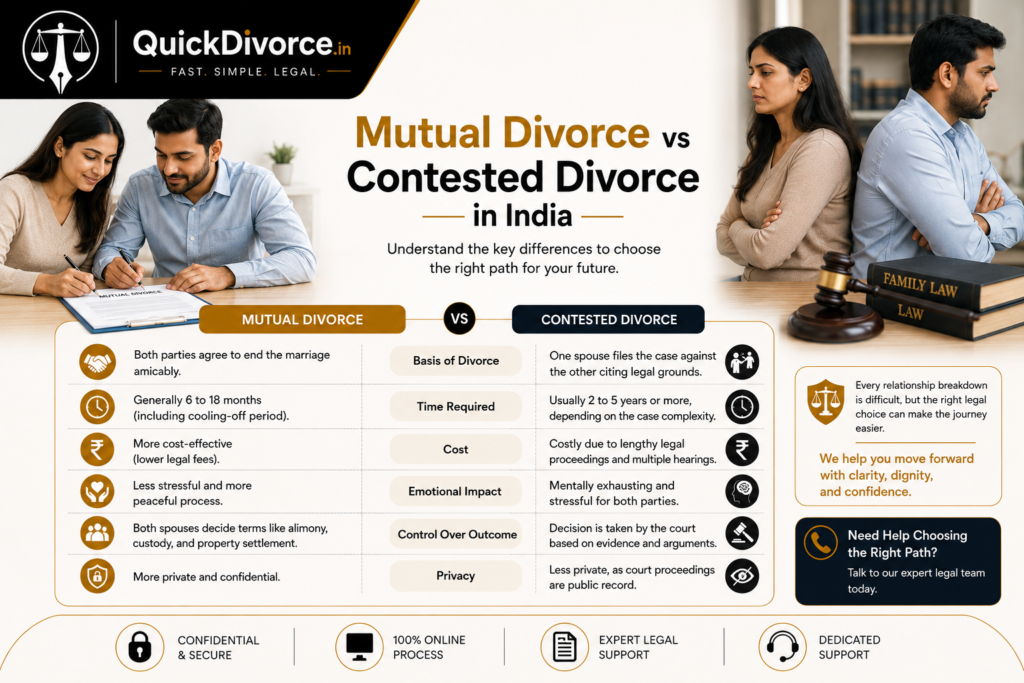
Key Differences — Mutual Divorce vs Contested Divorce
| Factor | Mutual Divorce | Contested Divorce |
|---|---|---|
| Consent | Both parties agree | Only one party files, other contests |
| Grounds Required | No specific grounds needed | Must prove a specific legal ground |
| Timeline | 4 to 18 months | 3 to 15 years |
| Cost | Significantly lower | Significantly higher |
| Court Appearances | Minimal — typically 2 to 3 dates | Many — trial can involve dozens of dates |
| Emotional Stress | Lower — cooperative process | Higher — adversarial process |
| Privacy | Higher — fewer court proceedings | Lower — detailed evidence becomes record |
| Children’s Impact | Lower — parents cooperate | Higher — children often drawn into conflict |
| Control Over Outcome | High — parties decide terms | Low — court decides everything |
| Certainty of Result | High — decree follows consent | Uncertain — court may refuse divorce |
| Possibility of Reconciliation | Present — cooling off period | Present — mediation stage |
| Property and Maintenance | Decided by parties through negotiation | Decided by court after evidence |
| Remarriage | Faster — decree obtained quickly | Delayed — must wait for final decree |
Cost Comparison — Mutual Divorce vs Contested Divorce
This is a critical practical consideration that legal guides often gloss over. Here is an honest estimate:
Mutual Divorce Costs (Approximate)
| Component | Approximate Cost |
|---|---|
| Lawyer’s fee for drafting and filing | ₹15,000 – ₹50,000 |
| Court fees | ₹500 – ₹2,000 |
| Notarization and documentation | ₹2,000 – ₹5,000 |
| Total Approximate Cost | ₹20,000 – ₹60,000 |
Contested Divorce Costs (Approximate)
| Component | Approximate Cost |
|---|---|
| Lawyer’s retainer and appearance fees | ₹1,00,000 – ₹10,00,000+ |
| Court fees and process fees | ₹5,000 – ₹20,000 |
| Evidence preparation and witnesses | ₹20,000 – ₹1,00,000+ |
| Interim application fees | ₹30,000 – ₹2,00,000+ |
| Appeal costs (if applicable) | ₹1,00,000 – ₹5,00,000+ |
| Total Approximate Cost | ₹2,00,000 – ₹20,00,000+ |
The difference is not marginal. A contested divorce can cost ten to fifty times more than a mutual divorce — and that is before accounting for the opportunity cost of years spent in litigation rather than rebuilding your life.
Impact on Children — The Factor Most Parents Underestimate
If you have children, the choice between mutual and contested divorce is not just about you. It is profoundly about them.
In a mutual divorce: Both parents cooperate. Custody and visitation are agreed upon without the children witnessing or being drawn into conflict. Children see their parents behave like adults even during a painful time. Adjustment is difficult — divorce is always hard on children — but the cooperative framework minimizes lasting psychological damage.
In a contested divorce: Children often become the central battleground. Custody battles are emotionally brutal — for parents and children alike. Children are sometimes asked to express preferences in court. They inevitably hear accusations and counter-accusations between their parents. Research consistently shows that prolonged parental conflict — far more than divorce itself — causes lasting psychological harm to children.
If there is any possibility of agreeing on terms — including custody — choosing mutual divorce is not just a legal decision. It is a parenting decision.
Can a Contested Divorce Become a Mutual Divorce?
Yes — and this happens more often than people expect.
Many divorces that begin as contested proceedings ultimately convert to mutual consent divorces after mediation, negotiation, or simply the exhaustion of both parties after years of litigation. Courts actively encourage this conversion — and a good lawyer will always explore this possibility rather than simply driving the contested litigation forward.
If you are currently in a contested divorce and both parties have reached a point of exhaustion or are open to settlement, speak to your lawyer about converting to mutual consent proceedings. It saves time, money, emotional energy, and — critically — protects your children from further conflict.
When Is Contested Divorce the Only Option?
There are genuine situations where mutual divorce is simply not possible and contested divorce is the only path:
When one spouse refuses to divorce at all If one spouse is categorically unwilling to dissolve the marriage — perhaps for religious reasons, financial control, or genuine desire to reconcile — the other spouse has no choice but to file a contested petition on proven grounds.
When there is ongoing abuse or danger A victim of domestic violence cannot wait for the abuser’s cooperation. A contested divorce petition — combined with domestic violence complaints and interim protection orders — is the necessary path.
When terms cannot be agreed upon despite genuine effort Sometimes both spouses want divorce but have irreconcilable differences on custody, maintenance, or property that make mutual consent impossible. Contested proceedings then become unavoidable.
When fraud or concealment is involved If one spouse has committed fraud — concealing assets, hiding income, or misrepresenting facts — a contested divorce with full evidence examination is necessary to ensure a just outcome.
When criminal conduct is involved Cases involving adultery, bigamy, cruelty, or other criminal conduct may require the court’s intervention through contested proceedings to ensure both divorce and appropriate legal consequences for the wrongdoer.
The Role of Mediation in Both Types of Divorce
Indian courts — particularly Family Courts — are increasingly emphasizing mediation as a first step in all matrimonial disputes, including divorce cases.
In mutual divorce, mediation is often used to help parties finalize the terms they have already broadly agreed upon — working out the specific numbers on maintenance, the precise custody schedule, the division of specific assets.
In contested divorce, courts refer cases to mediation before trial begins. A significant percentage of contested divorces are resolved at the mediation stage — either converting to mutual divorce or reaching a settlement that the court then formalizes.
A skilled mediator — particularly one with family law expertise — can often achieve in a few mediation sessions what years of litigation cannot: a genuine agreement that both parties can live with.
Supreme Court’s Power to Grant Divorce Under Article 142
In cases where a marriage has irretrievably broken down — where the parties have been separated for many years, all attempts at reconciliation have failed, and the marriage exists only on paper — the Supreme Court of India can dissolve the marriage under Article 142 of the Constitution, which gives it the power to pass any order necessary for complete justice.
This power has been used in cases where:
- The normal grounds for divorce cannot be technically proved
- The six-month cooling-off period in mutual divorce is causing unnecessary hardship
- The contested divorce has been pending for so long that continuing is itself unjust
In Shilpa Sailesh v. Varun Sreenivasan (2023), the Supreme Court provided a comprehensive framework for using Article 142 powers in matrimonial cases — a landmark judgment that continues to shape divorce proceedings in India in 2026.
Frequently Asked Questions
Q1. Which is faster — mutual divorce or contested divorce in India?
Mutual divorce occurs when both spouses agree to end the marriage and settle issues such as alimony, child custody, and property division. Contested divorce arises when one spouse does not agree to the divorce or disputes important issues, requiring the court to decide the matter.
Q2. Which type of divorce is faster in India?
Mutual divorce is generally faster because both parties consent to the separation and agree on the terms. Contested divorce often takes significantly longer due to hearings, evidence, and legal disputes.
Q3. What are the eligibility requirements for mutual divorce?
Generally, spouses must have lived separately for the required period under the applicable law and mutually agree that the marriage has broken down beyond repair. They must jointly file a divorce petition before the court.
Q4. Can one spouse refuse a mutual divorce petition?
Yes. Mutual divorce requires the consent of both spouses. If either spouse withdraws consent before the final decree is granted, the mutual divorce process may fail, and the other spouse may need to pursue a contested divorce.
Q5. On what grounds can a contested divorce be filed?
A contested divorce may be filed on legally recognized grounds such as cruelty, adultery, desertion, conversion, mental disorder, communicable disease (where applicable), or other grounds provided under personal laws.
Q6. Is legal representation necessary for both types of divorce?
While not mandatory in every situation, legal assistance is highly advisable. A lawyer can help protect rights, prepare documents, negotiate settlements, and represent parties before the court.
Which Path Is Right for You?
Here is a simple framework to help you think through which divorce path applies to your situation:
Choose Mutual Divorce if:
- Both of you genuinely want to end the marriage
- You can communicate, even if painfully, about terms
- You have children and want to minimize their exposure to conflict
- You want to move on with your life in months rather than years
- You want to control the outcome rather than leave it to a court
- You want to keep costs manageable
Consider Contested Divorce if:
- Your spouse refuses to divorce
- You are in an abusive relationship where cooperation is impossible or dangerous
- Your spouse is concealing assets or income that require court-ordered discovery
- Terms are so far apart that no negotiation is possible
- Criminal conduct — adultery, bigamy, serious cruelty — needs to be formally established
Talk to a lawyer immediately if:
- You are unsure which category you fall into
- Your situation has elements of both — some willingness to cooperate but significant disputes on terms
- There are children involved and custody is likely to be contested
- There are significant assets, property, or business interests at stake
Why Quick Divorce for Your Divorce Proceedings in India
Whether your divorce is mutual or contested — the quality of your legal representation determines the quality of your outcome.
For mutual divorces, the right lawyer drafts airtight settlement terms that protect your interests on maintenance, custody, and property — and ensures the process is completed quickly without unnecessary delays.
For contested divorces, the right lawyer builds a strategy from day one — on grounds, evidence, interim reliefs, and the long-term litigation roadmap — while always keeping an eye on opportunities to convert to settlement and spare you years of courtroom battles.
At Quick Divorce, we handle both — with equal expertise and equal commitment to getting you the best possible outcome as efficiently as possible.
Our team has handled hundreds of divorce cases across Delhi and India — mutual divorces completed in record time, contested divorces won on difficult grounds, and contested divorces successfully converted to mutual settlement at mediation — saving our clients years of litigation and lakhs of rupees.
We offer a free first consultation — where we listen to your situation, tell you honestly which path applies to you, and outline exactly what the process will look like.
Book your free consultation today: 📞 Call / WhatsApp: 8595439395
Final Word
Mutual divorce and contested divorce are not just two legal procedures. They are two fundamentally different experiences — of time, money, stress, privacy, and impact on everyone involved including your children.
If mutual divorce is possible — even if it requires difficult conversations, compromise, and the help of a skilled mediator or lawyer to bridge the gaps — it is almost always the better path. Not because it is easier emotionally, but because it gives you back control over your own life, your finances, and your children’s wellbeing.
If contested divorce is unavoidable — because your spouse refuses, because there is abuse, or because the gaps simply cannot be bridged — then fight it with the best legal team you can find, a clear strategy, and the patience that the process demands.
Either way — you do not have to navigate this alone.
Quick Divorce is with you, every step of the way.
📞 Call / WhatsApp: 8595439395
Need Help With Divorce or Legal Documentation?
🟡 QuickDivorce.in provides complete mutual divorce legal services — settlement negotiation, alimony structuring, property division, stridhan recovery, MoU drafting, court representation, and post-decree implementation — across all jurisdictions in India.
🟡Visit LegalTax.in for other Legal and Trademark related services as 👉 Money Recovery Cases
👉 Property Disputes 👉 Business & Licence Registrations
🟡Visit Business24hub for IT services
👉 Mutual Consent Divorce at QuickDivorce.in 👉 Contested Divorce Filing 👉 Child Custody and Maintenance 👉 Matrimonial Property Settlement 👉 NRI Divorce Services 👉 Alimony and Maintenance
🟡 Protect Your Rights 👉 Domestic Violence Legal Support at QuickDivorce.in 👉 Stridhan Recovery
📞 Call Now: +91 8595439395 🕐 Free Consultation: Monday to Saturday, 10 AM to 6 PM

Adv. Manish Kashyap is a Family Law & Divorce Lawyer with extensive experience in Mutual & Contested Divorce, NRI Divorce, Child Custody, Alimony, Domestic Violence, Judicial Separation, and Family Court matters, providing professional legal guidance to clients.

