

Views: 5
Table of Contents
- 1 The Honest Answer First
- 2 Why a Decree Is Legally Required, Not Optional
- 3 What “Without Going to Court” Often Actually Means to People Asking This
- 4 What Genuinely Can Be Done Outside Court
- 5 What Cannot Be Done Outside Court, Under Any Circumstances
- 6 How Close You Can Realistically Get to “No Court Hassle”
- 7 A Word of Caution About Services Promising More Than This
- 8 Frequently Asked Questions
- 9 Why Choose Quick Divorce
- 10 Get Expert Mutual Divorce Legal Assistance
The Honest Answer First
No. A legally valid divorce in India, including mutual consent divorce, cannot be obtained without a court passing a decree. There is no private agreement, notarized document, religious ceremony, or out-of-court settlement that, by itself, legally ends a marriage recognized under the Hindu Marriage Act, Special Marriage Act, Indian Divorce Act, or other applicable personal law.
This matters to state clearly upfront because the search for “divorce without going to court” usually comes from a genuine and understandable place — couples who have already agreed on everything and feel that a court process is an unnecessary formality standing between them and simply being done. The frustration is real. The legal requirement, however, does not bend to it.
What is genuinely true, and what this guide focuses on, is how little court involvement an efficient mutual divorce actually requires once both parties agree, and what can be handled outside the courtroom so that the in-court part is as brief and limited as the law allows.
Why a Decree Is Legally Required, Not Optional
Marriage in India is dissolved by a decree of a competent court under Section 13B of the Hindu Marriage Act, 1955, Section 28 of the Special Marriage Act, 1954, Section 10A of the Indian Divorce Act, 1869, or the equivalent provision applicable to your situation. Each of these provisions requires a court — specifically a Family Court or District Court exercising matrimonial jurisdiction — to record the parties’ consent and pass a formal decree.
This is not a bureaucratic add-on to an otherwise private agreement. It is the actual legal mechanism that changes your status from married to divorced. Without it:
- You remain legally married, regardless of any private agreement you have signed
- Remarrying without a decree would constitute bigamy
- A “settlement” or “divorce agreement” signed between spouses without court involvement has no power to dissolve the marriage itself, even if both parties fully intend it to
Some people have come across the term “customary divorce,” recognized in limited circumstances within certain communities under specific personal law or established custom. Where this genuinely applies, it is a narrow, community-specific exception, not a general route available to any couple who simply prefers to avoid court, and it requires its own careful legal verification rather than being assumed to apply.
What “Without Going to Court” Often Actually Means to People Asking This
In practice, when people ask this question, they are usually really asking one of these things, and it is worth separating them out:
“Can we avoid multiple court hearings stretched over many months?” — Yes, largely. This is addressed below.
“Can a lawyer handle everything and we just sign documents at home?” — Partially. Most of the process can be handled this way, but not all of it.
“Can we settle everything privately and just have a lawyer file paperwork that finalizes it without us ever appearing anywhere?” — No. This is the part that genuinely cannot be done.
“Can we use an online divorce service that promises a divorce without court?” — Be skeptical of any service making this specific claim for a legally binding Indian divorce. At best, this describes a private separation agreement with no legal effect on marital status; at worst, it is a service charging money for something it cannot actually deliver.
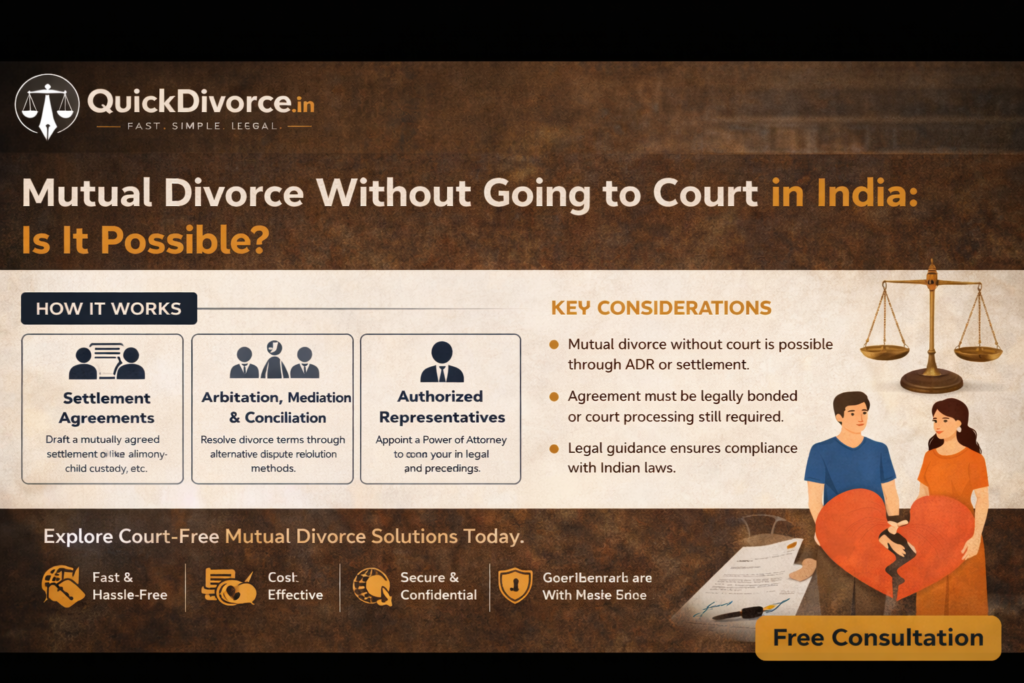
What Genuinely Can Be Done Outside Court
This is the real, useful answer to what people are actually looking for.
Negotiating and finalizing every term of your settlement privately. Maintenance, custody, property division, return of Stridhan — all of this, as covered in our detailed guide on drafting a mutual divorce settlement agreement, is worked out between you, your spouse, and your lawyers, entirely outside the courtroom. By the time you reach court, the substance of your divorce should already be fully agreed.
Most consultation and drafting work, done remotely. As covered in our guide on documents to prepare before an online divorce consultation, the entire preparatory phase — discussing your situation, drafting the settlement, preparing the petition — can be done over video calls and document sharing, without either of you setting foot in a court or even a lawyer’s physical office.
Minimizing the number of court appearances to the legal minimum. As covered in our detailed guide on the mutual divorce timeline, and our guide specifically on waiving the cooling-off period, a well-prepared mutual divorce with a complete settlement and a successful waiver application can mean as few as two short court appearances total — the First Motion and the Second Motion — rather than the many hearings a contested case might involve.
For NRIs, minimizing trips to India specifically. As covered in our guide on Power of Attorney for NRI divorce cases, while personal appearance for the First and Second Motion cannot be delegated, virtually everything else — filing, document submission, procedural steps — can be handled by a Power of Attorney holder, meaning an NRI’s actual time in an Indian courtroom can be reduced to two relatively brief appearances, timed as close together as the court allows.
What Cannot Be Done Outside Court, Under Any Circumstances
The First Motion personal statement. Both spouses must personally appear before the judge to confirm that their consent to divorce is genuine, free, and voluntary. This cannot be given through a lawyer, a Power of Attorney holder, or in writing alone.
The Second Motion reaffirmation of consent. The same requirement applies at this second, final stage, immediately before the decree is passed.
The judge’s actual decree. Only a court can issue the legal decree that dissolves the marriage. No private document substitutes for this.
There is no way around these three points for a legally valid mutual divorce in India. Any process claiming otherwise is either describing something other than a legally binding Indian divorce, or is simply inaccurate.
How Close You Can Realistically Get to “No Court Hassle”
Putting the genuine possibilities together, here is what an efficiently managed mutual divorce can look like in practice:
- All negotiation, drafting, and document preparation handled remotely, without visiting a court or lawyer’s office in person
- A complete, specific settlement agreement finalized before ever filing
- A waiver application for the cooling-off period filed alongside the First Motion
- Two total court appearances — First Motion and Second Motion, potentially scheduled close together if waiver is granted, as covered in our cooling-off period guide
- Each appearance itself lasting a relatively short time, generally limited to the judge recording your statement rather than any extended proceeding
This is, realistically, about as close to “without going to court” as Indian law currently permits for a legally valid divorce — two brief, unavoidable appearances, surrounded by a process that can otherwise be handled almost entirely remotely.
A Word of Caution About Services Promising More Than This
If you encounter any service, website, or individual claiming they can obtain a fully legal Indian mutual divorce with zero court appearances by either spouse, treat this claim with serious skepticism before paying anything or signing anything. At best, what is being offered is a private settlement document with no power to actually end your marriage in the eyes of the law. At worst, it is a service taking payment for something it has no ability to deliver, leaving you believing you are divorced when, legally, you are not — a problem that can surface in genuinely damaging ways later, including if either of you remarries believing the first marriage has already ended.
Frequently Asked Questions
Q1. Is there any legal way to get fully divorced in India without ever appearing before a judge?
No. Both the First Motion and Second Motion in mutual consent divorce require both spouses to personally appear before the judge. There is no legally valid route around this for a standard mutual consent divorce.
Q2. Can our lawyers attend court on our behalf instead of us?
Lawyers can and do handle filing, procedural hearings, and most administrative steps. However, the specific statements confirming consent at the First and Second Motion must be made personally by each spouse, not through a lawyer.
Q3. What about online divorce services that advertise a complete process without court visits?
Be cautious of any service specifically claiming this for a legally binding divorce. What such services can legitimately help with is the preparation and remote portions of the process; they cannot eliminate the legally required court appearances.
Q4. Is a notarized mutual settlement agreement enough to be considered divorced?
No. A notarized settlement agreement is a useful and often necessary document, but it does not by itself dissolve the marriage. It generally needs to be filed with, and incorporated into, an actual court petition and decree.
Q5. If we are NRIs, is there any way to avoid traveling to India entirely for a mutual divorce?
Generally no, if the divorce is being obtained under Indian law. Both spouses must personally appear for the First and Second Motion. What can be minimized is everything else, reducing the trip to as few appearances as possible, as covered in our guide on NRI divorce and Power of Attorney.
Q6. Are there any genuine exceptions where a marriage can end without a court decree?
Limited customary divorce provisions exist for specific communities under particular personal law or established custom, but these are narrow exceptions requiring specific verification, not a general alternative available to any couple who would simply prefer to avoid court.
Why Choose Quick Divorce
We will not tell you that your mutual divorce can be done without ever appearing in court, because that would not be true. What we will do is make sure everything that genuinely can be handled remotely is handled remotely, that your settlement is complete and specific enough to support a cooling-off period waiver, and that the two court appearances Indian law actually requires are as few, as brief, and as close together as the process allows.
Book your free consultation today: 📞 Call / WhatsApp: 8595439395 🌐 Website: www.quickdivorce.in
Get Expert Mutual Divorce Legal Assistance
🟡 QuickDivorce.in provides complete mutual divorce services — petition drafting, settlement negotiation and drafting, first and second motion representation, waiver applications, NRI video conferencing appearances, and post-decree implementation support across all jurisdictions in India.
🟡Visit LegalTax.in for other Legal and Trademark related services as 👉 Money Recovery Cases
👉 Property Disputes 👉 Business & Licence Registrations
🟡Visit Business24hub for IT services
👉 Mutual Consent Divorce at QuickDivorce.in 👉 Contested Divorce Filing 👉 Child Custody and Maintenance 👉 Matrimonial Property Settlement 👉 NRI Divorce Services 👉 Alimony and Maintenance
🟡 Protect Your Rights 👉 Domestic Violence Legal Support at QuickDivorce.in 👉 Stridhan Recovery
📞 Call Now: +91 8595439395 🕐 Free Consultation: Monday to Saturday, 10 AM to 6 PM

Adv. Manish Kashyap is a Family Law & Divorce Lawyer with extensive experience in Mutual & Contested Divorce, NRI Divorce, Child Custody, Alimony, Domestic Violence, Judicial Separation, and Family Court matters, providing professional legal guidance to clients.

