

Views: 1
Table of Contents
- 1 Quick Summary
- 2 📌 What Is Domestic Violence Under Indian Law?
- 3 🏛️ Why PWDVA 2005 Was a Landmark Law
- 4 👥 Who Is Protected Under PWDVA 2005?
- 5 👤 Who Can Be a Respondent Under PWDVA 2005?
- 6 🔍 Types of Domestic Violence Under Indian Law
- 7 🏠 What Is a Domestic Relationship?
- 8 ⚖️ Key Rights and Reliefs Under PWDVA 2005
- 9 📋 How to File a Domestic Violence Complaint in India
- 10 👮 Role of Protection Officers, Service Providers and Courts
- 11 📋 Interim and Final Orders Under PWDVA 2005
- 12 💔 Domestic Violence and Divorce
- 13 👶 Domestic Violence and Child Custody
- 14 💍 Domestic Violence and Stridhan Recovery
- 15 ⚖️ Criminal Remedies Alongside PWDVA 2005
- 16 🚫 Common Myths About Domestic Violence Law in India
- 17 🌟 How Quick Divorce Helps Domestic Violence Survivors
- 18 💰 Cost Breakdown: Domestic Violence Legal Action in India
- 19 ❓ Frequently Asked Questions (FAQs)
- 20 🎯 Who Needs This Guide Right Now?
- 21 ✅ Final Recommendation
- 22 Need Help With any Legal Sevices ?
Quick Summary
Domestic violence under Indian law is far broader than physical assault. The Protection of Women from Domestic Violence Act 2005 — PWDVA 2005 — is India’s most comprehensive law protecting women from all forms of abuse within the home.
Here is what you need to know upfront:
- 🔒 Four types of abuse are covered — physical, sexual, emotional or psychological and economic
- 👥 Who is protected — wives, live-in partners, mothers, sisters and any woman in a domestic relationship
- 🏠 Right to residence — a woman cannot be thrown out of the shared household even if she does not own it
- ⚖️ Multiple reliefs available — protection orders, residence orders, monetary relief, custody orders and compensation
- 📋 How to file — through a Protection Officer, Service Provider, Magistrate or police
- ✅ Quick Divorce provides expert legal assistance for domestic violence survivors starting at ₹499
If you or someone you know is experiencing domestic violence — this guide explains exactly what the law protects, what reliefs are available and how to access them immediately.
📌 What Is Domestic Violence Under Indian Law?
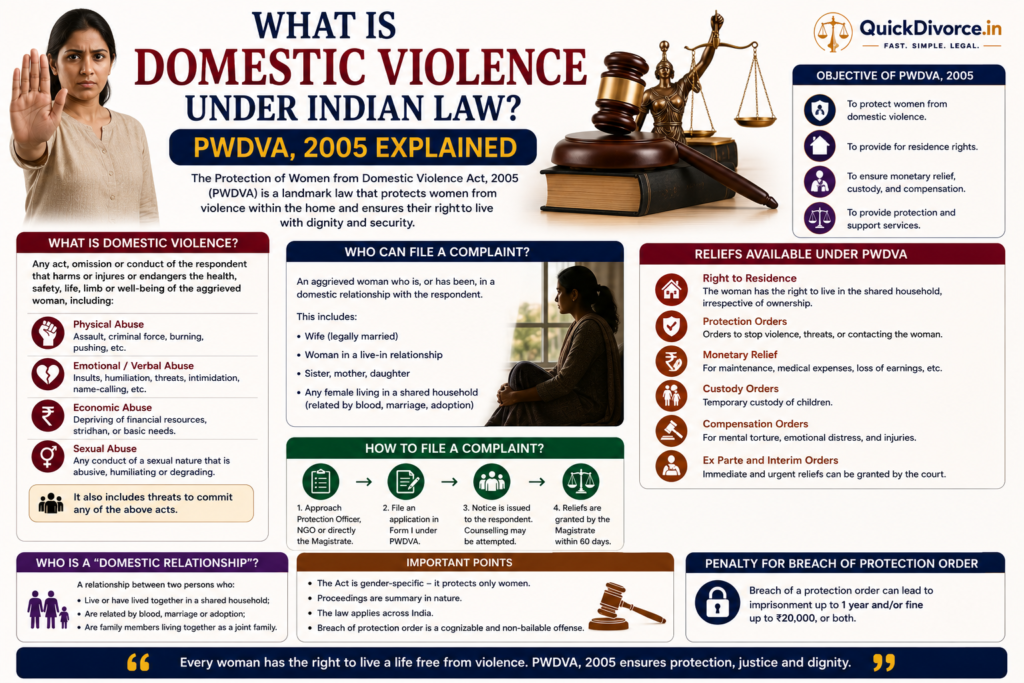
Domestic violence under Indian law is defined under Section 3 of the Protection of Women from Domestic Violence Act 2005 as any act, omission or commission or conduct of the respondent that:
- Harms or injures or endangers the health, safety, life, limb or wellbeing — whether mental or physical — of the aggrieved person
- Harasses, harms, injures or endangers the aggrieved person with a view to coerce her or any other person related to her to meet any unlawful demand for dowry or other property or valuable security
- Has the effect of threatening the aggrieved person or any person related to her by any conduct mentioned above
- Otherwise injures or causes harm — whether physical or mental — to the aggrieved person
This definition is deliberately wide. It covers physical violence, sexual abuse, verbal and emotional abuse, economic control and harassment related to dowry — all within the definition of domestic violence under Indian law.
The most important thing to understand: You do not need to have been physically hit to experience domestic violence under Indian law. Controlling your finances, threatening you, humiliating you, forcing sexual acts and denying you basic necessities are all forms of domestic violence under PWDVA 2005.
🏛️ Why PWDVA 2005 Was a Landmark Law
Before the Protection of Women from Domestic Violence Act 2005 came into force, women in abusive domestic situations had very limited legal remedies:
- They could file a criminal complaint under Section 498A IPC for cruelty by husband or relatives
- They could seek divorce on grounds of cruelty under personal laws
- They could apply for maintenance
But there was no civil law that:
- Specifically defined domestic violence comprehensively
- Gave women the right to remain in the shared household
- Provided immediate emergency protection orders
- Addressed economic abuse as a form of domestic violence
- Covered women in live-in relationships and other domestic situations beyond formal marriage
PWDVA 2005 changed all of this fundamentally.
It created India’s first comprehensive civil law framework specifically addressing domestic violence — providing fast, accessible and wide ranging remedies that operate independently of criminal proceedings.
Key Innovations of PWDVA 2005
Civil remedy alongside criminal: PWDVA 2005 is a civil law. It provides remedies through the Magistrate’s court without requiring criminal prosecution. This makes it faster, less adversarial and more accessible.
Broad definition of violence: The Act covers physical, sexual, verbal, emotional and economic abuse — far wider than the criminal law definition of cruelty.
Right to shared household: A revolutionary provision — the woman cannot be evicted from the shared household by the respondent even if she has no ownership rights in it.
Protection Officers: A dedicated infrastructure of Protection Officers was created to assist women in accessing their rights under the Act.
Emergency orders: Courts can grant immediate protection orders and residence orders on an ex-parte basis — without hearing the respondent first — where there is immediate danger.
👥 Who Is Protected Under PWDVA 2005?
PWDVA 2005 protects aggrieved persons — defined as any woman who is or has been in a domestic relationship with the respondent and who alleges that the respondent has committed domestic violence against her.
Women Protected Under PWDVA 2005
Wives Married women experiencing domestic violence from their husband or his family members.
Live-in Partners Women in live-in relationships — where a man and woman live together in a shared household as if they were husband and wife — are expressly protected. This was a significant and progressive inclusion that extended protection beyond formal marriage.
Mothers Mothers experiencing domestic violence from their adult sons or daughters-in-law.
Sisters Sisters experiencing domestic violence from brothers or other family members in a shared household.
Widows Widows experiencing domestic violence from in-laws after the husband’s death.
Daughters Adult daughters experiencing domestic violence from parents or other family members.
Women in Relationships in the Nature of Marriage Women who have been in relationships that resemble marriage — even without formal solemnization — are protected under the Act, as clarified by the Supreme Court.
Important: PWDVA 2005 specifically protects women. Men cannot file complaints under PWDVA 2005. However, children — both male and female — can be included in a woman’s complaint where they are also victims of the domestic violence.
👤 Who Can Be a Respondent Under PWDVA 2005?
The respondent under PWDVA 2005 is defined as any adult male person who is or has been in a domestic relationship with the aggrieved person.
Who Can Be Named as Respondent
Husband The most common respondent. A husband who commits any form of domestic violence against his wife.
Male Partner in Live-in Relationship The male partner in a live-in relationship who commits domestic violence against the female partner.
Father-in-law A father-in-law who participates in or facilitates domestic violence against a daughter-in-law.
Brother-in-law A brother-in-law who participates in domestic violence against a sister-in-law in the shared household.
Male Relatives of the Husband Any adult male relative of the husband who is part of the shared household and participates in domestic violence.
Can Women Be Named as Respondents?
This is an area of legal development. The original Act defined respondents as adult males. However, the Supreme Court has held in several cases that female relatives — mothers-in-law, sisters-in-law — who participate in domestic violence can also be named as respondents in certain circumstances.
In practice, many women name both the husband and the mother-in-law or other female in-laws as respondents — particularly in dowry-related violence cases.
🔍 Types of Domestic Violence Under Indian Law
Section 3 of PWDVA 2005 defines four distinct types of domestic violence under Indian law. Understanding all four types is critical — because many women experiencing domestic violence do not recognise non-physical forms of abuse as legal violations.
Type 1 — Physical Abuse
Physical abuse is the most visible and most commonly recognised form of domestic violence under Indian law.
It includes:
- 👊 Hitting, slapping, punching, kicking
- 🔥 Burning or scalding
- 🏥 Any act that causes bodily pain, injury or danger to life, limb or health
- 💊 Forcing consumption of substances — alcohol, drugs
- 🚗 Reckless driving with the woman in the vehicle
- 🔪 Use or threat of use of weapons
- 🏠 Physical confinement or imprisonment within the home
Physical abuse is also independently covered under criminal law — IPC sections for assault, grievous hurt, attempt to murder and murder — but PWDVA 2005 provides the civil remedy for immediate protection.
Type 2 — Sexual Abuse
Sexual abuse within a domestic relationship is recognised as domestic violence under Indian law under PWDVA 2005.
It includes:
- 🚫 Any conduct of a sexual nature that abuses, humiliates, degrades or violates the dignity of the woman
- 🚫 Forced sexual intercourse or sexual acts — marital rape is recognised as domestic violence under PWDVA 2005 even though it is not yet a criminal offence in India for all marriages
- 🚫 Forcing the woman to watch pornography or perform degrading sexual acts
- 🚫 Child sexual abuse where the woman’s child is subjected to sexual abuse
Type 3 — Verbal and Emotional Abuse
Verbal and emotional abuse is one of the most common and least recognised forms of domestic violence under Indian law — because it leaves no physical marks but causes profound and lasting psychological harm.
It includes:
- 🗣️ Insults, ridicule and humiliation — in private or in front of others
- 🗣️ Name calling and verbal degradation
- 😰 Threats of any kind — threats of physical harm, threats to take the children, threats of suicide to manipulate the woman
- 😢 Repeated taunting about the woman’s family, appearance, intelligence or character
- 🚫 Threats to harm or injure any person important to the aggrieved woman
- 🔇 Silent treatment used as a tool of control and punishment
- 😔 Accusations of infidelity without basis — used to humiliate and control
- 👶 Threats related to children — threatening to take away the children, threatening to harm the children
Type 4 — Economic Abuse
Economic abuse is perhaps the least understood form of domestic violence under Indian law — but it is one of the most powerful tools of control used by abusers.
It includes:
- 💰 Depriving the woman of economic or financial resources to which she is entitled — including household expenses and maintenance
- 🏠 Disposing of or alienating the woman’s stridhan, jewellery and other property
- 💳 Prohibiting the woman from taking up employment or forcing her to leave her job
- 🏦 Controlling all access to money and financial resources — leaving the woman entirely financially dependent
- 📋 Not providing money for essential expenses — food, medicine, children’s school fees
- 🚗 Disposing of jointly held or the woman’s property without her consent
- 💼 Preventing the woman from accessing her own bank accounts or financial assets
Why economic abuse is so damaging: Economic abuse is often the primary tool through which abusers maintain control and prevent women from leaving. A woman with no access to money, no knowledge of financial assets and no employment is effectively imprisoned — even if she has never been physically harmed.
🏠 What Is a Domestic Relationship?
A domestic relationship under PWDVA 2005 is defined as a relationship between two persons who live or have at any point in time lived together in a shared household — when they are related by:
- Consanguinity — blood relationship
- Marriage
- A relationship in the nature of marriage — live-in relationship
- Adoption
- Are family members living together as a joint family
Shared Household
A shared household under PWDVA 2005 is a household where the aggrieved person lives or at any stage has lived in a domestic relationship — either owned or tenanted by the respondent or jointly owned or tenanted, or belongs to the joint family of which the respondent is a member.
The Supreme Court has clarified that the shared household is the matrimonial home — or the home where the couple was living — regardless of who owns it.
⚖️ Key Rights and Reliefs Under PWDVA 2005
PWDVA 2005 provides a comprehensive menu of reliefs available to victims of domestic violence under Indian law:
1 — Protection Order
A protection order under Section 18 of PWDVA 2005 prohibits the respondent from:
- Committing any act of domestic violence
- Aiding or abetting domestic violence
- Entering the aggrieved person’s place of employment or school
- Attempting to communicate with the aggrieved person in any form
- Alienating any assets or operating bank accounts
- Causing violence to the aggrieved person’s relatives or others who provide assistance
A protection order is the most immediate relief available. It can be granted on an ex-parte basis — meaning without the respondent being present or heard — where there is immediate danger to the aggrieved person.
2 — Residence Order
A residence order under Section 19 of PWDVA 2005 is one of the most important reliefs — it protects the woman’s right to remain in the shared household.
A residence order can:
- Restrain the respondent from dispossessing or disturbing the woman’s possession of the shared household
- Direct the respondent to remove himself from the shared household
- Restrain the respondent or his relatives from entering the shared household
- Direct the respondent to secure alternative accommodation for the aggrieved person at the same level of standard as the shared household
- Direct the respondent to pay rent for alternative accommodation
Critical point: A woman cannot be evicted from the shared household by the respondent even if she has no ownership or tenancy rights in it. This protection applies regardless of whether the house is in the husband’s name, the in-laws’ name or jointly held.
3 — Monetary Relief
Monetary relief under Section 20 of PWDVA 2005 includes:
- 💰 Loss of earnings caused by the domestic violence
- 💊 Medical expenses incurred as a result of domestic violence
- 🏠 Loss caused to property as a result of domestic violence
- 👶 Maintenance for the woman and her children — which can be in addition to maintenance under any other law
- 📚 Children’s educational and other expenses
Monetary relief under PWDVA 2005 can be granted in addition to maintenance under Section 125 CrPC or under personal laws — it is not an either-or choice.
4 — Custody Order
A custody order under Section 21 of PWDVA 2005 can grant temporary custody of any child to the aggrieved person — while ensuring that the respondent does not have unsupervised access to the child if the court determines this is necessary for the child’s welfare.
5 — Compensation Order
A compensation order under Section 22 of PWDVA 2005 directs the respondent to pay compensation and damages to the aggrieved person for the injuries caused by domestic violence — including mental torture and emotional distress.
📋 How to File a Domestic Violence Complaint in India
Step 1: Immediate Safety First
Before any legal steps, ensure your immediate physical safety. If you are in immediate danger:
- 🚨 Call 112 (National Emergency Number)
- 🚨 Call 181 (Women Helpline — available in most states)
- 🚨 Reach a safe location — a trusted family member’s home, a shelter, a friend’s house
Step 2: Contact a Protection Officer
Protection Officers are government appointed officers specifically tasked with helping women access their rights under PWDVA 2005. They are available in every district across India.
A Protection Officer will:
- Help you prepare and file a Domestic Incident Report (DIR)
- Assist you in filing an application before the Magistrate
- Connect you with registered Service Providers — shelters, legal aid, counselling
- Provide information about available reliefs
Contact your nearest Protection Officer through the District Collector’s office or the Women and Child Development department in your district.
Step 3: Contact a Service Provider
Registered Service Providers under PWDVA 2005 are NGOs and other organisations registered with the state government to provide services to domestic violence victims — including shelter, legal aid, medical aid and counselling.
Service Providers can also file an application on behalf of the aggrieved woman.
Step 4: File Application Before the Magistrate
An application under PWDVA 2005 is filed before the Judicial Magistrate of First Class in:
- The area where the aggrieved person resides
- The area where the respondent resides
- The area where the domestic violence took place
The application states:
- Details of the domestic relationship
- Details of the domestic violence — nature, frequency, specific incidents
- The reliefs sought — protection order, residence order, monetary relief, custody, compensation
Quick Divorce assists in drafting and filing the PWDVA 2005 application — ensuring it is complete, specific and structured to obtain the maximum available reliefs.
Step 5: Magistrate’s Hearing and Order
The Magistrate must hear the application within 3 days of it being filed. The Magistrate can:
- Grant an ex-parte interim protection order immediately if there is immediate danger
- Issue notice to the respondent and schedule a hearing
- Direct a Protection Officer to prepare a home investigation report
- Pass final orders after hearing both parties
Step 6: Filing an FIR for Criminal Offences
Where the domestic violence also constitutes a criminal offence — assault, criminal intimidation, dowry harassment — an FIR can be filed at the police station simultaneously with or separately from the PWDVA 2005 application.
Common criminal sections used alongside PWDVA 2005:
- Section 498A IPC — cruelty by husband or his relatives
- Section 323 IPC — voluntarily causing hurt
- Section 354 IPC — assault or use of criminal force against a woman
- Section 506 IPC — criminal intimidation
- Section 406 IPC — criminal breach of trust (for stridhan)
- Dowry Prohibition Act 1961
👮 Role of Protection Officers, Service Providers and Courts
Protection Officers
Protection Officers are the backbone of PWDVA 2005 implementation. Their duties include:
- Assisting the aggrieved person in preparing the Domestic Incident Report
- Filing applications before the Magistrate on behalf of the aggrieved person
- Making available a list of service providers to the aggrieved person
- Ensuring the delivery of court orders to the respondent
- Assisting the Magistrate in the discharge of functions under the Act
- Ensuring that the aggrieved person is provided shelter if needed
Protection Officers are government employees — their services are free.
Service Providers
Registered Service Providers are NGOs and organisations that provide:
- Shelter in safe houses and shelter homes
- Legal aid and representation
- Medical aid and documentation of injuries
- Psychological counselling
- Vocational training and economic rehabilitation
- Assistance with filing applications
Service Providers can file a complaint on behalf of the aggrieved woman and can provide evidence before the Magistrate.
The Magistrate’s Role
The Magistrate under PWDVA 2005 has wide powers to:
- Grant ex-parte interim orders immediately where there is immediate danger
- Direct the police to protect the aggrieved person
- Direct the respondent to participate in counselling
- Appoint a welfare expert
- Pass all orders for reliefs under the Act
- Initiate breach of protection order proceedings — breach is a criminal offence
📋 Interim and Final Orders Under PWDVA 2005
Interim Orders — Immediate Protection
One of the most powerful features of PWDVA 2005 is the ability to obtain immediate interim relief — sometimes the same day as filing.
Ex-parte interim orders: Where there is immediate danger, the Magistrate can pass a protection order or residence order without hearing the respondent first. The respondent is heard subsequently.
Interim orders pending final hearing: While the main case is being heard, interim protection, residence and monetary orders ensure the woman is protected throughout the proceedings.
Final Orders
Final orders are passed after both parties have been heard and the Magistrate has considered all evidence. Final orders under PWDVA 2005 can combine all available reliefs — protection, residence, monetary, custody and compensation — in a comprehensive order addressing the full scope of the domestic violence.
Breach of Protection Order
Breach of a protection order granted under PWDVA 2005 is a criminal offence under Section 31 of the Act — punishable with imprisonment of up to one year and or fine up to ₹20,000.
This means: if the respondent violates a protection order — contacts the woman in violation of the order, enters the shared household in violation of the residence order, or commits any further act of violence — he can be arrested and prosecuted.
💔 Domestic Violence and Divorce
Domestic violence under Indian law and divorce are closely connected in two important ways:
Domestic Violence as a Ground for Divorce
Cruelty — which encompasses domestic violence — is a ground for divorce under all major Indian personal laws:
- Section 13(1)(ia) of the Hindu Marriage Act 1955 — cruelty as a ground for divorce
- Section 27(1)(d) of the Special Marriage Act 1954 — cruelty as a ground for divorce
- Section 10(1)(x) of the Indian Divorce Act 1869 — cruelty as a ground for divorce
Evidence of domestic violence established through PWDVA 2005 proceedings — Protection Officer reports, medical records, court orders — is powerful evidence in a divorce petition on grounds of cruelty.
Filing PWDVA and Divorce Simultaneously
Many women file both a PWDVA 2005 application and a divorce petition simultaneously or in quick succession. This is not only permitted but often strategically advisable:
- The PWDVA 2005 application provides immediate protection, residence rights and monetary relief while the divorce case proceeds
- Evidence gathered in PWDVA proceedings strengthens the divorce case
- Interim maintenance under PWDVA 2005 ensures financial support during the often lengthy divorce process
- Interim custody orders under PWDVA 2005 protect the children during the divorce proceedings
Quick Divorce handles both PWDVA 2005 applications and divorce petitions simultaneously — providing comprehensive legal protection from Day 1.
👶 Domestic Violence and Child Custody
Where domestic violence is present, child custody decisions become even more critical.
Impact of Domestic Violence on Custody Decisions
Indian courts treat domestic violence as a serious negative factor in custody assessments. A parent who has committed domestic violence:
- Is considered a risk to the child’s safety and wellbeing
- May have visitation restricted or supervised
- In serious cases may have contact with the child completely suspended
Children Witnessing Domestic Violence
Indian courts have increasingly recognised that children who witness domestic violence — even if they are not directly abused — are themselves victims. Exposure to domestic violence causes significant psychological harm to children.
This is a significant factor in custody decisions — courts are very reluctant to place children with a parent known to commit domestic violence.
PWDVA 2005 Interim Custody Orders
Section 21 of PWDVA 2005 allows the Magistrate to pass interim custody orders as part of the domestic violence proceedings — ensuring that children are protected even before the main custody case is resolved.
💍 Domestic Violence and Stridhan Recovery
Economic abuse — including withholding stridhan — is explicitly recognised as domestic violence under Indian law. PWDVA 2005 therefore provides an additional route for stridhan recovery alongside the criminal remedy under Section 406 IPC.
Under PWDVA 2005:
- The Magistrate can order the return of stridhan as part of monetary relief
- The Protection Officer can assist in documenting stridhan that has been withheld
- Evidence of economic abuse — including stridhan withholding — strengthens the overall domestic violence case
Quick Divorce handles stridhan recovery as part of comprehensive domestic violence legal assistance.
⚖️ Criminal Remedies Alongside PWDVA 2005
PWDVA 2005 is a civil law — but domestic violence also triggers criminal remedies that should be pursued simultaneously in appropriate cases:
Section 498A IPC — Cruelty by Husband or Relatives
The most commonly used criminal provision in domestic violence cases. Section 498A makes cruelty by a husband or his relatives a criminal offence — punishable with up to 3 years imprisonment and fine.
Cruelty under Section 498A includes:
- Any willful conduct likely to drive the woman to suicide or cause grave injury to her health
- Harassment with a view to coercing her or her family to meet unlawful demands including dowry
Dowry Prohibition Act 1961
Where domestic violence is linked to dowry demands — giving, taking or demanding dowry is a criminal offence under the Dowry Prohibition Act 1961.
Section 307 IPC — Attempt to Murder
Where domestic violence reaches the level of life threatening attacks — attempt to murder charges under Section 307 IPC.
Section 304B IPC — Dowry Death
Where a woman dies within 7 years of marriage under circumstances suggesting dowry related violence — Section 304B IPC creates a presumption of dowry death — punishable with 7 years to life imprisonment.
🚫 Common Myths About Domestic Violence Law in India
Myth 1: Domestic violence only means physical violence False. PWDVA 2005 expressly covers verbal, emotional, sexual and economic abuse. You do not need to have been physically hit to have a valid domestic violence complaint.
Myth 2: Only wives can file under PWDVA 2005 False. Any woman in a domestic relationship — mother, sister, live-in partner, daughter-in-law — can file under PWDVA 2005.
Myth 3: You will be thrown out of your home if you file a complaint False. PWDVA 2005 specifically protects the woman’s right to remain in the shared household — and the Magistrate can order the respondent to leave rather than the woman.
Myth 4: PWDVA 2005 means automatic divorce False. PWDVA 2005 is a civil protection law — it does not grant divorce. However, it provides protection, residence, financial and custody relief independently — and the evidence gathered can support a subsequent divorce petition on grounds of cruelty.
Myth 5: Filing a complaint will destroy the family The abuser’s conduct has already damaged the family. Seeking legal protection is not destroying the family — it is attempting to stop the destruction that is already happening.
Myth 6: The police will not help in domestic violence cases Police are required to act in domestic violence cases. Under PWDVA 2005, police must assist in serving notice and can be directed by the Magistrate to protect the aggrieved person. Where police are unresponsive, Quick Divorce can assist with legal remedies to compel police action.
Myth 7: Domestic violence law is misused and courts will not take it seriously Indian courts take domestic violence complaints very seriously. While abuse of any law is possible, the Supreme Court has consistently reinforced the importance of PWDVA 2005 and directed courts and police to implement it effectively.
Myth 8: I cannot afford a lawyer for domestic violence cases Free legal aid is available to women through the Legal Services Authority. Additionally, Quick Divorce provides affordable domestic violence legal assistance starting at ₹499 — far more accessible than traditional lawyer fees.
🌟 How Quick Divorce Helps Domestic Violence Survivors
Quick Divorce provides comprehensive legal assistance to women experiencing domestic violence in India — from the initial consultation and safety planning to PWDVA 2005 applications, divorce proceedings and complete post-separation legal support.
Services for Domestic Violence Survivors
Confidential Legal Consultation A ₹499 confidential consultation with an experienced family law specialist who listens to your situation, explains your rights under PWDVA 2005 and all applicable laws, and helps you create a clear legal action plan.
Safety Planning Advice Quick Divorce advises on practical safety planning — documenting evidence, understanding your legal options and preparing for each possible scenario before taking legal action.
PWDVA 2005 Application Preparation and Filing Quick Divorce drafts and files your PWDVA 2005 application — ensuring it is comprehensive, specific and structured to obtain the maximum available reliefs including protection orders, residence orders, monetary relief and interim custody.
Urgent Interim Relief Applications Where there is immediate danger, Quick Divorce assists with urgent ex-parte interim protection order applications — so that legal protection is obtained as fast as possible.
FIR Filing Assistance Quick Divorce assists with filing FIRs under Section 498A IPC and other applicable criminal sections — either before or alongside the PWDVA 2005 application.
Divorce Petition on Grounds of Cruelty Quick Divorce prepares and files the divorce petition on grounds of domestic violence — using the evidence and orders from PWDVA 2005 proceedings to build the strongest possible divorce case.
Stridhan Recovery Quick Divorce handles stridhan recovery as part of the comprehensive domestic violence case — including formal demand notice and criminal complaint under Section 406 IPC.
Child Custody Protection Quick Divorce files for interim custody orders under PWDVA 2005 and the main custody petition — ensuring children are protected from the abusive environment.
Maintenance and Financial Relief Quick Divorce files for maintenance under PWDVA 2005, Section 125 CrPC and applicable personal laws — ensuring financial support from Day 1 of legal proceedings.
NRI Domestic Violence Cases Quick Divorce handles domestic violence cases involving NRI respondents — including enforcement of orders against NRI abusers and coordination with foreign authorities where necessary.
Quick Divorce Services and Pricing
| Service | Price |
|---|---|
| Confidential Legal Consultation | ₹499 |
| PWDVA 2005 Application Drafting and Filing | ₹4,999 onwards |
| Urgent Interim Protection Order Application | ₹3,999 onwards |
| FIR Filing Assistance | ₹2,999 onwards |
| Divorce on Grounds of Domestic Violence | ₹9,999 onwards |
| Stridhan Recovery | ₹1,999 onwards |
| Child Custody Application | ₹4,999 onwards |
| Maintenance Application | ₹2,999 onwards |
| Complete Domestic Violence Legal Package | ₹14,999 onwards |
Book Your Confidential Domestic Violence Consultation with Quick Divorce →
💰 Cost Breakdown: Domestic Violence Legal Action in India
| Legal Action | With Quick Divorce | Traditional Lawyer |
|---|---|---|
| Initial consultation | ₹499 | ₹3,000 to ₹10,000 |
| PWDVA 2005 application | ₹4,999 onwards | ₹15,000 to ₹50,000 |
| FIR filing assistance | ₹2,999 onwards | ₹5,000 to ₹20,000 |
| Divorce petition | ₹9,999 onwards | ₹25,000 to ₹1,00,000 |
| Maintenance application | ₹2,999 onwards | ₹10,000 to ₹30,000 |
| Custody application | ₹4,999 onwards | ₹15,000 to ₹50,000 |
| Complete package | ₹14,999 onwards | ₹75,000 to ₹3,00,000 |
❓ Frequently Asked Questions (FAQs)
Q1. Can I file under PWDVA 2005 even if I am not married to the respondent?
Yes. PWDVA 2005 expressly covers women in live-in relationships — defined as relationships in the nature of marriage. The Supreme Court has confirmed that women in live-in relationships are entitled to all protections under the Act. You do not need to be formally married to file a domestic violence complaint.
Q2. Can I file under PWDVA 2005 after I have left the shared household?
Yes. The definition of domestic relationship covers persons who are or have at any point in time lived together in a shared household. You can file a complaint even after leaving the shared household. The right to return to the shared household is also a relief available under the Act.
Q3. Does filing under PWDVA 2005 mean I have to go to court?
Not necessarily in the initial stages. You can approach a Protection Officer or Service Provider who will help you without requiring you to go to court directly. The Protection Officer can file the application on your behalf. Court appearances become necessary as the case progresses, but Quick Divorce’s legal team can represent you — minimising the number of personal court appearances required.
Q4. What is the fastest relief available under PWDVA 2005?
An ex-parte interim protection order — granted by the Magistrate without hearing the respondent first — is the fastest relief. In cases of immediate danger, this can be obtained the same day as or within 24 to 48 hours of filing. Quick Divorce assists with urgent ex-parte applications where there is immediate risk.
Q5. Can I get monetary relief under PWDVA 2005 even if I am earning?
Yes. Monetary relief under PWDVA 2005 is not means-tested. It covers losses caused by the domestic violence — medical expenses, loss of property, loss of earnings where applicable — regardless of whether the aggrieved woman is employed. Maintenance under PWDVA 2005 is assessed based on both parties’ circumstances.
Q6. What happens if the respondent violates a protection order?
Breach of a protection order under PWDVA 2005 is a criminal offence under Section 31 of the Act — punishable with imprisonment up to 1 year and or fine up to ₹20,000. The aggrieved person can approach the police or file a complaint before the Magistrate. The respondent can be arrested for breach of the protection order. Quick Divorce assists with breach of protection order complaints.
Q7. Can I get custody of my children under PWDVA 2005?
Yes. Section 21 of PWDVA 2005 empowers the Magistrate to grant temporary custody orders as part of the domestic violence proceedings. This provides immediate protection for children while the main custody case under the personal laws or Guardians and Wards Act proceeds. The Magistrate can also restrict the respondent’s access to the children where their safety is at risk.
Q8. Is my complaint under PWDVA 2005 confidential?
The proceedings before the Magistrate are court proceedings and form part of the court record. However, the contents of the Domestic Incident Report prepared by the Protection Officer are shared only with the parties and the court. Your consultation with Quick Divorce is completely confidential — protected by lawyer-client privilege. Quick Divorce advises on all confidentiality considerations as part of the initial consultation.
🎯 Who Needs This Guide Right Now?
If you are currently experiencing any form of domestic violence — physical, verbal, emotional or economic → Your safety comes first. Call 112 if in immediate danger. Then book a ₹499 confidential Quick Divorce consultation to understand your legal options. You have more rights than you may know.
If your husband or in-laws are threatening to throw you out of your home → They cannot legally do this. PWDVA 2005 protects your right to remain in the shared household. Contact Quick Divorce immediately for an urgent residence order application.
If you are experiencing economic abuse — your husband controls all money and you have no financial independence → Economic abuse is domestic violence under Indian law. You are entitled to monetary relief and maintenance. Quick Divorce can help you access financial support immediately through legal proceedings.
If you have left the shared household and want to understand your rights → You retain legal rights even after leaving. Quick Divorce advises on your right to return, your financial entitlements and your options for divorce and custody.
If your children are being affected by domestic violence in the home → Urgent interim custody orders are available under PWDVA 2005. Quick Divorce assists with immediate custody protection for children in domestic violence situations.
If you want to file for divorce on grounds of domestic violence → Quick Divorce handles both the PWDVA 2005 application and the divorce petition simultaneously — providing comprehensive legal protection throughout the process.
✅ Final Recommendation
Domestic violence under Indian law — as defined by PWDVA 2005 — covers far more than physical violence. If you are experiencing any form of control, abuse, humiliation, economic deprivation or threat within your home — you are experiencing domestic violence and you have strong legal protections available to you right now.
PWDVA 2005 gives you:
- 🔒 Immediate protection orders — sometimes the same day
- 🏠 The right to remain in your home
- 💰 Financial relief and maintenance
- 👶 Protection for your children
- ⚖️ Compensation for the harm you have suffered
You do not have to endure this. You do not have to face it alone. And you do not need to have been physically hit to deserve legal protection.
Quick Divorce provides India’s most trusted, affordable and confidential legal assistance for domestic violence survivors — from the first consultation to complete legal protection including PWDVA 2005 application, FIR assistance, divorce, custody and stridhan recovery.
For ₹499, speak to a domestic violence legal specialist today — in complete confidence — who will explain your rights, assess your situation and give you a clear action plan to protect yourself and your children.
Your safety matters. Your rights are real. Quick Divorce stands with you.
Book Your Confidential Domestic Violence Consultation with Quick Divorce →
Need Help With any Legal Sevices ?
🟡 QuickDivorce.in provides complete legal services — settlement negotiation, alimony structuring, property division, stridhan recovery, MoU drafting, court representation, and post-decree implementation: across all jurisdictions in India.
🟡Visit LegalTax.in for other Legal and Trademark related services as 👉 Money Recovery Cases
👉 Property Disputes 👉 Business & Licence Registrations
🟡Visit Business24hub for IT services if you want any consultation regarding an IT startup.
👉 Mutual Consent Divorce at QuickDivorce.in 👉 Contested Divorce Filing 👉 Child Custody and Maintenance 👉 Matrimonial Property Settlement 👉 NRI Divorce Services 👉 Alimony and Maintenance
🟡 Protect Your Rights 👉 Domestic Violence Legal Support at QuickDivorce.in 👉 Stridhan Recovery
📞 Call Now: +91 8595439395 🕐 Free Consultation: Monday to Saturday, 10 AM to 6 PM

Adv. Manish Kashyap is a Family Law & Divorce Lawyer with extensive experience in Mutual & Contested Divorce, NRI Divorce, Child Custody, Alimony, Domestic Violence, Judicial Separation, and Family Court matters, providing professional legal guidance to clients.

