

Views: 20
Table of Contents
- 1 Quick Summary
- 2 📌 What Is Child Custody in India?
- 3 ⚠️ Why Understanding Types of Child Custody Matters
- 4 🏠 Type 1 — Physical Custody
- 5 ⚖️ Type 2 — Legal Custody
- 6 👤 Type 3 — Sole Custody
- 7 👫 Type 4 — Joint Custody
- 8 👴 Type 5 — Third Party or Guardianship Custody
- 9 🏛️ How Indian Courts Decide Child Custody
- 10 📜 Laws Governing Child Custody in India
- 11 🌅 Visitation Rights in India
- 12 🌍 Child Custody for NRI Parents
- 13 📄 Documents Required for Child Custody Cases in India
- 14 🤝 Mediation for Child Custody Disputes in India
- 15 🚫 Common Mistakes Parents Make in Custody Cases in India
- 16 🌟 How Quick Divorce Helps with Child Custody in India
- 17 💰 Cost Breakdown: Child Custody in India
- 18 ❓ Frequently Asked Questions (FAQs)
- 19 🎯 Who Needs This Guide Right Now?
- 20 ✅ Final Recommendation
Quick Summary
Understanding the types of child custody in India is the most important step for any parent going through a divorce or separation.
Here is what you need to know upfront:
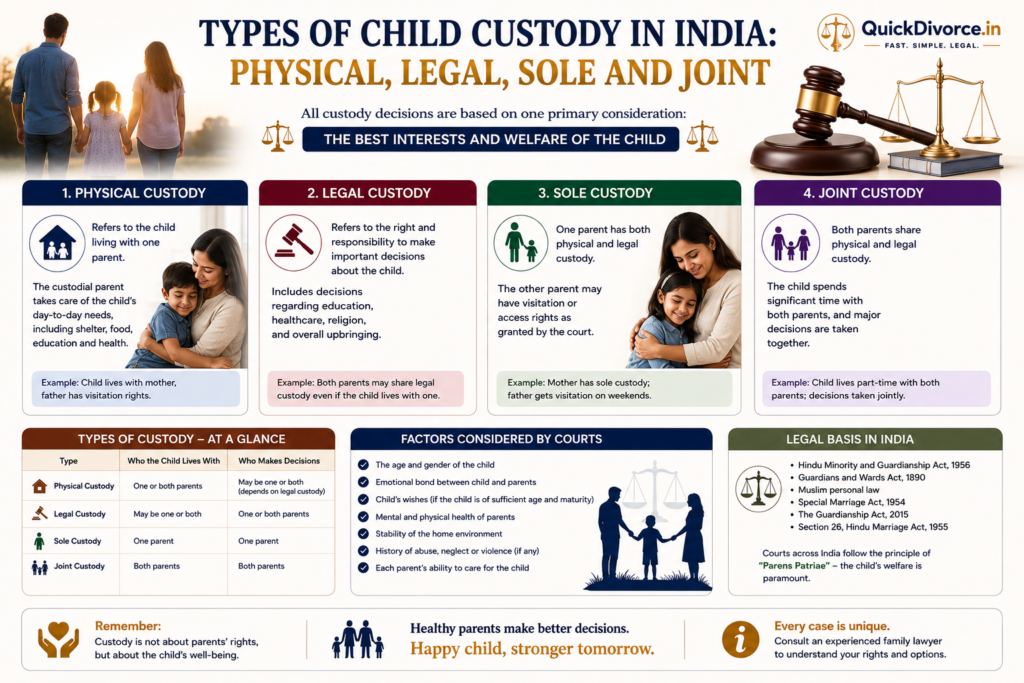
- 🏠 Physical Custody — Which parent the child lives with on a day to day basis
- ⚖️ Legal Custody — Which parent has the right to make major decisions about the child’s life
- 👤 Sole Custody — One parent has both physical and legal custody exclusively
- 👫 Joint Custody — Both parents share physical and or legal custody of the child
- 👴 Third Party Custody — Grandparents or other relatives are granted custody when neither parent is suitable
- 🏛️ Courts decide based on one overriding principle — the welfare and best interests of the child
Child custody is the most emotionally sensitive and legally complex aspect of any divorce in India. Getting the right legal advice from Day 1 is not optional — it is essential.
Quick Divorce provides expert child custody legal assistance starting at ₹499.
📌 What Is Child Custody in India?
Child custody in India refers to the legal right and responsibility of a parent or guardian to have the care, control and upbringing of a minor child.
When parents separate or divorce, the question of who the child will live with, who will make decisions about the child’s education, health and religion, and how much time the child will spend with each parent — all of these are determined through child custody proceedings.
In India, child custody is not just a family matter — it is a legal matter governed by a combination of personal laws, the Guardians and Wards Act 1890, and the consistent and overriding principle laid down by the Supreme Court of India — that the welfare of the child is paramount above all other considerations.
Child custody in India can be:
- Agreed between the parents through mediation or mutual consent
- Ordered by the family court after a full contested custody hearing
- Granted as interim custody while the final case is pending
- Modified by the court at any later stage if circumstances change
The most important thing to understand: No parent has an automatic right to custody in India. Every custody decision — whether by agreement or by court order — must serve the best interests of the child. Not the preferences of the mother. Not the rights of the father. The welfare of the child.
⚠️ Why Understanding Types of Child Custody Matters
Most parents entering custody proceedings do not fully understand the different types of child custody in India — and this lack of understanding leads to poor decisions, missed opportunities and outcomes that do not serve either the child or the parent.
Specifically, understanding the types of child custody in India helps you:
- Know exactly what you are asking for when you file a custody petition
- Understand what the other parent may be entitled to even if you have primary custody
- Structure a parenting plan that actually works for your child’s life
- Negotiate more effectively in mediation
- Set realistic expectations about what a court is likely to order
- Avoid custody arrangements that look good on paper but fail in practice
Parents who understand the legal framework are better equipped to protect their children’s interests — and their own rights as parents.
🏠 Type 1 — Physical Custody
What Is Physical Custody?
Physical custody refers to the right of a parent to have the child live with them on a day to day basis. The parent who has physical custody is responsible for the child’s daily care — meals, school, bedtime routines, medical appointments and all the practical realities of raising a child.
Physical custody is sometimes called residential custody — because it determines where the child physically resides.
Sole Physical Custody
In sole physical custody, the child lives primarily or exclusively with one parent. The other parent typically has visitation rights — scheduled time to spend with the child — but the child’s primary residence is with the custodial parent.
Sole physical custody is the most common arrangement in India — particularly for younger children — because courts generally believe that consistency of home environment is important for a child’s stability and development.
Shared Physical Custody
In shared physical custody (sometimes called joint physical custody), the child spends significant time living with both parents — not necessarily 50:50 but in a meaningful, substantial way.
Examples of shared physical custody arrangements:
- Child lives with mother during the school week, father on weekends and school holidays
- Child alternates weeks between both parents’ homes
- Child lives with each parent for alternating months
- Child lives with one parent during the school year, the other during summer vacation
Which Parent Typically Gets Physical Custody in India?
Indian courts historically favoured mothers for physical custody of young children — particularly children under 5 (the “tender years doctrine”). While this doctrine is not statutory, it has influenced court decisions for decades.
However, more recent Supreme Court and High Court judgments have moved toward a more gender neutral approach — focusing entirely on which parent is better positioned to serve the child’s welfare, regardless of gender.
Factors courts consider for physical custody:
- 🏠 Stability and quality of home environment
- 💼 Each parent’s work schedule and availability for the child
- 🏫 Proximity to the child’s school and social environment
- 👨👩👧 Quality of the existing parent-child relationship
- 💰 Financial capacity to provide for the child
- 🏥 Ability to meet the child’s physical and emotional needs
- 👴 Extended family support available to each parent
⚖️ Type 2 — Legal Custody
What Is Legal Custody?
Legal custody is separate from physical custody and is one of the most misunderstood types of child custody in India.
Legal custody refers to the right and responsibility to make major decisions about the child’s life — including:
- 📚 Education — which school, which stream, higher education choices
- 🏥 Healthcare — medical treatment, surgical decisions, choice of doctors
- 🕌 Religion — religious upbringing, religious education
- 🌍 Travel — permission for the child to travel, especially internationally
- 🏠 Residence — significant changes in the child’s place of residence
Sole Legal Custody
In sole legal custody, one parent alone has the right to make all major decisions about the child’s life. The other parent may have visitation rights but has no formal say in decisions about education, health or religion.
Sole legal custody is typically granted where:
- One parent is absent, uncontactable or uninvolved
- One parent has a history of domestic violence, substance abuse or mental illness
- The parents have such a high level of conflict that joint decision making is genuinely impossible
Joint Legal Custody
In joint legal custody, both parents share the right to make major decisions about the child’s life — regardless of where the child physically lives.
This means even if the child lives primarily with the mother, the father retains the right to be consulted and to participate in decisions about the child’s school, medical treatment and religious upbringing.
Joint legal custody is increasingly common in India — particularly in educated urban families where both parents are involved and the level of conflict, while real, does not make cooperation impossible.
The practical reality of joint legal custody: It requires both parents to communicate respectfully and cooperate in the child’s interest. It works well when parents can set aside their personal conflict. It fails when parental hostility is so high that every decision becomes a battleground.
Physical Custody vs Legal Custody — The Key Distinction
These two types of child custody in India are independent of each other and can be combined in different ways:
| Arrangement | Physical Custody | Legal Custody |
|---|---|---|
| Most common in India | Sole (with mother) | Joint (both parents) |
| High conflict cases | Sole (with one parent) | Sole (same parent) |
| Cooperative parents | Shared (both parents) | Joint (both parents) |
| Absent parent cases | Sole (present parent) | Sole (present parent) |
👤 Type 3 — Sole Custody
What Is Sole Custody?
Sole custody means one parent has both physical and legal custody of the child exclusively. The child lives with the sole custodial parent and that parent alone makes all decisions about the child’s upbringing.
The non-custodial parent may or may not be granted visitation rights — depending on the circumstances.
When Do Courts Grant Sole Custody in India?
Sole custody is granted when the court determines that one parent is clearly more suitable to have exclusive care and control of the child. Specific situations include:
Domestic violence or abuse: Where one parent has a history of violence toward the other parent or the child, sole custody is typically granted to the non-violent parent.
Substance abuse: Where one parent has a serious problem with alcohol or drug abuse that compromises their ability to safely care for the child.
Mental illness: Where one parent has a severe mental illness that makes them unable to provide safe and stable care.
Abandonment or absence: Where one parent has abandoned the child or been completely absent from the child’s life.
Parental alienation: Where one parent has systematically attempted to damage the child’s relationship with the other parent.
Criminal conduct: Where one parent has been convicted of serious criminal offences.
Sole Custody and Visitation
Even where sole custody is granted, the non-custodial parent typically retains the right to visitation — unless the court finds that contact with that parent would be harmful to the child.
Courts in India are reluctant to completely cut off a child’s relationship with a parent — recognising that both parents play an important role in a child’s development. Supervised visitation is a common middle ground where the court has concerns about one parent but does not want to eliminate contact entirely.
👫 Type 4 — Joint Custody
What Is Joint Custody?
Joint custody is an arrangement in which both parents share responsibility for the child’s upbringing — in terms of both physical care and legal decision making.
Joint custody in India has become significantly more common in recent years — reflecting both changing social attitudes and evolving judicial thinking about the importance of both parents remaining actively involved in a child’s life after divorce.
Joint Physical Custody
Both parents share the child’s physical care — the child spends substantial time living with each parent. The specific schedule is determined based on what works best for the child’s school, social life and emotional needs.
Common joint physical custody schedules in India:
- Week on / Week off: Child alternates weeks between both parents
- School week / Weekend: Child lives with one parent during school days, the other on weekends
- 2-2-3 rotation: Child spends 2 days with one parent, 2 days with the other, then 3 days with the first — rotating
- School term / Holiday: Child lives with one parent during school terms, the other during major holidays
Joint Legal Custody
Both parents share the right to make major decisions about the child’s life — education, healthcare, religion and major life decisions.
Joint legal custody does not require equal physical time. A child can live primarily with one parent (sole or primary physical custody) while both parents retain equal legal custody rights over major decisions.
Benefits of Joint Custody
Research consistently shows that children benefit from maintaining strong, meaningful relationships with both parents after divorce — provided both parents are loving, capable and not engaged in high conflict behavior.
Specific benefits of joint custody:
- 👶 Children maintain strong bonds with both parents
- 🧠 Better psychological outcomes for children
- 💪 Both parents remain actively engaged and responsible
- 💰 Financial responsibilities shared more equitably
- 🤝 Reduced parental conflict over time — parents who cooperate do so more easily as time passes
When Joint Custody Does Not Work
Joint custody is not appropriate in every situation. It fails where:
- There is a history of domestic violence or abuse
- One parent has serious substance abuse or mental health issues
- The level of parental conflict is so high that the child is caught in the middle
- The parents live very far apart making practical sharing difficult
- One parent is consistently uncooperative or undermining the other parent’s relationship with the child
👴 Type 5 — Third Party or Guardianship Custody
What Is Third Party Custody?
In exceptional circumstances, a court may grant custody of a child to a person other than either biological parent — typically grandparents, aunts, uncles or other close relatives.
Third party custody is granted under the Guardians and Wards Act 1890 when the court determines that neither biological parent is suitable or able to care for the child.
When Is Third Party Custody Granted?
- Both parents are deceased
- Both parents are incapacitated due to serious illness or disability
- Both parents are incarcerated
- Both parents are deemed unfit due to abuse, neglect or substance dependency
- Both parents have abandoned the child
Grandparents and Custody in India
Grandparents have no automatic right to custody in India — unlike some other legal systems. However, courts do consider grandparents’ petitions under the Guardians and Wards Act when it is in the child’s best interest.
Grandparents who have been primary caregivers for a child — where the parents were absent or incapable — have a strong claim to guardianship custody.
🏛️ How Indian Courts Decide Child Custody
Understanding how courts approach the types of child custody in India helps parents know what to expect and how to present their case effectively.
The Welfare Principle — Above All Else
Every custody decision in India is governed by a single overriding principle established by the Supreme Court and codified in the Guardians and Wards Act 1890:
The welfare of the minor child is paramount.
This means that neither parent has an automatic right to custody based on gender, religion, financial status or any other factor. The court asks one fundamental question: what arrangement serves this child’s best interests?
Factors Courts Consider in Custody Decisions
Age of the child Younger children — particularly those under 5 — are generally placed with the mother under the tender years doctrine, unless there are serious welfare concerns. Older children’s own preferences carry increasing weight as they mature.
Child’s own preference Courts in India are increasingly willing to hear the child’s preference — particularly for children above 9 to 10 years of age. A mature teenager’s clear preference is given significant weight, though it is not automatically determinative.
Existing parent-child bond Which parent has been the primary caregiver? With whom does the child have a stronger emotional bond? Courts look carefully at the reality of the parenting relationship prior to the divorce proceedings.
Stability and continuity Courts favour arrangements that maintain stability and continuity in the child’s life — same school, same neighbourhood, same friends, same extended family relationships where possible.
Each parent’s capacity to provide Financial capacity, availability of time, quality of home environment, extended family support — all are assessed for each parent.
Moral character and conduct of parents History of violence, substance abuse, criminal conduct, or morally questionable behavior is assessed — not to punish the parent, but to determine the child’s safety and wellbeing.
Willingness to facilitate the other parent’s relationship Courts favour parents who actively support the child’s relationship with the other parent. A parent who is seen as deliberately alienating the child from the other parent is viewed unfavourably.
Sibling bonds Courts are generally reluctant to separate siblings — recognising that sibling relationships are important to children’s wellbeing.
📜 Laws Governing Child Custody in India
The types of child custody in India are governed by different laws depending on the religion of the parties:
Guardians and Wards Act 1890
The foundational law governing child custody and guardianship in India. Applies to all religions and establishes the welfare of the child as the paramount principle. Family courts use this act as the primary framework for custody decisions.
Hindu Minority and Guardianship Act 1956
Applies to Hindus, Buddhists, Sikhs and Jains. Section 6 designates the father as the natural guardian of a minor — but Section 13 clarifies that the welfare of the minor is the paramount consideration, overriding the natural guardian designation.
Muslim Personal Law
Under Muslim personal law, the mother has the right of hizanat (custody) of young children — until the age of 7 for boys and until puberty for girls — after which the father’s custody rights become stronger. However, Indian courts apply the welfare principle even in Muslim custody cases.
Indian Divorce Act 1869
Governs custody matters for Christians. Courts have wide discretion to make custody orders based on the welfare principle.
Special Marriage Act 1954
Applies to inter-religion and civil marriages. Courts apply the welfare principle with broad discretion.
🌅 Visitation Rights in India
Visitation rights — also called access rights — are the rights of the non-custodial parent to spend time with the child.
Standard Visitation Arrangements in India
Indian courts typically grant the non-custodial parent visitation on:
- Alternate weekends (Friday evening to Sunday evening)
- School holidays — divided between both parents
- Summer vacation — typically 2 to 4 weeks with the non-custodial parent
- Alternate major festivals and religious occasions
- Child’s birthday — alternating years or shared
Supervised Visitation
Where the court has welfare concerns about a parent — but does not want to eliminate contact — supervised visitation is ordered. The parent spends time with the child but only in the presence of a specified supervisor (a trusted relative, social worker or court appointed supervisor).
Supervised visitation is ordered in cases involving:
- History of domestic violence
- Substance abuse concerns
- Allegations of child abuse
- Extreme parental alienation behaviour
Video Call and Online Visitation
For NRI parents or parents in different cities, courts increasingly recognise video call visitation as a supplement to (not a replacement for) in-person visitation.
Quick Divorce assists parents in negotiating workable visitation schedules as part of custody agreements.
🌍 Child Custody for NRI Parents
Child custody disputes involving NRI parents are among the most complex types of child custody cases in India.
Key Issues in NRI Custody Cases
Jurisdiction: Which country’s court has jurisdiction — India or the country where the NRI parent lives? If the child is in India, Indian courts have jurisdiction based on the child’s ordinary residence.
International parental abduction: Where one parent takes the child from India to another country without the other parent’s consent — or vice versa. India is not a signatory to the Hague Convention on international child abduction, making recovery of children taken abroad extremely difficult.
Enforcement of foreign custody orders: A foreign court’s custody order is not automatically enforceable in India. Indian courts independently assess what is in the child’s welfare — regardless of what a foreign court has ordered.
Practical visitation for NRI parent: When one parent is abroad, structuring visitation that is meaningful for the child and practical for the NRI parent requires creative legal arrangements — extended holiday visits, video call schedules and clear protocols for international travel.
Quick Divorce specialises in NRI child custody cases — with experience in cross border custody disputes, international parental abduction situations and enforcement of Indian custody orders against NRI parents.
📄 Documents Required for Child Custody Cases in India
Identity Documents
- 🪪 Aadhaar Card and PAN Card of both parents
- 🛂 Passport of both parents (especially if NRI issues are involved)
- 📜 Child’s birth certificate
- 🛂 Child’s passport (if applicable)
Marriage and Divorce Documents
- 📋 Marriage certificate
- ⚖️ Divorce petition or decree (if divorce proceedings are underway or completed)
- 📝 Any existing custody or visitation orders
Evidence of Parenting Capacity
- 🏠 Proof of residence — establishing stability of home environment
- 💰 Income proof — salary slips, income tax returns
- 🏫 Child’s school records and reports
- 🏥 Child’s medical records
- 📸 Photographs establishing the parent-child relationship
- 👨👩👧 Evidence of involvement in the child’s daily life — school pickups, medical appointments, extracurricular activities
Evidence Supporting Your Custody Position
- 📋 Witness statements from teachers, doctors, family members attesting to your parenting
- 🏥 Medical or psychological reports if relevant
- 📱 Digital evidence — messages, emails relevant to parenting and welfare issues
- 📝 School teacher or principal letters attesting to child’s welfare
For Sole Custody Applications
- 📋 Evidence of the other parent’s unsuitability — police reports, medical reports, court records as applicable
- 👥 Witness affidavits corroborating welfare concerns
🤝 Mediation for Child Custody Disputes in India
Mediation is increasingly recognised as the best first approach for resolving child custody disputes — and is now mandated by many family courts before contested custody hearings proceed.
Why Mediation Is Better for Child Custody
Children benefit most: Research consistently shows that children whose parents resolve custody through mediation have better outcomes than children whose parents litigate custody. The lower level of parental conflict during mediation protects the child.
Both parents retain input: In mediation, both parents shape the custody arrangement together — creating a parenting plan that reflects the real needs of their specific child’s life. Court orders are generic and often fail in practice.
Flexibility: Mediators help parents create parenting plans that a court could never order — custom holiday schedules, school event arrangements, protocols for communication between parents, decision making processes for future disagreements.
Speed: A mediated custody agreement can be reached in weeks. A contested custody case in an Indian family court takes years.
Compliance: Parents comply with custody arrangements they helped create at far higher rates than with court orders imposed on them.
Quick Divorce provides child custody mediation assistance — helping parents reach workable, child centred custody arrangements without years of damaging court litigation.
🚫 Common Mistakes Parents Make in Custody Cases in India
❌ Using the child as a messenger or weapon Asking the child to carry messages, spy on the other parent or take sides in the dispute. Courts view this extremely unfavourably and it causes lasting psychological harm to the child.
❌ Denying visitation unilaterally One parent refusing to allow court ordered or agreed visitation without legal justification. This is contempt of court and damages your credibility with the judge.
❌ Relocating with the child without consent Moving to another city or country with the child without the other parent’s written consent or court permission. This is potentially parental abduction and can result in the child being returned by court order.
❌ Making allegations without evidence Making serious allegations (abuse, domestic violence) in custody proceedings without adequate supporting evidence. Unsubstantiated allegations are treated very seriously by courts and can damage your overall credibility.
❌ Prioritising winning over the child’s welfare Approaching custody as a competition to be won rather than focusing on what arrangement genuinely serves the child best. Courts are experienced at identifying parents who are pursuing their own agenda rather than the child’s welfare.
❌ Failing to attend school events and medical appointments Non-custodial parents who fail to participate in the child’s school life, medical care and extracurricular activities undermine their case for more access or custody.
❌ Speaking negatively about the other parent in front of the child Parental alienation — deliberately damaging the child’s relationship with the other parent — is increasingly taken very seriously by Indian courts. It can result in a change of custody to the other parent.
❌ Ignoring interim custody orders Treating interim custody orders as optional or temporary. Courts take compliance with interim orders very seriously — consistent compliance demonstrates your respect for the legal process.
🌟 How Quick Divorce Helps with Child Custody in India
Quick Divorce provides comprehensive child custody legal assistance — from the initial consultation and strategy to mediation support, custody petition filing and court representation.
Services for Child Custody
Legal Consultation on Custody Rights A ₹499 consultation with an experienced family law specialist who explains all types of child custody in India as they apply to your specific situation — what you are entitled to, what the court is likely to order and what strategy makes sense.
Custody Mediation Support Quick Divorce facilitates child custody mediation — helping both parents reach a workable, child focused parenting plan without court litigation.
Parenting Plan Drafting Quick Divorce drafts detailed, legally sound parenting plans covering all practical aspects of shared parenting — schedules, holiday arrangements, decision making protocols and communication guidelines.
Custody Petition Preparation and Filing For contested custody cases, Quick Divorce prepares and files the custody petition with all required documents and supporting evidence.
Interim Custody Application Where urgent interim custody arrangements are needed — such as where a child is at risk or a parent is attempting to relocate — Quick Divorce assists with urgent interim custody applications.
NRI Custody Specialist Assistance Quick Divorce specialises in NRI custody cases — including cross border disputes, enforcement of Indian custody orders and international parental abduction situations.
Court Representation Through their network of verified family law advocates across India, Quick Divorce provides representation at all custody hearings.
Quick Divorce Services and Pricing
| Service | Price |
|---|---|
| Initial Custody Legal Consultation | ₹499 |
| Custody Mediation Support | ₹4,999 onwards |
| Parenting Plan Drafting | ₹2,999 onwards |
| Custody Petition Filing | ₹6,999 onwards |
| Interim Custody Application | ₹4,999 onwards |
| Full Divorce with Custody | ₹9,999 onwards |
| NRI Custody Case | ₹14,999 onwards |
Book Your Child Custody Consultation with Quick Divorce →
💰 Cost Breakdown: Child Custody in India
| Cost Item | Mediation Approach | Litigation Approach |
|---|---|---|
| Initial consultation | ₹499 | ₹3,000 to ₹10,000 |
| Custody mediation | ₹4,999 to ₹15,000 | Not applicable |
| Parenting plan drafting | ₹2,999 | Included in retainer |
| Custody petition filing | ₹6,999 | ₹20,000 to ₹50,000 |
| Court fees | ₹500 to ₹2,000 | ₹2,000 to ₹5,000 |
| Full legal representation | Based on complexity | ₹1,00,000 to ₹10,00,000 |
| Total estimated cost | ₹15,000 to ₹30,000 | ₹1,00,000 to ₹15,00,000 |
| Total estimated time | 4 to 12 weeks | 2 to 7 years |
❓ Frequently Asked Questions (FAQs)
Q1. Does the mother always get custody in India?
No. While Indian courts historically favoured mothers for custody of young children under the tender years doctrine, this is not a legal rule — it is a judicial tendency. Modern Indian courts apply the welfare principle gender neutrally. Fathers who are primary caregivers, or who are better positioned to serve the child’s welfare, are granted custody. The child’s welfare is the only determinant — not the gender of the parent.
Q2. At what age can a child decide which parent to live with in India?
There is no fixed age in Indian law. Courts consider the child’s preference as one factor among many. Generally, courts begin giving meaningful weight to a child’s preference around age 9 to 10, and by the time a child is 13 to 14, their clearly expressed preference carries significant weight. A mature teenager’s settled preference is rarely overridden by courts — unless there are clear welfare concerns about the chosen arrangement.
Q3. Can a father get sole custody in India?
Yes. Fathers can and do receive sole custody in India where the court determines that the mother is unsuitable or that sole paternal custody best serves the child’s welfare. Grounds include the mother’s substance abuse, mental illness, abandonment, domestic violence history or inability to provide a stable home environment. The welfare principle applies equally to both parents — neither has an advantage based on gender alone.
Q4. Can custody be changed after a court order?
Yes. Custody orders in India are not permanent and can be modified by the court at any time if there has been a material change in circumstances. Examples of material changes include: a parent relocating, a parent’s health changing significantly, evidence of a parent’s unsuitability emerging, or the child’s own needs and preferences changing as they grow older. Quick Divorce assists with custody modification applications.
Q5. What is parental alienation and how do Indian courts treat it?
Parental alienation is the deliberate manipulation of a child by one parent to reject or fear the other parent — through false allegations, emotional manipulation or interference with the child’s relationship with the other parent. Indian courts increasingly recognise parental alienation as a serious welfare concern. Evidence of parental alienation can result in a transfer of custody from the alienating parent to the targeted parent.
Q6. Can grandparents get custody in India?
Yes, under the Guardians and Wards Act 1890, grandparents can petition for guardianship custody if neither biological parent is suitable. Courts consider grandparents’ applications based on the welfare principle — where grandparents have been the de facto primary caregivers, they have a strong claim. However, there is no automatic right and each case is assessed on its facts.
Q7. What happens if one parent wants to relocate to another city or country with the child?
Relocation with a child requires either the written consent of the other parent or a court order permitting relocation. Unilaterally relocating with a child without consent or court permission is treated very seriously — it can be grounds for immediate return of the child by court order and contempt of court proceedings. Where both parents agree to relocation, the custody and visitation arrangement must be modified to reflect the new reality. Quick Divorce assists with relocation consent agreements and court applications.
Q8. How long does a child custody case take in India?
A contested child custody case in an Indian family court can take anywhere from 1 to 5 years, depending on the complexity of the case and the backlog of the court. Interim custody orders are typically granted within the first few hearings — so the child is not left in uncertainty while the full case proceeds. Mediated custody agreements can be reached in 4 to 12 weeks. This is one of the strongest arguments for attempting mediation before contested litigation.
🎯 Who Needs This Guide Right Now?
If you are going through a divorce and have children → Book a ₹499 Quick Divorce consultation immediately. Child custody is the most important issue in your case. Get the right advice before making any decision or any statement to the other parent.
If your spouse has taken the child and is refusing access → Act immediately. Quick Divorce assists with urgent interim custody applications. Do not wait.
If you are an NRI concerned about cross border custody → Quick Divorce specialises in NRI custody. Contact them before the situation escalates.
If you want to agree on custody with your spouse but need a proper legal framework → Quick Divorce’s custody mediation and parenting plan service creates a legally sound, practical agreement in weeks.
If you are a father worried about your custody rights → Modern Indian courts apply the welfare principle gender neutrally. A ₹499 Quick Divorce consultation will explain your specific rights and realistic options.
If existing custody arrangements are not working and you want to modify them → Quick Divorce assists with custody modification applications when circumstances have materially changed.
✅ Final Recommendation
Understanding the types of child custody in India — physical, legal, sole, joint and third party — is the foundation of protecting your child’s welfare and your own parental rights during and after divorce.
Child custody is too important to navigate without proper legal guidance. The decisions made now will affect your child’s life and your relationship with them for years to come.
The most important things you can do right now:
- 📞 Get proper legal advice before making any decisions or statements
- 🤝 Explore mediation before resorting to contested litigation
- 👶 Keep the child’s welfare at the centre of every decision you make
- 📋 Document your involvement in your child’s life — school, medical, activities
- ⚖️ Understand your legal rights and realistic expectations
Quick Divorce provides India’s most trusted and affordable child custody legal assistance — from initial consultation and mediation support to petition filing, interim applications and full court representation.
For ₹499, speak to a child custody specialist today who will explain your rights, assess your specific situation and give you a clear action plan that puts your child first.
Your child deserves the best possible outcome. So do you. Quick Divorce helps you achieve both.
Book Your Child Custody Consultation with Quick Divorce →

Adv. Manish Kashyap is a Family Law & Divorce Lawyer with extensive experience in Mutual & Contested Divorce, NRI Divorce, Child Custody, Alimony, Domestic Violence, Judicial Separation, and Family Court matters, providing professional legal guidance to clients.

