

Views: 15
Is Stridhan Claim Without Divorce possible in India ? Can a woman claim her Stridhan without filing for divorce in India? Learn about the laws, legal sections, Supreme Court judgments, step-by-step process, and FAQs that every woman must know.
Table of Contents
- 1 Introduction
- 2 What Is Stridhan? Understanding the Basics
- 3 Stridhan vs Dowry: A Critical Difference You Must Know
- 4 Can You Claim Stridhan Without Filing for Divorce?
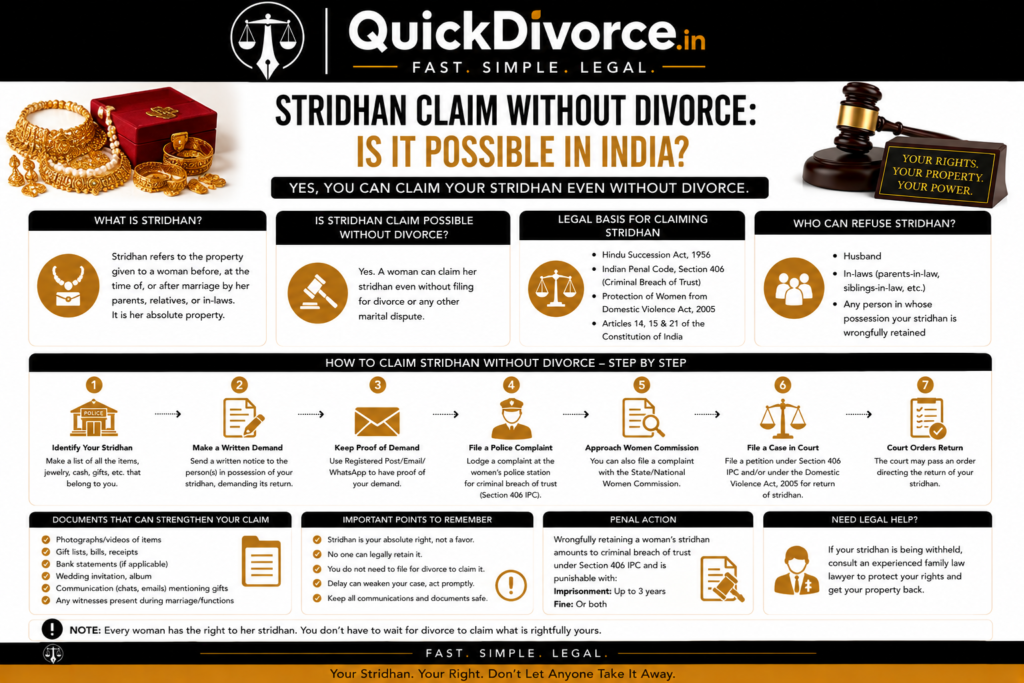
- 5 The Laws That Protect Your Stridhan in India
- 6 Landmark Supreme Court Judgments on Stridhan
- 7 Step-by-Step Process to Claim Stridhan Without Divorce
- 8 What Evidence Do You Need to Prove Stridhan?
- 9 Common Mistakes Women Make When Claiming Stridhan
- 10 Stridhan Rights for Non-Hindu Women in India
- 11 Frequently Asked Questions (FAQs) on Stridhan Claim Without Divorce
- 12 Final Word: Your Property, Your Right — Divorce Optional
- 13 Get Expert Consultation
Introduction
One of the most common and emotionally painful situations a married woman in India can face is this — her jewellery, gifts, cash, and personal belongings are sitting in her husband’s home or in the custody of her in-laws, but she is not ready to file for divorce. Maybe she still hopes for reconciliation. Maybe she is separated but the marriage is not legally dissolved. Maybe the dispute is about recovering her property first, and everything else can come later.
The single most important thing such a woman needs to know is this: You do not need a divorce to claim your Stridhan. Your right to Stridhan exists independently of your marital status.
This is not just a moral statement. It is the clear, settled legal position in India, backed by multiple Supreme Court judgments, statutory laws, and a robust enforcement framework. This guide breaks down everything you need to know — what Stridhan is, what laws protect it, how to claim it without filing for divorce, what steps to follow, and what mistakes to avoid.
What Is Stridhan? Understanding the Basics
The word “Stridhan” comes from two Sanskrit words — “Stri” meaning woman, and “Dhan” meaning property or wealth. Together, Stridhan simply means a woman’s own property.
Under Hindu law, Stridhan refers to all movable and immovable gifts, jewellery, cash, and other assets that a woman receives at various stages of her life. It is not restricted to gifts received only at the time of marriage. The scope is much broader.
Stridhan includes:
Gifts of jewellery, cash, or property received before marriage from parents, relatives, or friends. All gifts received during the wedding ceremony from the bride’s family, the groom’s family, or any guests. Gifts received after marriage from any person — including the husband, in-laws, or extended family. Gifts received at the time of childbirth. Property received during widowhood. Property purchased by a woman from her own earnings. Property received through inheritance or a will.
The legal foundation for Stridhan is established under Section 14 of the Hindu Succession Act, 1956, which gives a Hindu woman absolute ownership of any property she acquires. Section 27 of the Hindu Marriage Act, 1955 further reinforces that even if such property is in the custody of the husband or in-laws, the woman retains her full rights over it.
Stridhan vs Dowry: A Critical Difference You Must Know
Many people — and even some lawyers — confuse Stridhan with dowry. They are legally very different, and this distinction matters enormously when you are trying to recover your property.
Dowry is property or money demanded by the groom’s family as a condition of marriage. It is given under pressure or compulsion. Dowry is illegal under the Dowry Prohibition Act, 1961.
Stridhan, on the other hand, is given voluntarily and out of love and affection, to the woman herself — not to the groom’s family. It belongs to her alone. It is entirely legal and has the full protection of the law.
While dowry is illegal under the Dowry Prohibition Act, Stridhan is entirely legal and enjoys full protection under the law. This distinction has helped women assert their property rights without the fear of legal complications related to dowry.
This is why, when you demand your Stridhan back, you are not invoking dowry laws — you are asserting your right over your own property. The two are separate legal tracks entirely.
Can You Claim Stridhan Without Filing for Divorce?
Yes — absolutely, completely, and without any legal ambiguity.
The Supreme Court has ruled that a woman has inalienable rights over Stridhan and she can claim it even after separation from her husband, and denying it would amount to domestic violence, making the husband and in-laws liable to face criminal prosecution. Even in situations where the divorce has not been dissolved by a judicial decree, the woman can always claim back her Stridhan from her in-laws.
The legal position can be summarised in three clear points:
First, your Stridhan is your absolute property. It does not become joint property of the marriage just because it is kept in the matrimonial home. Second, your husband and in-laws are only trustees or custodians of your Stridhan — not its owners. Third, the moment you demand it back, they are legally obligated to return it. Refusal to return it is a criminal offence.
The husband or his family has no legal authority to withhold or claim any portion of Stridhan. If a woman’s Stridhan is not returned, she can initiate legal proceedings for its recovery under criminal breach of trust.
Divorce proceedings are a separate legal matter. Your Stridhan claim stands on its own — before divorce, during separation, after divorce, or even if you never file for divorce at all.
The Laws That Protect Your Stridhan in India
India has a layered legal framework protecting a woman’s right to Stridhan. Here are the key statutes you need to know.
1. Hindu Succession Act, 1956 — Section 14
As per Section 14 of the Hindu Succession Act, if Stridhan is kept with her husband or in-laws, then they are considered as trustees, which means they must return the property to her whenever she asks for it. This section makes a Hindu woman the absolute owner of all property she acquires — there is no requirement for her husband’s consent to use, transfer, or claim it.
2. Hindu Marriage Act, 1955 — Section 27
Section 27 of the Hindu Marriage Act specifically allows a court to make an order regarding any property presented jointly to the husband and wife, or belonging to either of them at the time of marriage. Even if the property is physically in the custody of the husband or in-laws, the woman can seek its return through court under this provision.
3. Protection of Women from Domestic Violence Act, 2005 — Sections 12, 18, and 20
Section 12 of the Domestic Violence Act provides for recovery of Stridhan in cases where women are victims of domestic violence, which helps the aggrieved woman obtain her Stridhan back from the husband or in-laws pursuant to orders passed by a competent court. Section 18(ii) enables the woman to get possession of clothes, jewellery, and other Stridhan items.
Crucially, this Act does not require divorce proceedings to be active. A woman living separately from her husband — even without any court case — can file an application directly under this Act and get her Stridhan returned through a Magistrate’s order.
4. Bharatiya Nyaya Sanhita (BNS), 2023 — Section 316 (formerly IPC Section 406)
If a woman’s Stridhan is not returned, she can initiate legal proceedings for its recovery under criminal breach of trust under Section 316(1) and (2) of the Bharatiya Nyaya Sanhita (corresponding to Sections 405 and 406 of the IPC for criminal breach of trust).
Section 316 of the Bharatiya Nyaya Sanhita, 2023 retains the core elements of criminal misappropriation of entrusted property. Section 406 penalises such misappropriation with imprisonment up to 3 years or a fine, or both.
This is a criminal provision — meaning your husband and in-laws can be arrested and prosecuted if they refuse to return your Stridhan.
Landmark Supreme Court Judgments on Stridhan
Indian courts — especially the Supreme Court — have been very consistent in protecting women’s rights over Stridhan. Here are the most important judgments you should know.
Pratibha Rani v. Suraj Kumar (1985)
This is the foundational judgment on Stridhan in India. The Supreme Court held that a Hindu married woman is the absolute owner of her Stridhan property and can deal with it in any manner she likes. Even if it is placed in the custody of her husband or her in-laws, they would be deemed to be trustees and bound to return the same if and when demanded by her. The husband had no right or interest in it, and could not burden her with the losses of his business by using her Stridhan.
Rashmi Kumar v. Mahesh Kumar Bhada (1997)
The Supreme Court reiterated in this case that the husband’s retention of Stridhan without returning it on demand amounts to criminal breach of trust, punishable under what was then Section 406 of the IPC.
Krishna Bhatacharjee v. Sarathi Choudhury (2016)
This case dealt with a situation where the couple had obtained a decree of judicial separation — a step short of divorce. The Supreme Court held that a judicial separation was different from divorce. Judicial separation did not sever or dissolve the marriage. A lady does not cease to have recourse to the Domestic Violence Act merely because she has obtained a decree of judicial separation. This judgment confirms that even in judicially separated marriages, a woman can claim her Stridhan under the Domestic Violence Act.
Maya Gopinathan v. Anoop S.B. (April 2024)
The Supreme Court reaffirmed in its judgment delivered on April 24, 2024, that Stridhan is the absolute property of a woman, and while the husband may have custody for safekeeping, he has no control or title over it. The Court overturned the Kerala High Court’s judgment and reinstated the Family Court’s decision with enhanced compensation, reinforcing the principle that Stridhan remains a woman’s absolute property.
Step-by-Step Process to Claim Stridhan Without Divorce
If your Stridhan is being withheld and you do not wish to file for divorce, here is the clear, practical path you can follow.
Step 1: Prepare a Detailed Inventory
Before you take any legal step, sit down and make a complete list of all your Stridhan items. Include jewellery with approximate weight and value, cash or cheques given to you, household items, property documents, and any other gifts. Gather supporting evidence — wedding photographs showing you wearing the jewellery, gift receipts, bills, witness statements from family members or friends who attended the wedding, and bank statements showing transfer of money to you.
It is advisable to prepare a detailed list of items with approximate values, along with any supporting evidence like bills, wedding photos, or witness statements, and submit it to the court to support your claim.
Step 2: Send a Formal Legal Notice
The first step is often to send a formal legal notice demanding the return of Stridhan articles. This puts the husband and in-laws on notice and creates a record of the demand.
Hire a lawyer to draft this notice. The notice should clearly list all the Stridhan items you are demanding back, give a specific time period for compliance (typically 15 to 30 days), and state that failure to comply will result in criminal and civil legal proceedings. The notice should be sent by registered post with acknowledgement due, so you have a documentary record.
Step 3: File Under the Domestic Violence Act (If Notice Is Ignored)
If your legal notice is ignored or refused, your next and most powerful remedy without divorce is filing an application under Section 12 of the Protection of Women from Domestic Violence Act, 2005. You can file this before a Magistrate in the area where you currently reside or where the matrimonial home is located. The Magistrate has the authority to pass orders for the return of specific Stridhan items, provide monetary compensation for items that cannot be returned, and even pass a protection order if you are facing threats or harassment.
This remedy does not require divorce proceedings. It is completely independent and can be initiated at any stage of the marriage.
Step 4: File an FIR Under Section 316 of the BNS
If the Domestic Violence route alone is not producing results, or if there is outright refusal and aggression from the other side, you can file a criminal complaint under Section 316 of the Bharatiya Nyaya Sanhita (previously Section 406 IPC) at your nearest police station.
Proceedings under Section 316 often begin with an FIR supported by an inventory of articles. Investigation may lead to recovery and interim restoration of property. The provision is frequently invoked alongside Section 85 of BNS (previously 498A IPC), enhancing both prosecutorial leverage and settlement prospects.
A formal demand through legal notice, while not mandatory under this section, significantly strengthens your case by demonstrating that your husband or in-laws deliberately refused to return your property.
Step 5: Approach the Family Court for Civil Recovery
Parallel to or instead of criminal proceedings, you can also file a civil suit for recovery of Stridhan in the Family Court. This is particularly useful when the items have been sold or disposed of and you want monetary compensation. The Family Court can pass a decree directing the husband to pay the market value of the Stridhan items.
What Evidence Do You Need to Prove Stridhan?
One of the practical challenges in Stridhan cases is proving which items belong to you. Courts have been sensitive to this issue and do not demand strictly formal documentation. Here is the kind of evidence that helps your case:
Wedding photographs and videos showing you wearing specific jewellery or using specific items. Purchase receipts or bills for jewellery, furniture, or other gifts. Bank statements showing cash transfers made to you as gifts. Letters, WhatsApp messages, or email conversations in which the husband or in-laws acknowledged your property. Statements from family members or wedding guests who can confirm what gifts were given to you. Invitation cards or wedding registers that can establish the context.
While documentary proof strengthens the case, courts have clarified that strict evidentiary standards cannot be imposed given the nature of matrimonial control over property. Courts are aware that women rarely have formal receipts for traditional gold jewellery given as wedding gifts, and they take a reasonable and pragmatic view of evidence in these matters.
Common Mistakes Women Make When Claiming Stridhan
Understanding what not to do is just as important as knowing the right steps.
Waiting too long to demand Stridhan. The sooner you formally demand it in writing, the better. Delays weaken your position. Not documenting your demand. A verbal demand is not enough. Always put your demand in writing through a lawyer. Thinking divorce must come first. This is the most widespread misconception. Your Stridhan claim is completely independent of divorce proceedings. Mixing up Stridhan with maintenance or alimony claims. These are separate legal rights. Claiming all three together is fine, but each must be argued on its own legal merits. Not consulting a lawyer early. Stridhan cases involve criminal, civil, and family law simultaneously. A lawyer experienced in matrimonial disputes is essential.
Stridhan Rights for Non-Hindu Women in India
While the strongest statutory protections for Stridhan come from Hindu personal law, women of other religions have similar protections available through different routes.
Muslim women can claim their Mehr (dower) and gifts given to them at the time of marriage as their exclusive property under Muslim personal law. They can also approach courts under the Protection of Women from Domestic Violence Act, 2005, which applies to all women regardless of religion.
Christian and Parsi women can similarly claim movable property and gifts under civil law provisions and through the Domestic Violence Act. The criminal provisions of the BNS — including Section 316 for criminal breach of trust — apply to all women regardless of religion.
Frequently Asked Questions (FAQs) on Stridhan Claim Without Divorce
1. Can a woman claim Stridhan without filing for divorce?
Yes. A woman can claim Stridhan without seeking a divorce. Stridhan is her exclusive property, and she has the legal right to recover it even if the marriage is still subsisting.
2. What is considered Stridhan under Indian law?
Stridhan includes jewellery, cash, gifts, ornaments, valuable articles, and other property received by a woman before, during, or after her marriage from her parents, relatives, friends, or husband. These items remain her exclusive property.
3. How can I recover my Stridhan without divorce?
If your Stridhan is being withheld, you may send a legal notice, attempt an amicable settlement, or approach the appropriate court for recovery. Depending on the facts, other legal remedies may also be available.
4. Can I claim Stridhan while living with my husband?
Yes. A woman can claim Stridhan even while living with her husband. Her right over Stridhan is independent of her marital status and continues throughout the marriage.
5. What documents are useful for a Stridhan claim?
Documents such as jewellery bills, gift invoices, bank statements, wedding photographs, gift lists, videos, receipts, and witness statements can help establish ownership of Stridhan.
6. What should I do if my husband or in-laws refuse to return my Stridhan?
If your husband or in-laws refuse to return your Stridhan, you should consult an experienced family law advocate. Depending on the circumstances, you may pursue appropriate civil or criminal legal remedies to recover your property.
7. Is there a time limit to claim Stridhan?
The applicable limitation period for recovering Stridhan depends on the specific facts and the legal remedy being pursued. Since limitation issues can be complex, it is advisable to seek legal advice and initiate proceedings without unnecessary delay.
Final Word: Your Property, Your Right — Divorce Optional
The law in India is unambiguous on this point. A woman’s Stridhan is her absolute property from the moment she receives it. It does not belong to the marriage. It does not belong to the husband. It does not belong to the in-laws. They are, at best, custodians — and the moment you ask for it back, they are legally obligated to return it.
You do not need to wait for a divorce to assert this right. You do not need to be in an active court case. You do not need your husband’s permission. What you do need is awareness of your rights, a clear inventory of your property, and a good lawyer who can guide you through the right legal route.
Whether through a legal notice, the Domestic Violence Act, a criminal FIR, or a civil suit — the law gives you multiple paths to reclaim what is yours. Use them.
Get Expert Consultation
🟡QuickDivorce offers trusted online legal services across India, including mutual divorce, contested divorce, child custody, alimony, marriage registration, and expert family law consultation.
👉 Mutual Consent Divorce
👉 Contested Divorce Filing
👉 Child Custody and Maintenance
👉 Matrimonial Property Settlement
👉 NRI Divorce Services
👉 Alimony and Maintenance
🟡 Protect Your Rights
👉 Domestic Violence Legal Support
👉 Stridhan Recovery
🟡For other Legal and Trademark related services visit
👉 Money Recovery Cases
👉 Property Disputes
👉 Business & Licence Registrations
📞 Call Now: +91 8595439395
🕐 Free Consultation: Monday to Saturday, 10 AM to 6 PM

Adv. Manish Kashyap is a Family Law & Divorce Lawyer with extensive experience in Mutual & Contested Divorce, NRI Divorce, Child Custody, Alimony, Domestic Violence, Judicial Separation, and Family Court matters, providing professional legal guidance to clients.

