

Views: 1
Table of Contents
- 1 Introduction
- 2 What Is Section 9 of the Hindu Marriage Act?
- 3 The Legal Requirements for a Section 9 Petition
- 4 How to File a Section 9 Petition: The Procedure
- 5 Defences to a Section 9 Petition
- 6 What Happens After a Decree of Restitution Is Granted?
- 7 Section 9 as a Tactical Tool in Matrimonial Litigation
- 8 The Constitutional Challenge to Section 9: The Debate
- 9 Section 9 and NRI Matrimonial Disputes
- 10 Key Supreme Court and High Court Judgments on Section 9
- 11 Frequently Asked Questions
- 12 Conclusion
- 13 Expert Family Law Services
Introduction
Indian matrimonial law provides not only routes to dissolve a marriage but also mechanisms to preserve and restore it. Of these preservation mechanisms, the most distinctive — and the most legally and constitutionally contested — is the remedy of Restitution of Conjugal Rights under Section 9 of the Hindu Marriage Act, 1955.
Section 9 allows a spouse to petition the Family Court for an order directing the other spouse to return to the matrimonial home and resume cohabitation. It is a remedy that has generated more judicial controversy, academic debate, and constitutional challenge than almost any other provision of Indian family law — with different High Courts reaching diametrically opposite conclusions on its constitutional validity, and the Supreme Court ultimately declining to resolve the question definitively for decades.
In 2026, Section 9 remains on the statute books, actively used by litigants, and routinely enforced by Family Courts across India. But it is also a remedy that is frequently misunderstood — both by spouses who seek to use it and by those against whom it is filed. Many petitions under Section 9 are filed not as a genuine attempt to restore the marriage but as a tactical move in matrimonial litigation — to establish a jurisdictional ground for divorce, to counter a divorce petition filed by the other side, or to create leverage in settlement negotiations.
This article explains everything about Section 9 of the Hindu Marriage Act — what it is, what the legal requirements are, how a petition is filed, what defences are available, what happens if the court grants the decree and it is not complied with, the constitutional challenges to the provision, the Supreme Court’s position, and the practical strategic considerations that any spouse — petitioner or respondent — needs to understand before engaging with this remedy.
For expert guidance on Section 9 petitions, matrimonial strategy, mutual consent divorce, contested divorce, and all aspects of Hindu marriage law, the family law team at QuickDivorce.in provides professional support across all Indian jurisdictions.
What Is Section 9 of the Hindu Marriage Act?
Section 9 of the Hindu Marriage Act, 1955 reads:
“When either the husband or the wife has, without reasonable excuse, withdrawn from the society of the other, the aggrieved party may apply, by petition to the district court, for restitution of conjugal rights and the court, on being satisfied of the truth of the statements made in such petition and that there is no legal ground why the application should not be granted, may decree restitution of conjugal rights accordingly.”
In plain terms: if one spouse leaves the matrimonial home and refuses to return without a reasonable excuse, the other spouse can go to court and ask the court to order the departing spouse to return.
The remedy is ancient in its origins — it was part of English ecclesiastical law before being transplanted into Indian law through the colonial courts — and its survival into modern Indian matrimonial legislation has been a source of sustained controversy.
The remedy is available to both husband and wife equally. Either spouse can file a petition under Section 9 against the other.

The Legal Requirements for a Section 9 Petition
For a court to grant a decree of restitution of conjugal rights under Section 9 HMA, the petitioner must establish:
Requirement 1 — Withdrawal from Society
The respondent must have withdrawn from the society of the petitioner. “Society” in this context means cohabitation — living together as husband and wife. The withdrawal need not be physical desertion from a shared home; it can also mean a refusal to cohabit even when both parties are technically in the same location.
The withdrawal must be from the matrimonial relationship itself, not merely a temporary absence for work or family reasons.
Requirement 2 — Without Reasonable Excuse
The withdrawal must be without reasonable excuse. If the respondent can establish a reasonable excuse for not cohabiting with the petitioner, the petition must be dismissed.
What constitutes a reasonable excuse is the central battleground in most Section 9 litigation. Courts have held the following to constitute reasonable excuses for withdrawal:
📋 Cruelty by the petitioner — physical or mental — that made it unsafe or unreasonable to continue cohabitation 📋 Adultery by the petitioner 📋 Desertion by the petitioner prior to the respondent’s withdrawal 📋 Failure to maintain the respondent 📋 Conduct that fundamentally destroys the mutual trust and confidence of the matrimonial relationship 📋 A genuine apprehension of harm or danger from the petitioner
Conversely, the following have generally not been accepted as reasonable excuses:
📋 General incompatibility or unhappiness in the marriage 📋 Differences with in-laws where the petitioner is not personally responsible 📋 A desire to live separately for career reasons without the petitioner’s consent
Requirement 3 — No Legal Ground to Refuse
Even if the petitioner establishes withdrawal without reasonable excuse, the court may still decline to grant the decree if there is a legal ground to refuse it — for example, if granting the decree would be inequitable in the circumstances.
How to File a Section 9 Petition: The Procedure
Jurisdiction
A petition under Section 9 is filed before the Family Court (or District Court where no Family Court exists) having jurisdiction over:
📋 The place where the marriage was solemnised 📋 The place where the respondent is currently residing 📋 The place where the parties last resided together 📋 The place where the petitioner is currently residing (in some situations)
Contents of the Petition
The petition must state:
📋 The details of the marriage — date, place, form of solemnisation 📋 The fact of withdrawal from society by the respondent 📋 The date and circumstances of the withdrawal 📋 That the withdrawal is without reasonable excuse 📋 A prayer for a decree of restitution of conjugal rights
The petition must be verified by the petitioner on affidavit.
Process After Filing
📋 The court issues notice to the respondent 📋 The respondent files a written statement setting out their defence — typically asserting a reasonable excuse for the withdrawal 📋 The parties exchange pleadings 📋 The court frames issues — primarily, whether the respondent withdrew from society and whether the withdrawal was without reasonable excuse 📋 Evidence is led by both sides — typically documents and oral testimony 📋 Arguments are heard 📋 The court delivers its judgment
Section 9 proceedings, like all Family Court proceedings, are held in camera — they are not open to the public.
Defences to a Section 9 Petition
The respondent in a Section 9 petition has several defences available:
Defence 1 — Reasonable Excuse
The most commonly pleaded and most frequently successful defence. The respondent establishes that there was a reasonable excuse for the withdrawal — typically cruelty, adultery, or conduct making cohabitation unreasonable.
Cruelty as a defence to Section 9 petitions is assessed under the same principles as cruelty as a ground for divorce under Section 13 HMA — the conduct must be of such a nature that it would be unreasonable or unsafe to require the respondent to return to cohabitation.
Defence 2 — Petitioner’s Own Wrong
Courts apply equitable principles to Section 9 petitions. A petitioner who is themselves guilty of matrimonial misconduct — cruelty, adultery, desertion — cannot be granted the equitable remedy of restitution. The principle that a person who comes to equity must come with clean hands applies directly.
Defence 3 — Desertion by the Petitioner
If the petitioner had already deserted the respondent before the respondent’s withdrawal, the respondent’s departure from cohabitation is a response to the petitioner’s prior desertion and cannot be treated as an unreasonable withdrawal by the respondent.
Defence 4 — Animus Deserendi of the Petitioner
Even where the petitioner physically remained in the matrimonial home, if they had the intention to bring the cohabitation to an end (animus deserendi), the respondent’s withdrawal cannot be treated as the party at fault.
Defence 5 — Constitutional Challenge (Limited)
In appropriate cases, respondents — particularly wives — have raised constitutional objections to Section 9 on the ground that compelling cohabitation violates the right to privacy and personal liberty under Article 21 of the Constitution. The Supreme Court has not definitively struck down Section 9, but the constitutional debate remains live and can be raised in appropriate cases.
What Happens After a Decree of Restitution Is Granted?
If the court grants a decree of restitution of conjugal rights, the respondent is directed to return to the matrimonial home and resume cohabitation. But a court decree cannot physically compel cohabitation — and the law recognises this reality.
The consequences of non-compliance with a decree of restitution of conjugal rights are:
Consequence 1 — Ground for Divorce by Desertion
Under Section 13(1A)(ii) of the Hindu Marriage Act, if a decree of restitution of conjugal rights has been passed and the respondent has not complied with it for a period of one year or more, either party to the marriage may petition for divorce on the ground that there has been no restitution of conjugal rights for one year after the decree.
This is one of the most important practical aspects of Section 9 — it creates an alternative pathway to divorce that does not require establishing the full grounds of cruelty, adultery, or desertion. An NRI or a spouse who finds it difficult to establish cruelty or desertion can obtain a decree of restitution, wait one year of non-compliance, and then file for divorce under Section 13(1A)(ii).
Consequence 2 — Enforcement as Civil Decree
A decree of restitution of conjugal rights is a civil decree and can theoretically be executed by attachment of the respondent’s property — though courts are reluctant to use coercive enforcement mechanisms in matrimonial cases.
Consequence 3 — Bar on Maintenance
Under Section 25 of the Hindu Marriage Act and under Section 125 CrPC (now BNSS), a wife who has without sufficient cause refused to comply with a decree of restitution of conjugal rights may lose her right to maintenance — though courts examine the facts carefully before applying this consequence.
Section 9 as a Tactical Tool in Matrimonial Litigation
In practice, many Section 9 petitions in India are filed not as genuine attempts to restore the marriage but as tactical moves in the broader context of matrimonial litigation. Understanding this strategic dimension is essential for any spouse — petitioner or respondent — engaging with Section 9.
Tactic 1 — Creating a Jurisdictional Ground for Divorce
Section 13(1A)(ii) HMA allows either party to petition for divorce after one year of non-compliance with a decree of restitution. A spouse who wants a divorce but whose spouse has not consented and has not committed cruelty or adultery may file a Section 9 petition, wait for non-compliance, and then convert it into a divorce petition. This creates a divorce pathway without requiring proof of specific fault grounds.
Tactic 2 — Establishing Jurisdiction
Filing a Section 9 petition in a particular court establishes jurisdiction. Where there is a competing divorce petition filed by the other spouse in a different court, a Section 9 petition can be used to establish jurisdiction in a preferred forum.
Tactic 3 — Counter to a Divorce Petition
A spouse who has been served with a divorce petition may file a Section 9 petition as a counter-move — indicating a desire to preserve the marriage and putting the petitioner in the divorce case on the defensive.
Tactic 4 — Leverage in Settlement
Filing or threatening to file a Section 9 petition can create leverage in settlement negotiations — particularly where the other spouse is anxious to avoid the delay and cost of resisting a restitution petition while a divorce is pending.
Courts and practitioners are well aware of these tactical uses of Section 9. The remedy is nonetheless available and enforceable — but the strategic dimensions must be understood by any spouse navigating matrimonial litigation.
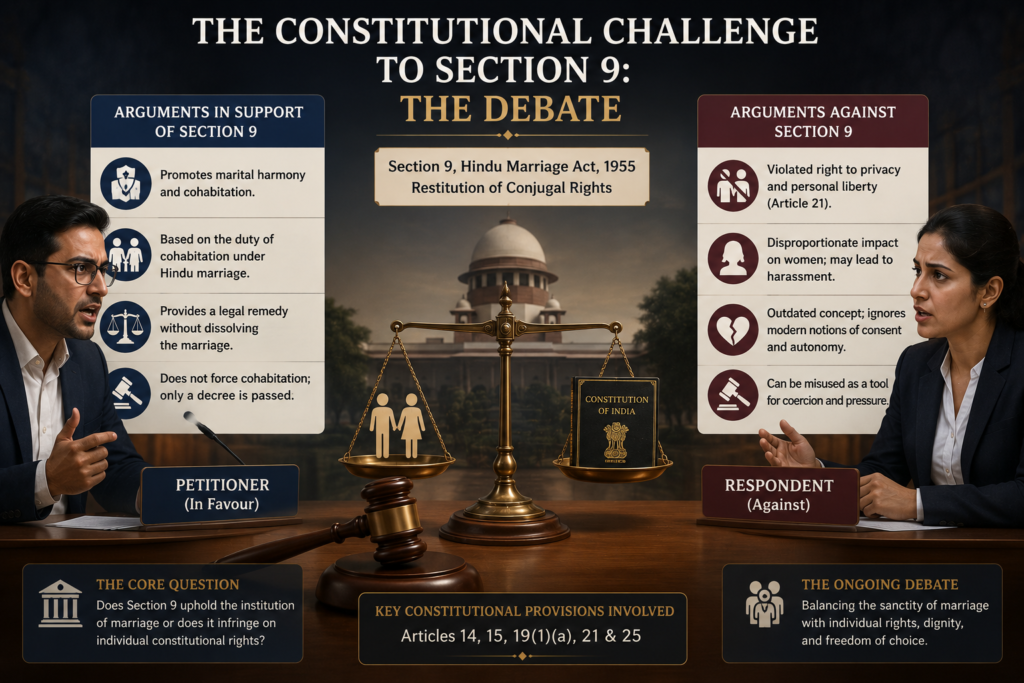
The Constitutional Challenge to Section 9: The Debate
Section 9 has been challenged as unconstitutional on the ground that compelling a spouse to cohabit with another violates the fundamental rights to privacy, personal liberty, and human dignity guaranteed by Article 21 of the Constitution of India.
The Andhra Pradesh High Court — Sareetha Case (1983)
In T. Sareetha v. T. Venkata Subbaiah (1983), the Andhra Pradesh High Court struck down Section 9 as unconstitutional, holding that compelling a wife to cohabit with her husband violated her right to privacy and bodily autonomy under Article 21. The Court reasoned that the decree of restitution, when executed against a wife, compels the most intimate of human relationships — cohabitation and potentially sexual intercourse — and that no court order can legitimately compel such intimacy.
The Delhi High Court — Harvinder Kaur Case (1984)
In Harvinder Kaur v. Harmander Singh Choudhry (1984), the Delhi High Court took the opposite view and upheld Section 9 as constitutional, reasoning that the decree does not physically compel cohabitation but merely creates consequences (primarily the pathway to divorce under Section 13(1A)) for non-compliance. The Court held that Section 9 serves the legitimate purpose of preserving marriages and is consistent with the constitutional framework.
The Supreme Court — Saroj Rani Case (1984)
In Saroj Rani v. Sudarshan Kumar Chadha (1984), the Supreme Court upheld the constitutional validity of Section 9, agreeing with the Delhi High Court’s reasoning. The Court held that Section 9 does not violate Article 21 because it does not physically compel cohabitation — it merely creates legal consequences for non-compliance, primarily by providing a ground for divorce under Section 13(1A).
The Post-Puttaswamy Debate
Following the Supreme Court’s landmark nine-judge bench ruling in Justice K.S. Puttaswamy v. Union of India (2017), which held that the right to privacy is a fundamental right under Article 21, the constitutional challenge to Section 9 has been renewed with fresh arguments. Several commentators and some litigants have argued that Puttaswamy fundamentally undermines the reasoning in Saroj Rani and that Section 9 should be reconsidered.
As of May 2026, the Supreme Court has not revisited the constitutional validity of Section 9 in the light of Puttaswamy. Section 9 remains on the statute books and is enforceable. The constitutional debate, however, remains academically and legally live — and is a ground that can be raised in appropriate cases before High Courts.
Section 9 and NRI Matrimonial Disputes
Section 9 petitions arise with some frequency in NRI matrimonial disputes, typically in the following scenarios:
Where the wife returns to India and refuses to rejoin the husband abroad: A husband who is an NRI may file a Section 9 petition against a wife who has returned to India and refuses to accompany him back to his country of residence. Courts in these cases examine carefully whether the wife’s refusal to join the husband abroad constitutes withdrawal from society without reasonable excuse — or whether the living conditions abroad, the treatment by the husband, or other circumstances provide a reasonable excuse.
Where the husband leaves for abroad and refuses to take the wife: A wife may file a Section 9 petition against a husband who has gone abroad and refuses to either take her with him or return to India to resume cohabitation.
As a prelude to NRI divorce: As noted above, Section 9 followed by non-compliance creates an alternative pathway to divorce under Section 13(1A)(ii) HMA — a pathway that NRIs sometimes use where they cannot establish specific fault grounds.
For NRIs, jurisdictional questions in Section 9 petitions are particularly important. The petition must be filed in a court with proper territorial jurisdiction — and an NRI spouse may find that the Section 9 petition has been filed in a court that is inconvenient or that lacks jurisdiction. These jurisdictional challenges can and should be raised promptly at the outset of proceedings.
Key Supreme Court and High Court Judgments on Section 9
📋 Saroj Rani v. Sudarshan Kumar Chadha (1984): Supreme Court upholding the constitutional validity of Section 9 HMA.
📋 T. Sareetha v. T. Venkata Subbaiah (1983): Andhra Pradesh High Court striking down Section 9 as unconstitutional — subsequently overruled by Saroj Rani.
📋 Harvinder Kaur v. Harmander Singh Choudhry (1984): Delhi High Court upholding Section 9 — affirmed by Saroj Rani.
📋 Sushila Bai v. Prem Narayan (1986): Madhya Pradesh High Court on what constitutes a reasonable excuse for withdrawal under Section 9.
📋 Justice K.S. Puttaswamy v. Union of India (2017): Supreme Court recognising the right to privacy as a fundamental right under Article 21 — the constitutional basis for the renewed challenge to Section 9.
📋 Amardeep Singh v. Harbheen Kaur (2017): Supreme Court on waiver of cooling-off period — relevant where Section 9 proceedings are being converted into mutual consent divorce.
Frequently Asked Questions
What is Section 9 of the Hindu Marriage Act?
Section 9 of the Hindu Marriage Act, 1955 provides the remedy of Restitution of Conjugal Rights. It allows a spouse to approach the court when the other spouse has withdrawn from their society without a reasonable excuse and seek a decree directing the spouse to resume cohabitation.
Who can file a petition for Restitution of Conjugal Rights?
Either the husband or the wife can file a petition under Section 9 if they believe that their spouse has left the matrimonial relationship without a lawful or reasonable justification.
What does the court examine before granting a decree?
The court examines whether one spouse has withdrawn from the company of the other and whether there was a reasonable excuse for doing so. The burden of proving a valid reason generally lies on the spouse who left the matrimonial home.
Can a spouse refuse to return even after a decree is passed?
A spouse may choose not to comply with the decree, but non-compliance can have legal consequences. Continued refusal to resume cohabitation may become a ground for seeking divorce after the statutory period prescribed by law.
Is cruelty a valid defence against a Section 9 petition?
Yes. If a spouse can prove cruelty, domestic violence, harassment, or any other reasonable ground that justifies living separately, the court may dismiss the petition for restitution of conjugal rights.
Conclusion
Section 9 of the Hindu Marriage Act is one of the most debated, most tactically deployed, and most legally complex provisions in Indian matrimonial law. It is simultaneously a remedy for preserving marriages, a tactical tool in divorce litigation, and a provision whose constitutional validity remains an open question in the post-Puttaswamy era.
For any spouse — in India or abroad — who is served with or is considering filing a Section 9 petition, the critical priorities are the same: understand the legal requirements, identify the available defences, assess the tactical context, and engage an experienced family law advocate immediately.
For spouses who want to convert a Section 9 situation into a mutual consent divorce — which is almost always the fastest, cheapest, and least damaging outcome — early and structured negotiation, ideally through mediation, is the most effective strategy. A mediated settlement that converts a Section 9 petition into a mutual consent divorce avoids years of litigation and produces an outcome that both parties can genuinely accept.
Know your rights. Understand your options. Act with a strategy.
Expert Family Law Services
🟡 QuickDivorce.in provides complete support for Section 9 petitions, contested divorce proceedings, mutual consent divorce, NRI divorce, mediation, and all aspects of Indian matrimonial law across all jurisdictions.
🟡Visit LegalTax.in for other Legal and Trademark related services as 👉 Money Recovery Cases 👉 Property Disputes 👉 Business & Licence Registrations
🟡Visit Business24hub for IT services
👉 Mutual Consent Divorce at QuickDivorce.in 👉 Contested Divorce Filing 👉 Child Custody and Maintenance 👉 Matrimonial Property Settlement 👉 NRI Divorce Services 👉 Alimony and Maintenance
🟡 Protect Your Rights 👉 Domestic Violence Legal Support at QuickDivorce.in 👉 Stridhan Recovery
📞 Call Now: +91 8595439395 🕐 Free Consultation: Monday to Saturday, 10 AM to 6 PM

Adv. Manish Kashyap is a Family Law & Divorce Lawyer with extensive experience in Mutual & Contested Divorce, NRI Divorce, Child Custody, Alimony, Domestic Violence, Judicial Separation, and Family Court matters, providing professional legal guidance to clients.

