

Views: 1
Table of Contents
- 1 Introduction
- 2 A Quick Note: What Changed With the New Criminal Laws
- 3 What Is Section 498A IPC (Now Section 85 BNS)?
- 4 What Is the Protection of Women from Domestic Violence Act, 2005?
- 5 Section 498A IPC vs Domestic Violence Act: Key Differences at a Glance
- 6 Criminal Remedy vs Civil Remedy: Why the Distinction Matters
- 7 Can You File Both Simultaneously?
- 8 Choosing the Right Remedy for Your Situation
- 9 Misuse Concerns and Recent Judicial Safeguards
- 10 How QuickDivorce.in Can Help
- 11 Frequently Asked Questions (FAQs)
- 12 Conclusion
- 13 Any query regarding Section 498A IPC vs Domestic Violence Act?
Introduction
When a woman facing cruelty or abuse within her marriage decides to seek legal recourse in India, she is almost immediately confronted with two overlapping but very different legal options: filing a criminal complaint under what was once Section 498A of the Indian Penal Code, or approaching the court for civil protection under the Protection of Women from Domestic Violence Act, 2005 (commonly called the “DV Act”). Many people assume these are interchangeable, or that filing one automatically covers the other — but the truth is, they serve fundamentally different purposes, follow different procedures, and offer very different remedies.
Understanding the real distinction between Section 498A IPC vs Domestic Violence Act isn’t just a legal technicality — it directly affects what kind of relief you can get, how fast you can get it, and what happens to the accused. This guide breaks down both laws in detail, explains how they’ve evolved with India’s new criminal code, and helps you understand which remedy — or combination of remedies — actually fits your situation.
A Quick Note: What Changed With the New Criminal Laws
Before comparing the two laws, it’s important to flag a structural change that affects this entire discussion. Effective July 1, 2024, India replaced the Indian Penal Code, 1860 with the Bharatiya Nyaya Sanhita (BNS), 2023. As part of this transition, Section 498A IPC has been renumbered as Section 85 of the BNS, with the explanation defining “cruelty” now structured as a separate provision under Section 86 BNS.
The substance of the law hasn’t changed — the punishment, the ingredients of the offence, and its cognizable, non-bailable, and non-compoundable nature all remain the same. So when this guide (and most legal resources) refer to “Section 498A,” they are referring to the same protection now codified as Section 85 read with Section 86 of the BNS. The Domestic Violence Act, 2005, by contrast, has not been renumbered or replaced — it continues to operate as a standalone civil law alongside the new criminal code.
What Is Section 498A IPC (Now Section 85 BNS)?
Section 498A was introduced into the Indian Penal Code in 1983, specifically to address the rising number of dowry-related deaths and cruelty against married women. It makes it a criminal offence for a husband or his relatives to subject a married woman to cruelty.
Under the law, “cruelty” is defined in two parts:
- Wilful conduct of such a nature that it is likely to drive the woman to commit suicide, or to cause grave injury or danger to her life, limb, or health — whether mental or physical.
- Harassment of the woman with a view to coercing her, or anyone related to her, to meet an unlawful demand for property or valuable security — typically dowry-related — or harassment arising from failure to meet such a demand.
Key Features of Section 498A IPC / Section 85 BNS
- Punishment: Imprisonment for up to three years, along with a fine
- Cognizable offence: Police can register an FIR and investigate without needing prior court permission
- Non-bailable: Bail is not a matter of right and must be granted by a court
- Non-compoundable: The complainant cannot simply “withdraw” the case once filed; it requires the court’s permission to quash proceedings, often through a settlement route under Section 482 CrPC (now Section 528 of the BNSS)
- Who can be accused: The husband, or his relatives by blood, marriage, or adoption — this can include in-laws living in the same household
Because it is a criminal provision, the entire process moves through the police and criminal courts — FIR registration, investigation, arrest (where warranted), chargesheet, and trial before a Magistrate.
What Is the Protection of Women from Domestic Violence Act, 2005?
The Domestic Violence Act takes a fundamentally different approach. Rather than criminalising specific conduct, it is primarily a civil remedy law, designed to provide fast, practical protection to women facing abuse within a domestic relationship — without necessarily sending anyone to jail.
The Act defines “domestic violence” far more broadly than Section 498A, covering:
- Physical abuse — any act causing bodily pain, harm, or danger to life
- Sexual abuse — any conduct of a sexual nature that abuses, humiliates, or degrades
- Verbal and emotional abuse — insults, ridicule, humiliation, or name-calling, including in relation to not having a child or a male child
- Economic abuse — deprivation of financial resources, stridhan, or means necessary for the woman’s survival
Key Features of the Domestic Violence Act
- Who can file: Not just wives — the Act extends to women in any domestic relationship, including live-in partners, mothers, sisters, and daughters facing abuse within a shared household
- Reliefs available:
- Protection orders — preventing further acts of violence or contact
- Residence orders — allowing the woman to continue living in the shared household, regardless of property title
- Monetary relief — covering medical expenses, loss of earnings, and maintenance
- Custody orders — temporary custody arrangements for children
- Compensation orders — for injury, including mental trauma
- Filed before: A Magistrate, with the assistance of a Protection Officer appointed under the Act
- Standard of proof: Lower than criminal cases, since the proceedings are essentially civil in nature, decided on the balance of probability
- Enforcement: While the Act itself is civil, breach of a protection order is a separate criminal offence under Section 31, punishable with imprisonment of up to one year, a fine, or both
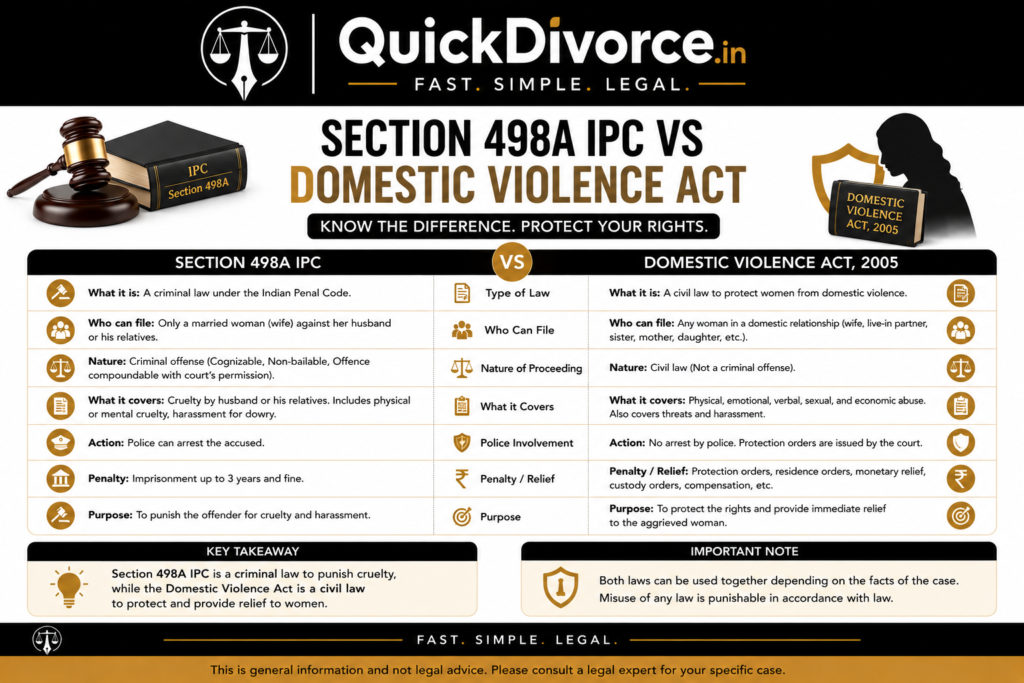
Section 498A IPC vs Domestic Violence Act: Key Differences at a Glance
| Aspect | Section 498A IPC / Section 85 BNS | Domestic Violence Act, 2005 |
|---|---|---|
| Nature of law | Criminal | Primarily civil, with criminal consequences for breach |
| Objective | Punish the offender | Protect the victim and provide practical relief |
| Who can file | Only a married woman, against husband/his relatives | Any woman in a domestic relationship, against any “respondent” |
| Forum | Police / Criminal Court (Magistrate) | Magistrate’s Court, with Protection Officer assistance |
| Arrest | Possible, subject to Arnesh Kumar safeguards | No automatic arrest; civil orders are passed instead |
| Burden of proof | Higher — beyond reasonable doubt | Lower — balance of probability |
| Compoundable | No, requires court’s permission to quash | Largely flexible; civil orders can often be modified by consent |
| Primary remedy | Imprisonment and fine | Protection, residence, monetary relief, custody, compensation |
| Speed of relief | Often slower, due to investigation and trial | Generally faster, especially for protection and residence orders |
| Scope of “abuse” covered | Cruelty linked to dowry or wilful harm | Much broader — physical, sexual, verbal, emotional, and economic abuse |
Criminal Remedy vs Civil Remedy: Why the Distinction Matters
The most fundamental difference in any comparison of Section 498A IPC vs Domestic Violence Act comes down to what each law is actually trying to achieve.
Section 498A / Section 85 BNS is punitive — its primary goal is to hold the offender criminally accountable, with imprisonment as the ultimate consequence. This makes it a powerful deterrent, but also a slower, more adversarial process, since criminal proceedings require a higher standard of proof and typically take years to conclude.
The Domestic Violence Act is protective — its primary goal is to stabilise the victim’s immediate situation: securing a safe place to live, preventing further contact or harassment, and ensuring some financial support, often within weeks rather than years. It is not designed to punish the abuser through imprisonment in the first instance, though violating its orders can itself trigger criminal liability.
This is why many lawyers describe the DV Act as the “first response” tool — useful for securing urgent, practical protection — while Section 498A is often viewed as the “accountability” tool, pursued in parallel or afterward to seek criminal consequences for the underlying conduct.
Can You File Both Simultaneously?
Yes. There is no legal bar on filing both a criminal complaint under Section 498A (Section 85 BNS) and a petition under the Domestic Violence Act for the same set of facts. In fact, this is a common strategy, since the two laws serve complementary purposes — one seeking punishment for the offender, the other seeking immediate, practical protection and relief for the victim.
That said, pursuing both simultaneously requires careful legal coordination, since facts presented in one proceeding can influence the other, and courts examining either case will often be aware of parallel litigation. A consistent, well-documented account of events across both proceedings strengthens your overall case.
Choosing the Right Remedy for Your Situation
If you’re trying to decide where to start, here’s a practical way to think about Section 498A IPC vs Domestic Violence Act based on your immediate priorities:
- If your most urgent need is a safe place to live, financial support, or stopping ongoing harassment — the Domestic Violence Act is generally the faster, more immediately useful route.
- If you want the abuser to face criminal prosecution and potential imprisonment — Section 498A (now Section 85 BNS) is the appropriate criminal remedy.
- If the abuse extends beyond your husband to other family members, or includes economic or emotional abuse not strictly tied to dowry demands — the DV Act’s broader definition of abuse may cover situations that Section 498A does not.
- If you are not married but face abuse in a live-in relationship or within your natal family — Section 498A does not apply at all, since it is restricted to married women and their husbands/in-laws; the DV Act remains your primary legal option in such cases.
Many family lawyers recommend starting with the Domestic Violence Act for immediate protective relief, while simultaneously evaluating whether the facts justify also pursuing a criminal complaint for accountability.
Misuse Concerns and Recent Judicial Safeguards
No discussion of Section 498A IPC vs Domestic Violence Act would be complete without addressing the long-running debate over misuse — particularly around Section 498A. Over the years, courts have expressed concern that the provision is sometimes used to file broad, vague allegations against entire families, including elderly in-laws or distant relatives with no direct involvement, often as leverage during matrimonial disputes or divorce negotiations.
In response, the Supreme Court has introduced several safeguards over time:
- Arnesh Kumar v. State of Bihar (2014) mandated that police must satisfy specific legal conditions before making any arrest under Section 498A, rather than arresting mechanically upon FIR registration.
- Rajesh Sharma v. State of U.P. (2017) initially proposed Family Welfare Committees to screen complaints before action, although this specific mechanism was later struck down by the Supreme Court in Social Action Forum for Manav Adhikar (2018) as exceeding the Court’s law-making authority.
- More recently, the Allahabad High Court issued guidelines requiring a two-month “cooling-off” period along with screening by a Family Welfare Committee before arrest in Section 498A cases — guidelines that the Supreme Court has since upheld, signalling a renewed judicial push toward balancing protection for genuine victims with safeguards against indiscriminate prosecution.
The Domestic Violence Act, being civil in nature, has faced comparatively fewer misuse concerns, largely because its remedies are protective rather than punitive — though courts do scrutinise frivolous or exaggerated claims under this Act as well before granting relief.
How QuickDivorce.in Can Help
Deciding between Section 498A IPC vs Domestic Violence Act — or pursuing both together — requires a clear understanding of your immediate needs, the strength of your evidence, and the realistic timelines involved. At QuickDivorce.in, our family law team helps clients evaluate their situation honestly, file the right combination of criminal and civil remedies, and pursue protection orders, maintenance, and accountability through the correct legal channels — without unnecessary delays or missteps that could weaken your case.
Frequently Asked Questions (FAQs)
1. Is Section 498A IPC still in force, or has it been completely replaced?
The substance of the law continues in force; it has simply been renumbered as Section 85 (read with Section 86) of the Bharatiya Nyaya Sanhita, 2023, effective from July 1, 2024, with no change in punishment or scope.
2. Can a husband be arrested immediately after a 498A complaint is filed?
Not automatically. Following the Arnesh Kumar guidelines and subsequent High Court directions upheld by the Supreme Court, police must follow specific safeguards, including preliminary screening, before making an arrest.
3. Can an unmarried woman in a live-in relationship use the Domestic Violence Act?
Yes. The Domestic Violence Act applies broadly to women in a “domestic relationship,” which includes live-in partnerships, unlike Section 498A, which applies only to married women.
4. Which law provides faster relief — Section 498A or the Domestic Violence Act?
Generally, the Domestic Violence Act provides faster practical relief, such as residence and protection orders, since it is a civil remedy decided on a lower standard of proof compared to a criminal trial.
5. Can a Section 498A case be withdrawn once filed?
Not directly by the complainant alone, since it is a non-compoundable offence. Quashing typically requires approaching the High Court, often on the basis of a settlement between the parties.
6. Does filing under the Domestic Violence Act automatically result in criminal punishment for the husband?
No. The Act’s primary remedies are civil — protection, residence, and monetary relief. Criminal liability under this Act arises specifically if a court order under the Act is later violated.
Conclusion
The debate around Section 498A IPC vs Domestic Violence Act isn’t really about which law is “better” — it’s about understanding that they serve different purposes entirely. Section 498A (now Section 85 BNS) is a criminal provision focused on punishing cruelty and dowry-related harassment, while the Domestic Violence Act is a civil remedy designed to deliver immediate, practical protection and support to women facing abuse in a broader range of domestic relationships.
For many women, the most effective approach isn’t choosing one over the other, but understanding how the two can work together — using the Domestic Violence Act to secure urgent safety and stability, while evaluating whether the facts of the case also warrant pursuing criminal accountability under Section 85 BNS.
If you’re facing abuse or cruelty within your marriage or household and aren’t sure which legal remedy fits your situation, reach out to the family law team at QuickDivorce.in for guidance tailored to your circumstances.
Any query regarding Section 498A IPC vs Domestic Violence Act?
🟡QuickDivorce offers trusted online legal services across India, including mutual divorce, contested divorce, child custody, alimony, marriage registration, and expert family law consultation.
👉 Mutual Consent Divorce
👉 Contested Divorce Filing
👉 Child Custody and Maintenance
👉 Matrimonial Property Settlement
👉 NRI Divorce Services
👉 Alimony and Maintenance
🟡 Protect Your Rights
👉 Domestic Violence Legal Support
👉 Stridhan Recovery
🟡For other Legal and Trademark related services visit
👉 Money Recovery Cases
👉 Property Disputes
👉 Business & Licence Registrations
📞 Call Now: +91 8595439395
🕐 Free Consultation: Monday to Saturday, 10 AM to 6 PM

Adv. Manish Kashyap is a Family Law & Divorce Lawyer with extensive experience in Mutual & Contested Divorce, NRI Divorce, Child Custody, Alimony, Domestic Violence, Judicial Separation, and Family Court matters, providing professional legal guidance to clients.

