

Views: 17
Table of Contents
- 1 Introduction
- 2 Understanding Property Division After Divorce in India
- 3 Legal Framework Governing Property Division After Divorce
- 4 Types of Property Considered During a Settlement
- 5 Factors Courts Consider When Deciding Property Division After Divorce
- 6 Can a Wife Automatically Claim a Share in the Husband’s Property?
- 7 Stridhan and Its Place in the Settlement
- 8 Methods of Executing a Property Settlement
- 9 Mediation vs Litigation: Which Route Works Better?
- 10 Special Considerations for NRI Couples
- 11 Maintenance vs. Asset Settlement: Knowing the Difference
- 12 Sample Clauses Often Included in a Settlement Agreement
- 13 Legal Documents Required to Execute the Settlement
- 14 Step-by-Step Process to Execute Property Division After Divorce
- 15 Tax and Stamp Duty Implications
- 16 Common Challenges Couples Face
- 17 How we Can Help in cases of Property Division After Divorce
- 18 Frequently Asked Questions (FAQs)
- 19 Conclusion
- 20 Want to know more about Cases of Property Division After Divorce
Introduction
For most couples going through a separation, the emotional end of a marriage is only half the battle — the other half is figuring out who keeps what. Property Division After Divorce is, in fact, one of the most contested and misunderstood parts of Indian matrimonial law, largely because India does not follow a single, automatic formula for splitting marital assets the way some Western countries do.
Unlike a community property system, where everything acquired during marriage is split equally by default, Property Division After Divorce in India depends heavily on ownership documents, financial contribution, and judicial discretion. This makes the process unpredictable for many couples — and it’s exactly why understanding how the law actually works, and how to properly execute a settlement once an agreement is reached, matters so much.
This guide walks you through everything you need to know about Property Division After Divorce in 2026 — from the legal principles courts apply, to the documents required, to the practical steps for executing your settlement so it actually holds up in the real world.
Understanding Property Division After Divorce in India
India does not have a community property regime. This means that simply being married does not automatically make every asset acquired during the marriage jointly owned. Ownership generally follows the title of the property — whoever’s name appears on the deed, bank account, or registration documents is treated as the legal owner, regardless of who actually paid for it.
This single principle is the foundation of how courts approach Property Division After Divorce, and it often surprises people who assume that marriage itself creates automatic co-ownership of assets.
Legal Framework Governing Property Division After Divorce
Several laws come into play depending on the religion of the parties and the nature of the property involved:
- Section 27 of the Hindu Marriage Act, 1955 allows the court to pass orders regarding property that was presented jointly to both spouses at or around the time of marriage.
- The Hindu Succession Act, 1956 governs inheritance rights and ancestral property, particularly relevant after the landmark Vineeta Sharma v. Rakesh Sharma (2020) ruling, which strengthened daughters’ coparcenary rights.
- The Special Marriage Act, 1954 provides analogous provisions for interfaith couples under Sections 36 and 37 for maintenance and permanent alimony.
- The Protection of Women from Domestic Violence Act, 2005 secures a wife’s right to reside in the shared household, regardless of whose name is on the title — as affirmed in Satish Chander Ahuja v. Sneha Ahuja (2020).
Together, these statutes shape the legal landscape within which courts approach Property Division After Divorce, though none of them provides a single, uniform formula for splitting assets.
Types of Property Considered During a Settlement
Not all property is treated the same way. Before any negotiation begins, it helps to classify what you actually own:
1. Self-Acquired Property
Property purchased by one spouse using their own funds, before or during the marriage, generally remains that spouse’s individual asset unless the other party can prove a financial contribution.
2. Joint or Marital Property
Assets purchased jointly during the marriage — a house, car, or investments registered in both names — are typically divided based on ownership share, contribution, or mutual agreement.
3. Ancestral Property
Property inherited through generations within a Hindu Undivided Family is governed by succession law, not matrimonial law, and a spouse generally cannot claim a share in their partner’s ancestral property simply by virtue of marriage.
4. Stridhan
Stridhan refers to gifts, jewellery, and property given to a woman before, during, or after her wedding. The Supreme Court, in Pratibha Rani v. Suraj Kumar (1985), held that stridhan remains the absolute property of the wife, and that a husband or in-laws holding it merely act as trustees who are bound to return it.
Correctly classifying each asset is the first real step toward a fair and enforceable Property Division After Divorce settlement.
Factors Courts Consider When Deciding Property Division After Divorce
Where parties cannot agree and the matter goes before a Family Court, judges typically weigh several factors before approving any division of assets:
- Financial contribution — direct payments toward purchase, loan EMIs, or major renovations
- Non-financial contribution — homemaking, childcare, and indirect support that enabled the other spouse to earn or invest
- Duration of the marriage — longer marriages tend to be viewed through a more collaborative, jointly-built lens
- Economic independence — a financially dependent spouse may be awarded a larger share or higher maintenance
- Custody of children — the parent retaining primary custody may be allowed to continue residing in the family home
- Existing agreements — prenuptial or postnuptial arrangements, while not strictly binding under Indian law, may still influence the court’s view of fairness
It’s worth noting that Indian courts have, in recent years, shown a growing willingness to recognise non-financial contributions more seriously. While this trend is most visible outside matrimonial law — for instance, the Supreme Court’s 2026 ruling recognising the economic value of a homemaker’s unpaid domestic labour in compensation cases — it reflects a broader judicial shift that is gradually influencing how courts view fairness in Property Division After Divorce as well.
This is one of the most common misconceptions in Indian family law. As per existing legal position, a wife does not automatically acquire co-ownership of her husband’s self-acquired or ancestral property merely by virtue of marriage. What she is entitled to instead includes:
- Maintenance and alimony under Section 25 of the Hindu Marriage Act
- The right to reside in the shared household, irrespective of title
- Return of her stridhan
- A proportionate share in any property she can demonstrate she financially or substantially contributed to
This distinction is critical to understand before entering settlement negotiations, since unrealistic expectations on either side often delay an otherwise straightforward Property Division After Divorce.
Stridhan and Its Place in the Settlement
Stridhan deserves special mention because it sits outside the general framework of asset division. Since it legally belongs to the wife regardless of how other marital assets are split, it should never be bundled into broader negotiations over jointly held property — doing so often creates unnecessary confusion and weakens an otherwise clean settlement.
Methods of Executing a Property Settlement
Once both spouses (or the court) have agreed on who gets what, the next challenge is making that agreement legally binding and practically enforceable. There are several routes couples commonly use:
1. Selling the Property and Splitting Proceeds
If neither spouse wishes to retain a jointly owned asset, the simplest approach is often to sell it and divide the proceeds as agreed — avoiding ongoing entanglement altogether.
2. One Spouse Buying Out the Other’s Share
Here, one party retains the property and compensates the other for their share, usually based on an independent valuation to ensure fairness.
3. Continued Co-Ownership
In some cases, particularly where children are involved, couples choose to retain joint ownership temporarily (for instance, until children finish school), with clearly defined terms for eventual sale or transfer.
Choosing the right method is often the most practical part of Property Division After Divorce, since the legal principle of “who is entitled to what” only becomes meaningful once it is converted into an actual transfer of title or funds.
Mediation vs Litigation: Which Route Works Better?
Couples facing Property Division After Divorce often default to assuming that a contested court battle is the only way to resolve disputed assets. In practice, mediation is frequently the faster, cheaper, and less adversarial route.
Mediation involves a neutral third party helping both spouses negotiate terms directly. Most Family Courts in India now actively refer matrimonial disputes to court-annexed mediation centres before allowing a case to proceed to a full trial, since a negotiated outcome tends to be both faster to implement and easier for both parties to accept voluntarily. Mediation works particularly well where the dispute is primarily about valuation or timing rather than a fundamental disagreement over entitlement.
Litigation, on the other hand, becomes necessary where one spouse disputes the other’s claim entirely — for instance, denying any financial contribution toward a property held in their name, or refusing to acknowledge a benami arrangement. In such cases, the court examines documentary evidence, bank records, and witness testimony before deciding how the asset should be treated.
For most couples, a hybrid approach works best: attempt mediation first for the issues that can realistically be agreed upon, and reserve litigation only for the specific assets where a genuine, irreconcilable dispute exists. This significantly narrows the scope of what needs to be contested, and in turn, speeds up the overall timeline.
Special Considerations for NRI Couples
When one or both spouses are Non-Resident Indians, or when the disputed property is located outside India, dividing marital assets becomes considerably more complex. Indian Family Courts generally have jurisdiction over assets located within India, but enforcing orders against property held abroad often requires separate proceedings in the foreign jurisdiction where the asset is situated.
Couples in this situation should be especially careful to:
- Maintain clear documentation of contributions made in foreign currency toward Indian property
- Understand that a consent decree passed by an Indian court may need to be separately recognised or enforced abroad, depending on the country’s laws
- Account for currency conversion and repatriation rules under FEMA (Foreign Exchange Management Act) when transferring settlement amounts internationally
- Engage lawyers familiar with cross-border enforcement, since a purely domestic legal strategy is often insufficient when assets span multiple countries
Maintenance vs. Asset Settlement: Knowing the Difference
A common point of confusion for separating couples is the distinction between maintenance and the actual splitting of marital assets. These are legally separate remedies, and conflating them often leads to unrealistic expectations during negotiation.
Maintenance (or alimony) is a recurring or lump-sum financial support obligation, awarded under Section 25 of the Hindu Marriage Act or analogous provisions under other personal laws, based on the paying spouse’s income, the recipient’s needs, the duration of the marriage, and the standard of living during the relationship. It is forward-looking — designed to support the financially weaker spouse going forward.
Asset settlement, by contrast, deals with existing property already acquired — houses, vehicles, investments, jewellery, and bank balances built up during the marriage. This is backward-looking — it settles who owns what, based on title, contribution, and fairness, rather than future need.
In practice, the two often interact. A spouse who receives a larger share of the marital home, for instance, may be awarded comparatively lower monthly maintenance, since their housing need has already been addressed through the settlement. Courts frequently look at the combined effect of both remedies together when assessing whether the overall outcome is fair to both parties, rather than evaluating maintenance and asset division in isolation.
Understanding this distinction early in negotiations helps avoid a common pitfall: one spouse focusing exclusively on securing a larger share of property while inadvertently weakening their case for ongoing maintenance, or vice versa. A well-rounded settlement strategy considers both elements together.
Sample Clauses Often Included in a Settlement Agreement
While every settlement should be drafted to fit the specific facts of the case, most well-structured agreements include certain recurring elements:
- A clear, itemised list of all assets being divided, with their estimated current value
- The agreed method of division for each asset (sale, buyout, or continued co-ownership)
- A defined timeline for completing each transfer, registration, or payment
- Provisions for handling any outstanding loans or liabilities tied to a specific asset
- A clause addressing what happens if either party fails to comply within the agreed timeline
- Confirmation that stridhan and personal belongings are excluded from the general settlement and are to be returned separately
- A mutual release clause, confirming that once the settlement is executed, neither party will raise further claims over the listed assets
Including these elements upfront significantly reduces the chances of post-settlement disputes, which are unfortunately common when agreements are drafted in vague or general terms.
Legal Documents Required to Execute the Settlement
Whichever method you choose, the settlement must be backed by proper legal documentation to avoid future disputes. Commonly required documents include:
- Settlement Agreement / Memorandum of Understanding — capturing the agreed terms in writing
- Consent Decree — filed before the Family Court under Order XXIII Rule 3 of the Civil Procedure Code, converting the private agreement into a binding court order
- Partition Deed — used where ancestral or jointly held family property is being formally divided; this can be registered with the local Sub-Registrar
- Family Settlement Deed — typically used for amicable divisions among family members, and in many states does not require compulsory registration or stamping, unlike a standard conveyance
- Sale Deed / Transfer Deed — required where one spouse is buying out the other’s share or where the property is being sold to a third party
- Mutation Application — filed with local municipal or revenue authorities to update ownership records after the transfer
Without these documents properly executed and, where required, registered, even a mutually agreed Property Division After Divorce can remain legally vulnerable to future challenge.
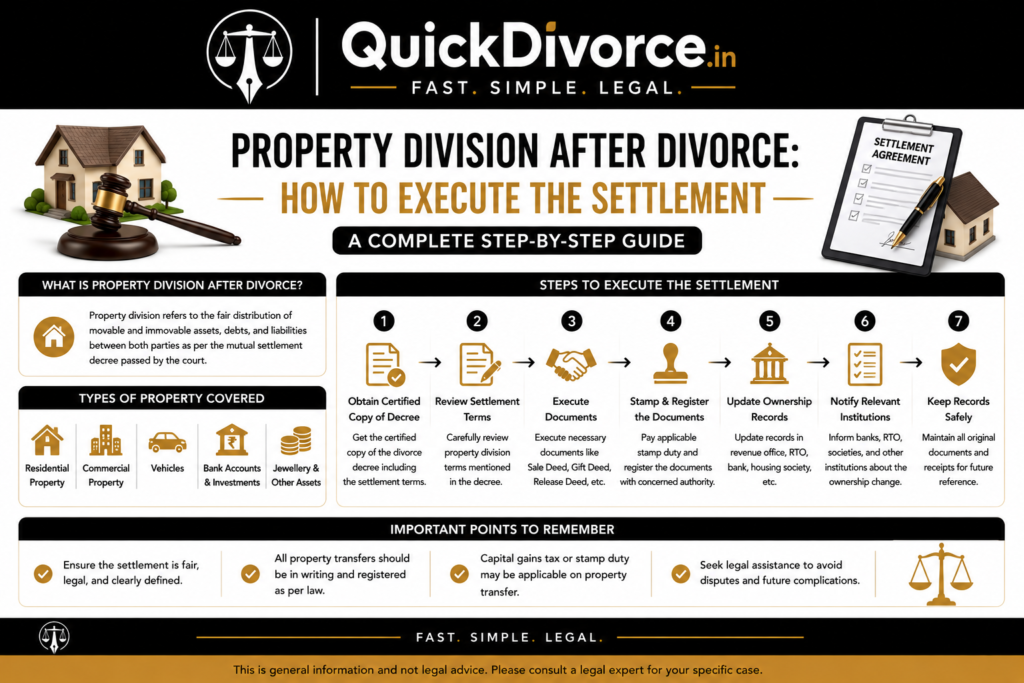
Step-by-Step Process to Execute Property Division After Divorce
- Identify and classify all assets — self-acquired, joint, ancestral, and stridhan — with supporting ownership documents.
- Gather proof of contribution — bank statements, loan documents, and payment records that establish who paid for what.
- Negotiate terms directly or through mediation — many Family Courts actively encourage court-annexed mediation before proceeding to trial.
- Draft a written Settlement Agreement — clearly specifying which spouse retains, sells, or transfers each asset, and the timeline for doing so.
- Get the agreement converted into a Consent Decree, where the divorce itself is being finalised through the court, to give it the force of a judicial order.
- Execute the relevant deed — sale deed, transfer deed, or partition deed — and get it registered with the Sub-Registrar’s office where legally required.
- Update revenue and municipal records through mutation, so the new ownership is officially reflected.
- Settle any outstanding loans or liabilities tied to the property before or simultaneously with the transfer, to avoid future complications for either party.
Following this sequence carefully is what actually converts a paper agreement into a legally secure, real-world transfer of ownership.
Tax and Stamp Duty Implications
Many couples overlook the financial side effects of executing their settlement, which can be just as significant as the division itself.
- Income Tax: Assets transferred between spouses as part of a divorce settlement are generally treated as a tax-free receipt at the time of transfer. However, any future income or capital gains generated from that asset will be taxable in the hands of the spouse who now owns it.
- Stamp Duty: Rates vary by state and depend on whether the transfer is structured as a court-ordered settlement, a family settlement deed, or a standard conveyance. Some states offer concessional stamp duty rates for transfers between spouses or for transfers executed under a court decree.
- Capital Gains: If the recipient spouse later sells the asset, capital gains tax will apply based on the original acquisition cost and holding period, not the value at the time of the divorce transfer.
Consulting a tax professional alongside your family lawyer before finalising the settlement can prevent unpleasant surprises down the line.
Common Challenges Couples Face
Even after reaching an agreement, several practical issues can complicate execution:
- Disputed valuations — disagreements over the current market value of a property can stall settlements for months, particularly for unique assets like ancestral land or family businesses where comparable sales data is hard to find.
- Title disputes — when a property is held benami (in one spouse’s name but financed by the other), establishing the true contribution requires documentary proof and can be legally complex.
- Delayed compliance — one spouse agreeing to a settlement but delaying the actual transfer, registration, or payment is a frequent source of post-divorce litigation, often requiring a separate execution petition to enforce.
- Outstanding loans — jointly held mortgages or loans complicate the transfer process if not resolved as part of the settlement, since lenders typically require their consent before any change in ownership of mortgaged property.
- Emotional resistance — especially where the family home is involved, emotional attachment can make even a legally sound settlement difficult to execute smoothly, sometimes requiring a cooling-off period built into the agreement itself.
- Third-party interests — where parents or other family members have also contributed to a property, or where it forms part of a larger joint family holding, additional parties may need to be involved in the settlement to make it fully valid.
A well-drafted settlement agreement that anticipates these issues in advance is the best safeguard against a Property Division After Divorce settlement falling apart after the fact.
How we Can Help in cases of Property Division After Divorce
Negotiating who gets what is only half the job — actually executing that agreement so it holds up legally is where many couples get stuck. At QuickDivorce.in, our family law team helps clients classify their assets correctly, negotiate fair settlement terms, draft enforceable agreements, and complete every step of execution — from consent decrees to registered deeds and mutation filings — so your Property Division After Divorce doesn’t just exist on paper, but is fully and legally complete in practice.
Frequently Asked Questions (FAQs)
1. What is Property Division After Divorce?
Property Division After Divorce is the legal process of distributing assets, property, and financial interests between spouses after the dissolution of marriage. The settlement may be based on mutual agreement or a court order, depending on the circumstances of the case.
2. How is Property Division After Divorce decided in India?
Property Division After Divorce is determined based on the applicable personal laws, ownership of assets, financial contributions, and the terms agreed upon by the spouses or directed by the court. Each case is decided on its own facts and legal provisions.
3. What documents are required for Property Division After Divorce?
To complete Property Division After Divorce, parties may need property ownership documents, sale deeds, bank statements, loan records, valuation reports, settlement agreements, tax documents, and any court orders related to the divorce.
4. Can Property Division After Divorce be completed without going to court?
Yes. Property Division After Divorce can often be completed through a mutually agreed settlement between the spouses. Once the settlement is properly documented and legally executed, court intervention may be limited, depending on the circumstances.
5. What happens if one spouse refuses to follow the Property Division After Divorce settlement?
If a spouse fails to comply with the Property Division After Divorce settlement or court order, the other party may seek legal remedies through the appropriate court to enforce the terms of the settlement.
6. How can a lawyer help with Property Division After Divorce?
A family lawyer can assist with Property Division After Divorce by drafting settlement agreements, verifying ownership documents, negotiating fair terms, ensuring legal compliance, and representing clients during negotiations or court proceedings to protect their legal interests.
Conclusion
Property Division After Divorce in India is rarely as simple as a 50-50 split — it is shaped by ownership documents, financial and non-financial contributions, and judicial discretion, all layered on top of an already emotionally difficult process. But understanding the legal framework, classifying your assets correctly, and following the right execution steps — from settlement agreements to registered deeds and mutation — can turn an uncertain negotiation into a secure, enforceable outcome.
If you’re approaching this stage of your separation, don’t just focus on reaching an agreement — focus equally on executing it properly, so your settlement is not just fair on paper, but final in practice.
For end-to-end legal support with negotiating and executing your property settlement, connect with the family law experts at QuickDivorce.in.
Want to know more about Cases of Property Division After Divorce
🟡QuickDivorce offers trusted online legal services across India, including mutual divorce, contested divorce, child custody, alimony, marriage registration, and expert family law consultation.
👉 Mutual Consent Divorce
👉 Contested Divorce Filing
👉 Child Custody and Maintenance
👉 Matrimonial Property Settlement
👉 NRI Divorce Services
👉 Alimony and Maintenance
🟡 Protect Your Rights
👉 Domestic Violence Legal Support
👉 Stridhan Recovery
🟡For other Legal and Trademark related services visit
👉 Money Recovery Cases
👉 Property Disputes
👉 Business & Licence Registrations
📞 Call Now: +91 8595439395
🕐 Free Consultation: Monday to Saturday, 10 AM to 6 PM

Adv. Manish Kashyap is a Family Law & Divorce Lawyer with extensive experience in Mutual & Contested Divorce, NRI Divorce, Child Custody, Alimony, Domestic Violence, Judicial Separation, and Family Court matters, providing professional legal guidance to clients.

