

Views: 2
Get expert online consultation for domestic violence cases in India. Learn about legal rights, protection orders, documents, court process, and FAQs.
Table of Contents
- 1 Introduction
- 2 Understanding Domestic Violence Under Indian Law
- 3 Why Online Consultation Matters So Much in Domestic Violence Cases
- 4 How Online Consultation for Domestic Violence Cases Works
- 5 Combining Domestic Violence Proceedings with Divorce or Separation
- 6 Advantages of Online Consultation Specifically for Domestic Violence Victims
- 7 Common Concerns Victims Have — and How They’re Addressed
- 8 What to Prepare Before Your First Online Consultation
- 9 A Note on Immediate Safety
- 10 Choosing the Right Legal Service for Online Domestic Violence Consultation
- 11 Final Thoughts
- 12 Get Expert Guidance For Legal Services
Introduction
Domestic violence is one of the most sensitive and urgent legal issues a person can face, and reaching out for help is often the hardest first step. For many victims, the idea of walking into a lawyer’s office, sitting in a waiting room, and narrating painful personal experiences face-to-face feels intimidating, and in some cases, simply unsafe. This is exactly why online consultation has become such an important development in how domestic violence cases are handled in India today.
Whether the victim is still living with the abuser, has recently moved out, is staying with family, or is even located in another city or country, online legal consultation offers a safer, more private, and more accessible starting point. This article explains in detail how online consultation for domestic violence cases works in India, what legal protections are available, and how the process unfolds from the very first conversation to the final resolution.
Understanding Domestic Violence Under Indian Law
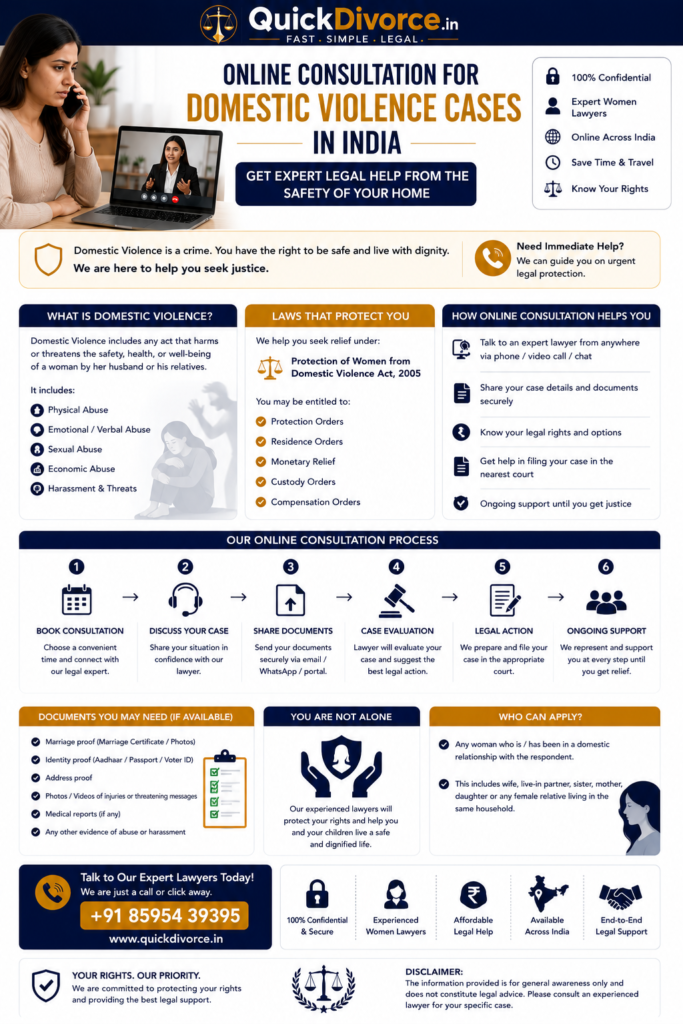
Before discussing the consultation process, it helps to understand the legal framework that governs domestic violence cases in India. The primary law is the Protection of Women from Domestic Violence Act, 2005 (PWDVA), which is a civil law designed specifically to provide protection, relief, and remedies to victims of domestic violence.
Under this Act, domestic violence is not limited to physical abuse. It also includes:
- Physical abuse — hitting, slapping, or any act causing bodily harm
- Emotional and verbal abuse — insults, ridicule, humiliation, or name-calling
- Economic abuse — denying financial resources, controlling income, or disposing of assets without consent
- Sexual abuse — any form of non-consensual sexual conduct within the relationship
Importantly, the law is not limited to wives filing against husbands. It extends to any woman in a “domestic relationship,” which includes relationships by marriage, live-in relationships, and relationships with in-laws or other family members sharing a household.
In addition to the civil remedies under the PWDVA, victims may also file a criminal complaint under relevant provisions of the Bharatiya Nyaya Sanhita (which replaced the Indian Penal Code) dealing with cruelty by husband or relatives, particularly in cases involving dowry harassment or severe physical abuse.
Because both civil and criminal remedies may be relevant depending on the situation, the first consultation with a lawyer is critical in determining the right combination of legal steps.
Why Online Consultation Matters So Much in Domestic Violence Cases
Domestic violence cases carry unique sensitivities that make online consultation particularly valuable, sometimes even more important than in other legal matters:
1. Safety Concerns If a victim is still living with the abuser, visiting a lawyer’s office in person may not be possible without raising suspicion or risking confrontation. A private video call or phone consultation, conducted discreetly, removes this risk.
2. Emotional Comfort Recounting incidents of abuse is emotionally difficult. Many victims find it easier to speak from a familiar, safe space — their own room, a friend’s house, or even their car — rather than an unfamiliar office setting.
3. Immediate Access to Legal Guidance In situations that feel urgent, waiting days for an in-person appointment can feel unbearable. Online consultation allows a victim to speak with a lawyer within hours, sometimes even the same day.
4. Geographic Flexibility Victims who have moved to a different city, gone to stay with parents, or relocated abroad temporarily can still consult a lawyer familiar with the specific jurisdiction relevant to their case.
5. Anonymity in the Early Stages Before deciding whether to take formal legal action, many victims simply want to understand their options. Online consultation allows this exploration without committing to anything or revealing their situation to anyone in their immediate physical surroundings.
How Online Consultation for Domestic Violence Cases Works
Step 1: Reaching Out Safely and Confidentially
The process usually begins with a discreet first contact — through a website inquiry form, a WhatsApp message, or an email — rather than a public phone call that might be overheard. Reputable legal service providers understand this sensitivity and often offer:
- Encrypted or password-protected contact forms
- Options to request a callback at a specific “safe” time
- Confirmation that all conversations will remain strictly confidential
This first step is designed to feel low-pressure, allowing the victim to simply ask questions without any obligation to proceed further.
Step 2: Scheduling a Private Video or Phone Consultation
Once initial contact is made, a consultation is scheduled at a time and through a mode (video call, voice call, or even text-based chat) that feels safest for the victim. Lawyers experienced in domestic violence cases are trained to:
- Conduct the conversation with sensitivity, without pressuring the victim to share more than they are comfortable with
- Allow the victim to lead the narrative at their own pace
- Explain, in simple language, what legal protections exist and what the process would involve
Step 3: Assessing the Situation and Immediate Safety
During the consultation, the lawyer will typically assess:
- Whether there is an immediate risk to the victim’s safety or the safety of any children involved
- Whether emergency protective measures are needed, such as a protection order
- The nature and history of the abuse — physical, emotional, sexual, or economic
- Whether the victim wishes to continue living in the shared household or needs alternative accommodation
- Financial dependence on the abuser and immediate monetary needs
If the situation indicates urgent danger, the lawyer will typically guide the victim toward immediate safety steps, including contacting local police, a women’s helpline, or a nearby shelter, before proceeding with longer-term legal strategy.
Step 4: Explaining Available Legal Remedies
Based on the assessment, the lawyer explains which remedies are appropriate. These commonly include:
Protection Orders A court order restraining the abuser from committing further acts of violence, contacting the victim, or entering specific premises.
Residence Orders An order allowing the victim to continue residing in the shared household, or in some cases, directing the abuser to arrange alternative accommodation.
Monetary Relief Compensation for expenses and losses suffered due to domestic violence, including medical costs, loss of earnings, and property damage.
Custody Orders Temporary custody arrangements for children, if applicable, to ensure their safety and stability during proceedings.
Compensation Orders Additional compensation for the mental and emotional distress caused by the abuse.
Criminal Complaint In cases involving serious physical harm, dowry-related harassment, or cruelty, the lawyer may also advise filing a criminal complaint alongside the civil remedies under the PWDVA.
The lawyer will typically outline which combination of these remedies is realistic and appropriate, based on the specific facts shared during the consultation.
Step 5: Document Collection Through Secure Channels
If the victim decides to proceed, the lawyer will request supporting evidence and documents, which can usually be shared digitally through secure, password-protected channels. This may include:
- Medical reports or photographs of injuries, if any
- Messages, emails, or call records showing abusive behavior
- Witness contact details, such as neighbors, family members, or friends aware of the situation
- Financial documents, if economic abuse or maintenance is involved
- Marriage certificate and any prior legal correspondence
Victims are often understandably anxious about safely gathering and storing this evidence, especially if they are still living with the abuser. Lawyers frequently advise practical, safe methods for backing up evidence, such as saving copies to a trusted family member’s device or a personal cloud account not accessible to the abuser.
Step 6: Drafting the Complaint or Application
The lawyer, or in many cases a Protection Officer appointed under the PWDVA, helps draft the Domestic Incident Report (DIR), which forms the basis of the application filed before the Magistrate. This document outlines:
- The relationship between the parties
- A detailed account of incidents of abuse
- The specific relief being sought
The involvement of a Protection Officer is an important feature of the PWDVA framework — these officers act as a bridge between the victim and the court system, and a lawyer can guide the victim on how to access and coordinate with a Protection Officer in their district, even remotely in the initial stages.
Step 7: Filing the Application and Initial Hearing
Once the application is ready, it is filed before the Magistrate having jurisdiction — generally the court where the victim resides, where the domestic relationship existed, or where the cause of action arose. This flexibility in jurisdiction under the PWDVA is specifically designed to make it easier for victims to access courts near their current, safer location, rather than being forced back to a location associated with the abuse.
While the filing itself is typically handled by the lawyer or Protection Officer, courts may require the victim’s presence for certain hearings. However, many courts have increasingly allowed video-conferencing for at least some stages, particularly where the victim’s safety could be compromised by physical presence.
Step 8: Ongoing Case Support and Communication
Throughout the case, online consultation continues to play a role through:
- Regular update calls or messages after each hearing
- Guidance on responding to counter-allegations, if any
- Coordination with counselors or support services, if the victim needs additional emotional support
- Advice on interim compliance, such as ensuring the abuser adheres to a protection order
Combining Domestic Violence Proceedings with Divorce or Separation
In many cases, a domestic violence complaint is filed alongside, or shortly before, divorce proceedings. Online consultation allows a lawyer to address both matters together in a coordinated strategy, since:
- Evidence of domestic violence often strengthens grounds for divorce on the basis of cruelty
- Protection and residence orders can directly affect negotiations around alimony, child custody, and property division
- Filing both matters with a clear understanding of how they interact prevents contradictions or delays between the two proceedings
A lawyer experienced in both family law and domestic violence law can walk the client through this combined strategy during the very first set of consultations, saving significant time and confusion later.
Advantages of Online Consultation Specifically for Domestic Violence Victims
1. Reduced Risk of Retaliation Since there is no need to visibly step out to visit a lawyer’s office, the risk of the abuser noticing and reacting negatively is significantly reduced.
2. Faster Access to Emergency Guidance When time is critical, a same-day or next-day video consultation can be the difference between continued risk and timely protective action.
3. Comfort of a Familiar Environment Speaking from a space where the victim feels safe often results in a more complete and accurate account of events, which strengthens the eventual legal case.
4. Easier Continuity of Support If the victim needs to relocate during the case — to a parent’s home, a shelter, or another city — online consultation ensures the legal relationship with the lawyer continues without disruption.
5. Support for NRI and Relocated Victims Women who have moved abroad after marriage, or who return to India to escape an abusive relationship, can consult Indian lawyers online to understand their rights without needing to be physically present in a specific city first.
Common Concerns Victims Have — and How They’re Addressed
“Will speaking online be taken as seriously as an in-person meeting?” Yes. Lawyers handling domestic violence cases are trained to conduct thorough consultations remotely, and the legal weight of the advice, drafting, and eventual court filing is exactly the same regardless of whether the initial conversation happened online or in person.
“What if my partner finds messages or call records with the lawyer?” This is a valid and common concern. Lawyers experienced in these cases often advise on safe communication practices, such as using a separate email address, a trusted friend’s phone, or scheduling calls at specific safe times, to minimize this risk.
“Can I get a protection order without my abuser knowing I’ve consulted a lawyer?” The initial consultation and even the filing of an application can often be managed with discretion. However, once the application reaches the court and notice is issued to the other party, they will eventually become aware of the proceedings, as due process requires them to be given an opportunity to respond.
“What if I’m not ready to file a case yet, but just want to understand my options?” Most lawyers are comfortable providing an initial, no-obligation consultation purely to explain rights and options, without any pressure to file immediately. This is often an important first step for victims still deciding on their next move.
“Is online consultation confidential?” Reputable law firms treat all consultations, whether online or offline, as strictly confidential, protected by lawyer-client privilege. It’s reasonable to directly ask a firm about their specific confidentiality practices before sharing details.
What to Prepare Before Your First Online Consultation
If you are considering reaching out for an online consultation regarding a domestic violence situation, it can help to have the following ready, though it is not mandatory:
- A rough timeline of significant incidents, even if only in your own words
- Any photographs, messages, or documents you have already managed to safely save
- Details of your current living situation and any immediate safety concerns
- A list of questions about your specific legal options
- Information about children involved, if applicable, including their current safety and living arrangements
However, it is important to remember that not having all of this ready should never be a reason to delay reaching out. A good lawyer will help you gather and organize this information over time.
A Note on Immediate Safety
While online consultation is an excellent starting point for understanding legal remedies, it is not a substitute for emergency assistance in situations of immediate danger. If you or someone you know is in immediate physical danger, contacting local police, a women’s helpline, or a nearby shelter should take priority over scheduling a legal consultation. Legal remedies under the PWDVA and other laws are designed to work alongside, not instead of, these emergency protective steps.
Choosing the Right Legal Service for Online Domestic Violence Consultation
When looking for a law firm or legal service offering online consultation for domestic violence cases, it helps to look for:
- Specific experience handling cases under the Protection of Women from Domestic Violence Act, in addition to general family law
- A clear, upfront explanation of confidentiality practices
- Flexibility in scheduling, including options outside standard business hours
- Willingness to coordinate with Protection Officers, counselors, or shelters where needed
- A calm, non-judgmental approach during the very first conversation, rather than rushing toward filing a case immediately
- Transparent communication about realistic timelines and the practical steps involved, rather than overly simplified promises
Final Thoughts
No one should have to face domestic violence alone, and no one should feel that seeking legal help is out of reach simply because in-person visits feel unsafe or impractical. Online consultation has made it significantly easier for victims across India, and even those temporarily abroad, to take that first difficult step of reaching out, understanding their rights, and beginning the path toward safety and legal protection.
If you are dealing with domestic violence, or supporting someone who is, know that a confidential, judgment-free conversation with an experienced lawyer is often just a video call away. That first conversation, even if it doesn’t lead to immediate legal action, can provide clarity, support, and a clearer sense of the options available.
Get Expert Guidance For Legal Services
🟡QuickDivorce offers trusted online legal services across India, including mutual divorce, contested divorce, child custody, alimony, marriage registration, and expert family law consultation.
👉 Mutual Consent Divorce
👉 Contested Divorce Filing
👉 Child Custody and Maintenance
👉 Matrimonial Property Settlement
👉 NRI Divorce Services
👉 Alimony and Maintenance
👉 Court Marraige
👉 Stridhan Recovery
🟡For other Legal and Trademark related services visit
👉 Money Recovery Cases
👉 Property Disputes
👉 Business & Licence Registrations
📞 Call Now: +91 8595439395
🕐 Free Consultation: Monday to Saturday, 10 AM to 6 PM

Adv. Manish Kashyap is a Family Law & Divorce Lawyer with extensive experience in Mutual & Contested Divorce, NRI Divorce, Child Custody, Alimony, Domestic Violence, Judicial Separation, and Family Court matters, providing professional legal guidance to clients.

