

Views: 10
Table of Contents
- 1 Quick Summary
- 2 📌 What Is NRI Marriage Registration in India?
- 3 ⚠️ Why NRI Marriage Registration Is Legally Critical
- 4 📜 Which Law Governs NRI Marriage Registration in India?
- 5 🌍 Types of NRI Marriage Situations
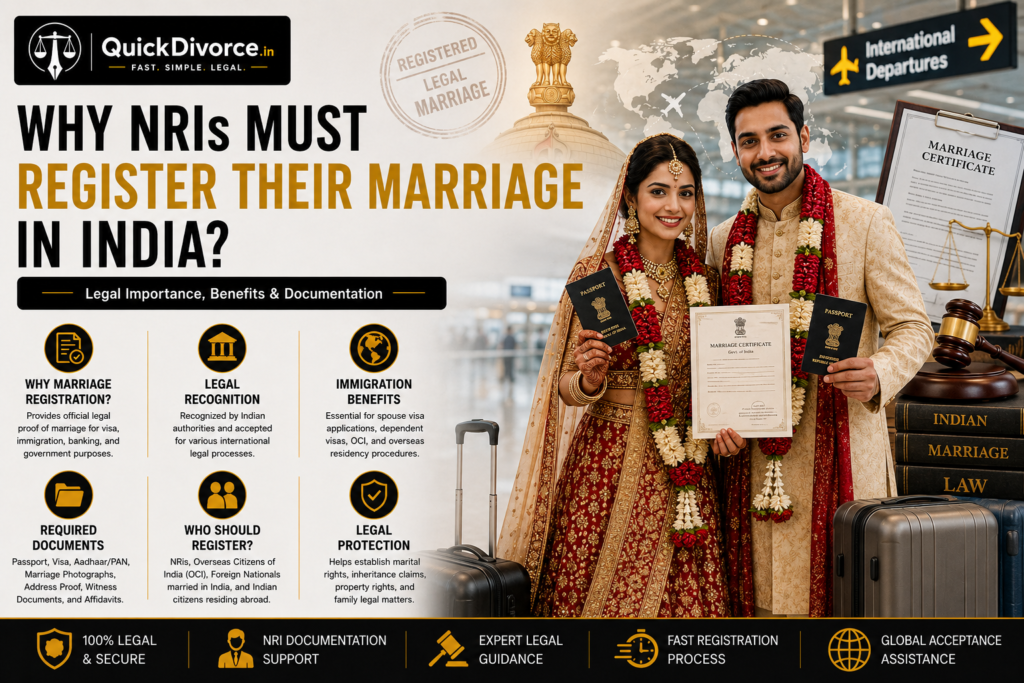
- 6 🏆 10 Reasons Why NRIs Must Register Their Marriage in India
- 7 🚫 Consequences of Not Registering NRI Marriage in India
- 8 📋 How to Register NRI Marriage in India — Step by Step
- 9 📄 Documents Required for NRI Marriage Registration
- 10 🏛️ Registration of Marriage Solemnized Abroad
- 11 🌏 NRI Marriage Registration at Indian Embassy or Consulate
- 12 🪪 The OCI Card and NRI Marriage Registration
- 13 🏠 NRI Marriage Registration and Property Rights in India
- 14 💰 NRI Marriage Registration and Inheritance Rights
- 15 💔 NRI Marriage Registration and Divorce
- 16 🗺️ State Wise NRI Marriage Registration Requirements
- 17 🚫 Common Mistakes in NRI Marriage Registration
- 18 🌟 How Quick Divorce Helps with NRI Marriage Registration
- 19 💰 Cost Breakdown: NRI Marriage Registration in India
- 20 ❓ Frequently Asked Questions (FAQs)
- 21 🎯 Who Needs This Guide Right Now?
- 22 ✅ Final Recommendation
- 23 Need Consutation
Quick Summary
NRI marriage registration in India is not just a bureaucratic formality — it is a legal necessity that protects your rights to property, inheritance, maintenance, custody and all matrimonial entitlements under Indian law.
Here is what every NRI couple must know:
- 🌍 Indian law applies — Indian personal laws apply to Indian nationals regardless of where they marry or live
- 📋 Registration is essential — An unregistered NRI marriage creates serious legal vulnerabilities in India
- 🏠 Property rights — Without registered marriage proof, claiming rights in Indian property is enormously difficult
- 💰 Inheritance — Unregistered marriage makes inheritance and succession claims legally vulnerable
- 👶 Children’s rights — Legitimate status of children and their inheritance rights require proof of registered marriage
- ✅ Quick Divorce helps NRIs with complete marriage registration across India — Call 📞 8595439395
📌 What Is NRI Marriage Registration in India?
NRI marriage registration in India refers to the formal legal registration of a marriage involving one or both Non-Resident Indian parties — either with a government authority in India or at an Indian Embassy or Consulate abroad.
A Non-Resident Indian (NRI) is an Indian citizen who resides outside India for employment, business, education or any other purpose indicating an intention to stay outside India for an indefinite period.
Marriage registration for NRIs is important because:
- Indian personal laws continue to apply to Indian nationals regardless of where they live
- Significant assets — property, bank accounts, investments, family business interests — are frequently held in India
- Inheritance and succession under Indian law requires proof of family relationships including marriage
- India does not automatically recognise all foreign marriage registrations as sufficient proof of marriage for all legal purposes in India
- An officially registered marriage certificate is required for a wide range of legal and administrative processes involving Indian authorities
The registration can happen:
- In India — through the Sub-Registrar of Marriages under the Hindu Marriage Act or through the Marriage Officer under the Special Marriage Act
- At an Indian Embassy or Consulate abroad — for marriages solemnized outside India
- Through retrospective registration — for marriages solemnized long ago that were never formally registered
The fundamental principle: For any matter involving Indian law, Indian property, Indian courts or Indian government authorities — a marriage registered in India under an Indian law is the most reliable and accepted proof of marriage. NRIs who have not done this are legally vulnerable in India in a way they may not realise until a dispute arises.
⚠️ Why NRI Marriage Registration Is Legally Critical
Many NRI couples operate under the assumption that their marriage — properly registered in the country where they live — is sufficient for all purposes. This assumption is dangerously incorrect when it comes to matters governed by Indian law.
The Core Problem
India is a country with multiple personal laws — Hindu Marriage Act, Muslim Personal Law, Indian Christian Marriage Act, Special Marriage Act — each governing different aspects of marriage, divorce, maintenance and succession for different religious communities.
Indian authorities — from courts to government offices to banks to property registrars — are most comfortable and most legally certain when dealing with marriage documents issued under Indian law by Indian authorities. Foreign marriage certificates, while generally admissible as evidence, frequently raise questions about:
- Which Indian personal law applies to the marriage
- Whether the foreign marriage was valid under Indian law
- Whether the parties were eligible to marry under Indian law at the time
- Whether any formalities required by Indian law were complied with
None of these questions arise where the marriage is registered in India under Indian law.
📜 Which Law Governs NRI Marriage Registration in India?
For Hindu NRIs
Hindu Marriage Act 1955 — governs marriage and its registration for Hindus, Buddhists, Sikhs and Jains. Section 8 of the Act provides for registration of Hindu marriages. The marriage may have been solemnized through any customary Hindu ceremony — in India or abroad — and can be registered in India.
For Muslim NRIs
Muslim Personal Law (Shariat) Application Act 1937 — governs Muslim marriages. Muslim marriages are recorded through Nikah registers maintained by Qazis or mosque authorities. State-level regulations in some states provide for registration of Muslim marriages.
For Christian NRIs
Indian Christian Marriage Act 1872 — governs Christian marriages in India. Registration is provided for under the Act.
For Parsi NRIs
Parsi Marriage and Divorce Act 1936 — governs Parsi marriages. The Parsi Panchayat maintains marriage registers.
For Inter-Religion NRI Couples
Special Marriage Act 1954 — the appropriate law for inter-religion NRI couples. Provides for both solemnization and registration in India, as well as registration of marriages solemnized abroad.
Compulsory Registration — Some States
Several Indian states have enacted compulsory marriage registration legislation or rules. These include:
- Delhi — Compulsory registration for all marriages
- Maharashtra — Compulsory registration
- Karnataka — Compulsory registration
- Tamil Nadu — Compulsory registration
- Andhra Pradesh and Telangana — Compulsory registration
- Kerala — Compulsory registration
- Rajasthan — Compulsory registration
In these states — registration is not optional. It is legally mandated regardless of whether the couple is resident or NRI.
🌍 Types of NRI Marriage Situations
NRI marriage registration cases fall into several distinct categories — each with specific requirements:
Situation 1 — Both Parties Are NRIs, Married in India
Indian citizens who married in India through a religious ceremony and then both moved abroad. The marriage may have been solemnized but never formally registered with a government authority in India.
Most common issue: The Arya Samaj or pandit-performed wedding certificate exists but no government registration was done before the couple moved abroad.
Situation 2 — Both Parties Are NRIs, Married Abroad
Indian citizens who married in the country where they are resident — through a foreign civil or religious ceremony — and have a foreign marriage certificate.
Most common issue: The foreign marriage certificate exists but is not registered in India — creating vulnerability for all India-related legal matters.
Situation 3 — One Party Is NRI, One Is Indian Resident
An NRI married an Indian resident — either in India or abroad. The marriage may or may not have been registered in India.
Most common issue: Complex jurisdiction questions, different places of residence and frequent confusion about which registration is required.
Situation 4 — NRI Married a Foreign National
An Indian NRI married a foreign national outside India. The marriage is registered in the foreign country but has no Indian registration.
Most common issue: The Indian party’s rights in India — property, inheritance, succession — are affected by the marriage but the marriage has no direct Indian registration.
Situation 5 — Marriage Registered Abroad, Now Returning to India
An NRI couple is returning to India permanently or semi-permanently and needs their foreign marriage to be recognised for all Indian purposes.
Solution: Registration in India under the appropriate personal law — Quick Divorce assists with this process. Call 8595439395.
🏆 10 Reasons Why NRIs Must Register Their Marriage in India
Reason 1 — Property Rights in India
India is a country where real estate and property are primary assets for most families. Many NRIs own — or stand to inherit — significant property in India.
The problem without registration:
- Claiming ownership rights in property requires proof of relationship to the person in whose name property is held
- Adding a spouse’s name to property records requires proof of marriage
- Challenging or defending property claims in Indian courts requires proof of marriage
- Transfer of property on the basis of marriage — such as under a will or through inheritance — requires the marriage to be provable under Indian law
A foreign marriage certificate may be admitted as evidence in Indian courts — but it is subject to challenge, requires authentication and translation, and does not have the automatic recognition that an Indian registration certificate has.
Real scenario: An NRI’s husband dies. He owned a flat in Mumbai. His family disputes the wife’s claim. Without a registered marriage certificate under Indian law — the wife faces an uphill battle proving her entitlement before the Mumbai courts.
Reason 2 — Inheritance and Succession Rights
Under the Hindu Succession Act 1956 and the Indian Succession Act 1925 — a legally married spouse has specific inheritance rights. These rights depend on proof of the legal marriage.
Where the marriage is not registered in India — succession claims face serious evidentiary hurdles. The legal heirs who dispute the claim can challenge the proof of marriage — forcing expensive and time consuming litigation that a simple registration would have made unnecessary.
Reason 3 — Maintenance Claims Under Indian Law
Where an NRI marriage breaks down — the wife’s right to maintenance under Indian law (Section 125 CrPC, Section 24 and 25 Hindu Marriage Act, PWDVA 2005) depends on proof of the marriage.
An unregistered marriage makes maintenance claims more difficult to establish. The other party may challenge the validity of the foreign marriage registration as proof under Indian law.
Reason 4 — Children’s Legal Status and Rights
Children born of a marriage have rights — to inheritance, to nationality, to both parents’ support — that depend on the legal validity of the marriage.
Where the marriage is unregistered in India:
- Establishing the legitimate status of children in Indian legal proceedings is more difficult
- Children’s inheritance rights in India can be challenged
- Custody proceedings involving Indian courts require proof of the marriage
NRI marriage registration protects not just the couple but their children’s rights in India.
Reason 5 — Visa and Immigration Documentation
Indian visa authorities — and immigration authorities in many countries — require proof of marriage for spouse visas, dependent visas and family reunification applications.
An Indian government registered marriage certificate is the most universally accepted proof of marriage for Indian immigration purposes. A foreign certificate may be accepted but often requires additional authentication, translation and may still be questioned.
Reason 6 — Passport and OCI Card Applications
Passport name change: A spouse who wants to change their name in their Indian passport after marriage requires a registered marriage certificate.
OCI Card applications: The Overseas Citizen of India (OCI) card — India’s primary long term visa facility for foreign nationals of Indian origin and their spouses — requires proof of marriage for a spouse’s application. The marriage must be registered and the certificate submitted.
Reason 7 — Banking and Financial Accounts in India
Adding a spouse as nominee or joint holder in Indian bank accounts, mutual funds and other financial investments requires proof of marriage — which for NRIs is most cleanly provided through an Indian registered marriage certificate.
Without this — financial institutions may require additional documentation, authentication and verification that creates delays and complications.
Reason 8 — Protection in Case of NRI Husband Abandonment
One of the most serious problems affecting NRI marriages in India is abandonment — NRI husbands who marry Indian women, take them abroad, and then abandon them — either leaving them in India or sending them back.
An NRI wife who has been abandoned needs to pursue:
- Maintenance under Indian law
- Divorce under Indian law
- Return of stridhan
- Property claims
All of these proceedings are significantly more straightforward when the marriage is registered in India. An unregistered marriage gives the abandoning spouse ammunition to complicate and delay proceedings.
Quick Divorce specifically helps NRI wives in abandonment situations — many of whom are dealing with unregistered marriages. Call 8595439395.
Reason 9 — Protection Against Bigamy
An NRI who marries a second time without divorcing the first spouse commits bigamy under Section 494 IPC — a criminal offence.
However — where the first marriage is not registered in India — proving the first marriage for bigamy proceedings can be difficult.
Registration of the first marriage creates an official, searchable government record — making it harder for a bigamist spouse to deny the first marriage.
Reason 10 — Mutual Recognition in Indian Courts
Indian courts dealing with matrimonial disputes — maintenance, divorce, custody, property — give the highest evidentiary weight to marriage certificates registered under Indian law.
Foreign marriage certificates are admissible but:
- Must be authenticated (typically Apostilled or through MEA)
- Must be translated if not in English
- Can be challenged by the opposing party
- May require expert testimony on foreign law
- Are subject to the court’s assessment of their validity under Indian law
An Indian registered marriage certificate avoids all of these complications and is accepted at face value.
🚫 Consequences of Not Registering NRI Marriage in India
The consequences of failing to register an NRI marriage in India range from inconvenient to potentially catastrophic:
Legal Consequences
Property disputes: Inability to straightforwardly establish rights in Indian property — leading to expensive litigation.
Inheritance challenges: Family members of the deceased spouse can challenge the unregistered spouse’s inheritance claims — citing insufficient proof of marriage.
Maintenance difficulties: Obtaining interim maintenance orders from Indian courts requires proof of marriage — an unregistered marriage makes this harder and slower.
Custody complications: International custody disputes involving Indian courts are more complex without Indian registered marriage documentation.
Administrative Consequences
Passport difficulties: Name change in Indian passport after marriage requires registered certificate.
OCI card delays: OCI card applications for foreign national spouses face additional scrutiny and delay without Indian registration.
Banking complications: Adding spouse to Indian financial accounts requires registered marriage certificate.
Property registration problems: Registering property jointly or in a spouse’s name requires proof of marriage acceptable to the Sub-Registrar.
Personal Consequences
Vulnerability in case of abandonment: An unregistered marriage leaves an abandoned NRI wife in a significantly weaker legal position.
Difficulty in divorce proceedings: Where divorce becomes necessary — an unregistered marriage creates additional procedural hurdles.
Children’s rights at risk: The children’s legitimate status and inheritance rights in India are more easily challenged.
📋 How to Register NRI Marriage in India — Step by Step
Path A — Marriage Solemnized in India, Not Yet Registered
Step 1 — Determine applicable personal law Identify which personal law applies — Hindu Marriage Act, Special Marriage Act, Indian Christian Marriage Act etc. — based on the religion of the parties.
Step 2 — Gather documentation Collect all required documents — identity proof, age proof, address proof, proof of the marriage ceremony (photos, invitation card, religious certificate, witness statements).
Step 3 — File registration application File the registration application with the Sub-Registrar of Marriages (for Hindu Marriage Act) or Marriage Officer (for Special Marriage Act) in the district where:
- The marriage was solemnized, or
- Either party last resided in India
Step 4 — Personal appearance Both parties must appear in person before the Registrar — or one party can appear with a Power of Attorney where the other is abroad. Quick Divorce assists with Power of Attorney arrangements.
Step 5 — Certificate issued After verification — the marriage is entered in the Marriage Register and a certificate is issued.
Path B — Marriage Solemnized Abroad, Registering in India
Step 1 — Determine applicable law For Indian nationals married abroad — the Special Marriage Act 1954 Part V (Section 17) provides for registration of marriages solemnized abroad.
Step 2 — File application Apply to the Marriage Officer in India — in the district where either party’s parents reside or where either party last resided in India.
Step 3 — Submit documents Submit the foreign marriage certificate (with Apostille authentication and translation if not in English), identity documents and other required documentation.
Step 4 — Verification and registration The Marriage Officer verifies the documents and registers the marriage — issuing an Indian marriage certificate.
Path C — Registration at Indian Embassy or Consulate Abroad
Step 1 — Contact nearest Indian Embassy or Consulate Indian Embassies and High Commissions in most countries have a consular section that handles marriage registration for Indian nationals abroad.
Step 2 — Prepare documents Prepare all required documents — identity proofs, foreign marriage certificate with authentication, photographs.
Step 3 — Submit application Submit the application to the Embassy’s consular section. Requirements vary by country and Embassy — confirm with the specific Embassy.
Step 4 — Certificate issued The Embassy issues a marriage registration certificate which is sent to the relevant Indian authority for formal recording.
📄 Documents Required for NRI Marriage Registration
Core Documents (Required in All Cases)
- 🪪 Passport of both parties — Indian passport is the primary identity and age proof for NRIs
- 🛂 Valid visa — evidence of current immigration status if outside India
- 🏠 Address proof in India — last known Indian address of either party
- 📸 Passport size photographs — typically 4 to 6 of each party
- 📋 Proof of marriage ceremony — religious certificate, wedding photographs, invitation card, witness statements
Additional Documents Based on Marriage Type
For Hindu marriages solemnized in India:
- Proof of Hindu religion — typically evident from name and documents
- Pandit certificate or Arya Samaj certificate if applicable
- Wedding photographs showing ceremony
For marriages solemnized abroad:
- 📜 Foreign marriage certificate — original and certified copy
- 🔏 Apostille authentication of foreign certificate — from the foreign country’s Apostille authority
- 📝 Translation of foreign certificate — certified English translation if not in English
- 📋 Proof of both parties’ Indian citizenship or PIO status
If Previously Married:
- ⚖️ Divorce decree — certified copy
- 📜 Death certificate (if widowed)
For Foreign National Spouse:
- 🛂 Foreign passport
- 📋 No Objection Certificate from their country’s Embassy in India
- 🌍 Proof of their immigration status in India
🏛️ Registration of Marriage Solemnized Abroad
Where an NRI couple married in a foreign country — Section 17 of the Special Marriage Act 1954 provides a specific mechanism for registering that marriage in India.
What Section 17 Provides
Section 17 of the Special Marriage Act states that marriages between Indian nationals solemnized outside India may be registered under the Act — by the Marriage Officer in India or at an Indian Embassy abroad.
The Registration Process Under Section 17
Option 1 — Registration in India:
The couple — or one party with Power of Attorney for the other — applies to the Marriage Officer in India. The foreign marriage certificate (authenticated and translated) is submitted along with the application.
The Marriage Officer examines the documents and registers the marriage if satisfied — issuing an Indian marriage certificate under the Special Marriage Act.
Option 2 — Registration at Indian Embassy:
The couple applies at the Indian Embassy in their country of residence. The Embassy’s consular section processes the registration and forwards the record to India.
Authentication of Foreign Marriage Certificate
Before a foreign marriage certificate can be used for registration in India — it must typically be:
- Apostilled — if the foreign country is a signatory to the Hague Apostille Convention (which most countries are)
- Legalized through Embassy — if the foreign country is not an Apostille signatory
- Translated — if the certificate is not in English, a certified English translation is required
Quick Divorce assists with authentication and translation requirements for foreign marriage certificates.
🌏 NRI Marriage Registration at Indian Embassy or Consulate
How Embassy Registration Works
Indian Embassies and High Commissions are empowered under the Consular, Passport and Visa Division of the Ministry of External Affairs to provide consular services — including marriage registration for Indian nationals abroad.
Procedure at Indian Embassy
Step 1: Contact the consular section of the nearest Indian Embassy or High Commission in your country of residence.
Step 2: Inquire about the specific requirements for marriage registration — requirements can vary between different Embassies.
Step 3: Submit the application form along with required documents — typically including both parties’ passports, foreign marriage certificate, photographs and application fee.
Step 4: The Embassy processes the application and issues a Marriage Registration Certificate — which is also forwarded to the relevant civil registration authority in India.
Limitations of Embassy Registration
Embassy registration creates a consular record of the marriage — but does not automatically create a registration under the Hindu Marriage Act or Special Marriage Act in India. For matters governed by Indian personal law — a formal registration under the applicable Indian law may additionally be required.
Quick Divorce advises NRI couples on whether Embassy registration alone is sufficient for their specific purposes — or whether additional Indian registration is needed.
🪪 The OCI Card and NRI Marriage Registration
The Overseas Citizen of India (OCI) card is India’s long term multiple entry visa facility — available to foreign nationals of Indian origin and spouses of Indian citizens or OCI holders.
OCI Card for Foreign National Spouse
Where an Indian NRI has married a foreign national — the foreign national spouse can apply for an OCI card. The application requires:
- Proof of the Indian spouse’s Indian citizenship
- Proof of marriage — a registered marriage certificate
The OCI card application specifically requires a marriage certificate that is:
- Issued by a competent authority
- Registered under the applicable law
- Clear and authentic
A foreign marriage certificate that has not been registered in India may be accepted — but submissions have faced rejection or additional scrutiny where the Indian registration is not present.
Quick Divorce assists NRI couples with OCI card documentation — ensuring the marriage is properly registered to support the OCI application. Call 8595439395.
🏠 NRI Marriage Registration and Property Rights in India
Property is one of the most significant reasons why NRI marriage registration in India is essential.
Adding Spouse to Property Records
Where an NRI wants to:
- Add their spouse’s name to the title deed of property in India
- Transfer property to their spouse
- Register a jointly purchased property in both names
The Sub-Registrar requires proof of marriage. A government registered marriage certificate under Indian law is the cleanest and most readily accepted proof.
Claiming Property Rights After Spouse’s Death
Where an NRI’s spouse dies owning property in India — the surviving spouse needs to establish their entitlement to the property through succession. This requires:
- Proof of marriage
- Succession certificate or probate of will (where applicable)
- Mutation of property records in the survivor’s name
Each of these steps is significantly smoother with an Indian registered marriage certificate.
Property Rights Under FEMA
The Foreign Exchange Management Act (FEMA) governs the acquisition and transfer of property in India by NRIs and foreign nationals. The property rights of a foreign national spouse depend on their immigration status (NRI, OCI, foreign national) and their marital relationship with the Indian spouse.
Establishing the marital relationship for FEMA purposes requires a registered marriage certificate.
💰 NRI Marriage Registration and Inheritance Rights
Hindu Succession Act 1956
Under the Hindu Succession Act — a legally married Hindu wife is a Class I heir of her husband. She inherits equally with children and the deceased’s mother.
Without registered marriage: The wife’s status as Class I heir can be challenged by other family members — particularly in high value estates. A registered marriage certificate under the Hindu Marriage Act is the strongest evidence of her entitlement.
Indian Succession Act 1925
Governs succession for Christians, Parsis and in some cases for those who married under the Special Marriage Act. A legally married spouse has specific inheritance rights.
Without registered marriage: Same vulnerability — inheritance claims can be challenged on the basis of insufficient proof of marriage.
Nomination in Indian Financial Assets
Where an NRI holds Indian bank accounts, mutual funds, insurance policies or other financial assets — they can nominate their spouse as beneficiary. Nomination does not replace legal succession but facilitates transfer.
Most Indian financial institutions accept nomination from a spouse based on:
- Registered marriage certificate, or
- Other proof of marriage — but registered certificate is the most readily accepted
💔 NRI Marriage Registration and Divorce
The connection between NRI marriage registration and divorce is significant in both directions.
Divorce Is Easier with Indian Registration
Where an NRI marriage is registered in India — filing for divorce in India is procedurally straightforward. The registered marriage certificate establishes the marriage clearly and the divorce petition can proceed directly.
Where the marriage is not registered in India — the divorce petition must first establish the validity of the marriage — often requiring authentication of foreign documents, expert evidence on foreign law and additional procedural steps that delay and complicate proceedings.
Which Law Governs Divorce
The personal law applicable to the divorce depends on:
- The religion of the parties
- Whether the marriage was registered under a specific Indian personal law
An unregistered foreign marriage creates uncertainty about which law governs the divorce — which is used by the other party to complicate and delay proceedings.
NRI Husband Abandonment Cases
One of the most common and most tragic NRI marriage problems is abandonment — where an NRI husband marries an Indian woman and then abandons her. In these cases:
- The wife needs to file for maintenance, divorce and stridhan recovery in India
- All of these proceedings require proof of the marriage
- An unregistered marriage significantly weakens the wife’s position
Quick Divorce specifically assists abandoned NRI wives — helping them establish their marriage legally and pursue all available remedies. Call 8595439395.
🗺️ State Wise NRI Marriage Registration Requirements
While the core legal framework is national — some states have specific additional requirements:
Delhi
Compulsory marriage registration for all marriages under the Delhi Compulsory Registration of Marriages Order 2014. Both parties must appear before the Sub-Registrar. NRIs can appear through Power of Attorney.
Maharashtra
Compulsory registration under Maharashtra Regulation of Marriage Bureau and Registration of Marriages Act 1998. Both parties or their Power of Attorney holders must appear.
Karnataka
Compulsory registration under the Karnataka Marriages (Registration and Miscellaneous Provisions) Act 1976.
Tamil Nadu
Registration under the Tamil Nadu Registration of Marriages Act 2009 — applicable to all marriages.
Uttar Pradesh
Registration under the UP Marriage Registration Rules. Additional documentation may be required for NRIs.
Rajasthan
Registration under the Rajasthan Compulsory Registration of Marriage Act 2009.
Quick Divorce confirms the specific requirements for your state as part of their NRI marriage registration service. Call 8595439395.
🚫 Common Mistakes in NRI Marriage Registration
❌ Assuming a foreign marriage certificate is sufficient for all Indian purposes The most common and most damaging mistake. A foreign certificate is admissible evidence in India — but not automatically equivalent to Indian registration for all purposes. Always register in India.
❌ Not registering because “we will do it later” Registration is deferred indefinitely — until a legal dispute, a property transaction or an official requirement makes the absence of registration a crisis. Register promptly.
❌ Not getting proper Apostille authentication of foreign certificate A foreign marriage certificate that has not been properly Apostilled cannot be used for Indian registration purposes. Quick Divorce assists with Apostille guidance.
❌ Not appearing personally because of NRI status Assuming that NRI status excuses the requirement to appear personally. In most states — personal appearance is required for at least one party. Where both are abroad — Power of Attorney arrangements can be made. Quick Divorce assists with Power of Attorney based registration.
❌ Registering only the Arya Samaj certificate without government registration The Arya Samaj certificate is not a government document. Many NRI couples who had an Arya Samaj ceremony in India before moving abroad believe they have a registered marriage — but the Arya Samaj certificate is not a government registration.
❌ Not updating Indian documents after marriage After registering the marriage — failing to update passport (if name change is desired), PAN card, bank accounts and property records creates ongoing complications.
❌ Not registering before OCI card application Applying for an OCI card for a foreign national spouse without first completing Indian marriage registration — leading to delays and rejections.
🌟 How Quick Divorce Helps with NRI Marriage Registration
Quick Divorce provides complete end-to-end NRI marriage registration assistance — for all types of NRI marriage situations, across all states of India and from any country in the world.
Services for NRI Marriage Registration
Initial Legal Consultation A ₹499 consultation with an NRI family law specialist who assesses your specific marriage situation, identifies the correct registration route and explains exactly what needs to be done.
Document Assessment and Checklist Quick Divorce provides a personalised document checklist based on your specific situation — type of marriage, state of registration, whether the marriage was in India or abroad.
Apostille and Authentication Guidance For marriages solemnized abroad — Quick Divorce advises on the correct Apostille and authentication requirements for the specific foreign country and helps coordinate the process.
Power of Attorney Arrangements Where one or both NRI parties cannot travel to India for registration — Quick Divorce prepares and processes Power of Attorney documents — allowing registration to proceed without requiring both parties to be physically present.
State Specific Registration Quick Divorce handles registration in all Indian states — with knowledge of the specific requirements, offices and procedures in each state.
Hindu Marriage Act Registration Complete registration under the Hindu Marriage Act for Hindu NRI couples — from application preparation and filing through certificate collection.
Special Marriage Act Registration Complete registration under the Special Marriage Act — both for inter-religion NRI couples and for those preferring civil registration.
Embassy Registration Coordination For NRIs who prefer registration at the Indian Embassy in their country of residence — Quick Divorce advises on requirements and coordinates the process.
OCI Card Documentation Support Quick Divorce prepares marriage registration documentation specifically structured for OCI card applications.
Abandoned NRI Wife Assistance Quick Divorce provides specific urgent assistance for NRI wives who have been abandoned — helping establish the marriage legally and pursuing all available remedies including maintenance, divorce and stridhan recovery.
Quick Divorce NRI Marriage Registration Services and Pricing
| Service | Price |
|---|---|
| Initial NRI Marriage Consultation | ₹499 |
| NRI Marriage Registration (Hindu Marriage Act) | ₹4,999 onwards |
| NRI Marriage Registration (Special Marriage Act) | ₹6,999 onwards |
| Power of Attorney Based Registration | ₹7,999 onwards |
| Marriage Solemnized Abroad — Indian Registration | ₹9,999 onwards |
| OCI Card Documentation Package | ₹4,999 onwards |
| Abandoned NRI Wife Legal Package | ₹14,999 onwards |
| NRI Marriage Registration plus Divorce Package | ₹14,999 onwards |
📞 Call Quick Divorce: 8595439395
Get NRI Marriage Registration Assistance from Quick Divorce →
💰 Cost Breakdown: NRI Marriage Registration in India
| Cost Item | Estimated Cost |
|---|---|
| Initial legal consultation | ₹499 |
| Government registration fee | ₹100 to ₹1,000 (varies by state) |
| Apostille of foreign certificate (if applicable) | ₹500 to ₹3,000 |
| Translation of foreign certificate (if applicable) | ₹1,000 to ₹5,000 |
| Power of Attorney (if required) | ₹2,000 to ₹5,000 |
| Quick Divorce professional assistance | ₹4,999 to ₹9,999 |
| Certified copies of Indian certificate | ₹50 to ₹200 per copy |
| Total with Quick Divorce assistance | ₹8,000 to ₹20,000 approximately |
❓ Frequently Asked Questions (FAQs)
Q1. If my marriage is registered in the USA — do I still need to register in India?
Yes — for most India-related legal purposes. A US marriage certificate is admissible as evidence in Indian courts and before Indian authorities — but must be Apostilled and translated, is subject to challenge and does not have automatic equivalence to Indian registration for all purposes. For property transactions, succession claims, OCI card applications, passport name changes and matrimonial legal proceedings in India — an Indian registered marriage certificate is the most reliable and accepted document. Quick Divorce handles registration of foreign marriages in India. Call 8595439395.
Q2. Can I register my NRI marriage in India if I cannot travel to India?
Yes — in most states, registration can be done through a Power of Attorney. One party attends in person — or a designated Power of Attorney holder attends on behalf of the absent party. Quick Divorce prepares the required Power of Attorney documents and manages the complete registration process for NRI couples who cannot travel to India. Call 8595439395.
Q3. How long does NRI marriage registration in India take?
With Quick Divorce handling the process — registration under the Hindu Marriage Act typically takes 20 to 40 days from the time all documents are ready. Registration under the Special Marriage Act requires the 30 day notice period — bringing the total to approximately 40 to 60 days. Quick Divorce’s experience with specific state offices helps minimise delays.
Q4. My NRI husband has abandoned me in India and never registered our marriage. What are my legal options?
This is a serious situation and Quick Divorce specifically handles it. Even without a registered marriage — you can pursue legal remedies if you can establish the marriage through other evidence (ceremony photos, witness statements, communication records, children’s birth certificates). Quick Divorce helps establish the marriage through available evidence and simultaneously pursues maintenance, divorce and stridhan recovery. Act immediately — call 8595439395.
Q5. We had an Arya Samaj marriage in India before moving abroad. Is that certificate sufficient?
The Arya Samaj certificate confirms the ceremony but is NOT a government registration. For all practical purposes in India — government registration under the Hindu Marriage Act or Special Marriage Act is required. Quick Divorce handles retrospective government registration of Arya Samaj marriages for NRI couples. Call 8595439395.
Q6. We married in the UK under UK law. What documents do we need to register the marriage in India?
You need: the original UK marriage certificate, an Apostille of the UK marriage certificate (obtained from the UK Foreign, Commonwealth and Development Office), a certified English translation if not in English (UK certificates are typically in English so this may not be needed), both parties’ Indian passports and address proof. Quick Divorce advises on the complete documentation requirements for UK and other country marriages. Call 8595439395.
Q7. Does NRI marriage registration affect which law governs our divorce?
Yes — this is an important consideration. If you register under the Hindu Marriage Act — your divorce will be governed by the Hindu Marriage Act. If you register under the Special Marriage Act — your divorce will be governed by the Special Marriage Act. These differ in grounds for divorce and in succession implications. Quick Divorce advises NRI couples on the implications of each registration route before they decide. Call 8595439395.
Q8. Is there a time limit for registering a marriage in India after the ceremony?
There is no strict national time limit for registering a marriage after it was solemnized — though some states specify time limits (typically within 30 to 60 days for new marriages with reduced fee, and later registration possible with higher fee). For marriages solemnized years or decades ago — retrospective registration is available through an affidavit-based process. Quick Divorce handles both timely and retrospective NRI marriage registrations. Call 8595439395.
🎯 Who Needs This Guide Right Now?
If you are an NRI couple who married in India but never completed government registration → Register now. Quick Divorce handles the complete process. Call 8595439395.
If you are an NRI couple who married abroad and want Indian registration → Quick Divorce specialises in registering foreign marriages in India — including Apostille guidance and Power of Attorney arrangements.
If you are applying for an OCI card for your foreign national spouse → You need Indian marriage registration. Quick Divorce prepares OCI-specific marriage documentation packages.
If you are an NRI wife who has been abandoned and the marriage was never registered → Act immediately. Quick Divorce provides urgent assistance for abandoned NRI wives. Call 8595439395.
If you are an NRI dealing with property or inheritance matters in India → An Indian registered marriage certificate is essential. Quick Divorce handles registration and advises on property and succession rights simultaneously.
If you had an Arya Samaj ceremony before moving abroad but no government registration → Quick Divorce handles retrospective government registration for Arya Samaj marriages.
✅ Final Recommendation
NRI marriage registration in India is not paperwork to be deferred — it is a fundamental legal protection that every NRI couple needs.
The consequences of not registering range from inconvenient administrative complications to catastrophic losses — of property, inheritance, maintenance rights and children’s legal status.
The stakes are too high to leave unaddressed.
Whether your marriage was solemnized in India or abroad — whether you are Hindu, Muslim, Christian, inter-religion or any other combination — whether you need registration under the Hindu Marriage Act, Special Marriage Act or through the Embassy — Quick Divorce has the expertise and experience to handle your specific situation.
For ₹499, speak to an NRI marriage registration specialist today who will:
- ✅ Assess your specific marriage situation
- ✅ Identify the correct registration route
- ✅ Explain exactly what documents you need
- ✅ Handle the complete registration process — including Power of Attorney where needed
- ✅ Deliver your Indian marriage certificate — your legal protection in India
Your marriage is registered in your country of residence. Make sure it is registered in India too. Quick Divorce makes it simple.
📞 Call Quick Divorce: 8595439395
Get NRI Marriage Registration Assistance from Quick Divorce →
Need Consutation
🟡 QuickDivorce.in provides complete legal assistance for NRI marriage — including documentation, affidavits, registration support, embassy attestation guidance, and legal compliance across India and abroad.
🟡Visit LegalTax.in for other Legal and Trademark related services as
👉 Money Recovery Cases
👉 Property Disputes
👉 Business & Licence Registrations
🟡Visit Business24hub for IT services
👉 Mutual Consent Divorce
👉 Contested Divorce Filing
👉 Child Custody and Maintenance
👉 Matrimonial Property Settlement
👉 NRI Divorce Services
👉 Alimony and Maintenance
🟡 Protect Your Rights
👉 Domestic Violence Legal Support
👉 Stridhan Recovery
📞 Call Now: +91 8595439395
🕐 Free Consultation: Monday to Saturday, 10 AM to 6 PM

Adv. Manish Kashyap is a Family Law & Divorce Lawyer with extensive experience in Mutual & Contested Divorce, NRI Divorce, Child Custody, Alimony, Domestic Violence, Judicial Separation, and Family Court matters, providing professional legal guidance to clients.

