

Views: 13
Table of Contents
- 1 Two Laws. One Decision. A Lifetime of Legal Consequences.
- 2 The Two Laws — A Quick Overview Before We Go Deep
- 3 Who Can Marry Under Each Law — Eligibility Comparison
- 4 The Ceremony — Religious vs Civil
- 5 The Notice Period — The Single Biggest Practical Difference for NRIs
- 6 Registration Process — Step by Step Comparison
- 7 Divorce — Key Differences in Applicable Law
- 8 International Recognition — Critical for NRI Couples
- 9 Property Rights — Are There Differences?
- 10 Succession Rights — A Critical Difference
- 11 Children Born of the Marriage — Legitimacy and Rights
- 12 NRI-Specific Considerations — Which Law Makes More Sense?
- 13 Side-by-Side Comparison Table
- 14 Documents Required — Comparison
- 15 Frequently Asked Questions
- 16 Why Choose Quick Divorce for NRI Marriage Legal Guidance
- 17 Final Word
- 18 Need Consutation
Two Laws. One Decision. A Lifetime of Legal Consequences.
Every NRI couple planning to marry in India — or register a marriage that happened abroad — faces a question that most people answer without fully understanding what they are choosing.
Which law should govern our marriage?
For most Hindu NRI couples, the instinct is to go with the Hindu Marriage Act. It feels familiar. It feels culturally appropriate. It feels like the natural choice.
But familiar is not always right. And for NRI couples specifically — where one or both partners may be foreign nationals, where visa applications depend on the marriage certificate, where the marriage may need legal recognition in two or more countries simultaneously — the choice between the Special Marriage Act and the Hindu Marriage Act carries legal consequences that can follow you for decades.
This guide cuts through the confusion. It tells you exactly what each law provides, how they differ, which one suits your specific situation, and what the practical implications are — for your marriage certificate, your spouse’s visa, your property rights, and your future.
The Two Laws — A Quick Overview Before We Go Deep
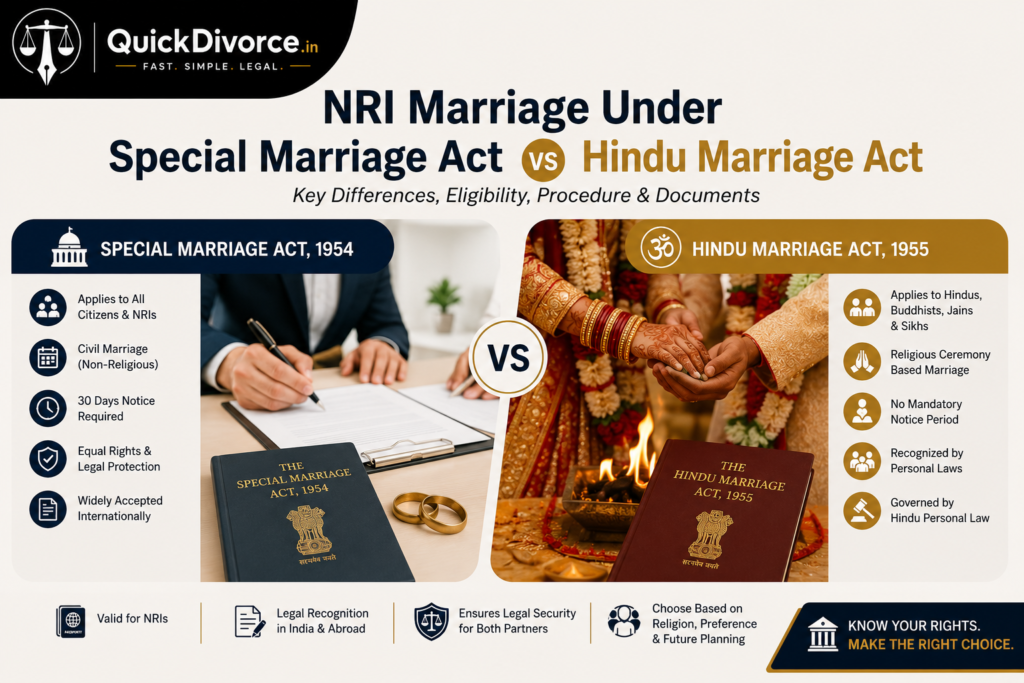
NRI Marriage Under Special Marriage Act vs Hindu Marriage Act
The Hindu Marriage Act, 1955 A personal law applicable specifically to Hindus, Sikhs, Jains, and Buddhists. It governs the solemnization and registration of marriages between two people belonging to these communities. It is rooted in religious identity and applies based on the faith of the parties — not the nature of the ceremony or the location of the marriage.
The Special Marriage Act, 1954 A secular civil law applicable to all Indian citizens regardless of religion, caste, or community. It also applies to marriages between an Indian citizen and a foreign national. It is not rooted in religious identity — it is a purely civil registration framework that treats marriage as a legal contract between two consenting adults.
For NRI couples, the critical practical difference between these two laws begins with eligibility and ends with international legal recognition — and everything in between matters.
Who Can Marry Under Each Law — Eligibility Comparison
Hindu Marriage Act — Eligibility
Both parties must be Hindu — meaning both must belong to the Hindu, Sikh, Jain, or Buddhist faith. The Act does not apply where one party is Muslim, Christian, Parsi, or of any other religion not covered under the Act’s definition of Hindu.
For NRI couples, this creates an immediate limitation — if one partner is a foreign national who is not Hindu, Sikh, Jain, or Buddhist, the Hindu Marriage Act simply does not apply. Period.
Additionally both parties must:
- Not be within the degrees of prohibited relationship unless custom permits
- Not be sapindas of each other unless custom permits
- The groom must be at least 21 years of age
- The bride must be at least 18 years of age
- Neither party should have a living spouse at the time of marriage
Special Marriage Act — Eligibility
The Special Marriage Act applies to any two persons regardless of religion, caste, community, or nationality — provided:
- The groom is at least 21 years of age
- The bride is at least 18 years of age
- Neither party has a living spouse
- Neither party is incapable of giving valid consent due to unsoundness of mind
- Neither party suffers from mental disorder that makes them unfit for marriage or procreation
- Neither party has been subject to recurrent attacks of insanity
For NRI couples, the Special Marriage Act is the only option where:
- One partner is a foreign national of any religion
- One partner is a non-Hindu Indian — Muslim, Christian, Parsi
- Both partners want a civil marriage without religious ceremony
- The couple wants international legal recognition without religious framing
The Ceremony — Religious vs Civil
Hindu Marriage Act — Ceremony
Marriage under the Hindu Marriage Act is solemnized through religious ceremonies and rites — traditionally the Saptapadi (seven steps around the sacred fire) being the most recognized ceremony that constitutes the binding moment of the marriage.
The Act does not mandate a specific ceremony but requires that the marriage be solemnized in accordance with the customary rites and ceremonies of either party. Once solemnized, the marriage can be registered with the Marriage Registrar under the Hindu Marriage Act.
For NRI couples who want a traditional Hindu wedding that is also legally registered — the Hindu Marriage Act is the natural framework.
Special Marriage Act — Ceremony
Marriage under the Special Marriage Act is an entirely civil process. There is no religious ceremony involved. The marriage is solemnized before a Marriage Officer — a government official — in the presence of three witnesses.
Both parties and three witnesses appear before the Marriage Officer, sign the marriage register, and the marriage is complete. No priest, no sacred fire, no religious rituals of any kind are required or involved.
For NRI couples who want a clean civil registration without religious elements — or where the religious element has already happened separately and they now want civil legal registration — the Special Marriage Act is the appropriate framework.
The Notice Period — The Single Biggest Practical Difference for NRIs
This is where the Special Marriage Act creates its most significant practical challenge for NRI couples — and the Hindu Marriage Act offers a significant advantage.
Special Marriage Act — 30-Day Mandatory Notice Period
Under Section 5 of the Special Marriage Act, before a marriage can be solemnized, both parties must give written notice to the Marriage Officer of the district where at least one of them has resided for a minimum of 30 days immediately before the notice.
The Marriage Officer then:
- Enters the notice in the Marriage Notice Book
- Displays a copy of the notice in a conspicuous place in his office
- Keeps it displayed for 30 days — inviting any person to file an objection to the marriage
Only after this 30-day notice period — and provided no valid objection has been filed — can the marriage be solemnized.
For NRI couples, this 30-day residency and notice requirement is a serious practical obstacle.
An NRI who visits India on a short trip — even a trip planned specifically around the marriage — must ensure that at least one partner has been residing in the relevant district for 30 days before giving notice, and then remain in India for another 30 days for the notice period to expire.
That is a minimum of 60 days in India — often incompatible with the visa status, work obligations, and practical reality of NRI life.
Hindu Marriage Act — No Mandatory Notice Period
The Hindu Marriage Act has no mandatory notice period. Once the religious ceremony is conducted, the marriage can be registered with the Marriage Registrar immediately or within a short time thereafter.
For NRI couples visiting India for their wedding, this is a significant advantage — the marriage can be solemnized and registered during a normal visit without requiring an extended stay.
Registration Process — Step by Step Comparison
Registration Under Hindu Marriage Act
Step 1 — Solemnization of Marriage The marriage is first solemnized through Hindu religious ceremonies — typically the Saptapadi and Havan. This can be done at home, at a temple, at a wedding venue, or at an Arya Samaj Mandir.
Step 2 — Application for Registration After solemnization, both parties apply to the Hindu Marriage Registrar of the district where the marriage was solemnized or where either party resides.
Step 3 — Documents Submission Documents required include identity proof, age proof, address proof, photographs, marriage invitation card, and photographs from the ceremony.
Step 4 — Verification The Registrar verifies documents and may require both parties and witnesses to appear in person.
Step 5 — Certificate Issuance The Hindu Marriage Certificate is issued — typically within a few days of application in most districts.
Registration Under Special Marriage Act
Step 1 — Establish 30-Day Residency At least one party must reside in the district for 30 days before the notice can be given.
Step 2 — Give Notice of Intended Marriage Both parties submit a written notice to the Marriage Officer of the district in the prescribed format.
Step 3 — 30-Day Display Period The notice is displayed publicly for 30 days. Any person can file an objection during this period.
Step 4 — Resolution of Objections If an objection is filed, the Marriage Officer must investigate and decide on it — this can add further time to the process.
Step 5 — Appearance Before Marriage Officer After the 30-day period, both parties and three witnesses appear before the Marriage Officer on the appointed date.
Step 6 — Declaration and Signing Both parties make declarations and sign the marriage register. The Marriage Officer countersigns.
Step 7 — Certificate of Marriage The Marriage Certificate under the Special Marriage Act is issued on the same day as solemnization.
Divorce — Key Differences in Applicable Law
Divorce Under Hindu Marriage Act
Divorce is governed by Section 13 of the Hindu Marriage Act. Grounds include cruelty, desertion, adultery, conversion, mental disorder, communicable disease, and renunciation.
Mutual consent divorce is available under Section 13B after one year of separation.
The Hindu Marriage Act also gives courts the power to grant maintenance under Sections 24 and 25 — interim and permanent alimony respectively.
Divorce Under Special Marriage Act
Divorce is governed by Section 27 of the Special Marriage Act. The grounds are broadly similar to the Hindu Marriage Act but are framed in secular language without religious references.
Mutual consent divorce is available under Section 28 after one year of separation.
Maintenance is governed by Sections 36 and 37 of the Special Marriage Act — again broadly similar in scope to the Hindu Marriage Act provisions.
Key Practical Difference for NRIs Divorce proceedings under the Special Marriage Act are heard by Civil Courts — whereas Hindu Marriage Act divorce proceedings are heard by Family Courts. In practice, most cities have specialized Family Courts that handle both — but the formal jurisdictional framework differs.
More importantly for NRIs — the Special Marriage Act marriage is more straightforwardly recognized by foreign courts in divorce proceedings because it is a civil registration without religious elements. Foreign courts dealing with jurisdiction in NRI divorce cases sometimes find it easier to engage with a Special Marriage Act marriage than a Hindu Marriage Act marriage with religious ceremony documentation.
International Recognition — Critical for NRI Couples
This is perhaps the most practically important consideration for NRI couples and the one most frequently overlooked.
Hindu Marriage Act — International Recognition
A Hindu Marriage Certificate issued under the Hindu Marriage Act is a valid Indian legal document. However, its international recognition depends on:
- Whether it is properly apostilled under the Hague Convention
- Whether the foreign country’s legal system recognizes religious marriages solemnized under personal law
- Whether the foreign embassy or immigration authority accepts it for visa and immigration purposes
Most major countries — UK, USA, Canada, Australia — do accept apostilled Hindu Marriage Certificates for spouse visa purposes. However, some countries with strictly civil marriage frameworks may require additional documentation or affidavits confirming the legal validity of the religious ceremony.
Special Marriage Act — International Recognition
A Special Marriage Act certificate is a civil registration document issued by a government Marriage Officer. It is structurally equivalent to civil marriage certificates issued in most Western countries — making it more straightforwardly recognized internationally.
For NRI couples where one partner needs a spouse visa to the husband or wife’s country of residence, a Special Marriage Act certificate — properly apostilled — is often the cleaner, more universally accepted document.
Foreign embassies processing spouse visas — particularly UK, Canadian, and Australian immigration — tend to process Special Marriage Act certificates with fewer additional queries than Hindu Marriage Act certificates accompanied by ceremony documentation.
Property Rights — Are There Differences?
For most practical purposes, property rights of spouses are similar under both Acts. However there are some nuances:
Hindu Marriage Act — Property Rights
The Hindu Succession Act, 1956 governs inheritance and property rights for marriages under the Hindu Marriage Act. A wife married under this Act has inheritance rights in the husband’s Hindu Undivided Family (HUF) property — a concept that does not exist under the secular Special Marriage Act framework.
If the husband has significant HUF assets — ancestral property held in a joint Hindu family structure — marriage under the Hindu Marriage Act preserves the wife’s rights in that property framework.
Special Marriage Act — Property Rights
A marriage under the Special Marriage Act takes the couple outside the HUF framework for inheritance purposes. Section 21A of the Hindu Succession Act specifically provides that where a Hindu marries under the Special Marriage Act, the marriage does not affect the separate property rights of the parties but does exclude them from certain HUF inheritance provisions.
For NRI couples where HUF property is involved — particularly families with significant ancestral property — this distinction can have substantial financial consequences. Legal advice specific to the property situation is strongly recommended before choosing the applicable law.
Succession Rights — A Critical Difference
This is one of the most significant legal differences between the two Acts — yet almost no one discusses it when helping couples choose.
Hindu Marriage Act — Succession
For Hindus married under the Hindu Marriage Act, succession to property is governed by the Hindu Succession Act, 1956. The wife is a Class I heir of her husband and vice versa — with specific rights in self-acquired property, ancestral property, and HUF property.
Special Marriage Act — Succession
Section 21 of the Special Marriage Act provides that where both parties to a Special Marriage Act marriage are Hindus, succession to their property is governed by the Indian Succession Act, 1925 — not the Hindu Succession Act, 1956.
The Indian Succession Act creates a different inheritance framework — particularly relevant for intestate succession (dying without a will). The shares of heirs and the structure of succession differ between the two Acts in ways that can significantly affect what the surviving spouse inherits.
This is a critical point that many NRI couples discover only after marriage — and sometimes only after a spouse’s death. If you are choosing between these two Acts, understand the succession implications clearly before deciding.
Children Born of the Marriage — Legitimacy and Rights
Under both Acts, children born of the marriage are legitimate and have full legal rights to inheritance, maintenance, and all other legal entitlements.
The choice of Act does not affect the legitimacy or legal status of children born from the marriage.
NRI-Specific Considerations — Which Law Makes More Sense?
Let us now bring all of this together with a specific focus on NRI situations:
Situation 1 — Both Partners Are Hindu NRIs Marrying in India
Either Act is legally available. The Hindu Marriage Act is faster — no 30-day notice period. The Special Marriage Act gives a more internationally recognized civil certificate.
Recommendation — If the couple wants a traditional Hindu ceremony and plans to stay in India for the wedding celebrations anyway, the Hindu Marriage Act with registration is perfectly adequate. If international visa applications are the immediate priority and the couple wants the cleanest possible civil certificate, the Special Marriage Act is worth the additional time.
Situation 2 — One Partner Is a Foreign National
The Hindu Marriage Act does not apply if the foreign national partner is not Hindu. The Special Marriage Act is the only option for legally registering this marriage in India.
The 30-day notice period must be planned around. If the foreign national partner cannot stay in India for the full period, the Indian partner can fulfill the 30-day residency requirement and the foreign national partner can arrive closer to the ceremony date — provided at least one party has the required residency.
Situation 3 — Inter-Religious NRI Couple
If one partner is Hindu and the other is Muslim, Christian, Parsi, or of any other religion — the Hindu Marriage Act does not apply. The Special Marriage Act is mandatory.
Situation 4 — NRI Couple Married Abroad Wanting Indian Registration
If the marriage happened outside India and the couple wants it registered in India — the Foreign Marriage Act, 1969 is the primary applicable law for registration at the Indian Embassy abroad.
However, if the couple wants registration in India itself upon return, the Special Marriage Act provides a mechanism for this — and is generally the more appropriate framework for marriages that were solemnized outside India in a civil ceremony.
Situation 5 — NRI Couple Wanting Arya Samaj Marriage
Arya Samaj marriages are solemnized and certified under the Hindu Marriage Act framework. They are ideal for Hindu NRI couples wanting a fast, cost-effective, legally valid marriage without elaborate ceremony planning. The Arya Samaj certificate plus SDM registration gives a complete legal package under the Hindu Marriage Act.
Situation 6 — NRI Couple With Significant Ancestral Property
If either partner has significant HUF or ancestral property, the succession implications of choosing the Special Marriage Act over the Hindu Marriage Act must be carefully examined. Legal advice from both a family law advocate and a property lawyer is strongly recommended before making the choice.
Side-by-Side Comparison Table
| Factor | Hindu Marriage Act 1955 | Special Marriage Act 1954 |
|---|---|---|
| Applicable To | Hindus, Sikhs, Jains, Buddhists | All religions, all nationalities |
| Foreign National Partner | Not applicable | Fully applicable |
| Inter-Religion Marriage | Not applicable | Fully applicable |
| Notice Period | None | 30 days mandatory |
| Ceremony | Religious ceremony required | Civil signing before Marriage Officer |
| Time to Complete | Faster — no notice period | Minimum 30 days plus residency |
| Certificate Type | Hindu Marriage Certificate | Civil Marriage Certificate |
| International Recognition | Accepted with apostille | More universally accepted |
| Divorce Law | Section 13 HMA | Section 27 SMA |
| Succession Law | Hindu Succession Act | Indian Succession Act (for Hindus) |
| HUF Property Rights | Preserved | May be affected |
| Maintenance | Sections 24 and 25 HMA | Sections 36 and 37 SMA |
| Mutual Divorce | Section 13B — 1 year separation | Section 28 — 1 year separation |
| Best For | Hindu NRI couples wanting traditional ceremony and faster registration | Inter-religion couples, foreign national partners, couples wanting civil certificate |
Documents Required — Comparison
Hindu Marriage Act — Documents
- Identity proof of both parties — Aadhaar, Passport, Voter ID
- Age proof — Birth Certificate, Passport, Matriculation Certificate
- Address proof — Aadhaar, Passport, Utility Bill
- Photographs from the wedding ceremony
- Wedding invitation card
- Passport-sized photographs of both parties
- If divorced previously — Divorce Decree
- If widowed — Death Certificate of former spouse
- For NRI partner — Valid Passport, Visa copy, Address proof abroad
Special Marriage Act — Documents
All of the above plus:
- Proof of 30-day residency in the district for at least one party
- Notice of intended marriage in prescribed form
- Declaration by both parties in prescribed form
- Three witnesses with their identity documents
- For foreign national partner — Passport, Valid Visa, No Objection Certificate from Embassy, Certificate of Single Status from Embassy
Frequently Asked Questions
Q1. Can a Hindu NRI choose between the Special Marriage Act and Hindu Marriage Act freely?
Yes. If both parties are Hindu, either Act is legally available. The choice depends on practical considerations — timeline, international recognition needs, property implications, and personal preference for religious versus civil ceremony.
Q2. Can the 30-day notice period under the Special Marriage Act be waived for NRIs?
There is no statutory waiver of the notice period specifically for NRIs. However, some courts have in exceptional circumstances allowed relaxation. The better approach is to plan the India visit to accommodate the notice period — or choose the Hindu Marriage Act if timeline is the primary concern.
Q3. Is a Hindu Marriage Act certificate accepted for spouse visa applications abroad?
Yes — properly apostilled Hindu Marriage Certificates are accepted by most foreign embassies for spouse visa purposes. However, some embassies request additional documentation confirming the legal validity of the religious ceremony. A Special Marriage Act certificate typically requires fewer additional queries.
Q4. What if we had a religious ceremony but want a Special Marriage Act certificate?
The religious ceremony and the legal registration are separate. You can have a Hindu wedding ceremony and choose to register it under the Special Marriage Act — provided you fulfill the 30-day notice and residency requirements. Many couples do exactly this to get the internationally recognized civil certificate.
Q5. Does the choice of Act affect child custody if we divorce later?
The child custody principles — based on the welfare of the child as the paramount consideration — are broadly similar under both Acts. The specific procedural framework differs slightly but the substantive outcome in custody cases is not significantly affected by which Act governs the marriage.
Q6. Can an NRI register their marriage under the Special Marriage Act at the Indian Embassy abroad?
The Foreign Marriage Act, 1969 governs marriages at Indian Embassies and Consulates abroad. It operates on broadly similar civil principles to the Special Marriage Act and the certificate issued carries equivalent legal weight in India.
Why Choose Quick Divorce for NRI Marriage Legal Guidance
Choosing the right legal framework for your marriage — and navigating the documentation requirements correctly — is the foundation on which every other legal right you have as a couple rests.
At Quick Divorce, our experienced team has guided hundreds of NRI couples through exactly this decision — helping them understand which Act applies to their specific situation, what documents they need, how to handle the notice period, how to ensure their certificate is internationally recognized, and how to protect their property and succession rights from day one.
We provide:
- Complete assessment of which Act is appropriate for your specific situation
- Document preparation and verification for both Hindu Marriage Act and Special Marriage Act registration
- Guidance on apostille and embassy attestation for international recognition
- Advice on succession and property implications of the choice of Act
- Assistance with SDM registration following Arya Samaj or religious ceremony
- NRI-specific legal guidance on marriage, divorce, maintenance, and property in India
- Remote consultation for NRI couples who cannot be physically present in India
Book your free consultation today: 📞 Call / WhatsApp: 8595439395
Final Word
The choice between the Special Marriage Act and the Hindu Marriage Act for your NRI marriage is not just a procedural formality. It is a legal decision with consequences for your divorce rights, your property inheritance, your succession framework, and the international recognition of your marriage certificate.
Make it with full information. Make it with proper legal guidance. And make it once — because changing the framework after the fact is complicated, expensive, and sometimes impossible.
Quick Divorce is here to make sure you make the right choice from the very beginning.
Need Consutation
🟡 QuickDivorce.in provides complete legal assistance for NRI marriage — including documentation, affidavits, registration support, embassy attestation guidance, and legal compliance across India and abroad.
🟡 For other Legal and Trademark related services
👉 Money Recovery Cases
👉 Property Disputes
👉 Business & Licence Registrations
🟡To explore IT services Click here
👉 Mutual Consent Divorce
👉 Contested Divorce Filing
👉 Child Custody and Maintenance
👉 Matrimonial Property Settlement
👉 NRI Divorce Services
👉 Alimony and Maintenance
🟡 Protect Your Rights
👉 Domestic Violence Legal Support
👉 Stridhan Recovery
📞 Call Now: +91 8595439395
🕐 Free Consultation: Monday to Saturday, 10 AM to 6 PM

Adv. Manish Kashyap is a Family Law & Divorce Lawyer with extensive experience in Mutual & Contested Divorce, NRI Divorce, Child Custody, Alimony, Domestic Violence, Judicial Separation, and Family Court matters, providing professional legal guidance to clients.

