

Views: 4
Table of Contents
- 1 The Wedding Is Over. Now Comes the Part That Actually Protects You.
- 2 Step Zero — Choose the Right Law Before Anything Else
- 3 Understanding the Delhi Marriage Registration System
- 4 Complete Step-by-Step Process — Hindu Marriage Act Registration in Delhi
- 5 Complete Step-by-Step Process — Special Marriage Act Registration in Delhi
- 6 Getting Your Marriage Certificate Apostilled for International Use
- 7 NRI Marriage Registration When One Spouse Is a Foreign National
- 8 Common Problems NRI Couples Face in Delhi Marriage Registration — And How to Solve Them
- 9 Checklist — Everything You Need Before Going to the SDM Office
- 10 Timeline Summary — NRI Marriage Registration in Delhi 2026
- 11 Cost Overview — NRI Marriage Registration in Delhi 2026
- 12 Frequently Asked Questions
- 13 Why Choose Quick Divorce for NRI Marriage Registration in Delhi
- 14 Final Word
- 15 Need Consutation
The Wedding Is Over. Now Comes the Part That Actually Protects You.
The ceremony was beautiful. The photographs are stunning. The family is happy. And somewhere in the middle of the celebration, someone mentioned — almost as an afterthought — that the marriage needs to be registered.
For NRI couples, that afterthought can become the most consequential legal step of the entire marriage. Because without a registered marriage certificate, the spouse’s visa application stalls. The property transfer does not go through. The passport name change cannot happen. The bank will not add the spouse as nominee. And in the worst case — if the marriage breaks down — there is no legal proof that the marriage ever existed.
NRI Marriage Registration in Delhi is not a formality. For NRI couples specifically, it is the legal foundation on which every other right, benefit, and protection of the marriage rests.
Delhi — as the capital of India and one of the largest cities with a significant NRI population — handles thousands of NRI marriage registrations every year. The process is well-established but has specific requirements, specific offices, specific timelines, and specific pitfalls that catch unprepared couples off guard.
This guide walks you through every single step — from choosing the right law to collecting the final registered certificate — so you walk into the process prepared and walk out with exactly the legal documentation you need.
Step Zero — Choose the Right Law Before Anything Else
Before gathering a single document or visiting a single office, you must make the most important legal decision of the entire registration process — which law will govern your marriage registration.
This decision determines everything that follows — the documents required, the office you go to, the timeline you face, and the legal rights that flow from the registration.
Option 1 — Hindu Marriage Act, 1955
Applicable when: Both partners are Hindu, Sikh, Jain, or Buddhist. The Act is based on religious identity — not nationality. An NRI who is Hindu by religion can register under this Act regardless of which country they live in.
Key advantage for NRIs: No mandatory notice period. The marriage can be solemnized through religious ceremony and registered with the Sub-Divisional Magistrate immediately after — without waiting for any notice period to expire.
Key limitation: Cannot be used if one partner is a foreign national of non-Hindu faith. Cannot be used for inter-religion couples where one partner is Muslim, Christian, or of any other non-Hindu religion.
Option 2 — Special Marriage Act, 1954
Applicable when: Either or both partners are of any religion or nationality. The Act is secular and applies universally — making it the only option for inter-religion NRI couples and NRI-foreign national couples.
Key advantage: Internationally recognized civil marriage certificate. Stronger acceptance at foreign embassies for visa applications. No religious ceremony required — the registration itself constitutes the marriage.
Key limitation for NRIs: Mandatory 30-day notice period after at least one partner has resided in Delhi for 30 days. This means a minimum of 30 days of actual Delhi residency plus 30 days of notice period — a minimum 60-day commitment that many NRIs on short visits cannot accommodate.
Option 3 — Foreign Marriage Act, 1969
Applicable when: The marriage took place outside India and the couple wants it registered at the Indian Embassy or High Commission in the country where the marriage was solemnized.
Relevant for: NRI couples who married abroad and want the marriage recognized and registered in India. This Act allows the marriage to be registered at the Indian diplomatic mission abroad — the registered certificate is then recognized in India.
The Decision Framework for NRI Couples
Both partners are Hindu NRIs → Hindu Marriage Act is faster. Special Marriage Act gives stronger international certificate. Choose based on timeline and purpose.
One partner is a foreign national (non-Hindu) → Special Marriage Act only. No alternative.
Inter-religion Indian couple → Special Marriage Act only.
Marriage happened abroad → Foreign Marriage Act at Indian Embassy, or register in India under appropriate Act upon return.
NRI couple wanting fastest possible registration in Delhi → Hindu Marriage Act — no notice period.
NRI couple prioritizing visa application strength → Special Marriage Act — universally recognized civil certificate.
Not sure which applies to you? Call Quick Divorce at 8595439395 for a free consultation before you begin.
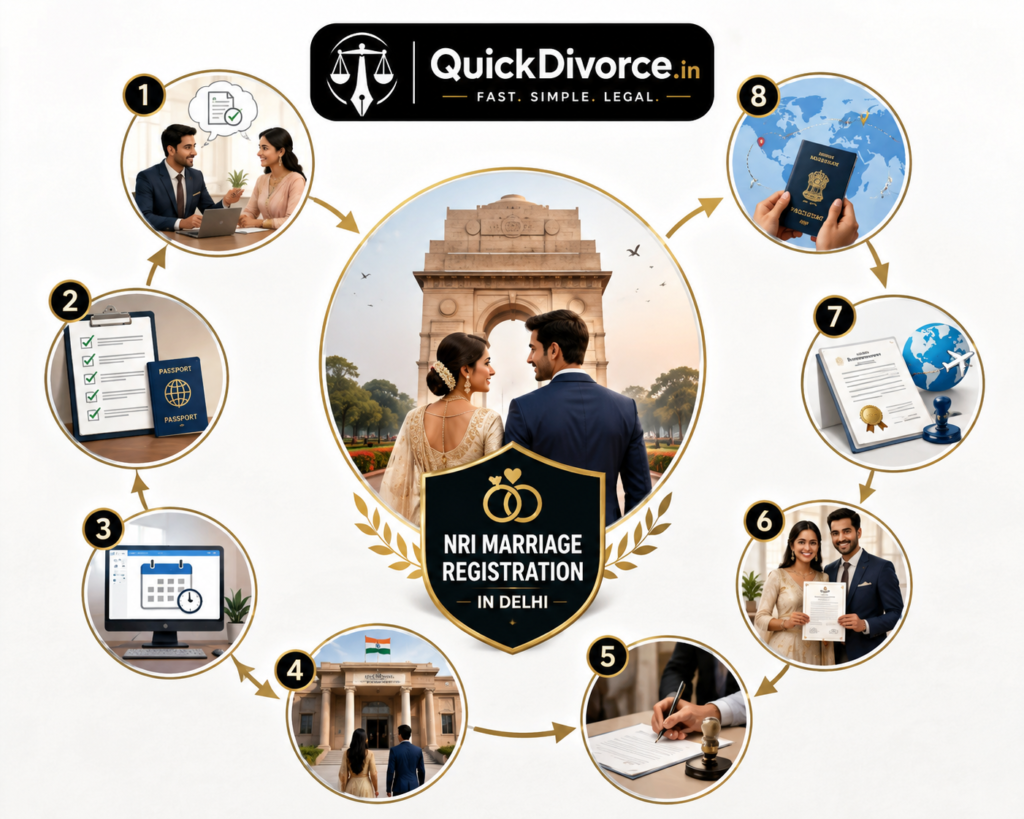
Understanding the Delhi Marriage Registration System
Delhi has a specific administrative structure for marriage registration that NRI couples must understand before beginning the process.
Sub-Divisional Magistrate (SDM) Offices
Marriage registration in Delhi happens at the SDM office of the Sub-Division where:
- The marriage was solemnized, or
- Either spouse has been residing for the required period
Delhi is divided into multiple Sub-Divisions — each with its own SDM office. The correct SDM office depends on the location of the marriage or the residence of one of the spouses.
Major SDM offices in Delhi handling marriage registration include:
- SDM Office, South Delhi (Saket)
- SDM Office, South West Delhi (Dwarka)
- SDM Office, West Delhi (Janakpuri)
- SDM Office, North Delhi (Civil Lines)
- SDM Office, North West Delhi (Rohini)
- SDM Office, East Delhi (Preet Vihar)
- SDM Office, North East Delhi (Seelam Pur)
- SDM Office, Central Delhi (Daryaganj)
- SDM Office, New Delhi (Connaught Place area)
- SDM Office, Shahdara
Online Appointment System
Delhi has implemented an online appointment system for marriage registration — accessible through the Delhi government’s official portal (edistrict.delhigovt.nic.in). Most SDM offices require prior online appointment rather than walk-in registrations.
Book your appointment well in advance — popular SDM offices in South Delhi and North Delhi can have appointment slots booked out 4 to 8 weeks in advance.
Marriage Officer Under Special Marriage Act
For registrations under the Special Marriage Act, the Marriage Officer is typically the SDM of the relevant sub-division. The Marriage Officer performs a different role under the Special Marriage Act compared to the SDM’s role under the Hindu Marriage Act — under the SMA, the Marriage Officer both solemnizes and registers the marriage.
Complete Step-by-Step Process — Hindu Marriage Act Registration in Delhi
This is the process for NRI couples where both partners are Hindu and the marriage has been or will be solemnized through a Hindu religious ceremony.
Step 1 — Solemnize the Marriage Through Hindu Religious Ceremony
Before registration can happen, the marriage must be solemnized through Hindu religious rites and ceremonies. The most common options in Delhi:
Home or Venue Wedding A traditional Hindu wedding conducted at home, a wedding venue, or a hotel — with a priest and witnesses. The wedding invitation card and photographs from the ceremony become important documentation.
Arya Samaj Mandir Marriage solemnized at an Arya Samaj Mandir in Delhi. The Mandir issues its own Arya Samaj Marriage Certificate on the day of the ceremony. This certificate is then used as supporting documentation for SDM registration.
The Arya Samaj route is particularly popular with NRI couples because:
- No advance notice period is required
- The entire ceremony and Mandir certificate issuance happens in one day
- The Mandir certificate itself is legally valid and can be used immediately for some purposes while the SDM registration is in process
Timeline: The religious ceremony can happen on any convenient date — there is no advance notice requirement under the Hindu Marriage Act.
Step 2 — Gather All Required Documents
Prepare the following documents for both spouses. Original documents plus self-attested photocopies of each are required.
For Both Spouses — Standard Documents
Identity Proof (Any One):
- Aadhaar Card
- Passport — mandatory for the NRI spouse, strongly recommended for both
- Voter ID Card
- Driving Licence
Age Proof (Any One):
- Birth Certificate issued by Municipal Authority
- Class 10th Board Marksheet
- Passport (date of birth page)
- School Leaving Certificate
Address Proof — Indian Address (Any One):
- Aadhaar Card showing Delhi address
- Voter ID with Delhi address
- Recent utility bill — electricity, water, or gas, not older than 3 months
- Rent agreement for current Delhi residence
- Bank statement showing Delhi address
For the NRI Spouse — Additional Documents
- Valid Passport — all relevant pages including personal details, visa stamps, and address
- Current Visa — showing legal residency status in the country of residence abroad
- Proof of Foreign Address — utility bill or bank statement from country of residence, not older than 3 months
- NRI Status Proof — employment letter, work permit, or residency permit from country of residence
Marriage Documentation
- Arya Samaj Marriage Certificate — if marriage was at Arya Samaj Mandir
- Wedding Invitation Card — showing date, venue, and names of bride and groom
- Wedding Photographs — minimum 2 to 4 clear photographs from the ceremony showing both spouses together
- Priest’s Certificate — a signed certificate from the officiating priest confirming the marriage (for home or venue weddings)
Photographs
- 3 to 5 recent passport-sized photographs of each spouse
For Previously Divorced Spouses
- Certified copy of the Court-issued Divorce Decree
For Widowed Spouses
- Death Certificate of the deceased former spouse
Witness Documents
Two witnesses are required for Hindu Marriage Act registration. Each witness must bring:
- Original identity proof — Aadhaar Card or Passport or Voter ID
- 2 passport-sized photographs
- Address proof
Step 3 — Book Online Appointment
Visit the Delhi government’s e-district portal (edistrict.delhigovt.nic.in) and book an appointment at the SDM office of the relevant sub-division.
Required for booking:
- Both spouses’ basic details — name, date of birth, contact number
- Preferred date and time slot
- Email address for confirmation
Important for NRI couples: Book the appointment before confirming travel plans to Delhi — or immediately upon arriving in Delhi — because appointment slots fill up quickly. If you are traveling from abroad specifically for the registration, confirm the appointment slot before booking flights.
Step 4 — Visit the SDM Office on Appointment Date
On the appointment date, both spouses and both witnesses must be physically present at the SDM office. This step cannot be delegated through a Power of Attorney — personal presence is mandatory.
At the SDM Office:
The Registration Clerk verifies all submitted documents — originals and copies. Any missing document can result in the appointment being rescheduled. Ensure every document is present before leaving home.
The SDM or Marriage Registrar:
- Reviews the application and documents
- Records statements of both spouses
- Records statements of both witnesses
- Verifies the identity of all parties
Both spouses and witnesses sign the marriage register in the presence of the SDM or Marriage Registrar.
Step 5 — Payment of Registration Fee
Pay the prescribed registration fee at the SDM office. In Delhi, the marriage registration fee under the Hindu Marriage Act is nominal — typically between Rs. 100 and Rs. 500. Fees may be paid at the SDM cashier counter or through the online payment gateway depending on the specific office.
Step 6 — Receive the Marriage Certificate
The Marriage Certificate under the Hindu Marriage Act is issued — either on the same day or within a few working days depending on the SDM office’s current workload.
The certificate bears:
- The official seal of the SDM office
- Signatures of both spouses and witnesses
- Signature and seal of the SDM or Marriage Registrar
- Registration number and date of registration
This government-issued Marriage Certificate is the primary legal proof of your marriage — valid across India and internationally when apostilled.
Timeline for Hindu Marriage Act registration in Delhi: From solemnization of marriage to receipt of SDM certificate — typically 1 to 4 weeks depending on appointment availability and processing time.
Complete Step-by-Step Process — Special Marriage Act Registration in Delhi
This is the process for inter-religion NRI couples, NRI-foreign national couples, or any NRI couple choosing the civil marriage route.
Step 1 — Establish 30-Day Residency in Delhi
At least one of the two parties must have been ordinarily residing in Delhi for a minimum of 30 days immediately before the notice of intended marriage is given.
For NRI couples, this is the most challenging requirement.
How to satisfy the residency requirement:
- One spouse arrives in Delhi and establishes residence — in the family home, rented accommodation, or a serviced apartment
- The 30-day period begins from the date of establishing residence
- Evidence of residency — Aadhaar with Delhi address, utility bills, rent agreement, or a letter from the local SHO confirming residence — must be available
Practical planning tip for NRIs: If one spouse has family in Delhi and can stay with them for 30 days before the marriage, this satisfies the residency requirement while also allowing the family to be involved in the wedding preparations. The other spouse can arrive later — closer to the ceremony and registration dates.
Step 2 — Give Notice of Intended Marriage
After completing 30 days of Delhi residency, both parties give a written Notice of Intended Marriage to the Marriage Officer (SDM) of the sub-division where the residency has been established.
The notice includes:
- Full names of both parties
- Dates of birth
- Current addresses
- Occupation
- Marital status
- Details of any previous marriage
- Declaration that neither party has a living spouse
- Declaration that the parties are not within prohibited degrees of relationship
Documents submitted with the notice: All identity, age, and address proof documents listed in the document checklist above — plus the residency proof for the 30-day requirement.
The Marriage Officer enters the notice in the Marriage Notice Book and displays a copy of the notice prominently at the office for 30 days.
Step 3 — 30-Day Notice Period
After the notice is given, a mandatory 30-day waiting period begins. During this period:
- The notice is publicly displayed at the Marriage Officer’s office
- Any person who has an objection to the marriage can file it in writing with the Marriage Officer
- Common grounds for objection include — one party already being married, parties being within prohibited degrees of relationship, one party being of unsound mind, or one party being a minor
If no objection is received — the marriage can proceed after the 30-day period.
If an objection is received — the Marriage Officer must investigate the objection. If the objection is valid, the marriage is refused. If it is invalid, it is dismissed and the marriage proceeds.
NRI planning implication: The total minimum time from arriving in Delhi to completing Special Marriage Act registration is 60 days — 30 days of residency plus 30 days of notice period. NRI couples must plan their India visit to accommodate this minimum timeline.
Step 4 — Gather All Required Documents
All documents listed in the Hindu Marriage Act section above, plus:
Specifically for Special Marriage Act:
- Proof of 30-day residency — Aadhaar with Delhi address, utility bill, or SHO residence certificate
- Notice of intended marriage in prescribed Form — available at SDM office or downloadable from Delhi government portal
- Declaration in prescribed format — to be signed before the Marriage Officer
For Foreign National Partner:
- Valid Passport — all pages
- Valid Indian Visa
- No Objection Certificate (NOC) from the Embassy of the foreign national’s country in India — confirming no legal bar to the marriage
- Certificate of Single Status (Bachelorhood/Spinsterhood Certificate) — issued by the competent authority in the foreign national’s home country, confirming they are legally free to marry
- If the foreign country is a Hague Convention signatory — the NOC and Single Status Certificate must be apostilled
- If the foreign country is not a Hague Convention signatory — the documents must be attested by the Indian Embassy in that country
Step 5 — Appear Before Marriage Officer After Notice Period
After the 30-day notice period (with no valid objection), both parties and three witnesses appear before the Marriage Officer on the appointed date.
At the appearance:
- Both parties make declarations in the prescribed form — confirming they meet all legal requirements for marriage
- Both parties and three witnesses sign the declaration
- The Marriage Officer verifies all documents and identities
Step 6 — Solemnization of Marriage
The marriage is solemnized in the presence of the Marriage Officer and three witnesses. Both parties:
- State that they take each other as lawful spouse
- Sign the marriage register
- Witnesses sign the register
The Marriage Officer countersigns and affixes the official seal.
Step 7 — Receive Marriage Certificate
The Marriage Certificate under the Special Marriage Act is issued on the same day as solemnization — immediately after the signing ceremony.
Timeline for Special Marriage Act registration in Delhi: Minimum 60 days from establishing residency to receiving the certificate — 30 days residency plus 30 days notice period plus the day of solemnization.
Getting Your Marriage Certificate Apostilled for International Use
For NRI couples who need the marriage certificate for use abroad — visa applications, immigration, property registration in a foreign country, or any other international legal purpose — the certificate must be apostilled.
The Apostille Process in Delhi
Step 1 — Notarization The marriage certificate is first notarized by a Notary Public in Delhi.
Step 2 — State Authentication The notarized certificate is authenticated by the Home Department of the Delhi Government — specifically the Additional District Magistrate or the notified authentication authority.
In Delhi, state-level authentication for apostille is handled by the General Administration Department (GAD) or the Home Department. Your lawyer or a professional apostille service will guide you to the correct office.
Step 3 — MEA Apostille After state authentication, the document is submitted to the Ministry of External Affairs (MEA) for apostille. The MEA has authorized apostille facilitation centers across Delhi — including at Patiala House Courts area and other locations.
The MEA affixes the official apostille sticker — a square sticker with a unique authentication code — on the reverse of the document.
Step 4 — Ready for International Use The apostilled marriage certificate is now accepted in all countries that are signatories to the Hague Convention — including UK, USA, Canada, Australia, Germany, France, and most European and many Asian countries.
Apostille Timeline in Delhi: 5 to 15 working days for the complete process. Apostille Cost: Rs. 50 to Rs. 200 in government fees plus professional service charges of Rs. 500 to Rs. 2,000 depending on the service provider.
For countries not on the Hague Convention — such as UAE, Qatar, Kuwait, Saudi Arabia, and other Gulf countries — embassy attestation by the relevant country’s embassy in India is required instead of apostille.
NRI Marriage Registration When One Spouse Is a Foreign National
This is the most complex scenario in Delhi NRI marriage registration — and the one most prone to delays and complications.
Additional Requirements for Foreign National Spouse
Visa Status The foreign national spouse must have a valid Indian visa throughout the registration process. Tourist visas are generally not valid for the purpose of marriage registration in India — the foreign national may need to obtain an appropriate visa category. Consult the concerned embassy about the correct visa type for marriage purposes.
No Objection Certificate from Embassy The foreign national’s embassy in India must issue a No Objection Certificate confirming:
- The foreign national is a citizen of that country
- There is no legal bar to their marriage under the laws of their country
- They are of legal age to marry
- They are not already married under the laws of their country
Embassy appointment processing times vary significantly — from a few days (Western embassies) to several weeks (some embassies). Factor this into your timeline.
Certificate of Single Status Most countries require their citizens to obtain a Certificate of Single Status (also called a Certificate of No Impediment or Bachelorhood Certificate) from a competent authority in their home country before marrying abroad. This certificate must then be apostilled or attested as applicable.
Translation of Foreign Documents Any foreign document — including the NOC and Single Status Certificate — that is not in English must be translated into English by a certified translator. The translated documents are then apostilled or attested alongside the originals.
Common Problems NRI Couples Face in Delhi Marriage Registration — And How to Solve Them
Problem — SDM Office Appointment Slots Are Fully Booked
Solution — Book appointments as far in advance as possible. If a specific SDM office has no availability within your required timeframe, check if you have residency proof for a different sub-division where appointments may be more readily available. A lawyer can sometimes facilitate expedited appointments in urgent cases.
Problem — Documents From Abroad Not Accepted
Solution — Any document issued by a foreign authority must be apostilled (Hague countries) or embassy-attested (non-Hague countries) to be accepted in India. This must be done before arriving in Delhi. Never arrive with foreign documents that have not been properly authenticated.
Problem — Foreign National’s NOC From Embassy Is Delayed
Solution — Start the embassy NOC process as early as possible — ideally before arriving in India. Many foreign embassies in Delhi have significant processing backlogs. Factor 2 to 6 weeks for embassy processing into your overall timeline.
Problem — Name Spelling Discrepancies Between Documents
Solution — If your name is spelled differently across different documents — passport versus Aadhaar versus school certificate — prepare a sworn affidavit explaining the discrepancy and confirming all names refer to the same person. A gazette notification for official name change, if applicable, should also be provided.
Problem — One Spouse Cannot Be Present in Delhi
Solution — Both spouses must personally appear for the registration under both Acts. A Power of Attorney cannot substitute for personal presence at marriage registration. If one spouse absolutely cannot be present, the only option is to delay registration until both can appear.
Problem — NRI Does Not Have a Delhi Address for the 30-Day Requirement (SMA)
Solution — The NRI can stay with family in Delhi, rent a room or apartment, or stay in a serviced apartment — any of which establishes Delhi residency. The residence proof must be documented — through Aadhaar update, utility bill, rent agreement, or SHO letter.
Problem — The Marriage Was Solemnized Abroad and Only One Spouse Is in India
Solution — For foreign marriages, registration at the Indian Embassy in the country of marriage under the Foreign Marriage Act is the appropriate route. Alternatively, both spouses must be present in India for Indian domestic registration under the HMA or SMA.
Checklist — Everything You Need Before Going to the SDM Office
Use this checklist to ensure you are fully prepared before your SDM appointment:
Identity Documents
- [ ] Aadhaar Card — both spouses — original and 2 photocopies each
- [ ] Passport — both spouses — original and 2 photocopies of all relevant pages
- [ ] Voter ID — both spouses (if available)
Age Proof
- [ ] Birth Certificate or Class 10th Marksheet or Passport — both spouses — original and 2 photocopies each
Address Proof
- [ ] Delhi address proof — both spouses or at least one — original and 2 photocopies
- [ ] Foreign address proof — NRI spouse — original and 2 photocopies
Marriage Documentation
- [ ] Arya Samaj Certificate (if applicable) — original and 2 photocopies
- [ ] Wedding invitation card — 2 copies
- [ ] Wedding photographs — minimum 4, clear, both spouses visible
NRI Specific Documents
- [ ] Valid Visa — original and 2 photocopies
- [ ] NRI status proof — employment letter or work permit
- [ ] Foreign address proof — utility bill or bank statement
For Foreign National Spouse
- [ ] NOC from Embassy — original and 2 photocopies
- [ ] Certificate of Single Status — original and apostilled copy
- [ ] Translated copies of all foreign documents
Special Marriage Act Specific
- [ ] 30-day residency proof
- [ ] Notice of intended marriage form — filled
- [ ] Declaration form — filled
Witness Documents (Both Witnesses)
- [ ] Identity proof — original and 2 photocopies each
- [ ] Address proof — original and 2 photocopies each
- [ ] 2 passport-sized photographs each
Photographs
- [ ] 5 passport-sized photographs — each spouse
Prior Marriage Documents (If Applicable)
- [ ] Divorce Decree — original and 2 photocopies
- [ ] Death Certificate of former spouse — original and 2 photocopies
Timeline Summary — NRI Marriage Registration in Delhi 2026
| Route | Minimum Timeline | Key Steps |
|---|---|---|
| Hindu Marriage Act — With Arya Samaj | 1 to 3 weeks | Arya Samaj ceremony (Day 1) → SDM appointment → Registration |
| Hindu Marriage Act — Religious Ceremony | 2 to 6 weeks | Wedding ceremony → Document preparation → SDM appointment → Registration |
| Special Marriage Act | 60 to 90 days | 30-day residency → Notice → 30-day notice period → Solemnization → Registration |
| With Apostille | Add 2 to 3 weeks | Registration → Notarization → State authentication → MEA apostille |
| With Embassy Attestation (Non-Hague) | Add 2 to 4 weeks | Registration → Embassy attestation process |
Cost Overview — NRI Marriage Registration in Delhi 2026
| Service | Approximate Cost |
|---|---|
| SDM Registration Fee (Hindu Marriage Act) | Rs. 100 – Rs. 500 |
| SDM Registration Fee (Special Marriage Act) | Rs. 150 – Rs. 500 |
| Arya Samaj Ceremony Fee | Rs. 5,000 – Rs. 15,000 |
| Affidavit and Notarization | Rs. 300 – Rs. 1,000 |
| Document Translation (Per Document) | Rs. 500 – Rs. 2,000 |
| Apostille (Government Fee) | Rs. 50 – Rs. 200 |
| Apostille Service Charge | Rs. 500 – Rs. 2,000 |
| Legal Assistance (Document Preparation) | Rs. 5,000 – Rs. 25,000 |
| Embassy NOC Processing Fee | Varies by Embassy |
Frequently Asked Questions
Q1. Can an NRI register their marriage in Delhi without being present in India?
No. Both spouses must be physically present in Delhi for marriage registration — under both the Hindu Marriage Act and the Special Marriage Act. A Power of Attorney cannot substitute for personal presence at the marriage registration appointment.
Q2. How long does NRI marriage registration in Delhi take under the Hindu Marriage Act?
From the date of the religious ceremony to receipt of the SDM certificate — typically 2 to 6 weeks depending on SDM office appointment availability and document processing time. With prior preparation and a booked appointment, it can be as fast as 1 to 2 weeks.
Q3. Is an Arya Samaj marriage certificate enough for a spouse visa application?
The Arya Samaj certificate is legally valid but most foreign embassies — particularly UK, Canadian, and Australian immigration — prefer or require the government-issued SDM-registered certificate. Always get SDM registration in addition to the Arya Samaj certificate for complete international coverage.
Q4. Can we register our marriage in Delhi if we live in another state?
Yes — provided at least one spouse has an address proof or has been residing in the relevant Delhi sub-division. For the Special Marriage Act, 30-day residency in Delhi is specifically required.
Q5. Does the 30-day notice period under the Special Marriage Act apply to NRIs?
Yes — the 30-day notice period is mandatory under the Special Marriage Act for everyone including NRIs. It cannot be waived. Only the six-month cooling period in mutual divorce (a different proceeding) can be waived — not the marriage notice period.
Q6. What if we got married abroad — do we still need to register in India?
Registration in India is not legally mandatory for a marriage that was validly solemnized abroad. However, Indian registration is strongly advisable for all practical purposes in India — property, banking, passport, and legal proceedings. The Foreign Marriage Act allows registration at Indian Embassies abroad, or the couple can register in India upon return under the applicable Act.
Why Choose Quick Divorce for NRI Marriage Registration in Delhi
NRI marriage registration in Delhi involves navigating multiple government offices, understanding which law applies, gathering documents from two countries, coordinating apostille and embassy attestation, and managing the entire process within the NRI’s limited time in India.
At Quick Divorce, we have guided hundreds of NRI couples through this process — from the initial law selection decision to the final apostilled certificate in hand.
We assist with:
- Complete assessment of which law applies to your specific NRI situation
- Document checklist specific to your case — Indian and foreign documents
- Guidance on apostille and attestation for foreign documents before you arrive in Delhi
- Online appointment booking at the correct SDM office
- Complete document preparation and verification before the SDM appointment
- Accompaniment to the SDM office on the appointment date
- Coordination with Arya Samaj Mandirs for same-day ceremony and certificate
- Apostille processing after registration for international use
- Embassy attestation for non-Hague countries — UAE, Gulf, etc.
- NRI-specific guidance on visa types, embassy NOC, and Single Status Certificate
We understand that NRIs have limited time in India and cannot afford delays, rescheduled appointments, or document rejections. We make sure everything is right the first time.
Book your free consultation today: 📞 Call / WhatsApp: 8595439395
Final Word
NRI marriage registration in Delhi is not complicated when you know exactly what to do, which law to choose, which documents to bring, and which office to go to.
It becomes complicated — expensively, stressfully, time-consumingly complicated — when you show up unprepared, with the wrong documents, at the wrong office, under the wrong law, with a visa that is about to expire and a return flight already booked.
This guide gives you the knowledge to avoid every one of those mistakes. And Quick Divorce gives you the legal team to handle every step — so your time in Delhi is spent celebrating your marriage, not chasing paperwork.
Call us at 8595439395 – before you book your flight.
Need Consutation
🟡 QuickDivorce.in provides complete legal assistance for NRI marriage — including documentation, affidavits, registration support, embassy attestation guidance, and legal compliance across India and abroad.
🟡 For other Legal and Trademark related services
👉 Money Recovery Cases
👉 Property Disputes
👉 Business & Licence Registrations
🟡To explore IT services Click here
👉 Mutual Consent Divorce
👉 Contested Divorce Filing
👉 Child Custody and Maintenance
👉 Matrimonial Property Settlement
👉 NRI Divorce Services
👉 Alimony and Maintenance
🟡 Protect Your Rights
👉 Domestic Violence Legal Support
👉 Stridhan Recovery
📞 Call Now: +91 8595439395
🕐 Free Consultation: Monday to Saturday, 10 AM to 6 PM

Adv. Manish Kashyap is a Family Law & Divorce Lawyer with extensive experience in Mutual & Contested Divorce, NRI Divorce, Child Custody, Alimony, Domestic Violence, Judicial Separation, and Family Court matters, providing professional legal guidance to clients.

