

Views: 31
Table of Contents
- 1 What Exactly Is NRI Marriage Fraud?
- 2 The Scale of the Problem in India
- 3 Laws That Protect Victims of NRI Marriage Fraud in India
- 4 Step-by-Step Process to File a Case Against NRI Marriage Fraud
- 5 What Is a Look Out Circular and Why Is It Critical
- 6 Practical Challenges in NRI Fraud Cases and How to Overcome Them
- 7 Frequently Asked Questions
- 8 Why Choose Quick Divorce for NRI Marriage Fraud Cases
- 9 Final Word
- 10 Need Consutation
What Exactly Is NRI Marriage Fraud?
NRI marriage fraud refers to a pattern of deception practiced by a Non-Resident Indian — or someone falsely claiming to be one — in the context of marriage. It takes several forms, but the common thread is deliberate misrepresentation and subsequent abandonment or exploitation of the Indian spouse.
The most common patterns include:
Concealment of Existing Marriage The NRI groom is already married — in India, abroad, or both — and conceals this fact entirely while entering into a second marriage in India. This is bigamy under Indian law and a serious criminal offence.
False Representation of Status and Wealth The NRI or his family misrepresents his financial status, profession, property ownership, immigration status, or social standing to make the match appear far more attractive than it actually is.
Visa and Immigration Fraud The NRI husband promises to sponsor the wife’s visa and bring her abroad, collects dowry and gifts, and then deliberately never files visa paperwork — leaving the wife stranded in India indefinitely.
Abandonment After Marriage The NRI husband returns abroad immediately or shortly after the wedding and then systematically cuts off contact — not responding to calls, blocking communication, and eventually filing for divorce abroad under foreign law while the wife in India has no idea proceedings have even begun.
Divorce Abroad Without Wife’s Knowledge The NRI husband obtains a divorce decree from a foreign court — sometimes called a postal divorce or ex-parte divorce — without the wife’s knowledge or participation. He then remarries abroad while the wife in India still considers herself legally married.
Dowry Extraction and Disappearance The NRI marriage is used as a vehicle to extract maximum dowry, cash, jewelry, and gifts from the bride’s family — after which the husband abandons the wife and refuses all contact.
False NRI Identity In some cases, the groom is not even an NRI at all — he has fabricated his foreign residency, job profile, and lifestyle to appear eligible for a wealthier match. The fraud is discovered only after the marriage.
The Scale of the Problem in India
NRI marriage fraud is not a rare occurrence. The Ministry of External Affairs operates a dedicated portal for distressed NRI spouses. State governments including Punjab, Kerala, Andhra Pradesh, Telangana, and Gujarat — states with high NRI populations — have set up special cells to handle NRI marriage fraud complaints.
In Punjab alone, thousands of such cases have been reported over the past decade. The National Commission for Women regularly receives complaints from abandoned NRI wives. And these are only the reported cases — the actual number is significantly higher because many victims never come forward due to social shame, family pressure, or ignorance of their legal rights.
In 2026, with the Indian diaspora larger than ever and matrimonial matching happening increasingly through apps and online portals with minimal verification, the risk of NRI marriage fraud has grown — not shrunk.
Laws That Protect Victims of NRI Marriage Fraud in India
Indian law provides multiple layers of legal protection for victims of NRI marriage fraud. These provisions work together to create a comprehensive legal response.
Indian Penal Code / Bharatiya Nyaya Sanhita, 2023
Section 318 BNS / Section 420 IPC — Cheating This is the most directly applicable provision. When an NRI husband misrepresents his marital status, financial position, immigration status, or any other material fact to induce the bride’s family into the marriage — and the family suffers harm as a result — it constitutes cheating under criminal law. Punishment extends to seven years imprisonment and fine.
Section 318 read with Section 317 BNS — Cheating by Personation If the NRI groom sent someone else to meet the bride’s family pretending to be him, or fabricated a false identity, cheating by personation is additionally attracted.
Section 82 BNS / Section 494 IPC — Bigamy If the NRI husband was already legally married at the time of the Indian marriage, he has committed bigamy — a cognizable offence punishable with up to seven years imprisonment.
Section 85 BNS / Section 498A IPC — Cruelty Dowry harassment, mental cruelty, and physical abuse by the NRI husband or his family members in India before his departure attract cruelty provisions.
Section 84 BNS / Section 498B IPC — Dowry Death Provisions Where dowry harassment is linked to the wife’s death or injury, additional provisions apply.
Sections 3 and 4 — Dowry Prohibition Act, 1961 Demanding or accepting dowry in connection with the marriage is a separate criminal offence — independent of the fraud charges.
Section 108 BNS / Section 306 IPC — Abetment of Suicide If the sustained fraud, abandonment, and humiliation drives the victim to attempt suicide, abetment provisions apply to the husband and potentially his family members who participated in the fraud.
Section 351 BNS / Section 506 IPC — Criminal Intimidation Threats made by the NRI husband or his family to prevent the victim from filing a case or to force her into silence are criminal intimidation.
Protection of Women from Domestic Violence Act, 2005
Even where the NRI husband is abroad, the Protection of Women from Domestic Violence Act can be invoked against family members who remain in India — typically the mother-in-law, father-in-law, or other relatives who participated in the fraud, harassment, or dowry demands.
Protection orders, residence orders, and monetary relief can be obtained against Indian-based family members of the NRI husband under this Act.
The Foreign Marriage Act, 1969
If the marriage was registered abroad at an Indian Embassy or Consulate under the Foreign Marriage Act, the provisions of that Act and related Indian matrimonial laws apply — giving Indian courts jurisdiction over the marriage and its consequences.
Special Marriage Act, 1954
If the marriage was registered under the Special Marriage Act in India, the family court in India retains jurisdiction over divorce, maintenance, and matrimonial property regardless of where the husband currently resides.
Passport Act, 1967 — Section 10(3)(h)
The Passport Act empowers the passport authority to impound, revoke, or refuse to issue a passport to a person against whom criminal proceedings are pending in India. This is a powerful tool — once an FIR is registered and a Look Out Circular is issued, the NRI husband’s Indian passport can be revoked, making international travel significantly more complicated for him.
Reciprocal Enforcement of Foreign Judgments
A critical legal issue in NRI fraud cases is when the husband obtains a divorce decree from a foreign court without the wife’s knowledge. Indian courts do not automatically recognize all foreign divorce decrees. Specifically, an ex-parte foreign divorce decree — obtained without the wife being served notice or given an opportunity to participate — is generally not recognized by Indian courts as valid.
This means the wife can challenge the foreign divorce in Indian courts and continue matrimonial proceedings in India simultaneously.
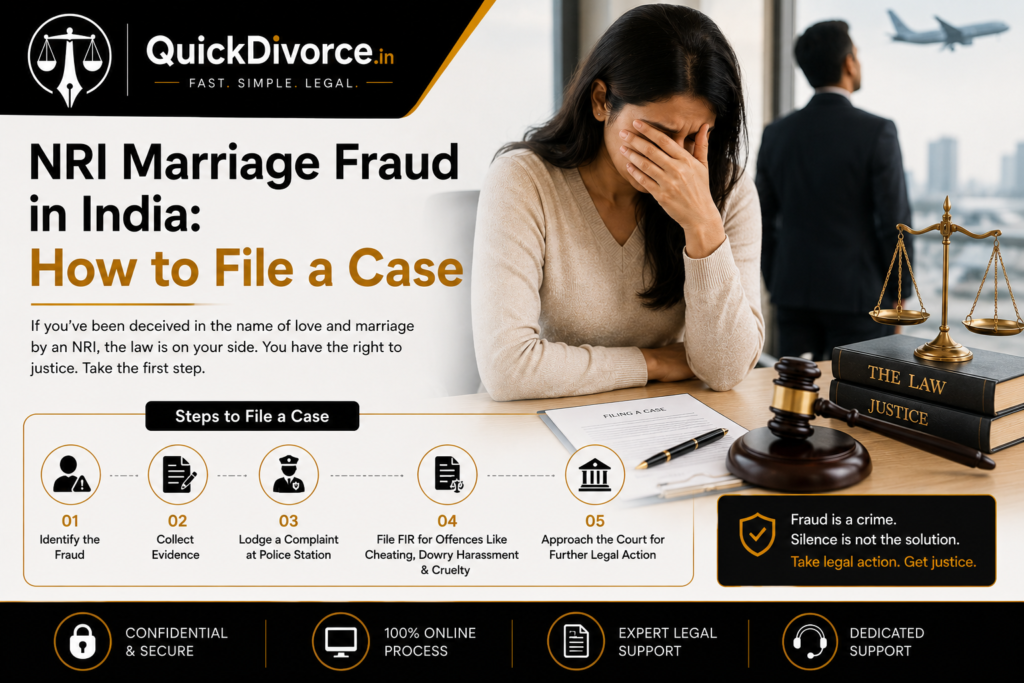
Step-by-Step Process to File a Case Against NRI Marriage Fraud
Step 1 — Collect and Preserve All Evidence
Before approaching any authority, organize your evidence comprehensively. In NRI fraud cases, documentation is everything — because the accused is in another country and physical confrontation is not possible.
Evidence to collect includes:
Marriage Documentation
- Marriage certificate (Arya Samaj, court-registered, or religious)
- Wedding photographs and videos
- Wedding invitation cards
- Marriage registration documents
Communication Records
- WhatsApp message history — save and back up to cloud immediately
- Email conversations — download and preserve
- Call logs showing communication history and subsequent blackout
- Social media conversations and profiles
- Video call recordings if available
Misrepresentation Evidence
- Any documents the husband or his family provided to show his status — salary slips, employment letters, property papers, visa documents — which turned out to be false
- Screenshots of matrimonial profiles on shaadi.com or other portals showing false information
- Witness statements from people who attended meetings where false representations were made
Dowry and Financial Evidence
- Bank statements showing transfers of money to the husband or his family
- Receipts for jewelry, gifts, or cash given at the time of marriage
- Any written demands for dowry — physical notes or digital messages
- Photographs of gifts and jewelry given
Abandonment Evidence
- Last communication records showing when contact was cut off
- Evidence that visa sponsorship was promised but never filed
- Any foreign divorce papers if they were served
Character Witnesses
- Names and contact details of family members, neighbors, or common acquaintances who witnessed interactions with the husband or his family
Step 2 — File a Complaint with the Police
File an FIR at the police station having jurisdiction over:
- The area where the marriage took place, or
- The area where the matrimonial home is located, or
- The area where you currently reside
Your FIR should invoke the relevant sections — primarily cheating under Section 318 BNS, bigamy under Section 82 BNS if applicable, cruelty under Section 85 BNS, and dowry related provisions.
Request the police to issue a Look Out Circular (LOC) against the accused immediately. An LOC alerts immigration authorities at all Indian airports and ports to detain the accused if he attempts to enter India. This is the single most effective tool for ensuring the accused cannot freely travel to India without facing the legal consequences.
If police are reluctant to register the FIR — which happens in NRI cases because of the perceived difficulty of pursuing someone abroad — escalate to the Superintendent of Police or approach the Judicial Magistrate directly under Section 173 BNSS.
Step 3 — Approach the NRI Marriage Fraud Cell
Several state governments have established dedicated NRI Marriage Fraud Cells specifically to handle these cases. In Punjab, the NRI cell operates under the Director General of Police. In Kerala, Andhra Pradesh, and Gujarat, similar dedicated units exist.
These specialized cells have experience dealing with the unique challenges of NRI fraud cases — including coordination with Interpol, foreign law enforcement agencies, and Indian embassies abroad.
If your state has such a cell, approach it in addition to filing the regular FIR. The dedicated cell often has more resources and political will to pursue these cases.
Step 4 — File a Complaint with the Ministry of External Affairs
The Ministry of External Affairs operates a dedicated portal — madad.gov.in — for distressed NRI spouses and overseas Indians. Register your complaint on this portal.
The MEA can:
- Flag the NRI husband’s passport for revocation proceedings
- Alert Indian embassies and consulates in the country where the husband resides
- Facilitate coordination between Indian authorities and foreign governments
- Provide consular assistance if you need to pursue legal action in the foreign country
Step 5 — Approach the National Commission for Women
File a complaint with the National Commission for Women (NCW) at ncwapps.nic.in. The NCW has statutory powers to:
- Take up complaints with state police and demand action reports
- Intervene directly with senior police officials when local police are not acting
- Provide legal assistance and connect victims with pro bono legal support
- Escalate cases to the Ministry of Women and Child Development
The NCW has handled numerous NRI fraud cases and can be a powerful ally in cutting through bureaucratic delays.
Step 6 — File for Maintenance Before the Family Court in India
Simultaneously with the criminal complaint, file a maintenance application before the Family Court in India under Section 125 BNSS. Indian family courts have jurisdiction to award maintenance against an NRI husband.
The court can pass an ex-parte maintenance order — meaning an order in your favor even without the husband’s physical presence — if he fails to appear after being properly served.
Maintenance orders passed by Indian courts can in some circumstances be enforced in foreign countries through bilateral legal cooperation agreements, depending on the country where the husband resides.
Step 7 — File for Divorce and Matrimonial Relief in India
Do not wait for the husband to initiate divorce proceedings abroad. File your own divorce petition in the Indian family court — on grounds of cruelty, desertion, and fraud — and simultaneously claim:
- Permanent alimony
- Return of dowry and gifts
- Matrimonial property rights
- Damages for fraud
Filing first in India establishes Indian court jurisdiction and prevents the husband from obtaining a favorable foreign divorce decree unilaterally.
Step 8 — Challenge Any Foreign Divorce Decree
If the husband has already obtained a divorce abroad, approach the Indian family court to challenge its validity. As noted earlier, ex-parte foreign divorce decrees obtained without the wife’s knowledge or participation are generally not recognized by Indian courts.
The Indian court can declare the foreign divorce invalid and proceed with its own divorce and maintenance proceedings under Indian law.
Step 9 — Seek Interpol Red Notice (In Serious Cases)
In cases involving large-scale financial fraud, bigamy, or where the accused has been charged with serious cognizable offences and is evading arrest, Indian police can request an Interpol Red Notice through the Central Bureau of Investigation (CBI). A Red Notice is a request to law enforcement worldwide to locate and provisionally arrest the accused pending extradition proceedings.
This is a more complex and resource-intensive process but has been successfully used in serious NRI fraud cases.
Step 10 — Explore Legal Action in the Country of Residence
If the NRI husband resides in a country with which India has legal cooperation agreements, it may be possible to initiate legal proceedings in that country as well — particularly for bigamy and fraud. Consult a lawyer experienced in international family law for guidance specific to the country involved.
Countries like the United Kingdom, Canada, Australia, and the United States have their own provisions against matrimonial fraud, bigamy, and domestic abuse that may be invocable.
What Is a Look Out Circular and Why Is It Critical
A Look Out Circular — commonly called an LOC — is an alert issued by the police or a court to all immigration check posts in India. It instructs immigration officers to stop the named individual from leaving India — or in some cases, to detain them upon arrival in India.
In NRI fraud cases, an LOC is one of the most powerful tools available because:
- It prevents the accused from visiting India and leaving again without facing legal consequences
- It creates practical pressure on the accused to engage with the Indian legal proceedings
- It signals to the accused that Indian authorities are actively pursuing the case
An LOC can be requested by the investigating police officer, or can be directed by a court. Once an FIR is registered and investigation is underway, immediately ask your lawyer to ensure an LOC application is filed.
Practical Challenges in NRI Fraud Cases and How to Overcome Them
Challenge — Accused is Abroad and Cannot Be Served Indian courts have provisions for substituted service — service by publication in newspapers, email service, and WhatsApp service in some jurisdictions. Courts have accepted WhatsApp blue tick as proof of service in several recent cases. Ensure your lawyer uses all available service mechanisms.
Challenge — Evidence Is Digital and May Be Deleted Preserve all digital evidence immediately — back up to cloud, take screenshots, and if possible get a digital evidence preservation certificate from a certified cyber forensics expert. Courts have increasingly accepted digital evidence in matrimonial fraud cases.
Challenge — Police Are Not Taking Action Escalate systematically — SP, NCW, MEA portal, and Magistrate’s court. Do not stop at the first refusal. The law is on your side and multiple escalation paths exist.
Challenge — Foreign Courts Are Proceeding Simultaneously Engage both an Indian family lawyer and if possible a lawyer in the country where the husband resides. File immediately in Indian courts to establish jurisdiction. Challenge the foreign proceedings on the ground that Indian courts have primary jurisdiction over the marriage.
Challenge — Family Pressure to Stay Silent This is perhaps the hardest challenge. Many victims are pressured by their own families not to file a case out of concern for social reputation. Understand clearly — silence protects the fraudster, not you. The law gives you remedies. Using them is not shameful. It is your right.
Frequently Asked Questions
Q1. What is NRI marriage fraud?
NRI marriage fraud occurs when a Non-Resident Indian (NRI) spouse deceives their partner through false information, abandonment after marriage, concealment of marital status, dowry harassment, or refusal to sponsor the spouse abroad.
Q2. Where can I file a complaint against an NRI spouse in India?
You can file a complaint at the local police station, the Women’s Cell, the Crime Against Women Cell, or approach the court with the help of a family lawyer. Complaints can also be submitted through the Ministry of External Affairs and NRI Cell where applicable.
Q3. What documents are required to file a case for NRI marriage fraud?
Important documents include the marriage certificate, wedding photographs, passport details, visa records, communication records (emails, chats, messages), financial transaction proofs, and any evidence of fraud or harassment.
Q4. Can an FIR be registered against an NRI husband living abroad?
Yes. An FIR can be registered in India even if the NRI spouse resides overseas. Indian authorities may initiate legal proceedings, issue summons, and take further action through international legal channels when necessary.
Q5. What legal remedies are available to victims of NRI marriage fraud?
Victims may seek criminal action for cheating, cruelty, dowry harassment, domestic violence, maintenance, child custody, and divorce. Courts may also order compensation depending on the circumstances of the case.
Q6. Can a court issue a lookout notice or impound an NRI spouse’s passport?
In serious cases involving non-cooperation or evasion of legal proceedings, courts may direct authorities to issue lookout notices or recommend action regarding passport-related matters as permitted under law.
Q7. How long does it take to resolve an NRI marriage fraud case in India?
The timeline varies depending on the complexity of the case, availability of evidence, cooperation of parties, and court workload. Some matters may take several months, while contested cases can continue for years.
Why Choose Quick Divorce for NRI Marriage Fraud Cases
NRI marriage fraud cases are among the most legally complex matrimonial disputes in India. They involve criminal law, family law, international law, digital evidence, and cross-border jurisdiction — all at the same time. Handling them requires a legal team that understands all of these dimensions and has practical experience navigating them.
At Quick Divorce, we have helped numerous victims of NRI marriage fraud across India to:
- File comprehensive FIRs with the correct legal sections
- Obtain Look Out Circulars and pursue passport revocation
- File and pursue cases through dedicated NRI fraud cells
- Register complaints with the NCW and MEA simultaneously
- File divorce, maintenance, and property claims in Indian family courts
- Challenge ex-parte foreign divorce decrees in Indian courts
- Preserve and present digital evidence effectively
- Coordinate with lawyers abroad where international legal action is needed
We understand that you may be going through the most difficult period of your life. We approach every case with complete confidentiality, genuine empathy, and aggressive legal representation.
You were deceived once. Let us make sure the law does not fail you a second time.
Book your free consultation today: 📞 Call / WhatsApp: 8595439395
Final Word
NRI marriage fraud is a crime. It is not a personal failure, not a family embarrassment to be hidden, and not something you simply have to accept and move on from.
The Indian legal system — imperfect as it is — has real tools to pursue justice in these cases. An FIR. A Look Out Circular. A passport revocation. A maintenance order. A divorce decree from an Indian court. A challenge to a fraudulent foreign divorce. These are not just theoretical remedies — they have been used successfully by victims just like you.
What you need is the courage to act — and the right legal team to act with you.
Quick Divorce is ready.
📞 Call / WhatsApp: 8595439395
Need Consutation
🟡 QuickDivorce.in provides complete legal assistance for NRI marriage — including documentation, affidavits, registration support, embassy attestation guidance, and legal compliance across India and abroad.
🟡 For other Legal and Trademark related services
👉 Money Recovery Cases
👉 Property Disputes
👉 Business & Licence Registrations
🟡To explore IT services Click here
👉 Mutual Consent Divorce
👉 Contested Divorce Filing
👉 Child Custody and Maintenance
👉 Matrimonial Property Settlement
👉 NRI Divorce Services
👉 Alimony and Maintenance
🟡 Protect Your Rights
👉 Domestic Violence Legal Support
👉 Stridhan Recovery
📞 Call Now: +91 8595439395
🕐 Free Consultation: Monday to Saturday, 10 AM to 6 PM

Adv. Manish Kashyap is a Family Law & Divorce Lawyer with extensive experience in Mutual & Contested Divorce, NRI Divorce, Child Custody, Alimony, Domestic Violence, Judicial Separation, and Family Court matters, providing professional legal guidance to clients.

