

Views: 1
Table of Contents
- 1 A Gap in the Criminal Law Does Not Mean a Gap in the Evidence
- 2 Where Medical Evidence Fits Into the Legal Picture
- 3 How Indian Courts Have Approached Medical Evidence in Matrimonial Cases
- 4 Your Rights Around Seeking Medical Documentation
- 5 Building the Fuller Evidence Picture Around a Medical Report
- 6 How This Evidence Translates Into Legal Strategy
- 7 Frequently Asked Questions
- 8 If You Need Help Right Now
- 9 Final Word
A Gap in the Criminal Law Does Not Mean a Gap in the Evidence
As covered in our earlier guide on legal remedies for married women facing forced relations, India does not currently criminalize marital rape as a standalone offence where the wife is above eighteen. That legislative gap is real, and it shapes how these cases are framed legally — usually as cruelty under matrimonial law, as domestic violence under the PWDVA, or as specific criminal offences like assault, rather than as rape.
What that gap does not do is make medical evidence irrelevant. If anything, in a legal landscape where the criminal label of marital rape is unavailable, the medical record becomes one of the most important pieces of evidence available — because it is contemporaneous, professionally documented, and difficult for the other side to simply deny in the way oral testimony alone can be disputed.
This guide looks specifically at the legal role medical evidence plays in these cases in India in 2026 — how courts treat it, what it can and cannot do on its own, and how to think about it as part of a wider legal strategy.
Where Medical Evidence Fits Into the Legal Picture
Medical evidence in marital sexual violence cases typically supports one or more of three separate legal proceedings, each with a different purpose and a different standard of proof.
Matrimonial cruelty proceedings. Under Section 13(1)(ia) of the Hindu Marriage Act, 1955, Section 27(1)(d) of the Special Marriage Act, 1954, and equivalent provisions for other communities, cruelty is a ground for divorce. Indian courts have, over decades of judgments, accepted that forced sexual relations within marriage can constitute cruelty for the purpose of these provisions, even though the same conduct is not separately criminalized as rape between spouses. Medical evidence of physical injury or psychological harm directly supports this ground.
Domestic violence proceedings. Under Section 3 of the Protection of Women from Domestic Violence Act, 2005, sexual abuse is explicitly included within the statutory definition of domestic violence. Medical evidence here supports applications for protection orders, residence orders, and monetary relief before a Magistrate.
Criminal proceedings under other provisions. Where the conduct involves physical assault, criminal force, or intimidation independent of the specific marital exception around rape, provisions of the Bharatiya Nyaya Sanhita, 2023 covering hurt, assault, and intimidation may apply, and medical evidence supports a police complaint and any resulting prosecution.
It matters which of these routes — or which combination — your lawyer is building toward, because the standard of proof differs. Divorce and domestic violence proceedings use a civil standard, “balance of probabilities,” which is a materially lower bar than the criminal standard of proof beyond reasonable doubt. This is worth understanding clearly: a case that might struggle to meet a criminal threshold can still succeed in a divorce or domestic violence proceeding on the same underlying facts.
How Indian Courts Have Approached Medical Evidence in Matrimonial Cases
Courts do not treat a medical report as an automatic, decisive piece of evidence that settles a case on its own — nor do they require one as an absolute precondition to believing a person’s account. The general judicial approach has been more balanced than either extreme.
Medical evidence is treated as corroborative, not as the sole basis for a finding. Indian courts have repeatedly held, across cruelty and assault cases generally, that the testimony of the affected person, if found credible, can sustain a finding even without medical corroboration. Medical evidence strengthens a case; its absence does not automatically defeat one. This principle has developed primarily through criminal sexual offence jurisprudence but the same evidentiary logic is applied by Family Courts assessing matrimonial cruelty.
Timing affects weight, not admissibility. A report obtained promptly after an incident is generally given more weight than one obtained much later, because physical findings have a natural timeline and fade. Courts have, however, accepted that delayed reporting — for reasons such as fear, social pressure, or simply not knowing legal options existed — does not by itself discredit a claim, particularly in matrimonial settings where the victim continues to live in the same household as the alleged perpetrator.
Psychological evidence is increasingly accepted alongside physical evidence. Indian courts hearing matrimonial cruelty cases have shown growing willingness to treat documented psychological harm — anxiety, depression, trauma symptoms recorded by a qualified psychiatrist or psychologist — as legitimate evidence of cruelty, independent of whether there is also physical injury. This reflects a broader judicial recognition that cruelty under matrimonial law is not limited to visible physical harm.
Consistency, not perfection, is what courts look for. Courts assessing medical evidence alongside testimony look for broad consistency between what is documented and what is described — they do not require every detail to align perfectly, and they are generally alive to the reality that recollection of traumatic events is not always linear or fully consistent in minor details.
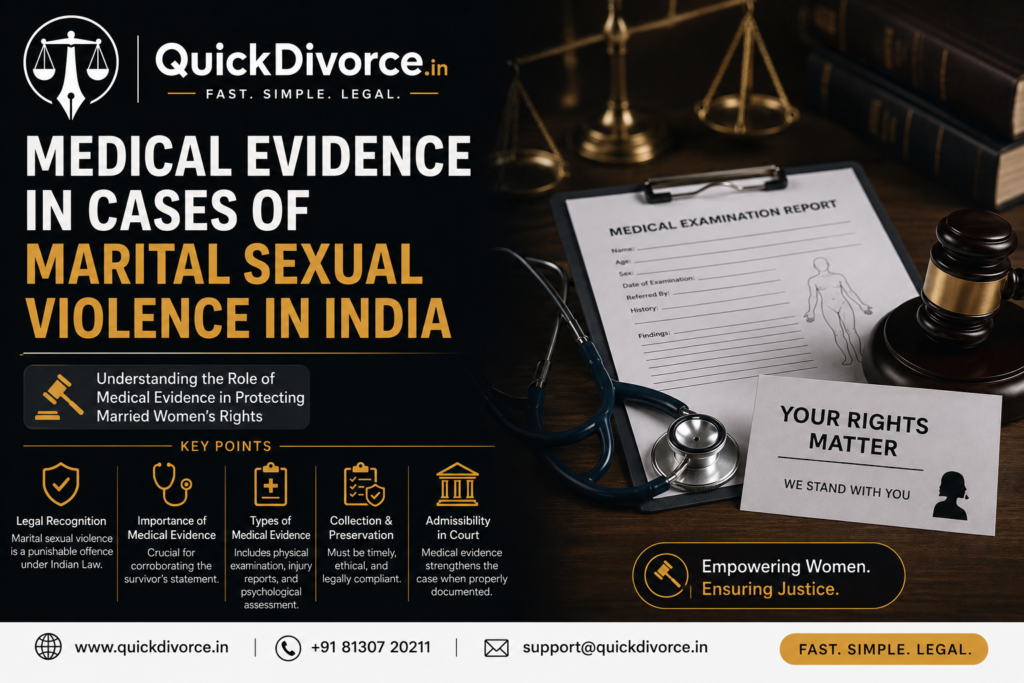
Your Rights Around Seeking Medical Documentation
If you are considering or pursuing a medical examination connected to a matrimonial sexual violence allegation, there are some general rights and practical points worth knowing — described here at a policy and rights level, not as a clinical guide.
Examination at a government hospital is generally available free of cost, and government hospitals are expected to conduct an examination and provide a report on request, including in many cases where a police complaint has not yet been filed.
A police complaint is generally not a strict precondition to being examined, though hospital-specific practice can vary, and confirming locally — including through a lawyer, a One Stop Centre (Sakhi Centre), or a women’s helpline — before going can help avoid being turned away over a policy that may not even apply to your situation.
Requesting a female doctor is a reasonable request that hospitals are generally expected to accommodate where feasible.
You are entitled to a copy of the report, and confirming how and when you will receive it before you leave is worth doing, since this document can matter much later in proceedings that may not begin for months.
You can usually be accompanied by someone you trust during the process, subject to the specific hospital’s protocols.
I’m deliberately not going further into what a clinical examination involves, how injuries are classified, or what specific findings are typically documented. That level of detail sits with treating doctors and forensic medical professionals, varies by individual circumstances in ways a general guide cannot responsibly anticipate, and getting it wrong on a public legal blog creates real risk for someone relying on it in a moment of crisis.
Building the Fuller Evidence Picture Around a Medical Report
Lawyers handling these cases generally advise gathering evidence that sits alongside, not instead of, any medical documentation:
Contemporaneous personal records. A dated diary entry, note, or even a message to oneself describing what happened, made close to the time of the incident, can carry real evidentiary weight as a contemporaneous account — separate from, and in addition to, any medical report.
Communication records. Messages, calls, or any written exchange around the time of the incident — including anything in which the other party acknowledged conduct, made threats, or pressured silence — can corroborate both the medical evidence and personal testimony.
Witness accounts. Anyone who observed the aftermath of an incident, heard distress, or was told about it at the time can provide testimony that supports the overall picture, even without having witnessed the incident itself.
A pattern across multiple incidents. Where there is more than one incident, a series of records — medical, written, or witness-based — spread across time tends to carry more weight collectively than any single report in isolation, because it demonstrates a pattern rather than an isolated event.
No single piece of evidence typically carries a matrimonial case on its own. Courts and experienced lawyers generally look at the totality of what is presented.
How This Evidence Translates Into Legal Strategy
Once medical and supporting evidence exists, a lawyer will generally help decide:
Which proceeding to prioritize. A domestic violence application can often produce faster interim relief — protection orders, monetary relief — than a full divorce petition, which takes longer to resolve. Many lawyers pursue both in parallel rather than choosing one over the other.
Whether to pursue a parallel criminal complaint. Where the facts support charges under provisions like assault, intimidation, or cruelty under the Bharatiya Nyaya Sanhita, a criminal complaint can run alongside civil and matrimonial proceedings, each using the same underlying evidence for a different legal purpose.
How to present the evidence without it feeling like an interrogation. A well-prepared affidavit and a lawyer who has organized the supporting evidence in advance generally reduces how much a person has to repeatedly relive or re-explain traumatic events during the legal process itself.
This is precisely the kind of fact-specific judgment call that benefits from a lawyer reviewing your actual documents and circumstances, rather than a generic article attempting to tell you which path applies to you.
Frequently Asked Questions
Q1. Is a medical report legally required to file a cruelty or domestic violence case? No. A medical report strengthens a case but is not a strict legal requirement. Testimony, written records, and witness evidence can also support a claim, particularly given the lower standard of proof in civil and matrimonial proceedings compared to criminal cases.
Q2. Does a delay in getting medically examined weaken a case permanently? It can affect the weight given to certain physical findings, but Indian courts have generally been understanding of delayed reporting in matrimonial situations, particularly where the person continued living with the alleged perpetrator. A lawyer can help present a delayed report appropriately alongside other evidence.
Q3. Can psychological evidence alone, without physical injury, support a cruelty case? Yes. Indian courts have increasingly accepted documented psychological harm as evidence of cruelty in matrimonial cases, independent of physical injury.
Q4. Will pursuing a domestic violence case and a divorce case at the same time create a conflict? Generally no. These are different proceedings before different forums — a Magistrate for domestic violence relief, a Family Court for divorce — and lawyers routinely run them in parallel using overlapping evidence.
Q5. What standard of proof applies in these cases compared to a criminal rape case? Divorce and domestic violence proceedings use a civil standard — balance of probabilities — which is a lower threshold than the criminal standard of proof beyond reasonable doubt used in criminal prosecutions.
Q6. Can the hospital share my examination details with my husband or his family? Hospitals generally maintain patient confidentiality, though specific privacy protocols can vary by hospital and state, so it’s worth confirming this directly with the hospital when you go in.
If You Need Help Right Now
If you are in immediate danger, please contact Police Emergency — 112 or the Women Helpline — 181.
For legal guidance on organizing medical and other evidence into a coherent case strategy:
📞 Call / WhatsApp: 8595439395
🌐 Website: www.quickdivorce.in
Final Word
The absence of a specific marital rape law in India does not mean the legal system has nothing to offer. Cruelty provisions, domestic violence law, and criminal provisions around assault and intimidation each give medical and supporting evidence a real, recognized role to play — and Indian courts have built a substantial body of judgment-based principle on how to weigh that evidence fairly, without demanding more certainty than any human account of trauma can reasonably provide.
Building a case well means combining what a doctor documents, what you document yourself, and what a lawyer who understands these specific proceedings can do with both.
Quick Divorce is here to help you build that case properly.
📞 Call / WhatsApp: 8595439395
🌐 www.quickdivorce.in
Need Help With Domestic Voilence Cases?
🟡 QuickDivorce provides complete legal services — settlement negotiation, alimony structuring, property division, stridhan recovery, MoU drafting, court representation, and post-decree implementation: across all jurisdictions in India.
🟡Visit LegalTax.in for other Legal and Trademark related services as 👉 Money Recovery Cases
👉 Property Disputes 👉 Business & Licence Registrations
🟡Visit Business24hub for IT services
👉 Mutual Consent Divorce 👉 Contested Divorce Filing 👉 Child Custody and Maintenance 👉 Matrimonial Property Settlement 👉 NRI Divorce Services 👉 Alimony and Maintenance
🟡 Protect Your Rights 👉 Domestic Violence Legal Support at QuickDivorce.in 👉 Stridhan Recovery
📞 Call Now: +91 8595439395
🕐 Free Consultation: Monday to Saturday, 10 AM to 6 PM

Adv. Manish Kashyap is a Family Law & Divorce Lawyer with extensive experience in Mutual & Contested Divorce, NRI Divorce, Child Custody, Alimony, Domestic Violence, Judicial Separation, and Family Court matters, providing professional legal guidance to clients.

