

Views: 5
Table of Contents
- 1 Quick Summary
- 2 What Is Mediation in Divorce?
- 3 Why Contested Divorce in India Is So Damaging
- 4 What Is the Legal Status of Mediation in India?
- 5 Mediation vs. Contested Divorce: A Detailed Comparison
- 6 10 Key Benefits of Mediation Over Contested Divorce
- 7 When Is Mediation Not Suitable?
- 8 How Does the Mediation Process Work in India?
- 9 Cost of Mediation in India
- 10 Where to Find Mediation Services in India
- 11 Recommended Services
- 12 Frequently Asked Questions (FAQs)
- 13 Which Approach Should You Choose?
- 14 Final Recommendation
- 15 Need Help With Mediation Over Contested Divorce?
Quick Summary
If you and your spouse are heading toward a contested divorce — stop and read this first.
Contested divorce in India can take 3–7 years, cost ₹2–10 lakhs, and leave both parties emotionally destroyed. Mediation offers a faster, cheaper, and far less damaging alternative.
Here is what mediation gives you:
- Speed — Most cases resolved in 3–6 sessions (weeks, not years)
- Cost — ₹10,000–₹50,000 total vs. lakhs in court fees and lawyer bills
- Privacy — No public court record of your personal disputes
- Control — You decide the outcome, not a judge
- Better for children — Far less collateral damage than courtroom battles
The bottom line: mediation should always be attempted before a contested divorce is filed — and in many Indian courts, it is now legally mandatory to try it first.
What Is Mediation in Divorce?
Mediation is a structured, voluntary process in which a neutral third party — called a mediator — helps both spouses communicate, negotiate, and reach a mutually acceptable agreement on the terms of their separation or divorce.
The mediator does not decide anything. The mediator does not take sides. The mediator’s job is to create a safe space for conversation and help both parties move toward resolution.
Issues typically resolved through mediation include:
- Division of marital assets and property
- Maintenance and alimony amounts
- Child custody and visitation arrangements
- Disposition of jointly held bank accounts and investments
- Repayment of shared debts
- Any other matrimonial disputes
Once an agreement is reached, it is documented and can be submitted to the family court for a consent decree — making it legally binding.
Why Contested Divorce in India Is So Damaging
Before understanding why mediation is better, it helps to understand just how brutal a contested divorce in India can be.
The Reality of Contested Divorce
Time: A contested divorce in India takes anywhere from 3 to 7 years on average. In cities with overloaded family courts — Mumbai, Delhi, Kolkata — cases routinely stretch to a decade.
Cost: Between court fees, lawyer retainers, appearances, and appeals, contested divorces regularly cost both parties combined anywhere from ₹5 lakhs to ₹30 lakhs or more in major cities.
Emotional toll: Every court date is a reopening of wounds. Every cross-examination is a confrontation. Every delay is months more of legal limbo — unable to move on, unable to plan your life.
Children: Children of parents in contested divorces are exposed to years of parental conflict. Research consistently shows long-term psychological harm to children caught between warring parents in protracted litigation.
Public record: Court proceedings in India are generally public. The intimate details of your marriage — finances, behavior, allegations — can become part of the public record.
Unpredictability: Even after years of litigation, the outcome is uncertain. A judge decides — not you.
The hard truth: In most contested divorces, both parties lose — financially, emotionally, and in terms of time. The only consistent winners are the lawyers.
What Is the Legal Status of Mediation in India?
Mediation in matrimonial disputes has strong legal backing in India:
- Section 89 of the Code of Civil Procedure, 1908 — requires courts to refer cases to alternative dispute resolution (ADR) mechanisms including mediation where settlement appears possible
- Family Courts Act, 1984 — family courts are specifically mandated to make efforts at settlement before proceeding with litigation
- Supreme Court guidelines — the Supreme Court of India has repeatedly directed family courts to actively refer matrimonial disputes to mediation
- High Court Mediation Centers — most High Courts now have their own Mediation and Conciliation Centers where trained mediators handle family disputes
- Many family courts now mandatorily refer divorce cases to mediation before allowing them to proceed to trial
Important: If you are already in a contested divorce proceeding, the court may refer you to mediation at any stage. You can also voluntarily approach a mediation center before filing.
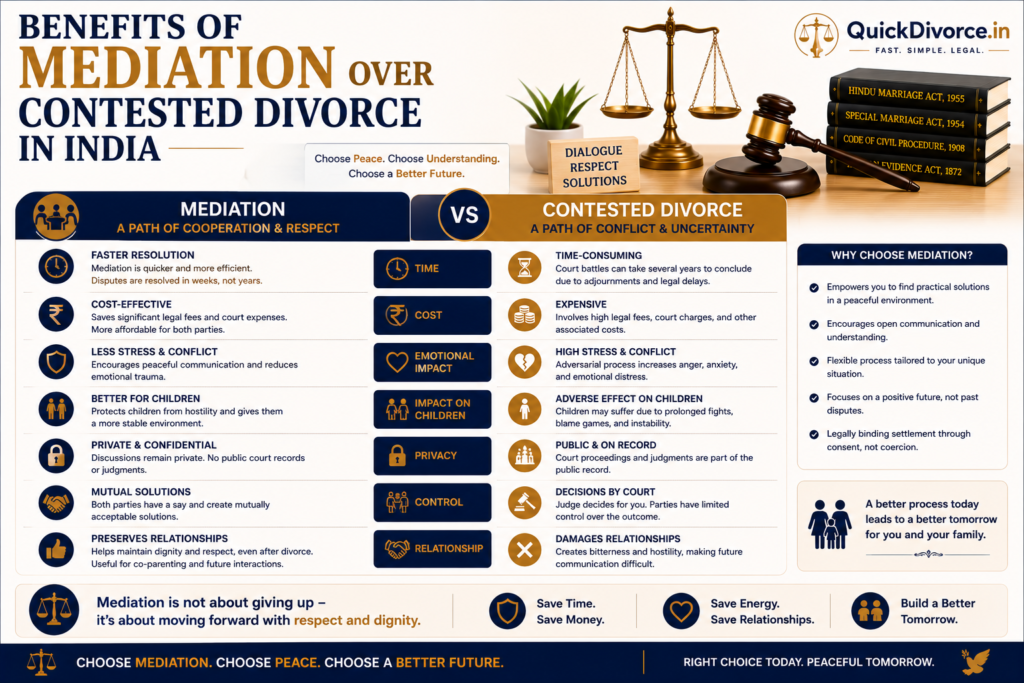
Mediation vs. Contested Divorce: A Detailed Comparison
| Factor | Mediation | Contested Divorce |
|---|---|---|
| Average duration | 2–8 weeks | 3–7 years |
| Average total cost | ₹10,000–₹50,000 | ₹2–30 lakhs |
| Privacy | Completely confidential | Public court record |
| Control over outcome | Both parties decide | Judge decides |
| Emotional impact | Lower — collaborative process | Very high — adversarial |
| Impact on children | Significantly lower | Severely damaging |
| Success rate | 70–80% in India | N/A (forced outcome) |
| Relationship post-divorce | Possible co-parenting relationship | Usually destroyed |
| Flexibility of agreement | Highly customizable | Limited to what court can order |
| Enforceability | Legally binding when converted to consent decree | Legally binding court order |
| Can be appealed | Rarely — both parties agreed | Yes — often leads to further years of appeals |
10 Key Benefits of Mediation Over Contested Divorce
1. Speed : Weeks Instead of Years
The single most dramatic advantage of mediation is time.
A contested divorce in an Indian family court — accounting for adjournments, evidence, cross-examination, arguments, and judgment — takes an average of 4–5 years in metropolitan cities. Many cases go longer.
Mediation typically resolves in 3 to 8 sessions, spread over a few weeks to a couple of months. Even complex cases with significant assets and child custody issues rarely require more than 10–12 sessions.
For people who want to move on with their lives — remarry, relocate, make financial plans — this difference is life-changing.
2. Cost : A Fraction of Litigation Expenses
Contested divorce lawyer fees in India range from ₹5,000–₹25,000 per hearing in tier-1 cities. With dozens of hearings over years, plus court fees, documentation costs, and appeals — total costs for both parties can easily reach ₹10–30 lakhs combined.
Mediation costs:
- Private mediator: ₹5,000–₹15,000 per session (shared between parties)
- Court-annexed mediation center: Often free or nominal (₹1,000–₹5,000 total)
- Lawyer to review final agreement: ₹5,000–₹15,000 (one-time)
Total mediation cost: ₹10,000–₹50,000 in most cases.
That is savings of lakhs — money that both parties can use to actually rebuild their lives.
3. Privacy and Confidentiality
Court proceedings are public. Anyone can sit in a family court and listen to the intimate details of your marriage being argued. Court records are accessible. Allegations made in divorce petitions can be read.
Mediation is entirely confidential. What is said in mediation stays in mediation. There is no public record. The mediator cannot be called as a witness in any subsequent court proceedings. Neither party can use statements made in mediation against the other in court.
For high-net-worth individuals, professionals, public figures, and anyone who values their privacy — this is an enormous advantage.
4. You Control the Outcome
In a contested divorce, a judge decides. The judge does not know you, your children, your finances, or your specific circumstances the way you do. The judge applies the law to the facts presented — and the outcome may satisfy neither party.
In mediation, both parties craft the agreement together. You can agree to arrangements that a court could never order — flexible custody schedules, creative asset division, business continuity arrangements, phased maintenance structures. The agreement reflects your reality, not a generic legal template.
People are also far more likely to comply with an agreement they helped create than with a court order imposed on them.
5. Far Better for Children
This cannot be overstated. Children are the most significant casualties of contested divorce.
Years of parental conflict — court dates, lawyer meetings, stressed parents, financial strain, ongoing hostility — cause measurable psychological harm to children. Studies consistently show that the level of parental conflict, not the divorce itself, is the primary predictor of long-term harm to children.
Mediation dramatically reduces parental conflict. It helps parents focus on what is best for the children rather than on defeating each other. It creates co-parenting agreements that both parents had input into — making compliance far more likely.
Children whose parents mediated their divorce consistently show better outcomes than children whose parents litigated.
6. Preserves the Possibility of Civil Communication
After a contested divorce, the relationship between ex-spouses is typically characterized by deep hostility and complete breakdown of communication. This is a serious problem when children are involved — co-parenting requires ongoing communication for years.
Mediation, by its nature, requires both parties to listen, communicate, and negotiate. Even when the relationship is damaged, mediation often leaves both parties with at least a functional ability to communicate — which is invaluable when raising children together.
7. Emotionally Less Destructive
Cross-examination in a contested divorce is designed to expose weaknesses, contradictions, and damaging facts. It is adversarial by design. Many people describe the experience of being cross-examined in a divorce case as one of the most humiliating experiences of their lives.
Mediation is structured to be non-adversarial. The mediator manages the tone and prevents the conversation from becoming an attack. Issues are addressed as problems to be solved — not as ammunition to be used.
The emotional recovery after mediation is dramatically faster than after contested litigation.
8. Higher Compliance and Fewer Violations
Research consistently shows that parties comply with mediated agreements at significantly higher rates than with court orders.
The reason is simple: ownership. When you helped create the agreement, you understand it, you agreed to it, and you are far more likely to follow it. Court orders imposed by a judge — often on terms neither party likes — generate resentment and non-compliance.
Fewer violations means fewer return trips to court, fewer contempt applications, and less ongoing legal expense.
9. Flexibility of Agreement
Courts are constrained by law in what they can order. A judge cannot, for example, order that a husband continue to pay for his ex-wife’s business expenses, or that a family home be sold only after a child finishes school, or that one parent gets summer custody in a specific city each year.
Mediation has no such constraints. If both parties agree to it, it can be included in the mediated settlement. This allows for genuinely customized arrangements that reflect the real-life complexity of the family’s situation.
10. Finality : No Appeals, No Uncertainty
A contested court judgment can be appealed. An appeal means more years of uncertainty, more legal fees, more emotional turmoil. Many contested divorces go through multiple rounds of appeals before they are truly final.
A properly documented mediated settlement, once converted to a consent decree by the family court, is extremely difficult to challenge or appeal. Both parties agreed. There is very little ground to appeal a decision you voluntarily made.
This finality is enormously valuable — it allows both parties to truly close the chapter and move forward.
When Is Mediation Not Suitable?
Mediation is not appropriate in every situation. It should not be used when:
- There is a history of domestic violence or abuse — the power imbalance makes genuine negotiation impossible and can be dangerous
- One party is completely unwilling to participate in good faith
- There are serious concerns about financial concealment — one party hiding assets requires court-ordered discovery, not mediation
- Emergency situations — child abduction, immediate safety concerns — require court intervention
- One party has a severe mental illness that prevents genuine participation
- Criminal proceedings (dowry harassment, domestic violence FIR) are running alongside the divorce — these require legal intervention
Important: If any of the above apply to your situation, contested divorce or protective legal action may be the appropriate path. Consult a lawyer immediately.
How Does the Mediation Process Work in India?
Step 1: Both Parties Agree to Mediate
Mediation requires the voluntary participation of both parties. Either both agree independently, or the family court refers the case to mediation.
Step 2: Choose a Mediator
Options include:
- Court-annexed mediation center — attached to the High Court or family court, often free or very low cost
- Private mediator — a trained and certified mediator in private practice, higher cost but more scheduling flexibility
- NGO / legal aid mediation centers — available in major cities for those who cannot afford private mediators
Step 3: First Session : Understanding Issues
The mediator meets with both parties (together, and sometimes separately — called “caucuses”) to understand the key issues in dispute and the interests of both parties.
Step 4: Subsequent Sessions : Negotiation
Over multiple sessions, the mediator helps both parties move through each issue — assets, property, custody, maintenance — exploring options and building toward agreement.
Step 5: Drafting the Agreement
Once both parties reach agreement on all issues, the mediator (or their lawyers) drafts a Memorandum of Understanding (MOU) or Settlement Agreement reflecting the agreed terms.
Step 6: Converting to Consent Decree
The settlement agreement is submitted to the family court. The court converts it into a consent decree — making it legally binding and enforceable.
Total timeline: 4–12 weeks in most cases.
Cost of Mediation in India
| Type of Mediation | Cost |
|---|---|
| Court-annexed mediation center (High Court) | Free – ₹5,000 |
| District Legal Services Authority (DLSA) | Free |
| Private mediator | ₹5,000–₹15,000 per session |
| NGO / Legal Aid centers | Free – ₹2,000 |
| Lawyer to review final agreement | ₹5,000–₹15,000 (one-time) |
| Typical total (private) | ₹15,000–₹50,000 |
| Typical total (court-annexed) | ₹1,000–₹10,000 |
Where to Find Mediation Services in India
Court-Annexed Mediation Centers (free / low cost):
- Delhi High Court Mediation and Conciliation Centre
- Bombay High Court Mediation Centre
- Madras High Court Mediation Centre
- Calcutta High Court Mediation Centre
- All district family courts have referral mechanisms
Online / Private Mediation Services:
- Quick Divorce — offers mediation assistance as part of their divorce resolution services
- LegalKart — connects you with trained family mediators
- Indian Institute of Arbitration and Mediation (IIAM)
- Bangalore Mediation Centre
Recommended Services
1. Quick Divorce
⭐ Rating: 4.8/5
Quick Divorce offers mediation-assisted divorce as a service — helping couples who want to resolve disputes without going to court. Their team includes trained family law professionals who can guide both parties through mediated settlement and then handle the consent decree filing.
Pros:
- Mediation + legal documentation in one service
- 100% online process where possible
- Hindi & English support
- Fast turnaround — most cases resolved in weeks
- Affordable flat-fee pricing
Cons:
- Both parties must be willing to participate
Pricing: Mediation-assisted divorce starting at ₹9,999
Best for: Couples who want to resolve disputes outside court and convert the agreement into a legal consent decree quickly.
Start Mediation with Quick Divorce →
Frequently Asked Questions (FAQs)
Q1. Is mediation legally binding in India?
The mediation process itself is voluntary and confidential. However, once both parties reach an agreement and it is documented as a settlement, it can be submitted to the family court and converted into a consent decree — which is fully legally binding and enforceable, just like any court order.
Q2. What if my spouse refuses to come to mediation?
You cannot force someone to mediate. However, if your case is already in family court, the judge can refer both parties to mediation — and a refusal to participate in good faith can be noted adversely by the court. In practice, most people agree to at least attempt mediation when referred by the court.
Q3. Can we use mediation for child custody disputes specifically?
Yes — and it is particularly recommended for child custody. Custody mediation focuses on the child’s best interests and helps parents create parenting plans that work practically for their family. Court-imposed custody orders are often rigid and hard to enforce; mediated parenting plans are typically more realistic and followed more consistently.
Q4. Is everything discussed in mediation confidential?
Yes. Mediation proceedings are legally confidential in India. The mediator cannot be called as a witness in any subsequent court proceedings. Statements made in mediation cannot be used as evidence in court. This confidentiality is one of the key reasons mediation works — people speak more openly when they know it cannot be used against them.
Q5. Can I have a lawyer with me in mediation?
Yes. Both parties can have their lawyers present during mediation sessions. Lawyers in mediation play a supportive and advisory role — not an adversarial one. Many mediators actually prefer that parties have legal advice available so they fully understand the implications of what they are agreeing to.
Q6. What happens if mediation fails — we cannot reach agreement?
If mediation fails, both parties are free to return to the contested divorce process. Nothing agreed or said in mediation can be used in subsequent court proceedings. You lose only the time and cost of mediation — which is far less than what a full contested trial would cost. Many mediations that appear to fail early on eventually succeed after a break and further reflection.
Which Approach Should You Choose?
If both parties are open to resolving things fairly: → Mediation is almost certainly the right path. Start with a consultation at Quick Divorce or LegalKart.
If disputes are serious but both parties are willing to try: → Court-annexed mediation at your nearest High Court mediation center — free, neutral, and court-supervised.
If one party is hiding assets or acting in bad faith: → Mediation may not work. Consult a contested divorce lawyer and consider court-ordered financial disclosure.
If domestic violence is involved: → Do not attempt mediation. Seek legal protection immediately.
If you just want to understand your options: → LegalKart (₹499) for an expert consultation first.
Final Recommendation
If you are considering or already in a contested divorce — please explore mediation before going further.
The numbers are stark: mediation takes weeks, contested divorce takes years. Mediation costs thousands, contested divorce costs lakhs. Mediation keeps the decision in your hands, contested divorce hands it to a judge.
For most couples — even those with serious disputes — mediation is worth attempting. The worst outcome is that it doesn’t work and you proceed to court. The best outcome is that you resolve everything in weeks and move forward with your life.
For mediation-assisted divorce in India, Quick Divorce offers:
- Trained family law professionals guiding the process
- Complete documentation and consent decree filing
- Online process — no unnecessary court visits
- Hindi & English support
- Starting at ₹9,999
Book your free first consultation today.
Need Help With Mediation Over Contested Divorce?
🟡 QuickDivorce.in provides complete mutual divorce legal services — settlement negotiation, alimony structuring, property division, stridhan recovery, MoU drafting, court representation, and post-decree implementation — across all jurisdictions in India.
🟡Visit LegalTax.in for other Legal and Trademark related services as 👉 Money Recovery Cases
👉 Property Disputes 👉 Business & Licence Registrations
🟡Visit Business24hub for IT services
👉 Mutual Consent Divorce at QuickDivorce.in 👉 Contested Divorce Filing 👉 Child Custody and Maintenance 👉 Matrimonial Property Settlement 👉 NRI Divorce Services 👉 Alimony and Maintenance
🟡 Protect Your Rights 👉 Domestic Violence Legal Support at QuickDivorce.in 👉 Stridhan Recovery
📞 Call Now: +91 8595439395 🕐 Free Consultation: Monday to Saturday, 10 AM to 6 PM

Adv. Manish Kashyap is a Family Law & Divorce Lawyer with extensive experience in Mutual & Contested Divorce, NRI Divorce, Child Custody, Alimony, Domestic Violence, Judicial Separation, and Family Court matters, providing professional legal guidance to clients.

