

Views: 19
Complete guide to marriage registration for inter-religion couples in India — process, documents, notice rules, and legal rights in 2026.
Table of Contents
- 1 Introduction
- 2 1. Which Law Applies to Inter-Religion Marriages?
- 3 2. Eligibility Conditions
- 4 3. Step-by-Step Registration Process
- 5 4. Documents Required
- 6 5. The 30-Day Notice Period Explained
- 7 6. Privacy Concerns and Recent Legal Developments
- 8 7. Succession and Inheritance Rights for Interfaith Couples
- 9 8. No Conversion Required
- 10 9. Fees and Timeline
- 11 10. State-Specific Considerations
- 12 11. Legal Protections for Interfaith Couples
- 13 12. Advantages and Challenges
- 14 13. Common Mistakes to Avoid
- 15 14. Expert Tips for Interfaith Couples
- 16 15. Quick Checklist
- 17 16. Real-Life Example
- 18 17. Latest 2026 Updates
- 19 18. Frequently Asked Questions
- 20 19. Conclusion
- 21 Get Expert Advice for Marriage Registration in India
Introduction
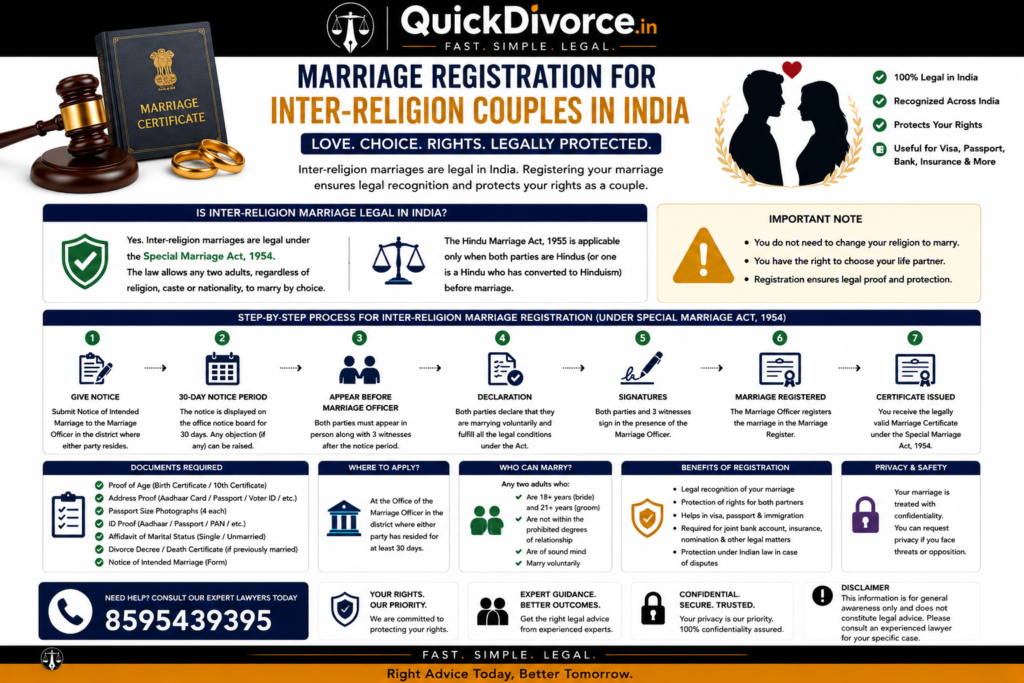
Marrying someone from a different religion in India comes with a legal process that same-faith couples never have to think about. Marriage registration for inter-religion couples in India is governed primarily by the Special Marriage Act, 1954 — a law designed to let two people marry as a civil contract, without either partner converting or performing religious rites.
But this route also comes with its own procedural quirks: a mandatory public notice period, specific succession rules for each partner, and, in recent years, real privacy and safety concerns that courts are actively debating. This guide walks through exactly how inter-religion couples can register their marriage, what documents are needed, what legal protections apply, and what to watch out for during the process.
1. Which Law Applies to Inter-Religion Marriages?
For couples belonging to different religions, the Special Marriage Act, 1954 is almost always the applicable law. Unlike the Hindu Marriage Act, Christian Marriage Act, or Muslim personal law — all of which are tied to a specific religion — the Special Marriage Act is secular and applies to any two Indian citizens regardless of faith.
This means an interfaith couple does not need either partner to convert to the other’s religion, and the marriage is treated as a purely civil contract rather than a religious sacrament. It’s also the same Act used by couples who simply prefer a court marriage over a religious ceremony, even if they share the same faith.
2. Eligibility Conditions
To register under the Special Marriage Act, both parties must meet these conditions:
- Age: The bride must be at least 18 and the groom at least 21.
- Sound mind: Both parties must be capable of giving valid consent.
- Free consent: Marriage must be entered into willingly, without coercion or fraud.
- No living spouse: Neither party should have a spouse who is still living, unless legally divorced or widowed.
- Prohibited relationships: Parties must not fall within degrees of prohibited relationship under the Act.
- Residency: At least one party must have resided in the district of the Marriage Officer for a minimum period (commonly 30 days) before filing notice.
3. Step-by-Step Registration Process
- File a Notice of Intended Marriage with the Marriage Officer in the district where either party has resided for the required period.
- Submit supporting documents — age proof, residence proof, identity proof, and photographs.
- The Marriage Officer publishes the notice and it remains open to objections for 30 days.
- If no valid objection is raised, the marriage can be solemnised after the notice period.
- If an objection is filed, the Marriage Officer must conduct an inquiry before deciding whether to proceed.
- On the appointed date, both parties and three witnesses must appear before the Marriage Officer.
- The marriage is solemnised and registered, and a certificate is issued — often the same day.
4. Documents Required
- Notice of Intended Marriage, signed by both parties
- Proof of age (birth certificate, passport, or matriculation certificate)
- Proof of residence for the required period in the district
- Passport-size photographs of both parties
- Identity proof (Aadhaar, PAN, passport, or voter ID)
- Affidavit confirming marital status, free consent, and no prohibited relationship
- Divorce decree or death certificate of a previous spouse, if applicable
- ID proof of three witnesses
Warning Box: If either party has recently moved districts, some registrars require proof of residence in both the previous and current district, which can extend processing time — confirm this with your Marriage Officer in advance.
5. The 30-Day Notice Period Explained
Once the notice is filed, the Marriage Officer is required to publish it — typically by posting a copy in a visible location at the office and sometimes sending a copy to the couple’s home addresses. Anyone can inspect the notice during this period and raise a written objection on statutory grounds, such as:
- Either party being underage
- One party already having a living spouse
- Unsoundness of mind
- The parties falling within a prohibited relationship
If an objection is raised, the Marriage Officer must investigate before deciding whether the marriage can proceed. If no valid objection is filed within 30 days, the couple can move forward with solemnisation.
6. Privacy Concerns and Recent Legal Developments
The 30-day public notice requirement has become a significant point of legal debate, particularly for inter-religion couples. Because personal details — names, photographs, and addresses — are made publicly viewable, some couples have faced harassment, doxxing, or targeted objections from relatives or outside groups after their notice was published or leaked online.
This has led to real legal pushback:
- The Allahabad High Court ruled that publishing the notice and inviting public objections is not mandatory, and couples can request the Marriage Officer to skip public notification if they choose.
- Petitions are pending before the Delhi High Court and the Supreme Court challenging the constitutionality of the mandatory notice provisions, arguing they violate the right to privacy and equality, since no equivalent notice requirement exists for marriages under personal laws like the Hindu Marriage Act.
- The Supreme Court’s observations in Supriyo v. Union of India (2023) acknowledged that the notice regime has a “chilling effect” on interfaith couples’ right to marry by exposing them to social and family scrutiny.
Important Note: As of 2026, the notice requirement remains technically in force under the law, but its enforcement varies — some registrars now treat public publication as optional if the couple requests otherwise, following the Allahabad High Court’s directive. Practices differ by state and even by individual Marriage Officer, so it’s worth asking directly whether your registrar allows a private notice process.
7. Succession and Inheritance Rights for Interfaith Couples
One detail many interfaith couples miss: marrying under the Special Marriage Act does not merge the couple’s inheritance laws. Each party’s estate continues to be governed by their own personal succession law, unless they write a will.
- If both parties were born Hindu, Buddhist, Jain, or Sikh, the Hindu Succession Act, 1956 applies to their estate.
- If either party is not Hindu, Buddhist, Jain, or Sikh, the Indian Succession Act, 1925 governs their estate.
This means, for example, that in a Hindu-Muslim marriage under the Special Marriage Act, the husband’s estate may devolve under Hindu succession rules while the wife’s estate follows Muslim personal law — unless both have valid wills specifying otherwise.
8. No Conversion Required
A major advantage of registering under the Special Marriage Act is that neither party is required to convert to the other’s religion. Each spouse retains their birth religion, and the marriage is treated as a secular civil contract rather than a religious union. This distinguishes it clearly from marrying under one partner’s personal law, which would typically require the other party to convert first.
9. Fees and Timeline
| Component | Approximate Cost (INR) |
|---|---|
| Notice fee | ₹100 – ₹150 |
| Solemnisation and certificate fee | ₹200 – ₹500 |
| Certified copy (if lost) | ₹50 per copy |
| Scenario | Approximate Timeline |
|---|---|
| No objections raised | 30 days (notice period) + a few days for solemnisation |
| Objection raised, inquiry needed | Add 30–60 days |
| Appeal against refusal in district court | Add 90–180 days |
10. State-Specific Considerations
Some states have introduced additional scrutiny for interfaith marriages, particularly where state-level “anti-conversion” laws exist. For example, Uttar Pradesh’s ordinance on religious conversion requires additional declarations in certain conversion-related scenarios, which can complicate matters if a conversion is contemplated alongside marriage — even though the Special Marriage Act itself does not require conversion. Couples should check their specific state’s rules if either partner is also considering converting religion around the time of marriage, as that triggers separate legal requirements distinct from marriage registration itself.
11. Legal Protections for Interfaith Couples
- Courts have consistently upheld the right of adults to marry a partner of their choice, regardless of religion, as part of the fundamental right to personal liberty.
- Several High Courts have directed police protection for interfaith couples facing threats or harassment from family or community members.
- The Special Marriage Act’s registration itself provides legal standing for maintenance, inheritance claims, and protection under domestic laws, just as with any other registered marriage.
12. Advantages and Challenges
Advantages
- No religious conversion required for either partner
- Legally recognised nationwide as a valid civil marriage
- Provides the same legal protections as any registered marriage
- Retains each partner’s personal succession rights
Challenges
- Mandatory 30-day notice period, with public disclosure of personal details in many states
- Potential family or community objections during the notice period
- Risk of harassment if notice details are leaked or misused online
- Longer overall timeline compared to same-faith registration under personal laws
13. Common Mistakes to Avoid
- Assuming conversion is required — it is not, under the Special Marriage Act
- Not checking whether your registrar allows a private (non-published) notice option
- Missing witness documentation on the day of solemnisation
- Failing to write a will, leaving succession governed by default personal laws that may not reflect the couple’s wishes
- Underestimating family objections and not preparing for potential harassment risks
14. Expert Tips for Interfaith Couples
- Ask your Marriage Officer directly whether the notice can be filed without public display, especially in states where courts have permitted this.
- Consider drafting a will soon after marriage if you want your estate to be distributed differently from default succession rules.
- Keep certified copies of your marriage certificate ready for any future visa, banking, or inheritance-related documentation.
- If you anticipate family objections, consult a family law advocate in advance about your legal protections and available police assistance if needed.
- Clarify with your registrar in advance which documents are needed if either partner has recently changed districts.
15. Quick Checklist
- [ ] Confirmed eligibility (age, consent, no living spouse)
- [ ] Selected Marriage Officer in the correct jurisdiction
- [ ] Filed Notice of Intended Marriage
- [ ] Gathered age, residence, and identity proof
- [ ] Asked about private/non-published notice option
- [ ] Arranged three witnesses with valid ID
- [ ] Attended solemnisation appointment after the 30-day period
- [ ] Collected marriage certificate
- [ ] Considered drafting a will for succession clarity
16. Real-Life Example
An interfaith couple — one Hindu, one Muslim — filed their Special Marriage Act notice in Delhi. A distant relative filed an objection during the 30-day window, citing concerns about the marriage. The Marriage Officer conducted an inquiry, found no valid legal ground for the objection, and the marriage was solemnised once the notice period concluded. Because both partners retained their birth religion, they later consulted a lawyer to draft individual wills, ensuring their respective estates would pass according to their own wishes rather than default succession rules.
17. Latest 2026 Updates
- The Allahabad High Court’s ruling that public notice publication is not mandatory continues to influence practice, with some Marriage Officers now allowing couples to skip public display of their notice on request.
- Petitions challenging the constitutionality of the Special Marriage Act’s notice provisions remain pending before the Delhi High Court and Supreme Court as of 2026.
- Reports of interfaith couples’ personal details being leaked or misused from published notices have prompted several states to review how notices are displayed and stored online.
- Digital marriage certificates with QR codes are increasingly available for Special Marriage Act registrations in states like Delhi, Maharashtra, and Karnataka.
18. Frequently Asked Questions
1. Which law governs Marriage Registration for Inter-Religion Couples in India?
Marriage Registration for Inter-Religion Couples is governed by the Special Marriage Act, 1954. This law allows two individuals of different religions to marry through a civil process without requiring either person to convert to the other’s religion.
2. Is religious conversion required for Marriage Registration for Inter-Religion Couples?
No. Marriage Registration for Inter-Religion Couples under the Special Marriage Act does not require either spouse to change or convert their religion. Both individuals are free to retain their respective faiths after marriage.
3. Is the 30-day notice period mandatory for Marriage Registration for Inter-Religion Couples?
Yes. The Special Marriage Act generally requires a 30-day public notice period before the marriage can be solemnised. However, in certain cases, courts have permitted relaxation of public notice requirements based on judicial decisions and the specific facts of the case.
4. Can family members object to Marriage Registration for Inter-Religion Couples?
Yes, objections may be submitted during the notice period, but only on valid legal grounds such as an existing marriage, prohibited relationship, or failure to meet the legal age requirement. Objections based solely on religion, caste, or family preference are not valid under the law.
5. How is inheritance handled after Marriage Registration for Inter-Religion Couples?
After Marriage Registration for Inter-Religion Couples, inheritance rights are generally governed by the applicable succession laws. Couples may also choose to prepare a valid will to clearly determine the distribution of their assets.
6. Can inter-religion couples receive police protection if they face threats?
Yes. Courts in India have repeatedly directed authorities to provide police protection to inter-religion couples who face threats, harassment, or intimidation from family members or other individuals because of their marriage.
7. How long does Marriage Registration for Inter-Religion Couples take?
Marriage Registration for Inter-Religion Couples usually takes a minimum of 30 days due to the statutory notice period under the Special Marriage Act. If objections are filed, the process may take longer until the Marriage Officer completes the required inquiry.
8. Can inter-religion couples request that the notice not be displayed publicly?
In some jurisdictions, based on recent judicial decisions, couples may request the Marriage Officer to avoid unnecessary public disclosure of the marriage notice in order to protect their privacy. The final decision depends on the applicable legal guidelines and local administrative practices.
9. Are additional documents required for Marriage Registration for Inter-Religion Couples?
Generally, no additional religious documents are required. Couples must submit the standard documents prescribed under the Special Marriage Act, including proof of age, identity, address, passport-size photographs, and any other documents required by the concerned Marriage Registrar.
10. Can Marriage Registration for Inter-Religion Couples be challenged after registration?
Once Marriage Registration for Inter-Religion Couples has been completed in accordance with the law, the marriage enjoys full legal recognition. It can only be challenged through appropriate legal proceedings, such as annulment or divorce, before a competent court.
19. Conclusion
Registering a marriage between partners of different religions in India is entirely legal and protected, primarily through the Special Marriage Act, 1954. While the process involves a mandatory notice period and some procedural hurdles not faced by same-faith couples, it does not require conversion and provides full legal recognition once completed.
Given the ongoing legal debate around the notice period’s privacy implications, interfaith couples should ask their Marriage Officer about available options, prepare for potential family objections, and consider drafting a will to clarify succession — since inheritance continues to follow each partner’s own personal law after marriage.
Get Expert Advice for Marriage Registration in India
🟡QuickDivorce offers trusted online legal services across India, including mutual divorce, contested divorce, child custody, alimony, marriage registration, and expert family law consultation.
👉 Mutual Consent Divorce
👉 Contested Divorce Filing
👉 Child Custody and Maintenance
👉 Matrimonial Property Settlement
👉 NRI Divorce Services
👉 Alimony and Maintenance
👉 Court Marraige
👉 Stridhan Recovery
🟡For other Legal and Trademark related services visit
👉 Money Recovery Cases
👉 Property Disputes
👉 Business & Licence Registrations
📞 Call Now: +91 8595439395
🕐 Free Consultation: Monday to Saturday, 10 AM to 6 PM

Adv. Manish Kashyap is a Family Law & Divorce Lawyer with extensive experience in Mutual & Contested Divorce, NRI Divorce, Child Custody, Alimony, Domestic Violence, Judicial Separation, and Family Court matters, providing professional legal guidance to clients.

