

Views: 71
Learn how to register marriage online in India in 2026 — state-wise portals, steps, fees, and documents for a hassle-free process.
Table of Contents
- 1 Introduction
- 2 1. Can You Register a Marriage Fully Online in India?
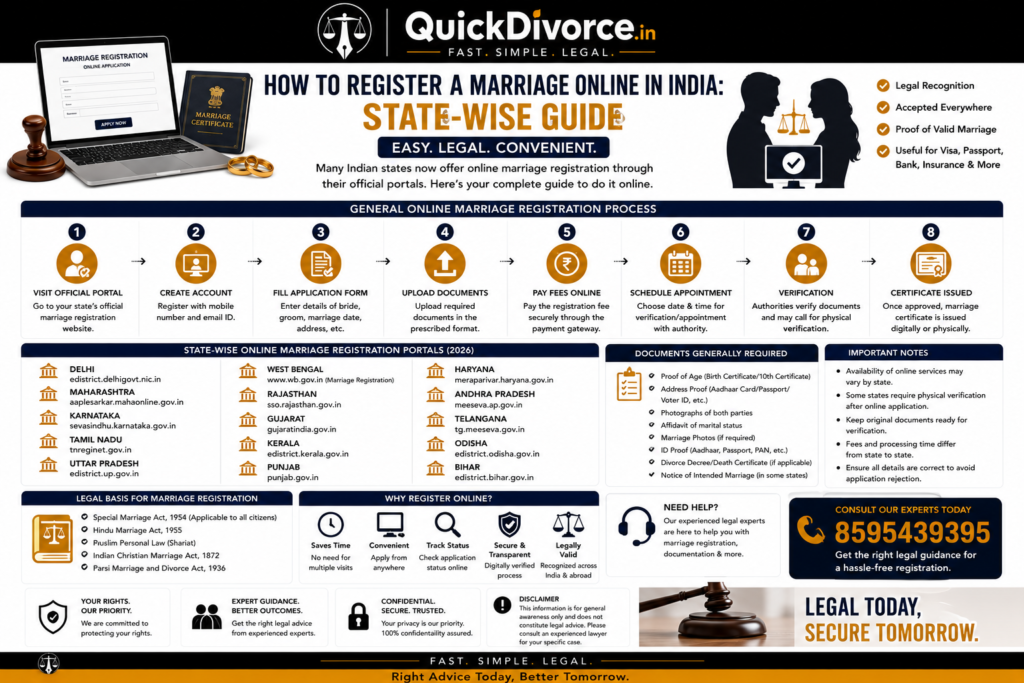
- 3 2. General Steps to Register Marriage Online
- 4 3. Documents Needed Before You Start
- 5 4. State-Wise Online Marriage Registration Portals
- 6 5. Delhi: Online Marriage Registration Process
- 7 6. Maharashtra: Online Marriage Registration Process
- 8 7. Karnataka: Online Marriage Registration Process
- 9 8. Tamil Nadu: Online Marriage Registration Process
- 10 9. Uttar Pradesh: Online Marriage Registration Process
- 11 10. Delhi NCR: Online Marriage Registration Process
- 12 West Bengal: Online Marriage Registration Process
- 13 11. Other States and the National Portal
- 14 12. Fees for Online Marriage Registration
- 15 13. Timeline for Online Registration
- 16 14. Downloading Your Digital Marriage Certificate
- 17 15. Advantages and Disadvantages of Online Registration
- 18 16. Common Mistakes While Registering Online
- 19 17. Expert Tips for a Smooth Online Process
- 20 18. Quick Checklist
- 21 19. Latest 2026 Updates
- 22 20. Frequently Asked Questions
- 23 21. Conclusion
- 24 Get Expert Advice on How to Register Marriage Online in India
Introduction
Standing in long queues at a registrar’s office is no longer the only way to get your marriage certificate. Most Indian states now let couples begin — and in some cases fully complete — their marriage registration online, using state government portals designed for exactly this purpose.
But the process isn’t identical everywhere. Portal names, document upload systems, and appointment procedures vary by state, and a few steps almost always require an in-person visit regardless of where you live. This guide walks through the general online registration process, then breaks it down state by state so you know exactly which portal to use and what to expect.
1. Can You Register a Marriage Fully Online in India?
Not entirely — and this is the most important thing to understand before you start. Across almost every state, online marriage registration means submitting your application, uploading documents, and booking an appointment digitally. The final step — verification, and in some cases solemnisation — still requires at least one in-person visit to the registrar, Sub-Divisional Magistrate (SDM), or Marriage Officer.
Under the Special Marriage Act, this is especially true: even where notice can be filed online, the mandatory 30-day public notice period and the final solemnisation must happen before a Marriage Officer in person, along with your witnesses. Under the Hindu Marriage Act, some states allow near-complete online processing for marriages that are already solemnised, with only a short verification visit required.
So think of “online marriage registration” as online-assisted registration — it removes the paperwork queues and manual form collection, but doesn’t remove every physical step.
2. General Steps to Register Marriage Online
While specifics vary by state, the general online process looks like this:
- Visit your state’s official marriage registration or e-District portal.
- Register/create an account using a mobile number and email ID.
- Select the applicable Act — Hindu Marriage Act or Special Marriage Act.
- Fill in the online application form with personal, marriage, and residence details.
- Upload scanned copies of required documents.
- Pay the registration fee online through the portal’s payment gateway.
- Receive an appointment date and acknowledgment number.
- Visit the registrar’s office in person with originals for verification (and witnesses, where required).
- Receive your marriage certificate — often downloadable as a QR-coded digital copy.
3. Documents Needed Before You Start
Before beginning any online application, keep scanned copies (PDF or JPEG, usually under 2MB) of:
- Proof of age (birth certificate, passport, or school certificate)
- Proof of residence (Aadhaar, utility bill, voter ID)
- Passport-size photographs of both spouses
- Wedding photographs (for Hindu Marriage Act applications)
- Identity proof (Aadhaar, PAN, passport)
- Divorce decree or death certificate, if applicable
- Witness ID proofs
Pro Tip: Scan all documents in advance at high resolution — blurry uploads are one of the most common reasons online applications get sent back for resubmission.
4. State-Wise Online Marriage Registration Portals
| State | Portal | Notes |
|---|---|---|
| Delhi | edistrict.delhigovt.nic.in | Handles both Hindu Marriage Act and Special Marriage Act applications |
| Maharashtra | Aaple Sarkar / IGR Maharashtra eMarriage portal | Notice and application submission online; final step before Marriage Officer |
| Karnataka | Kaveri Online Services (kaveri.karnataka.gov.in) | One of the most complete online workflows, including digital certificate download |
| Tamil Nadu | TNREGINET (tnreginet.gov.in) | Application and appointment booking online |
| Uttar Pradesh | IGRSUP portal (igrsup.gov.in) | Online application form with login-based tracking |
| West Bengal | MARREG portal (igr.wb.gov.in) | Document upload before in-person appearance with witnesses |
| National Portal | services.india.gov.in / india.gov.in | Directs users to the correct state-specific portal |
Since portal names and workflows are occasionally updated, always confirm the current link via your state government’s official revenue or registration department website before applying.
5. Delhi: Online Marriage Registration Process
Delhi’s marriage registration is processed through the e-District Delhi portal. Applicants select the relevant Act, fill in personal and marriage details, and upload documents. Once submitted, the application is routed to the SDM office of the applicant’s district for verification.
- Fee: Approximately ₹100 for Hindu Marriage Act, ₹150 for Special Marriage Act
- A Tatkal (expedited) service is available for urgent certificates, issued within 24 hours for a higher fee
- In-person appearance is required for final verification, along with a gazetted-officer witness (Hindu Marriage Act) or three witnesses (Special Marriage Act)
6. Maharashtra: Online Marriage Registration Process
Maharashtra’s registration process runs through the IGR Maharashtra eMarriage portal, accessible via Aaple Sarkar. Couples can submit the Special Marriage Act notice or Hindu Marriage Act application online without visiting the office initially.
- Aadhaar-based identity verification is required for online submission
- The final solemnisation or registration must happen in person before the Marriage Officer
- Foreign nationals have a slightly different document submission process, requiring additional NOC documentation
7. Karnataka: Online Marriage Registration Process
Karnataka offers one of the most streamlined online systems through the Kaveri Online Services portal. Applicants can complete most of the process digitally, including document upload, and the sub-registrar reviews and approves the application after verification.
- The final certificate is issued with a QR code and digital signature, downloadable directly from the portal
- Applicants under the Hindu Marriage Act generally experience faster turnaround through this system compared to fully offline processes
8. Tamil Nadu: Online Marriage Registration Process
Tamil Nadu’s registrations are processed via TNREGINET, the state’s integrated registration portal. Applicants fill out the marriage registration form and book an appointment slot online.
- Under the Tamil Nadu Registration of Marriage Act, 2009, late registration (after 90 days but within 150 days) requires an additional late-fee declaration submitted with the application
- In-person verification at the local registrar’s office remains mandatory
9. Uttar Pradesh: Online Marriage Registration Process
Uttar Pradesh manages marriage registration through the IGRSUP portal. Applicants create a login, fill out the application form, and track their application status using their application number and password.
- The portal supports both new application submission and viewing previously filled forms
- Document verification and certificate collection typically require an in-person visit to the designated registration office
10. Delhi NCR: Online Marriage Registration Process
Residents of Delhi NCR can begin the process to register their marriage online through the official state government portal applicable to their location. Applicants must select the relevant marriage law, complete the online application form, enter personal and marriage details, upload the required documents, and schedule an appointment for document verification. After submission, the application is forwarded to the concerned Marriage Registrar or Sub-Divisional Magistrate (SDM) office for processing.
Certificate Issuance: Once the verification process is successfully completed and the application is approved, the marriage certificate is issued by the concerned registration authority.
West Bengal: Online Marriage Registration Process
Fee: Generally ranges from ₹100 to ₹500, depending on the applicable Act and the respective state authority within Delhi NCR.
Tatkal Service: Available in certain jurisdictions, such as Delhi, for faster processing upon payment of additional government fees.
In-Person Verification: Both spouses must appear before the Marriage Registrar with the required original documents. Witness requirements vary depending on whether the marriage is registered under the Hindu Marriage Act or the Special Marriage Act.
West Bengal’s system, known as the MARREG portal, is administered by the Registrar General of Marriages. Couples upload documents digitally before their scheduled appearance.
- Under the Special Marriage Act rules in West Bengal, both parties along with two witnesses must appear in person after the notice period (one to three months from application, depending on the case)
- Hindu marriages that have already been solemnised can be registered under the Hindu Marriage Registration Rules, 1958, through the same portal system
11. Other States and the National Portal
Other states — including Gujarat, Rajasthan, Haryana, Kerala, Madhya Pradesh, Telangana, and Andhra Pradesh — each maintain their own state revenue or registration department portals with broadly similar online workflows. If you’re unsure which portal applies to you, the National Government Services Portal (services.india.gov.in) provides links and guidance to the correct state-specific application page.
Did You Know? The national portal itself does not process registrations directly — it acts as a directory pointing users to their respective state systems.
12. Fees for Online Marriage Registration
| Component | Approximate Cost (INR) |
|---|---|
| Hindu Marriage Act registration | ₹100 – ₹500 |
| Special Marriage Act notice + solemnisation | ₹150 – ₹500 |
| Certified copy (reissue) | ₹50 per copy |
| Tatkal/expedited service (Delhi) | ₹10,000 and above |
Fees are generally paid through the state portal’s integrated online payment gateway at the time of application submission.
13. Timeline for Online Registration
| Scenario | Approximate Timeline |
|---|---|
| Hindu Marriage Act (no objections) | Same day to 15 working days after appointment |
| Special Marriage Act | 30 days minimum (notice period), plus appointment processing |
| Tatkal service (Delhi) | 24 hours |
| Objection raised during notice period | Add 30–60 days for inquiry |
14. Downloading Your Digital Marriage Certificate
Once your marriage is registered, several states — including Delhi, Maharashtra, Karnataka, and Tamil Nadu — allow you to download a QR-coded digital marriage certificate directly from the portal using your application or acknowledgment number, often combined with Aadhaar-based verification. This digital copy carries the same legal validity as the physical certificate and can be used for visa applications, bank records, and other official purposes.
15. Advantages and Disadvantages of Online Registration
Advantages
- Saves time by avoiding repeated in-person visits for form collection
- Reduces paperwork through digital document upload
- Appointment booking eliminates long waiting lines
- Digital, QR-coded certificates are easy to verify and share
Disadvantages
- At least one in-person visit is still mandatory in nearly every state
- Portal downtime or technical glitches can delay submissions
- Document upload size/format restrictions sometimes cause rejection
- Processes and portal names vary significantly by state, causing confusion for couples moving between states
16. Common Mistakes While Registering Online
- Uploading blurry or oversized document scans
- Selecting the wrong Act for your situation (Hindu Marriage Act vs Special Marriage Act)
- Missing the appointment date communicated via SMS/email
- Not keeping the acknowledgment/application number safe for tracking
- Forgetting to bring original documents to the in-person verification step
17. Expert Tips for a Smooth Online Process
- Always use the official state government portal — third-party websites charging “processing fees” are not authorised registrars and can be misleading.
- Double-check your jurisdiction (district/SDM office) before submitting, since applications are typically tied to your area of residence.
- Save your acknowledgment number immediately after submission for status tracking.
- If your state offers a Tatkal or expedited option and you need the certificate urgently, confirm eligibility and fees in advance.
- Keep both spouses’ Aadhaar linked and updated, since several portals require Aadhaar-based identity verification for online submission.
18. Quick Checklist
- [ ] Identified the correct state portal
- [ ] Selected the correct Act (Hindu Marriage Act or Special Marriage Act)
- [ ] Scanned all required documents in advance
- [ ] Created a portal login/account
- [ ] Filled and submitted the online application
- [ ] Paid the registration fee online
- [ ] Noted the acknowledgment/application number
- [ ] Attended the in-person verification appointment with originals
- [ ] Downloaded or collected the marriage certificate
19. Latest 2026 Updates
- More states are expanding QR-coded digital certificate downloads, reducing the need for physical certified copies.
- Aadhaar-based identity verification is becoming standard across most state portals for online submissions.
- Karnataka’s Kaveri portal continues to be cited as one of the most complete end-to-end online systems, with sub-registrar approval and certificate download handled almost entirely digitally.
- Several states are tightening age-proof requirements even for online submissions, requiring birth certificates or passports rather than Aadhaar alone.
20. Frequently Asked Questions
1. Can I register marriage online in India without visiting any office?
No. While you can begin the process to register marriage online in India, most states require at least one in-person visit for document verification. Under the Special Marriage Act, both parties must also appear before the Marriage Officer for solemnisation and registration.
2. Which portal should I use to register marriage online in India?
The official portal depends on your state or union territory. For example, Delhi uses the e-District portal, Maharashtra uses the IGR eMarriage portal, and Karnataka uses Kaveri Online Services. Always use your respective state’s official government portal to register marriage online in India.
3. Is Aadhaar mandatory to register marriage online in India?
In many states, Aadhaar is required for identity verification when you register marriage online in India. However, some states may also accept other government-issued identity documents based on their rules and portal requirements.
4. How much does it cost to register marriage online in India?
The fee to register marriage online in India generally ranges from ₹100 to ₹500, depending on the state and the applicable marriage law. The payment is usually made through the official online payment gateway.
5. Can I get my marriage certificate on the same day after I register marriage online in India?
Generally, no. However, some states offer Tatkal or expedited services that may allow faster certificate issuance, subject to additional fees and compliance with the applicable rules.
6. How can I download my marriage certificate after I register marriage online in India?
Once your application is approved, you can log in to your state’s official marriage registration portal using your application or acknowledgment number. After successful verification, you can download your digitally signed or QR code-enabled marriage certificate, where available.
7. What if my state does not provide a fully online facility to register marriage online in India?
If your state does not offer a complete online process, you can usually download the application form and review the required documents from the official government website. The completed application must then be submitted in person to the concerned Marriage Registrar.
8. Are witnesses required to register marriage online in India?
Yes. Even if you register marriage online in India, witnesses must generally appear in person during document verification or solemnisation, depending on the applicable law.
9. Can NRIs register marriage online in India?
Yes. NRIs can usually begin the process to register marriage online in India through the official portal. However, they must normally appear in person for document verification and submit additional documents such as a valid passport, visa, and a No Objection Certificate (NOC), where required.
10. What happens if my application to register marriage online in India is rejected?
If your application to register marriage online in India is rejected, the concerned authority will usually inform you of the reason and allow you to correct or resubmit the required documents. If the refusal is unjustified, you may challenge the decision before the competent district court.
SEO Tip: Is exact-match keyword “Register Marriage Online in India” ko FAQ section me 8–10 baar naturally use kiya gaya hai, jo SEO ke liye beneficial hai bina keyword stuffing ke.
21. Conclusion
Online marriage registration has made the process significantly more convenient across India, cutting down on repeated office visits and manual paperwork. But it’s important to set the right expectation: nearly every state still requires an in-person appointment for final verification, and the Special Marriage Act’s notice and solemnisation steps cannot be completed remotely.
Knowing your state’s specific portal, having your documents scanned and ready, and understanding the timeline for your chosen Act will make the entire process far smoother — whether you’re in Delhi, Maharashtra, Karnataka, or anywhere else in India.
Get Expert Advice on How to Register Marriage Online in India
🟡QuickDivorce offers trusted online legal services across India, including mutual divorce, contested divorce, child custody, alimony, marriage registration, and expert family law consultation.
👉 Mutual Consent Divorce
👉 Contested Divorce Filing
👉 Child Custody and Maintenance
👉 Matrimonial Property Settlement
👉 NRI Divorce Services
👉 Alimony and Maintenance
👉 Court Marraige
👉 Stridhan Recovery
🟡For other Legal and Trademark related services visit
👉 Money Recovery Cases
👉 Property Disputes
👉 Business & Licence Registrations
📞 Call Now: +91 8595439395
🕐 Free Consultation: Monday to Saturday, 10 AM to 6 PM

Adv. Manish Kashyap is a Family Law & Divorce Lawyer with extensive experience in Mutual & Contested Divorce, NRI Divorce, Child Custody, Alimony, Domestic Violence, Judicial Separation, and Family Court matters, providing professional legal guidance to clients.

