

Views: 27
Learn how to recover stridhan after divorce in India — legal rights, the role of Section 316 BNS, civil remedies, and a step-by-step process to reclaim your property.
Table of Contents
- 1 Introduction
- 2 What Exactly Is Stridhan?
- 3 The Legal Foundation: Why Stridhan Belongs Solely to the Woman
- 4 Legal Remedies Available to Recover Stridhan After Divorce
- 5 Step-by-Step Process to Recover Stridhan After Divorce
- 6 What If the Husband or In-Laws Are Abroad or the Marriage Was Dissolved Overseas?
- 7 Common Mistakes That Weaken a Stridhan Recovery Case
- 8 How Long Do You Have to Recover Stridhan After Divorce?
- 9 What If You’re Falsely Accused of Withholding Stridhan?
- 10 How QuickDivorce.in Can Help
- 11 Frequently Asked Questions (FAQs)
- 12 Conclusion
- 13 For Expert Guidance Contact Now
Introduction
For many women, walking away from a marriage doesn’t just mean leaving a relationship behind — it often means leaving behind jewellery, gifts, and valuables that were always, legally, theirs to begin with. When in-laws or a former husband refuse to return these items, the question that follows is a deeply practical one: how do you actually recover stridhan after divorce in India, and what does the law really allow you to do about it?
The good news is that Indian law has consistently and unambiguously protected a woman’s right to her stridhan, treating it as her absolute, individual property regardless of marital status. The challenge, in practice, lies not in the legal principle itself, but in proving entrustment, documenting the items, and choosing the right legal route to pursue. This guide walks you through exactly how to recover stridhan after divorce in India in 2026 — the legal definition, your rights, the criminal and civil remedies available, and a clear step-by-step process to follow.
What Exactly Is Stridhan?
Stridhan is a concept rooted in Hindu legal tradition, combining the Sanskrit words “Stri” (woman) and “Dhan” (wealth), and it refers to any property — movable or immovable — given to a woman before, during, or after her marriage. This includes:
- Jewellery and gold ornaments gifted by either side of the family
- Cash, gifts, and valuables received at the wedding
- Property or assets received through a will or inheritance
- Items gifted for her personal use, or even for joint use within the household (such as furniture gifted specifically to the bride)
- Gifts received from her own parents, siblings, in-laws, or even friends, at any point connected to the marriage
What’s critical to understand before attempting to recover stridhan after divorce is that this property belongs exclusively to the woman. Marriage does not create joint ownership over it, and her husband or in-laws, even where they hold physical possession of these items, are legally regarded only as trustees or custodians — not owners.
The Legal Foundation: Why Stridhan Belongs Solely to the Woman
The Supreme Court settled this question decisively in Pratibha Rani v. Suraj Kumar (1985), holding that stridhan remains the wife’s absolute property and that a husband or his relatives who retain it are bound, in law, to return it. The Court firmly rejected the argument that a marital relationship somehow negates the legal concept of “entrustment” between spouses.
This position has been reaffirmed repeatedly since. In Rashmi Kumar v. Mahesh Kumar Bhada (1997), the Supreme Court held that continued refusal to return stridhan is a continuing offence, meaning the clock for limitation does not simply run out after a fixed period — the offence persists for as long as the property is wrongfully withheld. Later, in Krishna Bhattacharjee v. Sarathi Choudhury (2016), the Court went further, clarifying that divorce itself does not extinguish a woman’s right to reclaim her stridhan, nor does it weaken her ability to pursue a criminal remedy for its return.
Together, these rulings form the legal backbone for anyone seeking to recover stridhan after divorce — confirming that neither separation, nor divorce, nor the passage of time (within reason) defeats this right.
Legal Remedies Available to Recover Stridhan After Divorce
Indian law offers multiple, overlapping legal routes to recover stridhan after divorce, and women are not restricted to pursuing just one. The main remedies include:
1. Criminal Breach of Trust — Section 316, Bharatiya Nyaya Sanhita, 2023 (formerly Section 406 IPC)
This is the primary criminal remedy used to recover stridhan after divorce. Section 316 BNS (corresponding to the earlier Section 406 IPC) penalises criminal breach of trust, and applies squarely to situations where a husband or in-laws have been entrusted with stridhan — often kept in joint household lockers, cupboards, or bank lockers under the husband’s control — and subsequently refuse to return it.
To succeed under this provision, the complainant generally needs to establish:
- That the property existed and belonged to her
- That dominion or control over the property was handed over to the accused
- That she made a demand for its return
- That the accused dishonestly refused to return it or misappropriated it for personal use
Because courts recognise implied entrustment within a matrimonial household (unless specifically rebutted), the absence of a formal written handover document does not automatically defeat the case — though, as discussed below, specific and credible details still matter enormously.
2. Domestic Violence Act, 2005 — Sections 19 and 20
The Protection of Women from Domestic Violence Act provides a civil remedy that continues to apply even after the marriage has legally ended. Under this Act:
- Section 19 allows the court to pass protection orders, including orders restraining the alienation or disposal of stridhan
- Section 20 allows the Magistrate to grant monetary compensation for the loss of, or damage to, the woman’s stridhan
A significant advantage of this route is that DV Act proceedings operate on a lower standard of proof than criminal trials, and Magistrates can pass interim orders relatively quickly, including directing the seizure or return of specific movable assets.
3. Civil Suit for Recovery
A woman can also file a straightforward civil suit before the Family Court or District Civil Court for the recovery of her stridhan, where she must establish that the specific property was given to her and rightfully belongs to her. If successful, the court can pass a decree directing the return of the property (or its value), and continued non-compliance with this order can attract contempt proceedings.
4. Inclusion in Divorce Proceedings — Section 27, Hindu Marriage Act
Where divorce proceedings are already ongoing or have concluded, a stridhan claim can also be included as part of the pleadings under Section 27 of the Hindu Marriage Act, which empowers the court to pass orders regarding property presented jointly to both spouses at or around the time of marriage. This is often a convenient route since it avoids initiating an entirely separate proceeding.
5. Alongside Cruelty Proceedings — Section 85, BNS (formerly Section 498A IPC)
Refusal to return stridhan, particularly when accompanied by harassment, is frequently invoked alongside Section 85 BNS (the cruelty provision formerly known as Section 498A IPC), since the two often arise from the same set of facts and can strengthen each other’s evidentiary weight and settlement leverage.
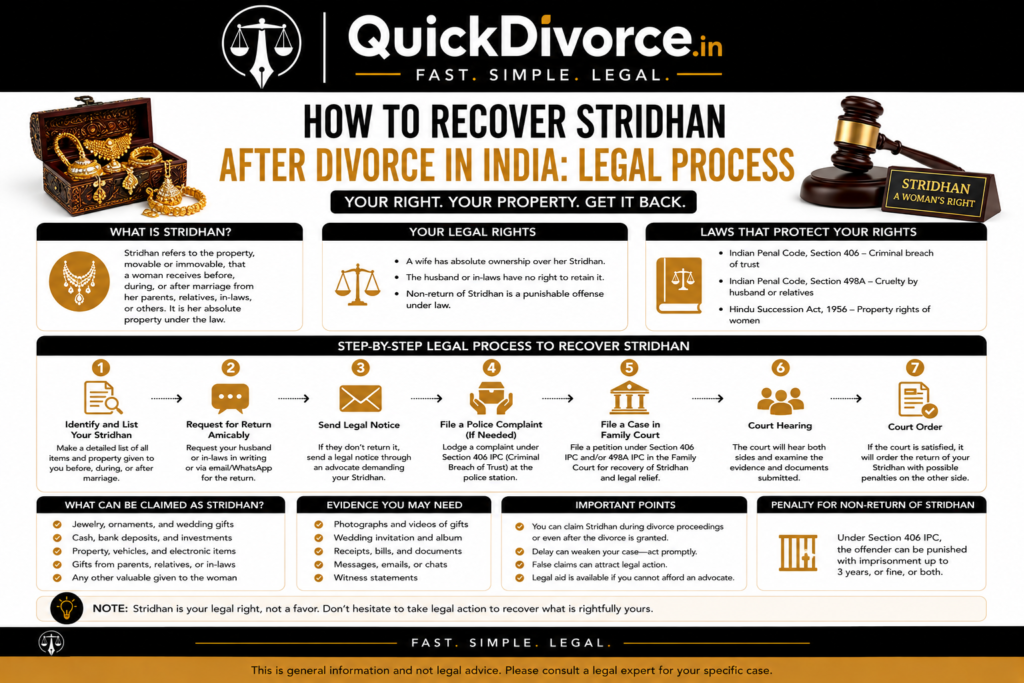
Step-by-Step Process to Recover Stridhan After Divorce
If you’re planning to recover stridhan after divorce, following a structured approach significantly improves your chances of a successful outcome.
Step 1: Prepare a Detailed Inventory
Create a clear, itemised list of every piece of stridhan — jewellery, cash, gifts, and other valuables — including approximate value, when it was received, and from whom. Supporting documentation such as purchase bills, the list maintained under Rule 2 of the Dowry Prohibition (Maintenance of Lists of Presents) Rules, 1985, wedding photographs showing the items, or witness testimony from family members significantly strengthens your claim later.
Step 2: Send a Legal Notice
Before initiating any formal proceedings, it’s advisable to send a legal notice to the husband and in-laws, demanding the specific return of the listed stridhan items. This step serves several purposes: it acts as a pre-litigation effort that may prompt voluntary return or negotiation, and it creates a documented, admissible record of your demand — which becomes important evidence in any later proceeding.
Step 3: File a Police Complaint / FIR
If there is no response, or the demand is deliberately refused, the next step to recover stridhan after divorce is approaching the police to register an FIR under Section 316 BNS (criminal breach of trust), often combined with Section 85 BNS where harassment is also alleged. The complaint should specifically detail each item, its approximate value, and the precise circumstances of how and when it was entrusted and subsequently withheld.
Step 4: Pursue Parallel Civil Remedies
Simultaneously, you can file an application under the Domestic Violence Act for protection and monetary relief, or include the stridhan claim within ongoing or concluded divorce proceedings under Section 27 of the Hindu Marriage Act. Pursuing both criminal and civil remedies together is legally permissible and often improves your overall chances of recovery.
Step 5: Cooperate With Investigation and Recovery
Where an FIR has been registered, police are empowered to conduct searches and, where appropriate, restore interim custody of the property to the complainant through what are known as Superdari orders, pending the conclusion of the case.
Step 6: Pursue Trial or Settlement
Many stridhan disputes are eventually resolved through settlement, particularly once criminal proceedings create sufficient pressure for a negotiated return or monetary compensation. Where settlement isn’t reached, the matter proceeds to trial, where the burden remains on the complainant to prove entrustment and wrongful retention with specific, credible evidence.
What If the Husband or In-Laws Are Abroad or the Marriage Was Dissolved Overseas?
Recovering stridhan after divorce becomes more complex when an NRI husband has obtained an ex parte divorce decree abroad, since such decrees often don’t account for the wife’s stridhan rights under Indian law. In such situations, Indian courts have held that:
- An FIR under Section 316 BNS can still be initiated, even where the alleged offence occurred partly or fully abroad, provided some part of the matrimonial life or relevant transactions took place in India
- The wife can still approach the Family Court in India under Section 27 of the Hindu Marriage Act to seek the return of her stridhan, even if the husband resides abroad
- The Domestic Violence Act has also been held applicable in matrimonial relationships spanning multiple countries, provided there is a sufficient connection to India
Common Mistakes That Weaken a Stridhan Recovery Case
Indian courts, including the Supreme Court, have quashed numerous stridhan-related complaints where the allegations were vague or unsupported. To avoid this outcome when trying to recover stridhan after divorce, steer clear of these common errors:
- Vague, generalised lists — simply stating “gold jewellery worth lakhs” without specifics (item, quantity, weight, approximate value) is a common reason complaints get quashed at an early stage.
- No proof of entrustment — courts require specifics of when and how the property’s “dominion” was actually handed over to the accused, not just an assumption that it must have happened because the parties were married.
- No proof of demand — you must be able to show, with specific dates and circumstances, that you actually demanded the return of the property and were refused.
- Excessive delay without explanation — courts have flagged complaints filed many years after divorce, especially where filed by a third party (such as a father) rather than the woman herself, as suspicious or non-maintainable. In one 2024 Supreme Court ruling, a complaint filed by a complainant’s father, more than five years after his daughter’s divorce and without her authorisation, was quashed for exactly this reason — reaffirming that only the woman herself (or someone she has formally authorised) can pursue her stridhan claim.
- Treating ordinary dowry/gift-giving as automatic entrustment — courts have clarified that merely giving traditional gifts at a wedding does not, by itself, establish a presumption of entrustment requiring return; the specific facts of retention and refusal still need to be demonstrated.
How Long Do You Have to Recover Stridhan After Divorce?
Because the wrongful retention of stridhan is treated as a continuing offence, criminal proceedings under Section 316 BNS technically face no fixed limitation period — refusal to return the property remains an ongoing wrong for as long as it continues. That said, civil claims for the return of stridhan or its value are generally best pursued within a reasonable timeframe — commonly cited as around three years from the date of divorce or from when the refusal became clear — since excessive delay can weaken the credibility of the claim, even if not technically time-barred.
In practice, courts have shown far more sympathy toward prompt claims filed by the woman herself than toward ones filed many years later, particularly by third parties on her behalf.
What If You’re Falsely Accused of Withholding Stridhan?
It’s worth noting that stridhan-related complaints, like Section 85 BNS cruelty cases, are sometimes filed with vague or exaggerated allegations. Men facing such accusations have legal options too — including seeking discharge at the framing-of-charges stage where the prosecution fails to establish specific facts, applying for quashing of the FIR before the High Court, or presenting evidence during trial to demonstrate the falsity of the claims. Indian courts have repeatedly emphasised that genuine stridhan claims require specific, demonstrable facts — not generalised accusations — and have discharged accused individuals where this standard wasn’t met.
How QuickDivorce.in Can Help
Whether you’re trying to recover stridhan after divorce, or you’ve been wrongly accused of withholding it, the outcome depends heavily on how well-documented and specifically pleaded your case is. At QuickDivorce.in, our family law team helps clients prepare detailed stridhan inventories, draft legally sound notices, file the right combination of criminal and civil remedies, and build cases backed by the kind of specific, credible evidence that Indian courts actually require — whether you’re pursuing recovery or defending against an unfounded claim.
Frequently Asked Questions (FAQs)
1. What is Stridhan under Indian law?
Stridhan refers to the movable and immovable property, gifts, jewellery, cash, and valuables received by a woman before, during, or after her marriage. A woman has exclusive ownership over her Stridhan, and it cannot be legally retained by her husband or in-laws.
2. Can I recover my Stridhan after divorce in India?
Yes. A woman has the legal right to recover her Stridhan after divorce if it has been retained by her husband or his family. Indian courts recognize Stridhan as the woman’s exclusive property.
3. What is the legal process to recover Stridhan after divorce?
The legal process to recover Stridhan after divorce generally involves sending a legal notice, attempting settlement, and, if necessary, filing a case before the appropriate court. The court may order the return of the Stridhan or award compensation if the property cannot be returned.
4. What documents are required to recover Stridhan?
Useful documents include wedding photographs, gift lists, jewellery bills, bank statements, invoices, witness statements, and any written communication proving ownership or possession of the Stridhan.
5. Can I claim Stridhan even if the divorce has already been finalized?
Yes. In many cases, a woman can still seek recovery of her Stridhan after the divorce has been granted, provided she can establish her legal ownership and the facts of the case.
6. What should I do if my husband or in-laws refuse to return my Stridhan?
If your husband or in-laws refuse to return your Stridhan, you should consult a family law advocate. Depending on the circumstances, you may pursue appropriate civil or criminal legal remedies available under Indian law.
7. Is there a time limit for recovering Stridhan after divorce?
The applicable limitation period depends on the facts of the case and the legal remedy being pursued. Since limitation issues can be complex, it is advisable to seek legal advice and initiate action as early as possible.
Conclusion
The right to recover stridhan after divorce is one of the most firmly settled principles in Indian matrimonial law — courts have consistently held, since 1985, that this property belongs exclusively to the woman and that divorce does not weaken her claim to it. But translating that legal right into an actual, successful recovery requires careful documentation, a clear inventory of items, and choosing the right combination of criminal and civil remedies for your specific situation.
If you’re facing this situation, the strongest first step isn’t necessarily filing an FIR immediately — it’s organising your evidence and demand properly, with professional legal guidance, so your case is built to withstand the scrutiny courts now routinely apply to these claims.
For personalised assistance with documenting, demanding, and legally recovering your stridhan, connect with the family law team at QuickDivorce.in.
For Expert Guidance Contact Now
🟡QuickDivorce offers trusted online legal services across India, including mutual divorce, contested divorce, child custody, alimony, marriage registration, and expert family law consultation.
👉 Mutual Consent Divorce
👉 Contested Divorce Filing
👉 Child Custody and Maintenance
👉 Matrimonial Property Settlement
👉 NRI Divorce Services
👉 Alimony and Maintenance
🟡 Protect Your Rights
👉 Domestic Violence Legal Support
👉 Stridhan Recovery
🟡For other Legal and Trademark related services visit
👉 Money Recovery Cases
👉 Property Disputes
👉 Business & Licence Registrations
📞 Call Now: +91 8595439395
🕐 Free Consultation: Monday to Saturday, 10 AM to 6 PM

Adv. Manish Kashyap is a Family Law & Divorce Lawyer with extensive experience in Mutual & Contested Divorce, NRI Divorce, Child Custody, Alimony, Domestic Violence, Judicial Separation, and Family Court matters, providing professional legal guidance to clients.

