

Views: 5
Table of Contents
- 1 No Marriage Certificate Gives Anyone the Right to Your Body
- 2 The Legal Landscape : Where India Stands in 2026
- 3 Understanding What Constitutes Forced Relations in Marriage
- 4 Legal Remedy 1 — Protection of Women from Domestic Violence Act, 2005
- 5 Legal Remedy 2 — Section 85 BNS / Section 498A IPC — Cruelty by Husband
- 6 Legal Remedy 3 — Section 63 BNS — Rape Provisions for Minor Wives
- 7 Legal Remedy 4 — Section 74 BNS / Section 354 IPC — Assault or Criminal Force to Outrage Modesty
- 8 Legal Remedy 5 — Section 75 BNS / Section 354A IPC — Sexual Harassment
- 9 Legal Remedy 6 — Section 108 BNS / Section 306 IPC — Abetment of Suicide
- 10 Legal Remedy 7 — Divorce on Ground of Cruelty
- 11 Legal Remedy 8 — Maintenance and Financial Independence
- 12 Legal Remedy 9 — Constitutional Remedies — Articles 14, 19, and 21
- 13 Evidence That Strengthens Your Case
- 14 What to Do Immediately — Step-by-Step Action Guide
- 15 Helplines and Support Organizations
- 16 The Ongoing Legal Battle — Where Marital Rape Law Is Headed
- 17 Frequently Asked Questions
- 18 Why Choose Quick Divorce for Legal Help in These Cases
- 19 Final Word
No Marriage Certificate Gives Anyone the Right to Your Body
There is a conversation that happens behind closed doors in thousands of Indian homes — a conversation that is never spoken aloud, never acknowledged at family dinners, never raised with neighbors or friends.
A wife says no. And it does not matter.
She says she is tired, unwell, unwilling. And it does not matter.
She tries to resist. And it does not matter.
Because somewhere along the way — in the ceremony, in the vows, in the unspoken social contract of Indian marriage — she was told, or made to feel, that this is simply what wives do. That saying no is not an option. That her body, by virtue of the marriage, belongs to her husband.
This is a lie. It has always been a lie. And in 2026, Indian law — imperfect as it still is on this specific issue — offers more protection to women in this situation than most people realize.
This guide is for every married woman in India who has experienced forced physical relations, who is afraid to speak about it, and who does not know that the law has tools — real, actionable, legal tools — that she can use to protect herself, seek justice, and rebuild her life on her own terms.
The Legal Landscape : Where India Stands in 2026
Let us begin with the honest legal reality, because clarity matters more than comfort here.
Marital rape — defined as forced sexual intercourse by a husband with his wife — is not recognized as a criminal offence under Indian law as of 2026.
Exception 2 to Section 375 of the Indian Penal Code — now replaced by Section 63 of the Bharatiya Nyaya Sanhita, 2023 — has historically exempted a husband from rape charges for non-consensual intercourse with his wife, provided the wife is above fifteen years of age. This exception has been widely criticized by legal experts, women’s rights organizations, the United Nations, and progressive voices within the Indian judiciary itself.
The marital rape exception has been challenged before the Supreme Court of India. As of the time of writing this guide in 2026, the Supreme Court’s final verdict on whether this exception is constitutionally valid remains one of the most anticipated judgments in Indian legal history. Several High Courts — including the Delhi High Court in a divided bench judgment — have examined this issue with deeply divergent opinions.
However — and this is the critical point that most people miss — the absence of a specific marital rape law does not mean a married woman is without legal protection against forced physical relations.
Indian law provides multiple overlapping legal remedies that a married woman can use when forced into sexual relations within marriage. These remedies do not require the specific label of “marital rape” to be effective. Used correctly, they provide real protection, real relief, and real consequences for the husband who forces himself on his wife.
This guide covers every one of them.
Understanding What Constitutes Forced Relations in Marriage
Before examining legal remedies, it is important to understand what the law recognizes as forced or non-consensual physical relations within marriage — because the spectrum is broader than most people realize.
Physical Force and Violence The husband uses physical strength, restraint, or violence to compel the wife into sexual intercourse against her will. Bruising, injuries, tearing, and physical trauma are common accompanying evidence.
Threats and Coercion The husband threatens harm — to the wife, to her children, to her family, or to her financial security — unless she complies. Compliance obtained through fear is not consent.
Drugging or Incapacitation The wife is given alcohol, sedatives, or other substances that impair her ability to resist or to be conscious of what is happening.
Emotional Manipulation and Psychological Pressure Sustained emotional abuse designed to break down the wife’s resistance — telling her it is her duty, that she has no right to refuse, that refusing is grounds for divorce or abandonment.
Forced Relations After Physical Assault Sexual intercourse forced upon the wife immediately after or in the context of domestic violence — where her physical condition makes resistance impossible.
Child Marriage Situations Sexual relations with a wife who is below eighteen years of age — regardless of marriage — is rape under Section 63 of the BNS without any exception. The marital exception does not apply to child brides.
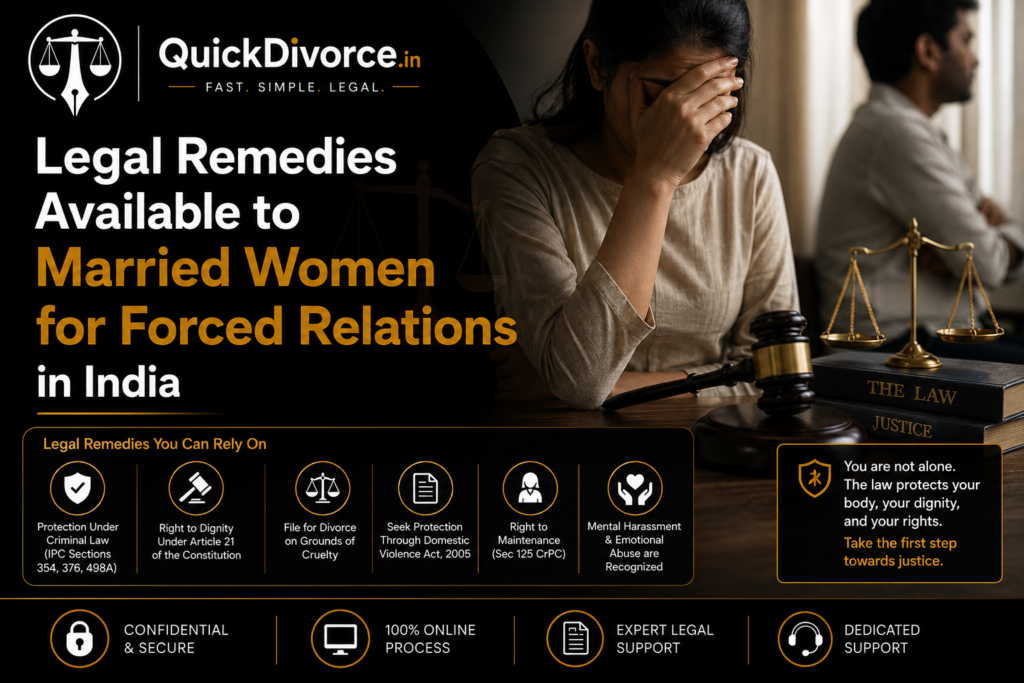
Legal Remedy 1 — Protection of Women from Domestic Violence Act, 2005
The Protection of Women from Domestic Violence Act, 2005 — the PWDVA — is the single most comprehensive and immediately effective legal tool available to a married woman facing forced physical relations.
The Act explicitly defines domestic violence to include sexual abuse — and sexual abuse is defined broadly to cover any conduct of a sexual nature that abuses, humiliates, degrades, or violates the dignity of the woman, including forced sexual intercourse.
Section 3 of the PWDVA — Definition of Domestic Violence Sexual abuse within the definition of domestic violence includes:
- Any conduct of a sexual nature that humiliates, degrades, or violates the dignity of the woman
- Forced sexual intercourse
- Any other act of a sexual nature that is committed against the woman’s will or without her consent
This means that forced physical relations within marriage — even without the criminal label of rape — constitutes domestic violence under this Act and entitles the wife to all remedies the Act provides.
Remedies Available Under the PWDVA
Protection Order The court can issue a protection order prohibiting the husband from committing any act of domestic violence — including sexual abuse — against the wife. Violation of a protection order is a criminal offence punishable with imprisonment up to one year and fine up to twenty thousand rupees.
Residence Order The court can allow the wife to continue living in the shared household — or can direct the husband to leave — ensuring she is not rendered homeless as a consequence of asserting her rights.
Monetary Relief The court can award monetary compensation to the wife for the losses she has suffered as a result of the domestic violence — including medical expenses, loss of earnings, and maintenance.
Custody Order The court can award interim custody of children to the wife, ensuring she is not separated from her children while proceedings are ongoing.
Compensation Order The court can award compensation for physical and psychological injuries suffered by the wife as a result of the domestic violence including sexual abuse.
How to Access PWDVA Remedies The wife can approach:
- A Protection Officer — appointed in every district under the Act
- A registered service provider — NGOs authorized under the Act to assist victims
- The Judicial Magistrate — directly, without going through police
Emergency protection orders can be obtained extremely quickly — sometimes within 24 to 48 hours in urgent cases. This is one of the fastest legal remedies available.
Legal Remedy 2 — Section 85 BNS / Section 498A IPC — Cruelty by Husband
Section 498A of the Indian Penal Code — now Section 85 of the Bharatiya Nyaya Sanhita, 2023 — makes it a criminal offence for a husband or his relatives to subject a wife to cruelty.
Cruelty under this section includes:
- Conduct likely to drive the woman to suicide or to cause grave injury to her life, limb, or health — whether physical or mental
- Harassment with a view to coercing her to meet unlawful demands
How Forced Relations Fits Within Section 498A / Section 85 BNS
Forced physical relations within marriage constitute cruelty under this section in two ways:
First — the physical act of sexual violence causes injury to the wife’s body and severe trauma to her mental health. This falls directly within “conduct likely to cause grave injury to health — physical or mental.”
Second — where the forced relations are accompanied by threats, violence, or demands, it constitutes harassment under the second limb of the cruelty definition.
Filing an FIR Under Section 85 BNS The wife can approach the police station and file an FIR for cruelty. This is a cognizable, non-bailable offence. Police can arrest the husband without a warrant. Upon conviction, punishment extends to three years imprisonment and fine.
Medical evidence — obtained immediately after the incident — significantly strengthens a Section 85 complaint. The wife should seek medical examination as soon as possible after any incident of forced physical relations.
Legal Remedy 3 — Section 63 BNS — Rape Provisions for Minor Wives
This is an absolute legal protection with no ambiguity whatsoever.
If a girl who has been married is below eighteen years of age, forced sexual intercourse by the husband is rape under Section 63 of the Bharatiya Nyaya Sanhita, 2023.
The marital exception under Exception 2 to Section 63 BNS only applies where the wife is eighteen years of age or above. Below eighteen — regardless of marriage, regardless of religious personal law, regardless of custom or tradition — it is rape. Full stop.
The Supreme Court in Independent Thought v. Union of India (2017) definitively settled this by striking down the part of Exception 2 that applied to wives between fifteen and eighteen years. The BNS has incorporated this position.
Punishment for rape under Section 63 BNS ranges from rigorous imprisonment of not less than ten years, which may extend to life imprisonment, along with fine.
Legal Remedy 4 — Section 74 BNS / Section 354 IPC — Assault or Criminal Force to Outrage Modesty
Where the husband uses physical force, assault, or criminal force in connection with forced sexual conduct — including grabbing, pinning down, restraining, or assaulting the wife — Section 74 of the BNS (formerly Section 354 IPC) is attracted.
This section does not require penetration or sexual intercourse to be established. Any assault or use of criminal force with intent to outrage modesty is punishable with imprisonment between one and five years and fine.
This provision can be used in cases where forced conduct falls short of full forced intercourse but still involves sexual assault, molestation, or forcible physical contact of a sexual nature.
Legal Remedy 5 — Section 75 BNS / Section 354A IPC — Sexual Harassment
Section 75 of the BNS covers sexual harassment — including unwelcome physical contact and advances of a sexual nature. Where a husband repeatedly forces unwanted physical contact on his wife in a harassing manner, this provision may be attracted.
This is a broader provision than the specific assault provisions and covers a wider range of unwanted sexual conduct within the domestic setting.
Legal Remedy 6 — Section 108 BNS / Section 306 IPC — Abetment of Suicide
In the most tragic cases — where sustained sexual violence, physical abuse, and emotional destruction drive a wife to attempt or complete suicide — the husband and any other family members who participated in the sustained abuse can be charged with abetment of suicide under Section 108 of the BNS.
Punishment for abetment of suicide extends to ten years imprisonment and fine.
Where the wife dies within seven years of marriage under these circumstances, Section 80 BNS (dowry death provisions) may also be attracted if the conduct was connected to dowry demands.
Legal Remedy 7 — Divorce on Ground of Cruelty
A married woman who has been subjected to forced physical relations within marriage has a strong ground for divorce on the basis of cruelty under:
- Section 13(1)(ia) of the Hindu Marriage Act, 1955 — for Hindus, Sikhs, Jains, and Buddhists
- Section 27(1)(d) of the Special Marriage Act, 1954 — for marriages under the Special Marriage Act
- Indian Divorce Act, 1869 — for Christians
Indian courts — including the Supreme Court — have repeatedly held that forced sexual intercourse within marriage constitutes matrimonial cruelty sufficient to ground a divorce petition.
The wife does not need to use the word “rape.” She needs to establish, through her own testimony supported by whatever corroborating evidence is available, that she was subjected to non-consensual, forced physical relations that constituted cruel treatment making it impossible for her to continue living with the husband.
This is both a standalone divorce ground and a basis for claiming permanent alimony, residence, and all other matrimonial reliefs simultaneously.
Legal Remedy 8 — Maintenance and Financial Independence
A woman who leaves her matrimonial home because of forced physical relations is entitled to claim maintenance from her husband — ensuring that asserting her rights does not leave her financially destroyed.
Maintenance can be claimed under:
Section 125 BNSS — A magistrate court can order the husband to pay monthly maintenance to the wife who is unable to maintain herself. This order can be obtained relatively quickly and provides immediate financial relief.
Section 24 and Section 25 of the Hindu Marriage Act — Interim maintenance during divorce proceedings and permanent alimony after the divorce decree.
Protection of Women from Domestic Violence Act — Monetary relief including maintenance as part of the domestic violence remedy package.
A woman should never feel that she cannot assert her rights because she depends financially on her husband. The law provides maintenance specifically to ensure financial dependence does not become a prison.
Legal Remedy 9 — Constitutional Remedies — Articles 14, 19, and 21
At the highest level of the Indian legal framework, the Constitution itself provides protection.
Article 21 — Right to Life and Personal Liberty The Supreme Court has consistently held that Article 21 encompasses the right to live with dignity — and that sexual violence, including within marriage, violates this fundamental right.
Article 14 — Right to Equality A law that treats married women as having fewer rights over their own bodies than unmarried women is a law that violates equality before the law — which is the core of the ongoing Supreme Court challenge to the marital rape exception.
Article 19 — Right to Freedom The right to bodily autonomy — the right to decide what happens to one’s own body — is increasingly recognized by the Supreme Court as part of the fundamental freedoms guaranteed under Article 19.
While constitutional remedies require approaching the High Court or Supreme Court and are more complex than the remedies listed above, they represent the foundational legal basis on which all other protections rest — and the basis on which advocates are pushing for the complete criminalization of marital rape in India.
Evidence That Strengthens Your Case
In any legal proceeding involving forced physical relations within marriage, evidence is critical. Here is what to gather and preserve:
Medical Evidence Seek medical examination as soon as possible after any incident. Medical records documenting physical injuries — bruising, tearing, trauma — are among the most powerful evidence available. A doctor’s report prepared close in time to the incident carries significant evidential weight.
Photographic Evidence Photograph all visible injuries — on your body and on any objects involved — as soon as possible.
Communication Records Save all WhatsApp messages, text messages, emails, and voice messages from the husband — including any in which he makes threats, acknowledges the conduct, or expresses controlling behavior. Back these up to cloud storage immediately.
Witness Evidence If anyone witnessed incidents — family members, domestic workers, neighbors who heard sounds of violence — their statements can corroborate your account.
Medical History If you have sought medical treatment in the past for injuries resulting from forced conduct — even if you described the cause differently at the time — these records can establish a pattern.
Psychological Assessment A report from a psychiatrist or psychologist documenting the trauma, PTSD, anxiety, depression, or other psychological consequences of the forced relations is valuable evidence of harm.
Diary or Personal Records A contemporaneous written record — a diary, notes app, or any form of private record maintained at the time of incidents — noting dates, circumstances, and what happened, carries evidential weight as a contemporaneous document.
What to Do Immediately — Step-by-Step Action Guide
Step 1 — Get to Safety If you are in immediate danger, leave the situation. Go to a family member, trusted friend, women’s shelter, or any safe location. Your physical safety comes first — everything else can be addressed once you are safe.
Step 2 — Seek Medical Attention Go to a hospital or doctor immediately for examination and treatment of any physical injuries. Ask the doctor to document all injuries in writing. This medical report is critical evidence.
Step 3 — Preserve All Evidence Back up all messages, photograph injuries, and write down a detailed account of what happened while it is fresh in your memory — dates, times, circumstances, and any witnesses.
Step 4 — Contact a Protection Officer or NGO Every district has a Protection Officer appointed under the Domestic Violence Act. You can approach them without going to the police first. Many NGOs also provide immediate shelter, counseling, and legal assistance to women in this situation.
Step 5 — Consult a Lawyer Before filing any complaint, consult a family law lawyer who understands matrimonial violence cases. The right legal strategy — choosing the right provisions, the right forum, and the right sequence of actions — significantly affects the outcome.
Step 6 — File a Complaint Based on your lawyer’s advice, file a complaint under the appropriate provisions — PWDVA, Section 85 BNS, or other applicable sections. Your lawyer will guide you on whether to approach the Protection Officer, the Magistrate, or the police first.
Step 7 — Seek Interim Relief Apply for an emergency protection order under the PWDVA to immediately restrain the husband from further contact or violence. Also apply for interim maintenance to ensure financial security during the proceedings.
Step 8 — File for Divorce Simultaneously with or following criminal and domestic violence proceedings, file a divorce petition on grounds of cruelty — establishing the forced relations as the basis for irretrievable breakdown of the marriage.
Helplines and Support Organizations
Every woman facing forced relations within marriage deserves immediate support — legal, emotional, and practical. These organizations provide it:
National Commission for Women Helpline — 7827170170 Immediate assistance for women facing any form of violence or rights violation.
Women Helpline — 181 A national helpline for women in distress — available across India.
Police Emergency — 112 For immediate physical danger situations.
iCall Mental Health Helpline — 9152987821 Psychological support and counseling for women experiencing trauma.
One Stop Centres (Sakhi Centres) Government-run centers providing integrated support — medical, legal, psychological, and shelter — to women affected by violence. Available in all districts across India.
The Ongoing Legal Battle — Where Marital Rape Law Is Headed
The Supreme Court of India is actively examining the constitutional validity of the marital rape exception. Several important developments have shaped the legal landscape in 2026:
The Delhi High Court’s divided bench judgment — where one judge held the exception unconstitutional and the other upheld it — crystallized the legal debate and made Supreme Court intervention inevitable.
The Union Government’s position before the Supreme Court has evolved — from initial resistance to a more nuanced acknowledgment that the issue requires careful examination of social, cultural, and legal factors.
Progressive High Courts across India — Bombay, Madras, Calcutta, and Kerala — have in various judgments recognized that forced sexual conduct within marriage violates a woman’s fundamental rights, even without using the specific label of marital rape.
The Law Commission of India has in its reports highlighted the need to revisit the marital rape exception in light of constitutional values of dignity, equality, and personal liberty.
The direction of legal evolution is clear — toward full recognition that a woman’s right to refuse physical relations does not end at the altar. The question in 2026 is not whether India will criminalize marital rape, but when.
Until that day comes — the existing legal framework, used strategically and with expert guidance, provides more protection than most women in this situation realize.
Frequently Asked Questions
1. Can a married woman take legal action if she is forced into physical relations by her husband?
Yes. A married woman may seek legal remedies under various laws, including provisions related to domestic violence, cruelty, physical abuse, and other applicable legal protections depending on the circumstances.
2. Does the law recognize consent within marriage?
Consent remains an important aspect of any physical relationship. Courts may consider issues of coercion, violence, threats, or abuse when examining disputes involving forced physical relations within marriage.
3. Can forced physical relations be considered domestic violence?
Yes. Forced physical relations accompanied by physical, emotional, verbal, sexual, or economic abuse may be treated as a form of domestic violence under applicable laws protecting women from abuse within the household.
4. What legal remedies are available to a woman facing such abuse?
A woman may seek protection orders, residence rights, monetary relief, custody-related orders, counseling support, and other remedies available under relevant laws designed to protect victims of domestic violence and cruelty.
5. Can a woman file a police complaint against her husband for cruelty or abuse?
Yes. If the conduct involves cruelty, physical violence, threats, harassment, or other unlawful acts, a complaint may be filed with the police, and appropriate legal action can be initiated based on the facts of the case.
6. What evidence can help support a legal case?
Medical records, photographs of injuries, text messages, emails, call recordings (where legally admissible), witness statements, and any other documentation showing abuse or coercion can be helpful.
Why Choose Quick Divorce for Legal Help in These Cases
Cases involving forced physical relations within marriage are among the most sensitive and complex in Indian family law. They require a lawyer who combines deep legal expertise with genuine human understanding — someone who can guide a woman through the legal process without adding to her trauma.
At Quick Divorce, our team has handled numerous cases involving domestic violence, sexual abuse within marriage, and related matrimonial cruelty — with complete confidentiality, deep respect for the client’s courage in coming forward, and aggressive pursuit of every available legal remedy.
We help with:
- Emergency protection orders under the PWDVA — obtained as quickly as possible
- FIR filing strategy under Section 85 BNS and related provisions
- Divorce petitions on grounds of cruelty — with comprehensive evidence preparation
- Maintenance and financial relief applications — ensuring financial independence
- Child custody protection — preventing the husband from using children as leverage
- Complete coordination of criminal and civil proceedings for maximum legal impact
- Full confidentiality — your case is handled with absolute discretion
You have already shown courage by reading this far. Taking the next step — speaking to a lawyer — is how you transform that courage into protection.
Book your free, completely confidential consultation today: 📞 Call / WhatsApp: 8595439395
Final Word
No marriage — no ceremony, no vow, no legal document — gives one person ownership of another person’s body. This is a principle of basic human dignity that predates any law and will outlast every law.
In India in 2026, the law is still catching up to this principle on the specific question of marital rape. But it has already caught up on the broader question of a married woman’s right to protection from sexual violence within marriage — through the Domestic Violence Act, through cruelty provisions, through divorce law, and through constitutional guarantees of dignity and personal liberty.
These tools exist. They are real. They have helped women escape abusive marriages, obtain financial security, protect their children, and rebuild their lives.
You deserve to know about them. You deserve to use them. And you deserve a legal team that will fight for you with everything the law provides.
Quick Divorce is here. Call us at 8595439395.
Need Legal Help?
QuickDivorce.in provides complete legal services for women facing domestic violence, sexual abuse within marriage, divorce, maintenance, stridhan recovery, and all matrimonial matters — across all jurisdictions in India.
Our specialists assist with contested divorce petitions (including cruelty-based), domestic violence complaints, maintenance claims, child custody, property settlements, MoU drafting, and court representation.
Mutual Consent Divorce
Contested Divorce Filing
Domestic Violence Legal Support
Alimony and Maintenance
Child Custody and Maintenance
Stridhan Recovery
Matrimonial Property Settlement
NRI Divorce Services
Also visit LegalTax.in for Money Recovery Cases, Property Disputes, and Business & Licence Registrations. Visit Business24hub for IT services.
Call now: +91 8595439395 ·
Mon–Sat, 10 AM–6 PM · Free Consultation

Adv. Manish Kashyap is a Family Law & Divorce Lawyer with extensive experience in Mutual & Contested Divorce, NRI Divorce, Child Custody, Alimony, Domestic Violence, Judicial Separation, and Family Court matters, providing professional legal guidance to clients.

