

Views: 15
Learn how to file for dowry recovery in Indian court — relevant laws, the FIR process, evidence required, and civil remedies to reclaim what’s rightfully yours.
Table of Contents
- 1 Introduction
- 2 Understanding What Counts as “Dowry” Under Indian Law
- 3 The Legal Framework Governing Dowry Recovery
- 4 Step-by-Step Process for Dowry Recovery in Indian Court
- 5 Where to File: Choosing the Right Forum
- 6 How Courts Have Strengthened — and Scrutinised — Dowry Recovery Claims
- 7 Limitation Period: How Long Do You Have?
- 8 Can Dowry Be Recovered Even After Divorce?
- 9 What If You’re Falsely Accused in a Dowry Case?
- 10 How QuickDivorce.in Can Help
- 11 Frequently Asked Questions (FAQs)
- 12 Conclusion
- 13 File for Dowry Recovery
Introduction
The practice of dowry remains illegal in India, yet it persists quietly across families, often disguised as “gifts” or “voluntary contributions.” When a marriage breaks down, one of the most pressing — and emotionally charged — questions many women face is whether they can legally get back what was given, demanded, or taken in connection with their marriage. Pursuing dowry recovery in Indian court is entirely possible, but it requires understanding which laws apply, what evidence courts actually expect, and which legal forum is right for your specific situation.
Despite the existence of a clear statutory framework, official data tells a sobering story: in a recent reporting year, 13,479 cases were registered under the Dowry Prohibition Act, 1961, with Uttar Pradesh, Bihar, and Karnataka recording the highest numbers — and a troublingly low chargesheeting rate, with many complaints closed for “insufficient evidence” despite being credible. This makes one thing clear: pursuing dowry recovery in Indian court isn’t just about knowing your rights, it’s about building a case the system can actually act on. This guide walks you through exactly how to do that.
Understanding What Counts as “Dowry” Under Indian Law
Before filing anything, it’s important to understand the legal definition you’re working with. Under Section 2 of the Dowry Prohibition Act, 1961, dowry is defined as any property or valuable security given, or agreed to be given, directly or indirectly, by either party to the marriage, or by their parents or any other person, to the other party — at, before, or at any time after the marriage, in connection with the marriage.
This broad definition covers cash, gold, vehicles, household items, land, and electronics — essentially anything demanded or given in connection with the marriage. Importantly, the law clarifies that demands made even after the wedding can still qualify as dowry, since courts have read an implied agreement into ongoing demands tied to the marriage.
One distinction worth understanding clearly: voluntary, customary gifts given without any pressure or demand, and properly documented, are generally not treated as dowry. The Supreme Court, in Satvir Singh v. State of Punjab, clarified that there must be a demonstrable connection between the demand and the marriage for an item to legally qualify as dowry — which is why documentation, timing, and the presence (or absence) of demand all matter enormously when pursuing dowry recovery in Indian court.
The Legal Framework Governing Dowry Recovery
Several overlapping laws come into play when pursuing dowry recovery in Indian court, and understanding how they interact is key to building an effective case.
1. The Dowry Prohibition Act, 1961
This is the foundational anti-dowry statute in India:
- Section 3 makes the giving or taking of dowry a punishable offence, carrying imprisonment of not less than five years and a fine of ₹15,000 or the value of the dowry, whichever is higher — applicable even where the dowry was exchanged before or after the marriage.
- Section 4 punishes the demanding of dowry, whether directly or indirectly, with imprisonment ranging from six months to two years, along with a fine of up to ₹10,000.
- Section 6 addresses what happens to dowry received by someone other than the woman herself, requiring it to be transferred to her, and prescribes punishment for failing to do so within the stipulated time.
- Section 8B empowers state governments to appoint Dowry Prohibition Officers, tasked with preventing dowry-related offences, collecting evidence, and assisting prosecutions — though courts have noted that their actual involvement in investigations remains inconsistent across states.
2. Section 85, Bharatiya Nyaya Sanhita, 2023 (formerly Section 498A IPC)
This provision criminalises cruelty by a husband or his relatives toward a married woman, specifically including harassment connected to unlawful dowry demands. It is frequently invoked alongside the Dowry Prohibition Act, since dowry harassment and cruelty often arise from the same pattern of conduct.
3. Section 316, Bharatiya Nyaya Sanhita, 2023 (formerly Section 406 IPC)
Where dowry items — particularly jewellery, cash, or valuables — were entrusted to the husband or in-laws and subsequently withheld, this provision on criminal breach of trust becomes directly relevant, treating wrongful retention as a punishable, continuing offence.
4. Section 304B, Bharatiya Nyaya Sanhita, 2023 (formerly Section 304-B IPC) — Dowry Death
In the most serious cases, where a woman dies within seven years of marriage under circumstances connected to dowry harassment shortly before her death, this provision treats the death as a dowry death, carrying significantly harsher consequences.
5. The Protection of Women from Domestic Violence Act, 2005
Particularly Sections 19 and 20, which allow a Magistrate to pass protection orders and award monetary compensation, including for the return or value of dowry-related property — even after the marriage has ended.
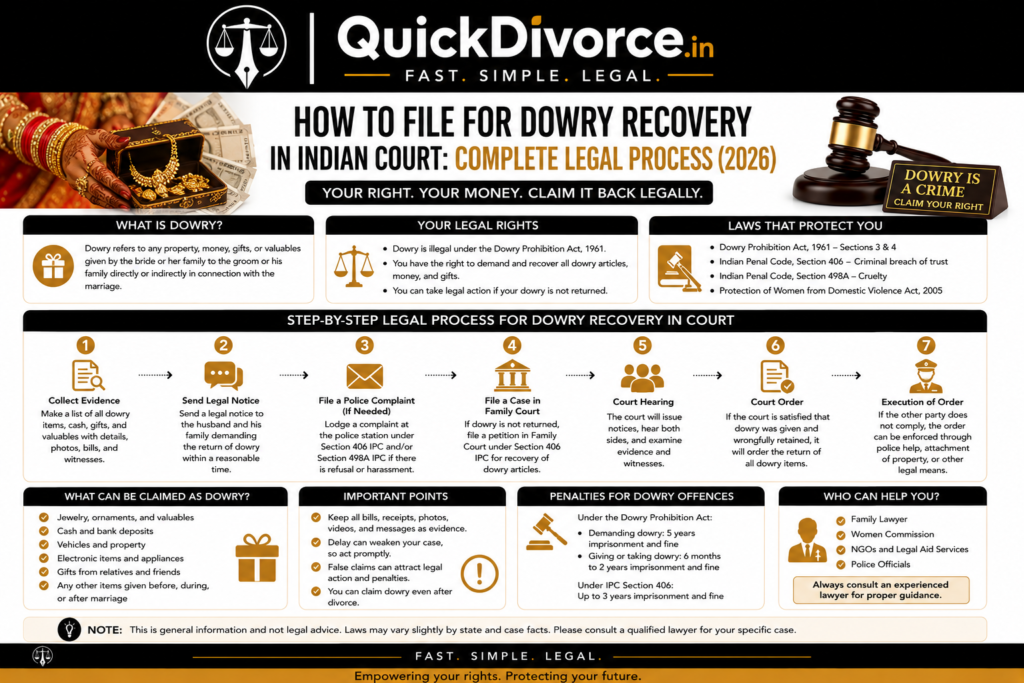
Step-by-Step Process for Dowry Recovery in Indian Court
Step 1: Compile a Detailed, Specific Inventory
The single biggest reason dowry-related complaints get closed for “insufficient evidence” or quashed before trial is vague, generalised claims. Before pursuing dowry recovery in Indian court, prepare a precise list including:
- Each item given, its description, and approximate value
- The date and circumstances under which it was given or demanded
- Who specifically made the demand, and to whom
- Supporting documents: purchase bills, receipts, wedding photographs or videos showing the items, and the gift list maintained under Rule 2 of the Dowry Prohibition (Maintenance of Lists of Presents) Rules, 1985, where available
Step 2: Send a Legal Notice
Before initiating formal proceedings, sending a legal notice through an advocate, demanding the return of specific dowry items, creates a documented, admissible record of your demand and may prompt voluntary resolution without the need for prolonged litigation.
Step 3: File a Police Complaint (FIR)
If the notice goes unanswered or is refused, the next step toward dowry recovery in Indian court is approaching the police to register an FIR, typically invoking relevant sections of the Dowry Prohibition Act alongside Section 85 BNS (cruelty) and Section 316 BNS (criminal breach of trust), depending on the specific facts. The complaint should detail each item, its estimated value, and precisely how and when it was given or demanded. A properly registered FIR initiates a police investigation, which can lead to seizure of the dowry articles.
Step 4: Pursue Civil and Family Court Remedies in Parallel
Alongside criminal proceedings, you can:
- Approach a Magistrate under Sections 19 and 20 of the Domestic Violence Act, 2005, to claim the return of stridhan-linked dowry items, monetary relief, and compensation
- File an application under Section 27 of the Hindu Marriage Act, if divorce proceedings are already ongoing, to claim the return of specific property
- File a separate civil recovery suit for money or valuables, particularly useful where criminal law limitations might otherwise apply
Step 5: Build Your Case With Strong, Specific Evidence
Indian courts have repeatedly emphasised that generalised allegations cannot sustain a prosecution. Useful evidence to support dowry recovery in Indian court includes:
- Bills and receipts for jewellery, electronics, and furniture
- Wedding photographs or videos showing the dowry items being exchanged
- Witness testimony from family, friends, or neighbours present at the time
- Bank transaction records, where cash dowry was transferred electronically
- WhatsApp messages, emails, or call recordings reflecting dowry demands
Step 6: Attend Investigation, Trial, or Settlement Proceedings
Once the FIR is registered, the police investigate, and the matter may proceed to trial, or, more commonly, to a negotiated settlement once the legal pressure of a registered complaint motivates the other side to resolve the matter. Throughout, the burden of proof for not having committed an offence under Sections 3 or 4 of the Dowry Prohibition Act shifts to the accused once a complaint is properly filed — a significant statutory advantage available to complainants.
Where to File: Choosing the Right Forum
Depending on which remedy you’re pursuing, your dowry recovery in Indian court will proceed through different forums:
- Police station / Magistrate’s Court — for FIRs and criminal proceedings under the Dowry Prohibition Act, Section 85 BNS, and Section 316 BNS
- Family Court — for civil recovery suits and applications under Section 27 of the Hindu Marriage Act, typically filed where the marriage was solemnised, where the couple last resided together, or where the wife currently resides
- Magistrate’s Court (under the DV Act) — for protection orders, residence orders, and monetary compensation
- Dowry Prohibition Officer — in some states, complaints can also be routed through the appointed Dowry Prohibition Officer, who is empowered to collect evidence and assist with prosecution, though courts have flagged inconsistent involvement of these officers across different states
A family lawyer can help determine which combination of forums best fits your specific facts, since pursuing multiple remedies simultaneously is both legally permissible and often more effective than relying on a single proceeding.
How Courts Have Strengthened — and Scrutinised — Dowry Recovery Claims
Several judicial pronouncements have shaped how dowry recovery in Indian court actually plays out:
- In Pawan Kumar v. State of Haryana, the Supreme Court held that dowry demands strike at the dignity of women and represent a serious social menace, reinforcing strict interpretation of the law in genuine cases.
- In S. Gopal Reddy v. State of Andhra Pradesh, the Court emphasised that the Dowry Prohibition Act must be interpreted strictly to suppress the underlying social evil it was designed to address.
- More recently, the Allahabad High Court, in Ankit Singh and 3 Others v. State of UP, expressed concern over the slow, inconsistent enforcement of the Act, specifically flagging the lack of mandatory gift lists, minimal involvement of Dowry Prohibition Officers in investigations, and the failure to actually recover alleged dowry amounts during investigations — directing the state government to address these systemic gaps.
At the same time, courts have been equally clear that vague, unsupported allegations cannot sustain a prosecution. Cases built on generalised claims — without specific dates, amounts, or demand details — have been quashed or resulted in discharge at the earliest stage, underscoring why detailed documentation is non-negotiable for anyone pursuing dowry recovery in Indian court.
Limitation Period: How Long Do You Have?
This is a frequently asked, and frequently misunderstood, aspect of dowry recovery in Indian court:
- Criminal proceedings under the Dowry Prohibition Act and related provisions like Section 316 BNS generally face no fixed limitation period, since wrongful retention of dowry-linked property is treated as a continuing offence.
- Civil claims for the return of dowry money or valuables should ideally be filed within three years of the divorce or of the discovery that the items will not be returned, since excessive, unexplained delay can weaken the credibility of a civil claim even where it isn’t technically barred.
Can Dowry Be Recovered Even After Divorce?
Yes. Indian courts have consistently held that the right to pursue dowry recovery in Indian court survives divorce — neither separation nor the dissolution of marriage extinguishes a woman’s right to reclaim dowry-related property or seek accountability for unlawful demands made during the marriage. This applies whether the divorce was obtained through mutual consent or was fully contested.
What If You’re Falsely Accused in a Dowry Case?
Given the volume of dowry-related litigation, false or exaggerated complaints do occur, and Indian law provides recourse here too. A person facing unfounded allegations can pursue quashing of the FIR before the High Court, file a defamation suit where appropriate, or present evidence during trial to demonstrate that the claims lack factual basis. Courts have consistently required specific, credible details — not generalised accusations — before allowing a dowry-related case to proceed to trial, which protects both genuine complainants and wrongly accused individuals.
How QuickDivorce.in Can Help
Successfully pursuing dowry recovery in Indian court depends heavily on documentation, the right combination of legal remedies, and a clear, specific account of what was given, demanded, and withheld. At QuickDivorce.in, our family law team helps clients compile detailed inventories, draft effective legal notices, file FIRs under the correct provisions, and pursue parallel civil and Family Court remedies — building cases that meet the evidentiary standards Indian courts actually require.
Frequently Asked Questions (FAQs)
1. Can I pursue dowry recovery in Indian court even years after my marriage ended? Yes, particularly through criminal remedies, which are treated as continuing offences with no fixed limitation period, though civil claims are best pursued within roughly three years of the divorce for stronger credibility.
2. Is every expensive wedding gift considered dowry? No. Voluntary gifts given without any demand or pressure, and properly documented as customary gifts, are generally not treated as dowry under the law.
3. What’s the difference between pursuing dowry recovery through the Dowry Prohibition Act versus the Domestic Violence Act? The Dowry Prohibition Act is primarily a criminal statute focused on punishing the giving, taking, and demanding of dowry, while the Domestic Violence Act offers a faster civil remedy through protection orders and monetary compensation, decided on a lower standard of proof.
4. What evidence is most important for a successful dowry recovery case? Specific, itemised evidence — bills, photographs, witness testimony, and documented demands with dates — carries far more weight than generalised claims, since courts have repeatedly quashed vague complaints lacking these details.
5. Who has to prove their innocence in a dowry case — the complainant or the accused? Notably, once a complaint is properly filed under Sections 3 or 4 of the Dowry Prohibition Act, the burden shifts to the accused to prove they did not commit the offence — a significant statutory advantage for genuine complainants.
6. Can both criminal and civil remedies be pursued together for dowry recovery? Yes, there is no legal bar on pursuing FIRs under criminal provisions alongside civil applications under the Domestic Violence Act or Hindu Marriage Act simultaneously, and this combined approach is often more effective.
7. What happens if the dowry amount given was unusually large or in cash? Courts have flagged concerns over inadequate investigation into the source and use of large, alleged dowry amounts, particularly cash, and have directed authorities to investigate and recover such proceeds more rigorously during prosecution.
Conclusion
Pursuing dowry recovery in Indian court is a legally well-supported path, backed by a strict statutory framework, a shifted burden of proof in the complainant’s favour, and judicial precedent that has consistently treated dowry as a serious social wrong deserving strict interpretation. But as courts have repeatedly emphasised, success ultimately depends on specific, well-documented claims — not generalised accusations — since vague complaints are increasingly being filtered out at early stages of the legal process.
If you’re considering this path, the most effective first step isn’t necessarily rushing to file an FIR — it’s organising detailed, credible evidence with proper legal guidance, so your case is built to withstand the scrutiny that dowry-related claims now routinely face in Indian courts.
For professional assistance with documenting, filing, and pursuing your dowry recovery case, connect with the family law team at QuickDivorce.in.
File for Dowry Recovery
🟡QuickDivorce offers trusted online legal services across India, including mutual divorce, contested divorce, child custody, alimony, marriage registration, and expert family law consultation.
👉 Mutual Consent Divorce
👉 Contested Divorce Filing
👉 Child Custody and Maintenance
👉 Matrimonial Property Settlement
👉 NRI Divorce Services
👉 Alimony and Maintenance
🟡 Protect Your Rights
👉 Domestic Violence Legal Support
👉 Stridhan Recovery
🟡For other Legal and Trademark related services visit
👉 Money Recovery Cases
👉 Property Disputes
👉 Business & Licence Registrations
📞 Call Now: +91 8595439395
🕐 Free Consultation: Monday to Saturday, 10 AM to 6 PM

Adv. Manish Kashyap is a Family Law & Divorce Lawyer with extensive experience in Mutual & Contested Divorce, NRI Divorce, Child Custody, Alimony, Domestic Violence, Judicial Separation, and Family Court matters, providing professional legal guidance to clients.

