

Views: 7
Table of Contents
- 1 Introduction
- 2 What Exactly Is a Legal Notice for Divorce?
- 3 Is Sending a Legal Notice Mandatory Before Filing for Divorce?
- 4 When Should You Send a Legal Notice for Divorce?
- 5 Essential Elements of a Well-Drafted Legal Notice for Divorce
- 6 Step-by-Step Process to Draft a Legal Notice for Divorce
- 7 A Sample Structure to Reference
- 8 How to Properly Serve the Notice
- 9 What Happens After the Notice Is Sent?
- 10 Mutual Consent Notice vs Contested Divorce Notice
- 11 Common Mistakes to Avoid
- 12 What to Do If You Receive a Legal Notice for Divorce
- 13 How QuickDivorce.in Can Help
- 14 Frequently Asked Questions (FAQs)
- 15 Conclusion
- 16 Want to Draft a Legal Notice for Divorce?
Introduction
Before most divorce proceedings in India reach a courtroom, they often begin with a single, carefully worded document — a legal notice. For many separating couples, this is the first formal, written acknowledgment that the marriage has reached a breaking point, and it sets the tone for everything that follows.
Drafting a legal notice for divorce isn’t just a formality — it’s a strategic legal document that can open the door to an amicable settlement, create a clear evidentiary record, or, if poorly drafted, weaken your position before you’ve even filed your petition. This guide walks you through exactly how to draft a legal notice for divorce in India — what it must contain, how it should be structured, how to serve it correctly, and the mistakes that most commonly undermine an otherwise valid notice.
What Exactly Is a Legal Notice for Divorce?
A legal notice for divorce is a formal written communication, typically drafted and sent by an advocate on behalf of one spouse, informing the other spouse of the sender’s intention to seek a divorce. It outlines the facts of the marriage, the issues that have led to the decision, the grounds being relied upon, and what the sender expects — whether that’s a response within a specified time, an attempt at reconciliation, or agreement to proceed with a mutual consent divorce.
While it may read like a warning, a well-drafted legal notice for divorce often serves a more constructive purpose: it gives both spouses a documented opportunity to resolve matters outside court, potentially saving years of litigation and significant legal costs.
Is Sending a Legal Notice Mandatory Before Filing for Divorce?
This is one of the most common misconceptions surrounding the process. There is no statutory requirement under the Hindu Marriage Act, Special Marriage Act, or other personal laws mandating that a legal notice for divorce must be sent before filing a divorce petition. Unlike certain civil suits against government authorities, which require a mandatory notice under Section 80 of the Civil Procedure Code, divorce proceedings carry no such compulsory pre-filing requirement.
That said, sending a notice is still strongly recommended in most situations, because it:
- Creates a documented timeline of the marital breakdown, which can later support claims like desertion
- Opens a window for negotiation, particularly useful when both spouses might actually prefer a mutual consent divorce but haven’t formally discussed it
- Demonstrates to the court, if litigation eventually follows, that the sender made a genuine, good-faith attempt to resolve matters before resorting to litigation
- Can prompt a quicker response from an otherwise unresponsive spouse, especially where there are pending issues like maintenance or custody
When Should You Send a Legal Notice for Divorce?
A legal notice for divorce is typically sent when:
- One spouse has decided to pursue divorce and wants to formally communicate this intent, particularly where direct conversation has broken down
- The couple wants to record their mutual intention to divorce before jointly filing a mutual consent petition
- One spouse has been deserted, and a notice can help establish the date from which the desertion period (legally relevant under several grounds) is counted
- There are unresolved issues — maintenance, custody, or return of stridhan — that the sender wants addressed before escalating to court
- A spouse wants to make a final attempt at reconciliation while also placing the other party on formal notice that further inaction will lead to litigation
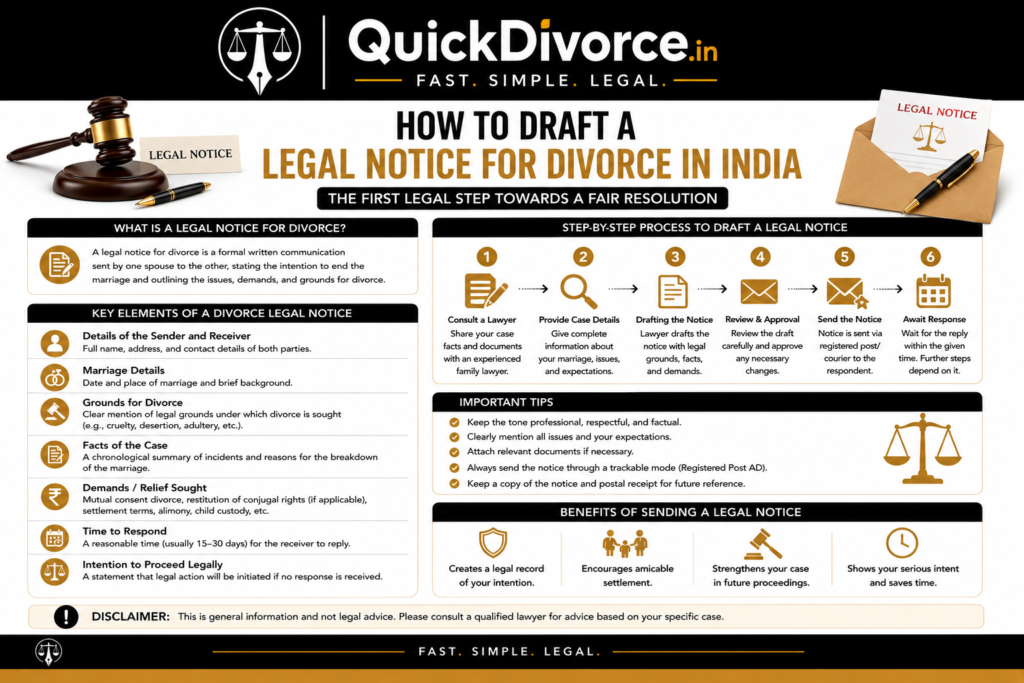
Essential Elements of a Well-Drafted Legal Notice for Divorce
A valid, effective legal notice for divorce must be structured carefully. Missing or vague details can weaken your credibility before the court later, so every notice should typically include:
1. Advocate’s Letterhead and Details
The notice is conventionally drafted and issued on the letterhead of a licensed advocate, including their name, registration details, office address, and contact information — lending the document the necessary legal weight.
2. Sender’s Details
The full legal name, address, and contact information of the spouse on whose behalf the notice is being sent, along with the capacity in which they are sending it (as husband or wife).
3. Recipient’s Details
The full legal name and current residential address of the other spouse. If their current address is unknown, the last known address should be used, along with any alternate addresses where they might reasonably be served.
4. Marriage Details
The date and place of marriage, the type of ceremony performed (and under which law — Hindu, Muslim, Christian, Parsi, or Special Marriage Act), and any relevant registration details.
5. Factual Background
A clear, chronological narrative of the relevant events in the marriage — leading up to the decision to seek divorce. This should be factual and specific, not vague or emotionally charged.
6. Grounds for Divorce
A summary of the specific legal ground(s) being relied upon — cruelty, adultery, desertion, irretrievable breakdown, or mutual consent — tailored to the applicable personal law.
7. Relief Sought
A clear statement of what the sender wants — whether that’s the recipient’s cooperation in filing a mutual consent petition, return of specific property or stridhan, resolution of maintenance, or simply an acknowledgment of intent to proceed with a contested divorce if no response is received.
8. Response Timeline
A specific window — typically 15 to 30 days — within which the recipient is expected to respond, after which the sender reserves the right to initiate court proceedings.
9. Advocate’s Signature and Date
The notice must be signed by the issuing advocate, dated, and assigned a reference number for record-keeping.
Step-by-Step Process to Draft a Legal Notice for Divorce
- Consult a family law advocate first. A self-drafted notice, or one built from a generic online template, often misses critical legal nuances and can weaken your position. Always have a qualified advocate draft or, at minimum, review the notice.
- Identify the applicable personal law and grounds. Your advocate will determine whether the Hindu Marriage Act, Special Marriage Act, Indian Divorce Act, Parsi Marriage and Divorce Act, or Muslim personal law governs your situation, and which grounds for divorce genuinely apply to your facts.
- Share complete and accurate information. Provide your advocate with the full picture — dates, incidents, prior attempts at resolution, and any supporting documentation — even details that may seem unfavourable to your case. Omitting facts can backfire later.
- Review the draft carefully. Once your advocate prepares the notice, go through it line by line to verify names, addresses, dates, and the accuracy of every factual claim before it is finalised.
- Finalise and sign off. Once both you and your advocate are satisfied with the draft, it is finalised on the advocate’s letterhead, ready for dispatch.
- Send the notice through a verifiable method. The notice should be dispatched via registered post with acknowledgment due (RPAD), speed post, or a reliable courier service, ensuring you retain proof of both dispatch and delivery.
- Retain copies of everything. Keep the original notice, the postal or courier receipt, and the delivery acknowledgment safely — these become important evidence if the matter proceeds to court.
A Sample Structure to Reference
While every notice should be customised to the specific facts of your marriage, a typical legal notice for divorce generally follows this skeleton:
[Advocate’s Name, Address, Contact Details] Ref No.: ___ Date: ___
To: [Spouse’s Full Name and Address]
Subject: Legal Notice for Divorce
Under instructions from my client, [Sender’s Name], residing at [address], I am directed to issue the following notice:
- That my client was married to you on [date] at [place], solemnised under [applicable law].
- That since [period/date], the following events have transpired: [factual narrative of relevant incidents].
- That due to the aforementioned circumstances, my client has decided to seek a divorce under [relevant section/ground].
- My client hereby calls upon you to [state relief sought — e.g., cooperate in filing a mutual consent petition / return specific property / respond regarding maintenance] within [15/30] days of receipt of this notice, failing which my client shall be constrained to initiate appropriate legal proceedings against you, at your own cost, risk, and consequence.
[Advocate’s Signature]
This is only an illustrative skeleton — your advocate will tailor the language, tone, and specific clauses to your actual situation and the legal ground being pursued.
How to Properly Serve the Notice
Proper service is just as important as proper drafting, since an improperly served notice can be challenged later as never having been received. Common, legally recognised methods include:
- Registered Post with Acknowledgment Due (RPAD) — the most traditional and widely accepted method, providing a signed proof of delivery
- Speed Post — similarly trackable and commonly used
- Courier service with delivery confirmation — acceptable, provided proof of delivery is retained
- Email — increasingly used as a supplementary method, particularly where the recipient’s physical address is uncertain, though courts generally still expect a parallel physical dispatch wherever the recipient’s address is known
- Publication in a newspaper — used only when the recipient’s whereabouts are genuinely unknown despite reasonable efforts to locate them, ensuring constructive notice is still served
Whichever method is used, retaining proof of both dispatch and delivery (or refusal/non-collection, which is often treated as deemed service) is essential for later legal proceedings.
What Happens After the Notice Is Sent?
Once a legal notice for divorce has been served, a few outcomes are typical:
- The recipient responds and agrees to a mutual consent divorce — in which case both parties can move forward with a joint petition, often resolving matters like custody, maintenance, and property division through a settlement agreement.
- The recipient responds but disputes the claims — leading to negotiation, possibly through mediation, before either party decides whether to escalate to litigation.
- The recipient sends a counter-notice — disputing the facts or raising their own grievances, which is a common and legitimate response.
- The recipient does not respond at all — after the stipulated period lapses, the sender can proceed to file a divorce petition, and the unanswered notice itself often becomes part of the documented record presented to the court.
Mutual Consent Notice vs Contested Divorce Notice
The tone and content of a legal notice for divorce differ depending on the underlying intent:
- For mutual consent divorce, the notice is generally cooperative in tone, expressing mutual willingness to dissolve the marriage and inviting the other spouse to jointly proceed with the formalities, rather than detailing grievances at length.
- For a contested divorce, the notice is more detailed and fact-heavy, laying out specific incidents supporting the grounds being relied upon (cruelty, adultery, desertion, etc.), since this version of the notice may later be referenced during trial to demonstrate consistency in the sender’s account.
Common Mistakes to Avoid
- Drafting it yourself or using a generic template — without legal review, a self-drafted notice can omit critical provisions or use language that weakens your case.
- Including inflammatory or threatening language — a legal notice is a formal document, not an outlet for venting; abusive or defamatory language can expose the sender to a counter-complaint.
- Exaggerating or omitting facts — inconsistencies between your notice and your later court petition can seriously damage your credibility before a judge.
- Sending it to the wrong address — always verify the recipient’s current address, and include any alternate known address to avoid disputes over valid service later.
- Failing to retain proof of dispatch and delivery — without this, it becomes difficult to prove the notice was ever sent or received if the matter is contested later.
- Setting an unreasonably short response window — courts generally expect a fair opportunity for response, typically between 15 and 30 days.
What to Do If You Receive a Legal Notice for Divorce
If you’re on the receiving end, don’t ignore it, and avoid responding emotionally on your own. Consult a family law advocate promptly to review the claims made against you, verify the facts, and draft an appropriate response — whether that’s agreement, a counter-notice disputing the claims, or an attempt to initiate settlement discussions. How you respond can meaningfully shape the trajectory of the case that follows.
How QuickDivorce.in Can Help
Drafting a legal notice for divorce is a deceptively simple-looking document with real legal consequences if done incorrectly. At QuickDivorce.in, our family law team drafts precise, legally sound notices tailored to your specific grounds and personal law, ensures proper service with verifiable proof, and helps you navigate whatever response follows — whether that leads to an amicable mutual consent settlement or a fully contested proceeding.
Frequently Asked Questions (FAQs)
1. Is it mandatory to send a legal notice before filing for divorce in India? No. There is no statutory requirement mandating a legal notice before filing a divorce petition, though it is widely recommended as a practical first step.
2. How long should the recipient be given to respond to a legal notice for divorce? Typically between 15 and 30 days, depending on the urgency and complexity of the matter.
3. Can a legal notice for divorce be sent via email or WhatsApp? Yes, increasingly so, but it’s best practice to also send it through registered post or speed post, since courts generally expect verifiable proof of physical delivery wherever the recipient’s address is known.
4. Can I draft and send a legal notice for divorce myself, without a lawyer? While not legally prohibited, this is strongly discouraged, since an improperly drafted notice can omit critical legal elements or use language that weakens your case later.
5. What happens if my spouse doesn’t respond to the legal notice at all? After the stipulated response period lapses, you can proceed to file a divorce petition in court, and the unanswered notice often becomes part of the documented evidence in your case.
6. Does sending a legal notice mean the marriage is automatically over? No. It only communicates intent to seek a divorce; the marriage legally ends only after a court grants a divorce decree, whether through mutual consent or a contested proceeding.
7. Can the recipient send a counter-notice disputing the claims? Yes, this is a common and legitimate response, and it often becomes the starting point for negotiation or, eventually, contested litigation.
Conclusion
A legal notice for divorce is far more than a procedural formality — it’s often the first real step toward either resolving a marriage amicably or laying the documented groundwork for a contested case ahead. Getting it right means working with a qualified advocate, including every essential element accurately, serving it through a verifiable method, and avoiding the common drafting mistakes that can undermine your position later.
If you’re at this stage of your marriage and need to communicate your intentions clearly and legally, don’t navigate it alone — a properly drafted notice today can save significant time, cost, and stress down the line.
For professional drafting and dispatch of your legal notice for divorce, reach out to the family law team at QuickDivorce.in.
Want to Draft a Legal Notice for Divorce?
🟡QuickDivorce offers trusted online legal services across India, including mutual divorce, contested divorce, child custody, alimony, marriage registration, and expert family law consultation.
👉 Mutual Consent Divorce
👉 Contested Divorce Filing
👉 Child Custody and Maintenance
👉 Matrimonial Property Settlement
👉 NRI Divorce Services
👉 Alimony and Maintenance
🟡 Protect Your Rights
👉 Domestic Violence Legal Support
👉 Stridhan Recovery
🟡For other Legal and Trademark related services visit
👉 Money Recovery Cases
👉 Property Disputes
👉 Business & Licence Registrations
📞 Call Now: +91 8595439395
🕐 Free Consultation: Monday to Saturday, 10 AM to 6 PM

Adv. Manish Kashyap is a Family Law & Divorce Lawyer with extensive experience in Mutual & Contested Divorce, NRI Divorce, Child Custody, Alimony, Domestic Violence, Judicial Separation, and Family Court matters, providing professional legal guidance to clients.

