

Views: 5
A complete breakdown of the Dowry Prohibition Act 1961 : definition of dowry, section-wise penalties, gifts vs dowry, landmark cases, and your legal rights in 2026.
Table of Contents
- 1 Introduction
- 2 Historical Background: Why Was the Dowry Prohibition Act 1961 Enacted?
- 3 What Is “Dowry” Under the Law? — Section 2
- 4 Section 3: Penalty for Giving or Taking Dowry
- 5 Section 4: Penalty for Demanding Dowry
- 6 Section 4-A: Prohibition on Dowry Advertisements
- 7 Section 6: Dowry to Be for the Benefit of the Wife
- 8 Section 7: Cognizance of Offences
- 9 Section 8-A: Burden of Proof
- 10 Section 8-B: Dowry Prohibition Officers
- 11 Key Amendments That Strengthened the Dowry Prohibition Act 1961
- 12 Complementary Laws That Work Alongside the Dowry Prohibition Act 1961
- 13 Landmark Judgments Shaping the Dowry Prohibition Act 1961
- 14 Real-World Enforcement Challenges
- 15 How QuickDivorce.in Can Help
- 16 Frequently Asked Questions (FAQs)
- 17 Conclusion
- 18 For Expert Consultation Contact
Introduction
Few pieces of legislation carry as much social weight as the Dowry Prohibition Act 1961. Enacted at a time when dowry demands had become deeply entrenched across communities, castes, and economic classes in India, this Act was Parliament’s formal declaration that the giving, taking, and demanding of dowry was no longer a social custom to be tolerated — it was a criminal offence.
Yet, six decades after the Dowry Prohibition Act 1961 came into force, dowry-related crimes remain among the most persistently reported offences in Indian criminal law. The gap between what the law says and how it is applied in practice makes understanding this statute genuinely important — not just for law students or legal professionals, but for any family approaching marriage, any woman facing harassment, or any man wrongly entangled in an exaggerated complaint.
This guide breaks down the Dowry Prohibition Act 1961 section by section — what it prohibits, what it permits, how its penalties work, who enforces it, and what landmark judgments have added to its interpretation over the years — so you understand not just the letter of the law but the real-world implications of every key provision.
Historical Background: Why Was the Dowry Prohibition Act 1961 Enacted?
The practice of dowry in India had existed for centuries, originally framed as a way for a bride’s family to provide her with resources for her new household. Over time, this custom mutated into a coercive transaction where the groom’s family made explicit financial demands — cash, jewellery, vehicles, property — as a condition of marriage. Failure to meet these demands frequently resulted in harassment, domestic violence, and, in extreme cases, dowry deaths.
By the late 1950s, the problem had escalated to a point where legislative intervention could no longer be deferred. The Dowry Prohibition Bill was introduced in the Lok Sabha on 24th April 1959, and after differences between the two Houses of Parliament were resolved at a joint sitting on 6th and 9th May 1961, the bill was passed and enacted as the Dowry Prohibition Act 1961. The Act came into force on 1st July 1961, and was subsequently amended notably in 1984 and 1986 to strengthen its provisions and enhance penalties.
The Dowry Prohibition Act 1961 was enacted under Article 246 of the Constitution of India and aligns with the constitutional principles of equality under Article 14 and the right to life and personal liberty under Article 21.
What Is “Dowry” Under the Law? — Section 2
Before any prosecution can succeed, the fundamental question is whether what was given or demanded actually qualifies as “dowry” under the Act’s definition. This is where many cases gain traction or fall apart.
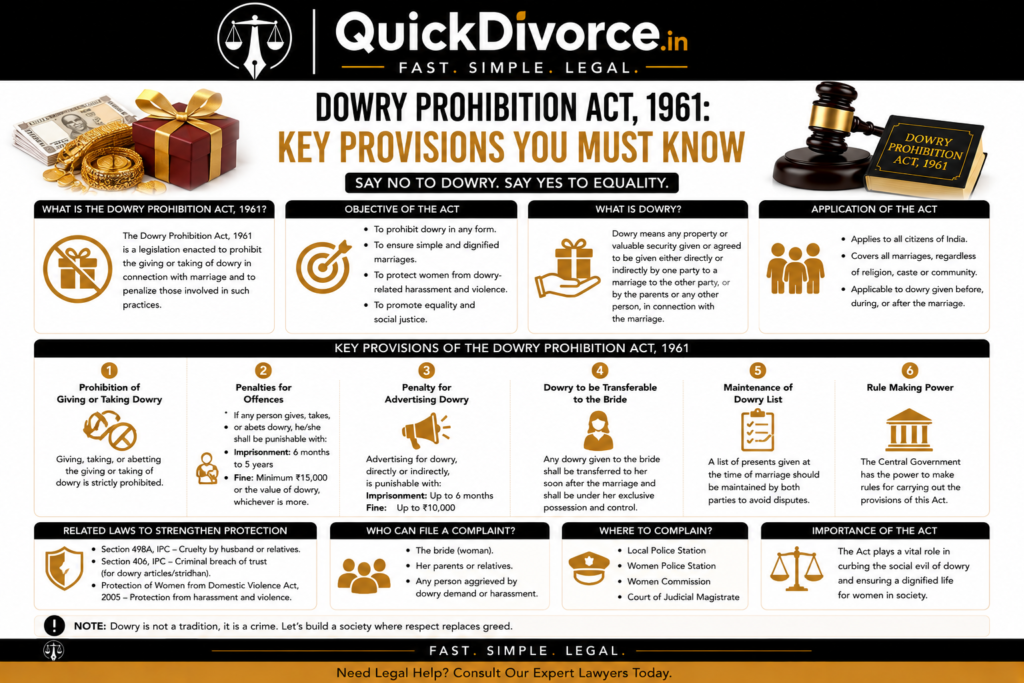
Under Section 2 of the Dowry Prohibition Act 1961, “dowry” means any property or valuable security given or agreed to be given either directly or indirectly by one party to a marriage to the other party to the marriage, or by the parents of either party to a marriage or by any other person, to either party to the marriage — at or before or any time after the marriage — in connection with the marriage of the said parties.
Three features of this definition deserve particular attention:
First, the timing is irrelevant. Dowry is not limited to what is exchanged at the time of the wedding ceremony. A demand made three years into the marriage, if connected to the marriage itself, still falls within the Act’s reach.
Second, the connection to marriage is essential. Courts have consistently held that there must be a demonstrable nexus between the demand and the marriage transaction. In Appasaheb v. State of Maharashtra, the Supreme Court clarified that ordinary financial demands unrelated to marriage may not amount to dowry unless linked with marriage consideration. A husband demanding money to pay his personal debts, without any connection to the marriage itself, may not meet this threshold.
Third, the Act explicitly excludes Mahr. The definition expressly provides that dower or Mahr in the case of persons to whom Muslim Personal Law (Shariat) applies is not treated as dowry — an important carve-out that reflects the constitutionally recognised personal law framework for Muslim marriages.
Section 3: Penalty for Giving or Taking Dowry
This is the provision that most people are aware of in its broad outline but rarely understand in detail. Critically, Section 3 of the Dowry Prohibition Act 1961 makes it illegal to both give and take dowry — placing equal legal liability on the bride’s family (who gives) and the groom’s family (who takes).
Section 3 prescribes that any person who, after the commencement of the Act, gives or takes or abets the giving or taking of dowry shall be punishable with imprisonment for a term of not less than five years, and with a fine of not less than ₹15,000 or the amount of the value of such dowry, whichever is more. However, the court may, for adequate and special reasons to be recorded in the judgment, impose a sentence of less than five years.
The “abetment” aspect of Section 3 is significant and is often overlooked — it means that third parties who assist or facilitate a dowry transaction can themselves be prosecuted, even if they are not the primary giver or receiver.
What Does Section 3 Permit? — The Gifts Exception
Section 3(2) carves out an important exception for voluntary gifts, making this crucial to understand for any family involved in a wedding. In 1984, the Act was amended to specify that presents given to a bride or groom at the time of a wedding are allowed, provided that a list is maintained describing each gift, its value, the identity of the person giving it, and that person’s relation to either party.
The Dowry Prohibition (Maintenance of Lists of Presents) Rules, 1985, formalised this requirement. The key distinction courts apply is whether a gift was given without demand and without coercion — voluntary, well-documented gifts are permissible; however, voluntary gifts given without demand and recorded properly may not amount to dowry, and conversely, gifts given under pressure or as a response to an explicit demand will almost certainly be treated as dowry regardless of how they are labelled.
Section 4: Penalty for Demanding Dowry
If Section 3 targets the actual transaction, Section 4 targets the demand that precedes it. This is a particularly important provision because it allows prosecution even where no dowry has actually changed hands — the demand itself is sufficient to constitute an offence.
Section 4 punishes any person who demands dowry, directly or indirectly, with imprisonment for a term of not less than six months, which may extend to two years, and a fine which may extend to ₹10,000.
Even verbal pressure or repeated harassment can amount to a dowry demand under this section. Courts have held that informal, verbal demands made to the bride’s family — whether in person or over the phone — constitute offences under Section 4 if they can be proven.
The punishment under Section 4 is somewhat lighter than Section 3, reflecting the fact that a demand, while serious, is at an earlier stage in the dowry chain than an actual exchange. However, in practice, Section 4 cases are often combined with cruelty charges under Section 85 of the Bharatiya Nyaya Sanhita, 2023 (formerly Section 498A IPC), giving courts a stronger overall sentencing framework.
Section 4-A: Prohibition on Dowry Advertisements
This is among the lesser-known provisions of the Dowry Prohibition Act 1961, but it carries significant relevance in the digital age.
Section 4-A prohibits any advertisement, publication, or notice that offers or invites dowry, including matrimonial advertisements that highlight wealth, property, or other valuables as marriage prerequisites. Violations are punishable by imprisonment for up to five years and fines of ₹15,000.
This provision has gained new relevance in the age of matrimonial websites and social media platforms, where profiles sometimes include language about expected financial status or “investments” in ways that could be read as inviting dowry offers. Courts and regulators have begun paying closer attention to such content, though dedicated enforcement remains patchy.
Section 6: Dowry to Be for the Benefit of the Wife
This provision addresses a common real-world scenario: dowry is received by the husband or his family, and the wife — the person it was ostensibly for — never actually benefits from it.
Section 6 of the Dowry Prohibition Act 1961 ensures that any dowry received by any person other than the bride must be transferred to her within three months of marriage. Failure to do so can lead to imprisonment and fine.
In other words, if a car, jewellery, or cash given as dowry ends up under the husband’s or in-laws’ control after the wedding, Section 6 creates an independent, enforceable obligation to transfer it to the wife within the stipulated period. This section works closely with the principle established by the Supreme Court in Pratibha Rani v. Suraj Kumar, where the Court held that stridhan remains the exclusive property of the wife, and refusal to return it may amount to criminal breach of trust.
Section 7: Cognizance of Offences
Understanding who can try offences under the Dowry Prohibition Act 1961, and how those proceedings are initiated, is important for anyone considering filing a complaint.
Only a Metropolitan Magistrate or a Judicial Magistrate of the First Class can try offences under this Act. Courts can take action based on police reports, complaints from the aggrieved party, or their own knowledge of an offence having occurred.
Additionally, the nature of the offences under the Act makes them particularly serious from a procedural standpoint. Offences under this Act are non-bailable, meaning bail is not automatically granted, and non-compoundable, meaning parties cannot privately settle the matter and simply withdraw the case. In some cases, the burden of proof lies on the accused to prove that no offence was committed.
This reversal of the burden of proof — a significant departure from the general principle that the prosecution must prove guilt — is one of the Act’s most powerful tools. Once the prosecution establishes the basic facts of a dowry demand or transaction, the burden shifts to the accused to disprove it.
Section 8-A: Burden of Proof
Related to Section 7 but worth examining separately, Section 8-A codifies the shifted burden of proof in a specific way: where a person is charged with an offence under Sections 3 or 4 of the Dowry Prohibition Act 1961, the court shall presume that the person has committed the offence unless the contrary is proved. This presumption applies in both giving-and-taking cases (Section 3) and demand cases (Section 4), and makes it considerably more difficult for an accused person to walk away on a technicality once the basic facts of a complaint are established.
Section 8-B: Dowry Prohibition Officers
To translate the law from paper to practice, the Act provides for a dedicated enforcement mechanism — the Dowry Prohibition Officer.
Dowry Prohibition Officers are appointed under the Act and are responsible for preventing dowry practices, investigating cases, and collecting evidence for prosecution. They are granted authority to inspect records and seize any dowry-related documents or items.
State governments may also appoint an advisory board of not more than five social welfare workers — at least two of whom must be women — from the area within which the Dowry Prohibition Officer exercises jurisdiction, to advise and assist the officer in performing their duties effectively.
In reality, courts have repeatedly flagged that the involvement of Dowry Prohibition Officers in actual investigations has been inconsistent and, in many states, largely nominal. The Allahabad High Court, for instance, has specifically directed state governments to ensure more meaningful participation of these officers in dowry-related investigations, particularly in tracking and recovering alleged dowry amounts during the course of a case.
Key Amendments That Strengthened the Dowry Prohibition Act 1961
The original 1961 statute was widely acknowledged to be insufficiently strong in its enforcement mechanisms. Two rounds of amendments materially changed this:
The 1984 Amendment
- Introduced the exception for voluntary gifts, with the mandatory gifts list requirement
- Expanded the definition of who could file a complaint
- Allowed any person, not just the aggrieved party, to report dowry-related offences
The 1986 Amendment
This was the more significant overhaul. The minimum imprisonment term for giving or taking dowry was increased from two years to five years, and the offences were made cognizable, enabling police to arrest individuals without a warrant. This amendment also allowed the victim’s family members or any third party to report dowry-related offences, broadening the scope for legal action considerably.
After the 2019 reorganisation of Jammu and Kashmir, the Act now extends to the whole of India, removing the earlier exclusion of J&K from its territorial scope.
Complementary Laws That Work Alongside the Dowry Prohibition Act 1961
The Dowry Prohibition Act 1961 does not operate in isolation — its reach and impact are significantly amplified by related provisions in other statutes:
Section 85, Bharatiya Nyaya Sanhita 2023 (formerly Section 498A IPC)
Criminalises cruelty by a husband or his relatives toward a married woman, specifically including harassment linked to unlawful dowry demands. This is a cognizable, non-bailable, and non-compoundable offence, with imprisonment extendable to three years.
Section 304B, Bharatiya Nyaya Sanhita 2023 (formerly Section 304-B IPC)
Addresses dowry death — where a woman dies within seven years of marriage under circumstances that indicate dowry-related harassment shortly before her death. Under the corresponding presumption provision, now under the Bharatiya Sakshya Adhiniyam 2023, the court may presume a dowry death against the husband or relatives once the prosecution proves the essential ingredients. The minimum sentence for dowry death is seven years, which may extend to life imprisonment.
Section 316, Bharatiya Nyaya Sanhita 2023 (formerly Section 406 IPC)
Criminalises criminal breach of trust — applicable where dowry or stridhan entrusted to the husband or in-laws is subsequently withheld, misappropriated, or refused to be returned.
The Protection of Women from Domestic Violence Act, 2005
Provides a civil remedy framework for victims, including protection orders, residence orders, and monetary compensation, addressing dowry-related harassment without requiring the criminal trial process.
Landmark Judgments Shaping the Dowry Prohibition Act 1961
Several Supreme Court and High Court rulings have significantly shaped how the Act is interpreted and applied:
- In Pawan Kumar v. State of Haryana, the Supreme Court held that dowry demands strike at the dignity of women and represent a serious social menace.
- In Satvir Singh v. State of Punjab, the Court clarified that there must be a connection between the demand and marriage for an item to legally qualify as dowry.
- In S. Gopal Reddy v. State of Andhra Pradesh, the Supreme Court emphasised that the Dowry Prohibition Act 1961 must be interpreted strictly to suppress the social evil it was designed to address.
- In Arjun Dhondiba Kamble v. State of Maharashtra, the Bombay High Court held that dowry, in the sense contemplated by the Act, is a demand for property or valuable security having an inextricable nexus with the marriage.
Real-World Enforcement Challenges
Despite the strength of its provisions, the Dowry Prohibition Act 1961 faces persistent enforcement challenges. Socio-cultural acceptance of dowry, deep-rooted in many parts of Indian society, the reluctance to challenge cultural norms especially in rural areas, and social stigma and fear of reprisal all continue to hinder the Act’s effectiveness.
More recently, courts have also flagged the opposite concern: that the Act’s powerful provisions — particularly the shifted burden of proof and the non-bailable nature of offences — are sometimes invoked in exaggerated or false complaints, particularly during matrimonial disputes. The Supreme Court’s direction in Arnesh Kumar v. State of Bihar (2014) — requiring police to apply their minds before arresting under these provisions — was a direct response to concerns about mechanical arrests that swept in entire families on the basis of broadly worded complaints.
Both these realities — genuine underenforcement and occasional misuse — coexist, and the courts are constantly navigating the tension between them.
How QuickDivorce.in Can Help
Whether you’re a woman facing dowry harassment and need to understand your legal options, or a family wrongly named in an exaggerated complaint and seeking to protect your rights, the Dowry Prohibition Act 1961 is a statute where legal strategy matters enormously. At QuickDivorce.in, our family law team helps clients navigate both sides of this legal framework — filing the right combination of complaints with proper evidence documentation, or building a sound defence where allegations are vague, unsubstantiated, or inflated.
Frequently Asked Questions (FAQs)
1. What is the Dowry Prohibition Act, 1961?
The Dowry Prohibition Act, 1961 is an Indian law that prohibits the giving, taking, or demanding of dowry in connection with a marriage. Its primary objective is to prevent the social evil of dowry and protect individuals from dowry-related harassment.
2. What is considered dowry under the Dowry Prohibition Act, 1961?
Under the Dowry Prohibition Act, 1961, dowry generally refers to any property, valuable security, or assets given or agreed to be given directly or indirectly by one party to the marriage or their relatives in connection with the marriage. Voluntary gifts given without any demand may be treated differently under the law.
3. Is demanding dowry a criminal offence?
Yes. The Dowry Prohibition Act, 1961 makes demanding, giving, or accepting dowry a punishable offence. Individuals found guilty may face penalties, including imprisonment and fines, as provided under the Act.
4. Who can file a complaint under the Dowry Prohibition Act, 1961?
A complaint under the Dowry Prohibition Act, 1961 may generally be filed by the aggrieved person, their parents or relatives, a recognized welfare organization, or any other person authorized under the law.
5. What is the punishment under the Dowry Prohibition Act, 1961?
The Dowry Prohibition Act, 1961 prescribes penalties that may include imprisonment and monetary fines for giving, taking, or demanding dowry. The exact punishment depends on the facts of the case and the applicable legal provisions.
6. Are wedding gifts prohibited under the Dowry Prohibition Act, 1961?
No. Genuine voluntary gifts exchanged during marriage without any demand are generally not prohibited under the Dowry Prohibition Act, 1961, provided they comply with the legal requirements and are not given as dowry.
7. How can a victim seek legal help under the Dowry Prohibition Act, 1961?
A person facing dowry-related harassment can approach the police, consult a family or criminal law advocate, or seek relief through the appropriate court. Depending on the circumstances, other legal provisions relating to cruelty, domestic violence, or harassment may also be available.
Conclusion
The Dowry Prohibition Act 1961 remains one of India’s most important social legislation statutes — covering not just the act of giving and taking dowry, but the demand for it, the advertising of it, and the failure to transfer it to the woman it was meant for. Its penalties are severe, its burden-of-proof provisions are powerful, and its complementary statutes — particularly Sections 85 and 304B of the Bharatiya Nyaya Sanhita, 2023 — add further layers of accountability.
At the same time, understanding the Act’s nuances — particularly around the distinction between dowry and voluntary gifts, the evidentiary requirements courts actually apply, and the procedural safeguards that have been built in to prevent misuse — is just as important as understanding its basic prohibitions.
Whether you’re approaching this statute as a victim seeking protection or as someone navigating a matrimonial dispute where the Act has been invoked, professional legal guidance is the surest way to ensure the law works as it was intended — not as a blunt instrument, but as a precise tool for justice.
For legal guidance on dowry-related matters, complaints, or defence strategies, connect with the family law team at QuickDivorce.in.
For Expert Consultation Contact
🟡QuickDivorce offers trusted online legal services across India, including mutual divorce, contested divorce, child custody, alimony, marriage registration, and expert family law consultation.
👉 Mutual Consent Divorce
👉 Contested Divorce Filing
👉 Child Custody and Maintenance
👉 Matrimonial Property Settlement
👉 NRI Divorce Services
👉 Alimony and Maintenance
🟡 Protect Your Rights
👉 Domestic Violence Legal Support
👉 Stridhan Recovery
🟡For other Legal and Trademark related services visit
👉 Money Recovery Cases
👉 Property Disputes
👉 Business & Licence Registrations
📞 Call Now: +91 8595439395
🕐 Free Consultation: Monday to Saturday, 10 AM to 6 PM

Adv. Manish Kashyap is a Family Law & Divorce Lawyer with extensive experience in Mutual & Contested Divorce, NRI Divorce, Child Custody, Alimony, Domestic Violence, Judicial Separation, and Family Court matters, providing professional legal guidance to clients.

