

Views: 0
Table of Contents
- 1 The Difference Between a Useful Consultation and a Wasted One
- 2 Why Document Preparation Matters More for Online Consultations Specifically
- 3 Documents Relevant Regardless of Your Specific Situation
- 4 Additional Documents Specific to Mutual Consent Divorce
- 5 Additional Documents Specific to Contested Divorce
- 6 Additional Documents If Children Are Involved
- 7 Additional Documents and Information Specific to NRI Situations
- 8 Information That Is Not a “Document” But You Should Prepare Anyway
- 9 A Simple Pre-Consultation Checklist
- 10 What Happens If You Simply Do Not Have Most of This Yet
- 11 Frequently Asked Questions
- 12 Why Choose Quick Divorce
- 13 Need Help With Mutual Divorce or Legal Documentation?
The Difference Between a Useful Consultation and a Wasted One
A person who arrives with their marriage certificate, a rough sense of their financial situation, and a clear timeline of what happened gets a consultation that produces a real strategy, a realistic timeline, and specific next steps. A person who arrives only with “my marriage is over and I want a divorce” gets a consultation that spends most of its time gathering basic facts, leaving little room for the actual strategic guidance the consultation exists to provide.
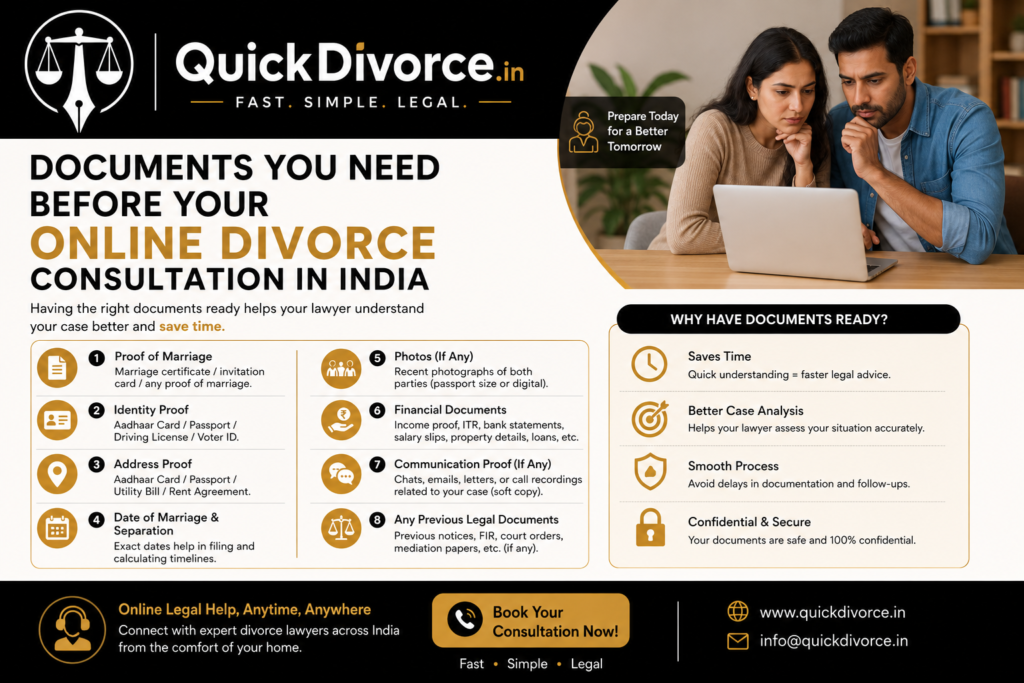
Before scheduling a legal consultation, it is important to understand the “Documents You Need Before Your Online Divorce Consultation” so that your lawyer can review your case efficiently. Keeping all necessary records ready in advance can help avoid delays, save valuable time, and ensure that you receive accurate legal guidance tailored to your situation.
Two people can have the exact same online consultation, with the exact same lawyer, about a fairly similar situation, and walk away with completely different value from it. The difference is almost never the lawyer’s skill. It is almost always preparation.
As covered in our broader guide on how to file a divorce petition after an online consultation, the consultation itself does not require physical documents in hand, but it is dramatically more useful when you know what you have, what you do not have, and roughly what each document will be needed for later. This guide is the preparation checklist that earlier guide assumes you have already worked through.
Why Document Preparation Matters More for Online Consultations Specifically
This deserves a moment of attention, because it is not obvious at first.
In an in-person consultation of an earlier era, a lawyer might physically flip through a folder you brought, point at things, and ask questions in real time as documents came up. In an online consultation, conducted over video or phone, that physical back-and-forth is harder to replicate. You are describing documents rather than handing them over, and the lawyer is forming an assessment based on your verbal account of what each document says.
This means the burden of accurate, organized preparation shifts slightly more onto you in an online setting. Knowing what you have, in what form, and being able to summarize the key dates and figures accurately during the call, directly determines how useful the lawyer’s assessment can be in that single session.
Documents Relevant Regardless of Your Specific Situation
These apply whether you are pursuing mutual consent divorce, contested divorce, or are not yet sure which applies to you.
Marriage Proof
Your original marriage certificate, whether issued under the Hindu Marriage Act, Special Marriage Act, through an Arya Samaj Mandir, or any other applicable process. If you do not have this readily available, note clearly where and how you were married, and whether you believe a certificate exists somewhere, since this affects which legal route is even available to you.
If your marriage certificate is lost, as covered in our dedicated guide on obtaining a duplicate Arya Samaj marriage certificate, mention this explicitly in your consultation rather than simply saying you do not have it, since recovering it may need to happen in parallel with the divorce process itself, and the lawyer needs to know this upfront to sequence things correctly.
Wedding photographs or invitation card, useful as secondary proof of the marriage and its date, particularly if the formal certificate is missing or delayed.
Identity and Basic Personal Documents
Aadhaar Card, Passport, Voter ID, or PAN Card for yourself, and the same for your spouse if you have copies. You are not expected to have your spouse’s documents in many situations, but if you do, they help establish basic facts quickly.
Proof of your current address, particularly important if you have moved out of the marital home, since this can affect which court has jurisdiction over your case.
A Written Timeline, Even a Rough One
This is not a formal document you already possess, but it is worth preparing specifically for the consultation: a simple chronological note of key dates — when you married, when problems began, any separation date, any significant incidents you may need to describe, and the current living situation. Lawyers spend a meaningful portion of first consultations simply establishing this timeline verbally; arriving with it already organized means that time gets spent on strategy instead.
Additional Documents Specific to Mutual Consent Divorce
If both you and your spouse are in agreement about divorcing, or are likely to be, these become relevant.
Any existing written understanding between you and your spouse, even informal notes, messages, or emails where terms have already been discussed — maintenance figures mentioned, who keeps what, custody ideas floated. This is not a binding document, but it gives the lawyer a starting point rather than building a settlement proposal from nothing, and as covered in our detailed guide on drafting a mutual divorce settlement agreement, vague verbal understandings are exactly what need to be converted into specific, enforceable terms.
Proof of the separation period, since mutual consent divorce generally requires at least one year of living separately. This could be separate utility bills, a rent agreement if you have moved out, or simply being prepared to explain clearly when and how the separation began.
A basic list of joint assets and liabilities, even approximate: property, joint bank accounts, loans, vehicles, investments. You do not need exact valuations for a first consultation, but having a rough sense of what exists prevents the conversation from being purely abstract.
Additional Documents Specific to Contested Divorce
If your spouse is not in agreement, or if specific grounds like cruelty, desertion, or adultery are relevant to your situation, these become important.
Evidence Connected to Your Specific Grounds
For cruelty claims: any medical reports documenting injuries, photographs of injuries or property damage, screenshots of threatening or abusive messages, and details of any prior police complaints filed. As covered in our detailed guide on medical evidence in matrimonial cases, even informal contemporaneous notes about specific incidents — dated, even briefly — are worth bringing up in your consultation, since timing of documentation significantly affects how evidence is later presented.
For desertion claims: anything establishing when your spouse left, and any communication (or lack of it) since then — last messages exchanged, any attempts you made to re-establish contact, and roughly how long the separation has continued.
For adultery-related claims: this is sensitive and evidence is often circumstantial rather than direct. Bring whatever you have, but understand the consultation itself is the right place to discuss realistically how strong or weak this evidence is, rather than assuming any one piece of information settles the matter.
Financial Documents
Salary slips, bank statements, and income tax returns for yourself, and for your spouse if you have access to them, covering roughly the last one to two years. These matter significantly for maintenance discussions and are worth having at least roughly organized before the call.
Property ownership documents, for anything you or your spouse own individually or jointly, even in summary form.
Additional Documents If Children Are Involved
Birth certificates of all children.
School records, including admission letters or fee receipts, useful both to establish the school the child currently attends and, indirectly, who has been managing that aspect of the child’s life.
Any existing informal custody or visitation arrangement, even if it has only existed verbally since separation, since the lawyer needs to understand the current practical reality before discussing what a formal arrangement should look like, a topic covered in detail in our guide on how Indian courts decide child custody.
Any documentation of specific concerns, if relevant, such as medical records for a child with ongoing health needs, or anything relevant to safety concerns connected to either parent.
Additional Documents and Information Specific to NRI Situations
If either you or your spouse is an NRI, a few additional categories matter specifically.
Passport and visa copies, for whichever party is the NRI, showing current residency status abroad.
Any foreign legal proceedings already underway or completed. This is critical and frequently underweighted by people preparing for a consultation: if your spouse has already filed for divorce abroad, or if a foreign decree already exists, bring whatever documentation you have of this, even informal knowledge of it, since this fundamentally changes the strategy, as covered in our guide on challenging ex-parte divorce decrees, particularly the section on foreign decrees obtained without an Indian spouse’s knowledge.
Details of your spouse’s current location and contact information, to the extent you have it, since this affects how service of notice will need to be handled if proceedings are contested.
Any existing Power of Attorney documents, if you have already had one prepared for any purpose connected to this situation, as covered in our dedicated guide on Power of Attorney for NRI divorce cases.
Information That Is Not a “Document” But You Should Prepare Anyway
A few things genuinely matter for the consultation’s usefulness that are not physical paperwork at all.
A realistic sense of your own priorities. Is your primary concern getting divorced quickly, protecting your financial position, securing custody arrangements, or some combination? Lawyers can advise more specifically when they understand what you are actually optimizing for, rather than guessing at priorities you have not yet articulated even to yourself.
Honesty about anything that might count against you. If there is something in your own conduct that your spouse might raise — financial issues, a past incident, anything relevant — mentioning this yourself during the consultation, rather than having it surface later as a surprise, allows the lawyer to actually plan around it.
Your availability and constraints. If you are an NRI with limited time in India, or have a specific deadline (a visa renewal, a planned move, a child’s school year), say so clearly, since this affects which legal strategy — mutual versus contested, whether to seek a cooling-off period waiver as covered in our guide on that exact topic — makes practical sense for you specifically.
A Simple Pre-Consultation Checklist
Use this as a quick reference before your call.
Always relevant:
- [ ] Marriage certificate, or clear notes on where/how you married if certificate is missing
- [ ] Your identity documents
- [ ] A basic written timeline of the relationship and current situation
If mutual divorce is likely:
- [ ] Any existing informal agreement on terms
- [ ] Proof or explanation of separation period
- [ ] Rough list of joint assets and liabilities
If contested divorce is likely:
- [ ] Evidence connected to your specific grounds (medical, messages, photographs)
- [ ] Financial documents — salary slips, bank statements, ITRs
- [ ] Property documents
If children are involved:
- [ ] Birth certificates
- [ ] School records
- [ ] Notes on current informal custody arrangement
If NRI factors apply:
- [ ] Passport and visa copies
- [ ] Any foreign proceedings or decrees, even informally known
- [ ] Spouse’s location and contact details, to the extent known
What Happens If You Simply Do Not Have Most of This Yet
This is worth saying plainly: arriving at a consultation without most of these documents organized is not disqualifying, and it does not mean the consultation is wasted. Many people reach out for a first consultation precisely because they do not yet know what they have, what they need, or even which type of divorce applies to their situation.
What this checklist changes is not whether you can have a useful first consultation without it — you can — but how much further that single consultation can take you. A person with no documents organized will generally leave the first consultation with a clear list of exactly what to gather next. A person who arrives with this checklist already worked through will generally leave with that same clarity, plus a meaningfully more developed sense of strategy and timeline, because the consultation time was spent on judgment rather than on basic fact-gathering.
If your situation is urgent — a deadline, a recent serious incident, an NRI trip with limited time in India — mention this at the very start of the call, before going through documents at all, since it may change how the lawyer chooses to prioritize the conversation.
Frequently Asked Questions
Q1. Do I need to physically have all these documents before my first online consultation?
No. Having them organized and accessible meaningfully improves the usefulness of the consultation, but a first consultation is still valuable even if you are starting with very little, and a clear next-steps list for gathering documents is itself a normal and useful outcome of that first call.
Q2. What if my spouse has documents I need but won’t give them to me?
This is common, and it is exactly the kind of issue to raise during the consultation rather than trying to resolve on your own beforehand. Legal mechanisms exist to compel disclosure of certain documents, particularly financial ones, once proceedings begin.
Q3. Should I send documents to the lawyer before the call, or just describe them during it?
Both can work, and this often depends on the specific platform or firm. Sending scanned copies in advance where you can generally allows for a more substantive discussion during the call itself, since the lawyer has already reviewed rather than hearing about them for the first time live.
Q4. Is it a problem if I don’t know which type of divorce applies to my situation yet?
No, this is actually one of the most common reasons people seek a first consultation in the first place, and determining this is one of the primary things the consultation is meant to establish, as covered in our guide on mutual versus contested divorce.
Q5. What if my marriage certificate is lost and I haven’t gotten a duplicate yet?
Mention this clearly in your consultation. Depending on your situation, getting a duplicate certificate may need to happen in parallel with, rather than strictly before, the divorce process, and your lawyer can advise on sequencing this correctly.
Q6. I am an NRI with very limited time in India for my next trip. Does document preparation matter more for me?
Significantly more. As covered in our guide on Power of Attorney for NRI divorce cases, much of the procedural work can be handled remotely once documentation is properly organized, meaning your limited time in India can be focused specifically on the steps that legally require your personal presence.
Why Choose Quick Divorce
A genuinely useful first consultation depends as much on what you bring to it as on the lawyer conducting it. We help clients prepare specifically for their first call, often sending a tailored document checklist in advance based on a brief initial description of the situation, so that the consultation itself can focus on strategy rather than basic fact-gathering.
Book your free online consultation today: 📞 Call / WhatsApp: 8595439395 🌐 Website: www.quickdivorce.in
Need Help With Mutual Divorce or Legal Documentation?
🟡 QuickDivorce.in provides complete mutual divorce legal services — settlement negotiation, alimony structuring, property division, stridhan recovery, MoU drafting, court representation, and post-decree implementation — across all jurisdictions in India.
🟡Visit LegalTax.in for other Legal and Trademark related services as 👉 Money Recovery Cases
👉 Property Disputes 👉 Business & Licence Registrations
🟡Visit Business24hub for IT services
👉 Mutual Consent Divorce at QuickDivorce.in 👉 Contested Divorce Filing 👉 Child Custody and Maintenance 👉 Matrimonial Property Settlement 👉 NRI Divorce Services 👉 Alimony and Maintenance
🟡 Protect Your Rights 👉 Domestic Violence Legal Support at QuickDivorce.in 👉 Stridhan Recovery
📞 Call Now: +91 8595439395 🕐 Free Consultation: Monday to Saturday, 10 AM to 6 PM

Adv. Manish Kashyap is a Family Law & Divorce Lawyer with extensive experience in Mutual & Contested Divorce, NRI Divorce, Child Custody, Alimony, Domestic Violence, Judicial Separation, and Family Court matters, providing professional legal guidance to clients.

