

Views: 8
Complete list of documents required for marriage registration in India in 2026 — Hindu Marriage Act, Special Marriage Act, checklist & tips.
Table of Contents
- 1 Introduction
- 2 1. Why Documentation Matters for Marriage Registration
- 3 2. Documents Required Under the Hindu Marriage Act
- 4 3. Documents Required for Marriage Registration Under the Special Marriage Act
- 5 4. Documents for Interfaith and Inter-Caste Marriages
- 6 5. Documents for Divorcees and Widows/Widowers
- 7 6. Documents Required for Witnesses
- 8 7. Photograph Requirements
- 9 8. Proof of Age: What’s Accepted and What Isn’t
- 10 9. Proof of Residence: Accepted Documents
- 11 10. Additional Documents for NRIs and Foreign Nationals
- 12 11. Step-by-Step Document Submission Process
- 13 12. State-Wise Document Variations
- 14 13. Common Mistakes With Documentation
- 15 14. Expert Tips for Document Preparation
- 16 15. Quick Checklist
- 17 16. Real-Life Example
- 18 17. Latest 2026 Updates
- 19 18. Industry Insights
- 20 19. Frequently Asked Questions
- 21 20. Conclusion
- 22 Get Expert Advice for Marriage Registration in India
Introduction
One of the most common reasons marriage registration applications get delayed or rejected in India isn’t eligibility — it’s missing or incorrect paperwork. Knowing exactly which documents are required for marriage registration in India before you visit the registrar’s office can save weeks of back-and-forth.
Requirements differ slightly depending on whether you’re registering under the Hindu Marriage Act, the Special Marriage Act, or a state-specific law, and whether your wedding has already taken place. This guide walks through the exact documents you need for each scenario, common verification issues, and a ready-to-use checklist so your application goes through on the first attempt.
1. Why Documentation Matters for Marriage Registration
Marriage registration is a legal process, and like any legal process, it depends entirely on verifiable paperwork. The registrar’s office cannot simply take a couple’s word for their age, residence, or marital history — every claim must be backed by an accepted document.
Incomplete documentation is the single biggest cause of delay. An application missing a witness ID, a wrongly attested photograph, or an unacceptable age-proof document often gets sent back for resubmission, adding weeks to the process. Preparing the correct documents in advance — originals and self-attested photocopies — is the fastest way to get your certificate without repeat visits.
It’s also worth understanding that the required documents vary depending on:
- Which Act you’re registering under (Hindu Marriage Act vs Special Marriage Act)
- Whether the marriage has already been solemnised or not
- Whether either party is divorced, widowed, or a foreign national
- The state or union territory where you’re applying
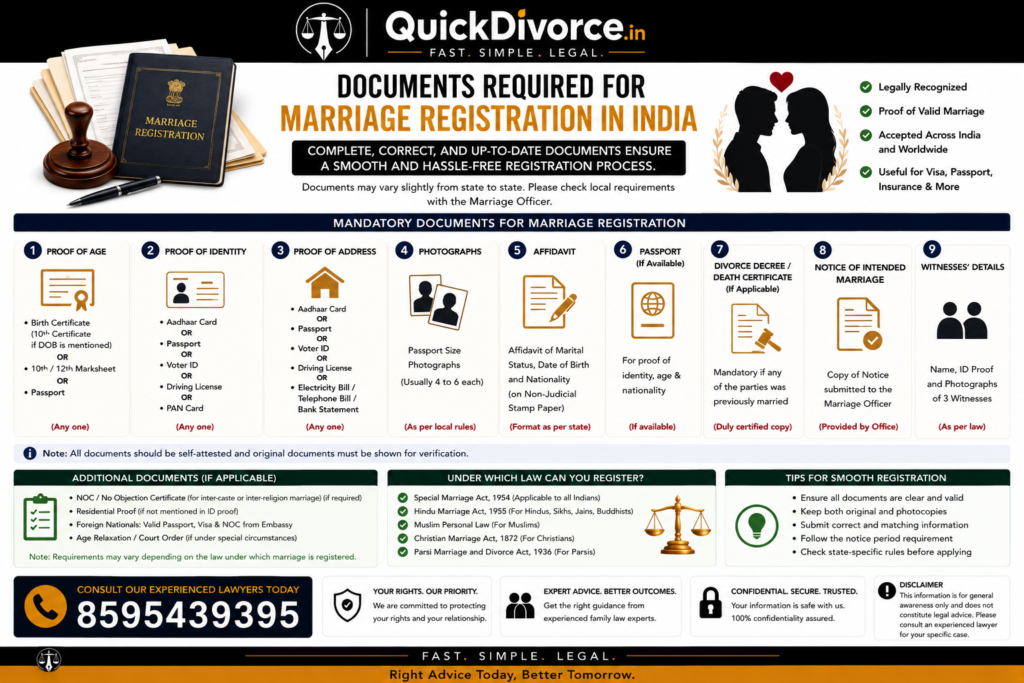
2. Documents Required Under the Hindu Marriage Act
Since the Hindu Marriage Act applies to marriages that are already solemnised through religious rituals, the documentation focuses on proving the wedding actually took place, along with standard identity checks.
- Duly filled and signed application form
- Proof of age of both parties (birth certificate, school leaving certificate, or passport)
- Proof of residence of both parties
- Aadhaar card, PAN card, or passport as identity proof
- Wedding invitation card (if available)
- Marriage photographs showing the ceremony (rituals such as saptapadi)
- Affidavit confirming date, place of marriage, and marital status of both parties
- Affirmation that the parties are not within the prohibited degree of relationship
- Passport-size photographs of both spouses (usually two copies each)
- Attested certificate with photographs of both parties, signed by a gazetted officer
Important Note: A gazetted officer who attended the wedding must typically be present on the registration date to confirm that the ceremony took place, along with valid ID.
3. Documents Required for Marriage Registration Under the Special Marriage Act
Because the Special Marriage Act allows two people of any religion to marry civilly, without rituals, the required documents focus more heavily on identity, residence, and legal eligibility.
- Notice of Intended Marriage, signed by both parties
- Proof of age (birth certificate, passport, or matriculation certificate)
- Proof of residence for at least 30 days in the district
- Passport-size photographs of both parties
- Identity proof (Aadhaar, passport, voter ID, PAN)
- Affidavit stating marital status, that parties are not within prohibited relationship, and consent is free
- Divorce decree or death certificate of previous spouse, if applicable
- Details and ID proof of three witnesses
Since this Act involves a mandatory 30-day public notice period, documents must be submitted upfront and are subject to public inspection and possible objection before the marriage is solemnised.
4. Documents for Interfaith and Inter-Caste Marriages
Interfaith and inter-caste couples almost always register under the Special Marriage Act since it doesn’t require either partner to convert religion. The document list is largely the same as above, but couples should additionally prepare:
- Proof of current religion of both parties (if requested by the registrar for succession-related purposes)
- A declaration that no religious conversion has taken place as a result of the marriage
- Any documentation clarifying inheritance elections, since succession for each partner is governed by their own personal law
Pro Tip: Interfaith couples should clarify with the registrar in advance which succession law will apply to each spouse’s estate, since this affects future documentation like wills and nominations.
5. Documents for Divorcees and Widows/Widowers
If either party has been married before, additional legal proof is mandatory:
- Certified copy of the divorce decree (final decree absolute, not just filing papers)
- Death certificate of the previous spouse, in case of widowhood
- Any court order relevant to custody or maintenance from a previous marriage, if applicable
Warning Box: Submitting only a filed divorce petition, rather than the final decree, is a common reason applications are rejected. The decree must show the divorce is legally finalised.
6. Documents Required for Witnesses
Both Acts require witnesses to be present with valid identification:
| Act | Number of Witnesses | Accepted ID Proof |
|---|---|---|
| Hindu Marriage Act | 1 gazetted officer who attended the ceremony | Government ID + proof of gazetted status |
| Special Marriage Act | 3 witnesses | Aadhaar, PAN, or passport |
Witnesses must be present in person on the date of registration; their documents cannot simply be submitted on their behalf.
7. Photograph Requirements
- Two passport-size photographs of each spouse (recent, plain background)
- Ceremonial or wedding photographs, attested by a gazetted officer, PSU official, or PAN holder (for Hindu Marriage Act applications)
- Joint photograph of the couple together, in some states
Photographs that are unclear, outdated, or not properly attested are frequently flagged during verification.
8. Proof of Age: What’s Accepted and What Isn’t
| Accepted as Primary Proof | Often Rejected as Sole Proof |
|---|---|
| Birth certificate | Aadhaar card alone |
| Passport | Voter ID alone |
| School/matriculation certificate | Driving license alone |
Registrars increasingly ask for stronger age documentation following stricter enforcement around minimum marriage age, so it’s best to carry a birth certificate or passport even if you also have Aadhaar.
9. Proof of Residence: Accepted Documents
- Aadhaar card
- Voter ID card
- Passport
- Utility bills (electricity, water, gas) in the applicant’s name
- Rent agreement, if residing as a tenant
At least one party typically needs to show residence within the registrar’s jurisdiction for the required minimum period (commonly 30 days), so recent utility bills or a rent agreement can be useful if Aadhaar reflects a different address.
10. Additional Documents for NRIs and Foreign Nationals
Foreign nationals or NRIs marrying in India under the Special Marriage Act need extra documentation:
- Valid passport and visa
- No Objection Certificate (NOC) from the respective embassy or consulate
- Proof of single status/unmarried certificate from the home country, translated and notarised if not in English
- Proof of residence in India for the required period before filing notice
Did You Know? Many embassies require the Indian marriage certificate itself before issuing a spouse visa — so foreign nationals should plan registration well ahead of any visa deadlines.
11. Step-by-Step Document Submission Process
- Identify the correct Act based on religion and marital circumstances.
- Gather originals and self-attested photocopies of all required documents.
- Fill out the application form (online where available).
- Submit documents at the registrar’s office or upload them via the state portal.
- Registrar verifies documents and schedules an appointment date.
- Under the Special Marriage Act, documents remain on public notice for 30 days.
- Attend the appointment with your spouse, witnesses, and all originals for final verification.
- Certificate is issued once verification is complete.
12. State-Wise Document Variations
Document requirements can differ slightly by state due to local marriage acts:
- Delhi: Uses the Delhi (Compulsory Registration of Marriage) Order 2014; requires identification via PAN holder attestation or a government official.
- Tamil Nadu: Registration of Marriage Act 2009; late registration (after 90 days) requires an additional late-fee declaration document.
- Maharashtra & Gujarat: Governed by the Bombay Registration of Marriages Act 1953.
- Karnataka: Karnataka Marriages (Registration and Miscellaneous Provisions) Act 1976.
- West Bengal: Registration managed through the state’s dedicated MARREG portal, with documents uploaded digitally before the in-person appointment.
Always check your specific state’s marriage registration portal, since minor documentation differences are common.
13. Common Mistakes With Documentation
- Submitting Aadhaar or voter ID as the only proof of age
- Forgetting to bring original documents alongside photocopies
- Submitting a divorce petition instead of the final decree
- Missing witness ID proofs on the appointment date
- Using outdated or unattested wedding photographs
- Not declaring a late registration period where required by the state
14. Expert Tips for Document Preparation
- Prepare at least two sets of every document — one for submission, one for your own records.
- Get wedding photographs attested well before your appointment date to avoid last-minute delays.
- If either party has a name mismatch across documents (e.g., Aadhaar vs passport), get it corrected beforehand — mismatches are a frequent cause of rejection.
- For interfaith marriages, keep clarity on succession documentation, since it affects future legal and financial planning.
- Double-check your state’s specific portal for any additional forms unique to local marriage acts.
15. Quick Checklist
- [ ] Application form (signed by both parties)
- [ ] Proof of age (birth certificate/passport/school certificate)
- [ ] Proof of residence (Aadhaar/utility bill/rent agreement)
- [ ] Identity proof (Aadhaar/PAN/passport)
- [ ] Passport-size photographs (2 copies each)
- [ ] Wedding photographs (attested, if applicable)
- [ ] Affidavit of marital status and consent
- [ ] Divorce decree/death certificate (if applicable)
- [ ] Witness ID proofs
- [ ] NOC and translated documents (for foreign nationals/NRIs)
16. Real-Life Example
A couple applying under the Hindu Marriage Act in Delhi had their application returned twice — first because their wedding photographs weren’t attested by a gazetted officer, and second because they submitted only their Aadhaar cards as age proof. Once they resubmitted with attested photographs and their passports as age proof, the certificate was issued the same day their gazetted-officer witness appeared for verification. The lesson: minor documentation gaps, not eligibility issues, are usually what slows the process down.
17. Latest 2026 Updates
- More states are shifting to digital document upload ahead of the in-person appointment, reducing physical paperwork.
- Registrars are increasingly strict about primary age proof, following continued rollout of the Prohibition of Child Marriage (Amendment) Act, 2021 — Aadhaar and voter ID are frequently insufficient on their own.
- States like Delhi, Maharashtra, Karnataka, and Tamil Nadu now issue QR-coded digital marriage certificates, which can be verified using the application reference number and Aadhaar-based authentication.
18. Industry Insights
Family law practitioners consistently report that the majority of registration delays stem from document mismatches — name spelling differences across ID proofs, unattested photographs, or incomplete affidavits — rather than any substantive legal issue. Preparing a complete, cross-checked document set before the first visit is, by far, the most effective way to avoid multiple trips to the registrar’s office.
19. Frequently Asked Questions
1. What are the most important documents required for marriage registration?
The most important documents include the completed application form, along with valid proof of age, proof of identity, and proof of address for both applicants. Incomplete or incorrect documentation is one of the most common reasons for delays or rejection of marriage registration applications.
2. Is an Aadhaar Card enough for marriage registration?
No. While an Aadhaar Card is commonly accepted as identity and address proof, it is generally not sufficient as standalone proof of age. Applicants are usually required to submit additional documents such as a Birth Certificate, Passport, or School Leaving Certificate to establish their age.
3. How many witnesses are required for marriage registration in India?
The number of witnesses depends on the applicable law. Under the Special Marriage Act, 1954, three witnesses are required at the time of registration. Under the Hindu Marriage Act, 1955, witness requirements may vary by state, but generally one or more witnesses who attended the marriage ceremony are required. Applicants should verify the specific requirements with the local marriage registrar.
4. What additional documents does a divorcee need for marriage registration?
A divorced applicant must submit a certified copy of the final divorce decree or divorce judgment issued by the competent court. A copy of the divorce petition alone is not considered sufficient proof.
5. Do foreign nationals need additional documents for marriage registration in India?
Yes. Foreign nationals are generally required to provide a valid passport, valid visa, No Objection Certificate (NOC) or marital status certificate from their embassy, and any other documents prescribed by the concerned Marriage Registrar or applicable law.
6. Are wedding photographs mandatory for marriage registration?
For marriages registered under the Hindu Marriage Act, 1955, wedding photographs are commonly required as evidence that the marriage ceremony was solemnised according to the applicable religious customs. Requirements may vary depending on the state.
7. What documents are accepted as proof of residence?
Accepted residence proof generally includes an Aadhaar Card, Passport, Voter ID Card, Driving Licence, recent utility bills, bank passbook, or a registered rent agreement, subject to the requirements of the respective state authority.
8. Do interfaith couples need different documents for marriage registration?
The basic documents—such as proof of age, identity, address, and passport-size photographs—remain the same. However, couples registering under the Special Marriage Act, 1954 may also need to submit additional declarations or documents as required by the Marriage Officer.
9. Can marriage registration documents be submitted online?
Yes. Many state governments now offer online marriage registration portals where applicants can fill out the application form, upload supporting documents, and book an appointment before visiting the Marriage Registrar’s office for verification.
10. What happens if a document is rejected during verification?
If any document is found to be incorrect, incomplete, or invalid, the Marriage Registrar may ask the applicant to submit the correct document or provide additional clarification. This can delay the marriage registration process until the verification requirements are fulfilled.
20. Conclusion
Getting your documents right the first time is the single biggest factor in a smooth marriage registration experience in India. Whether you’re registering under the Hindu Marriage Act or the Special Marriage Act, the core requirements — valid age proof, residence proof, identity documents, photographs, and witness details — remain largely consistent, with a few additions for divorcees, widows/widowers, interfaith couples, and foreign nationals.
Preparing a complete, verified document set in advance, rather than scrambling at the registrar’s office, is the easiest way to avoid delays and get your marriage certificate without repeat visits.
Get Expert Advice for Marriage Registration in India
🟡QuickDivorce offers trusted online legal services across India, including mutual divorce, contested divorce, child custody, alimony, marriage registration, and expert family law consultation.
👉 Mutual Consent Divorce
👉 Contested Divorce Filing
👉 Child Custody and Maintenance
👉 Matrimonial Property Settlement
👉 NRI Divorce Services
👉 Alimony and Maintenance
👉 Court Marraige
👉 Stridhan Recovery
🟡For other Legal and Trademark related services visit
👉 Money Recovery Cases
👉 Property Disputes
👉 Business & Licence Registrations
📞 Call Now: +91 8595439395
🕐 Free Consultation: Monday to Saturday, 10 AM to 6 PM

Adv. Manish Kashyap is a Family Law & Divorce Lawyer with extensive experience in Mutual & Contested Divorce, NRI Divorce, Child Custody, Alimony, Domestic Violence, Judicial Separation, and Family Court matters, providing professional legal guidance to clients.

