

Views: 18
Table of Contents
- 1 Quick Summary
- 2 📌 What Is a Divorce Petition in India?
- 3 ⚠️ Why Petition Drafting Is the Most Critical Step
- 4 📋 Types of Divorce Petitions in India
- 5 ✅ Legal Requirements for a Valid Divorce Petition
- 6 📝 What Every Divorce Petition Must Include — Complete Checklist
- 7 📋 Mutual Consent Divorce Petition — Specific Requirements
- 8 ⚔️ Contested Divorce Petition — Specific Requirements
- 9 🔍 Grounds for Divorce — How to Draft Them Correctly
- 10 📄 Format and Structure of a Divorce Petition in India
- 11 📎 Supporting Documents That Must Accompany the Petition
- 12 🏛️ Jurisdiction — Getting It Right in the Petition
- 13 🚫 Common Drafting Mistakes That Get Petitions Rejected
- 14 🗣️ Language Requirements for Divorce Petitions in India
- 15 📜 Divorce Petition Under Different Personal Laws in India
- 16 🔎 How Courts Scrutinise a Divorce Petition
- 17 📅 What Happens After the Petition Is Filed
- 18 🌟 How Quick Divorce Handles Petition Drafting
- 19 💰 Cost Breakdown: Divorce Petition Drafting in India
- 20 ❓ Frequently Asked Questions (FAQs)
- 21 🎯 Who Needs This Guide Right Now?
- 22 ✅ Final Recommendation
- 23 Need Help With Divorce Petition Drafting?
Quick Summary
Divorce petition drafting in India is the single most important document in your entire divorce process. A poorly drafted petition gets rejected, delays your case by months and gives the other side legal advantages.
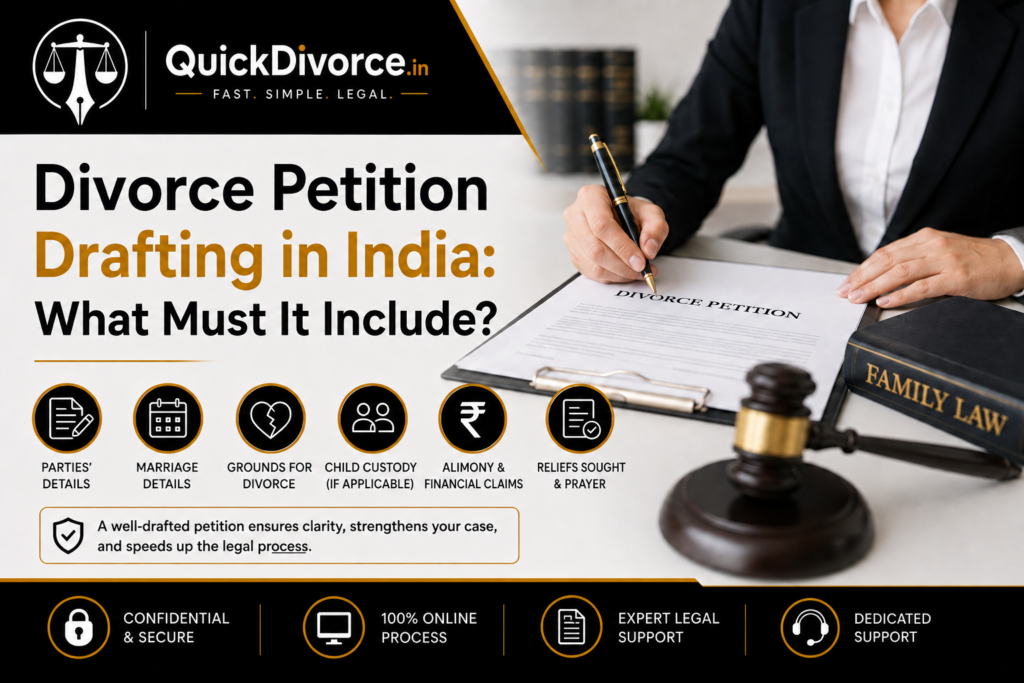
Here is what every divorce petition in India must include:
- 📋 Complete parties details — full names, addresses, ages and relationship of both parties
- 💒 Marriage details — date, place, form and registration of marriage
- ⚖️ Jurisdiction basis — why this specific court has authority to hear the case
- 📝 Grounds for divorce — clearly stated, specifically pleaded with dates and facts
- 👶 Children details — names, ages and custody arrangements sought
- 💰 Financial claims — maintenance, alimony and property relief sought
- 🙏 Prayer clause — exactly what orders the court is asked to pass
- ✍️ Verification — signed and sworn before a notary or magistrate
Quick Divorce drafts professionally correct petitions with 48 hour turnaround — starting at ₹4,999 for complete mutual divorce.
📌 What Is a Divorce Petition in India?
A divorce petition in India is the formal legal document through which one or both spouses formally request a family court to dissolve their marriage.
It is the foundation document of the entire divorce proceeding. Everything that follows — hearings, evidence, arguments, the final decree — flows from what is stated in the petition.
In Indian law, no marriage can be legally dissolved without a court proceeding — and no court proceeding can begin without a properly drafted and filed petition. There is no administrative divorce, no online divorce that bypasses the court, no self-declared dissolution of marriage that has any legal validity.
The petition is filed before the appropriate family court and must comply with:
- The requirements of the applicable personal law under which the divorce is sought
- The procedural requirements of the Code of Civil Procedure 1908
- The specific rules and practice directions of the family court where it is filed
- General principles of civil pleading — clarity, specificity and completeness
The most important thing to understand about divorce petition drafting in India: This is not a form to be filled in. It is a legal document that must accurately state facts, correctly identify legal grounds, establish jurisdiction and precisely claim the reliefs sought — all in a format acceptable to the specific court. Getting any element wrong leads to rejection, delay or a weakened case.
⚠️ Why Petition Drafting Is the Most Critical Step
Many people underestimate the importance of the divorce petition — treating it as a preliminary formality before the “real” legal work begins.
This is a serious mistake.
What a Well-Drafted Petition Does
A professionally drafted petition:
- Gets accepted and registered by the court on first filing — no rejection, no delay
- Establishes the correct legal grounds in precise language that the court can act on
- Correctly identifies jurisdiction — preventing the case from being transferred or dismissed
- Pleads all reliefs clearly — ensuring nothing is left out that cannot be claimed later
- Sets the narrative of the case from Day 1 — shaping how the judge reads the facts
- Prevents technical objections by the other side from derailing proceedings
- Ensures no factual inconsistencies that can be exploited in cross examination
What a Poorly Drafted Petition Does
A poorly drafted petition:
- Gets rejected by court staff on filing — and the process restarts from scratch
- Contains factual errors that contradict evidence presented later — damaging credibility
- Omits important grounds or reliefs that cannot be added without amendment
- States jurisdiction incorrectly — leading to the case being transferred or dismissed
- Gives the opposing lawyer grounds for preliminary objections that delay proceedings
- Misses mandatory requirements — leading to the petition being returned for correction
- Creates inconsistencies between the petition and subsequent affidavits
A rejected petition is not just an inconvenience. It means your filing date is lost, the other side gains time advantage, and in maintenance or custody matters — delay directly harms your position.
📋 Types of Divorce Petitions in India
Understanding which type of petition applies to your situation is the first step in divorce petition drafting in India:
Mutual Consent Divorce Petition
Filed jointly by both spouses when they agree to divorce. Filed under:
- Section 13B of the Hindu Marriage Act 1955 — for Hindus, Buddhists, Sikhs, Jains
- Section 28 of the Special Marriage Act 1954 — for civil and inter-religion marriages
- Section 10A of the Indian Divorce Act 1869 — for Christians
- Section 2 of the Dissolution of Muslim Marriages Act — not applicable (Muslim mutual divorce has different routes)
Characteristics: Both parties sign the petition together. Less adversarial. Requires agreement on all terms — maintenance, property, custody. Simpler drafting requirements but must still be complete and correct.
Contested Divorce Petition
Filed by one spouse against the other on specific statutory grounds. Filed under:
- Section 13 of the Hindu Marriage Act 1955
- Section 27 of the Special Marriage Act 1954
- Section 10 of the Indian Divorce Act 1869
- Dissolution of Muslim Marriages Act 1939 — for Muslim women
Characteristics: One party files against the other. More complex drafting requirements. Must specifically plead the grounds claimed with supporting facts.
Nullity Petition (Annulment)
Filed where the marriage was void or voidable from the beginning — not a divorce but a declaration that no valid marriage ever existed or that the marriage should be avoided. Filed under:
- Section 11 and 12 of the Hindu Marriage Act 1955 — for void and voidable marriages respectively
Judicial Separation Petition
Filed where the parties seek to live apart with legal recognition — without fully dissolving the marriage. Filed under:
- Section 10 of the Hindu Marriage Act 1955
- Section 23 of the Special Marriage Act 1954
✅ Legal Requirements for a Valid Divorce Petition
Before examining what must be included, it is essential to understand the threshold requirements that make a petition legally valid:
Requirement 1 — Proper Court and Jurisdiction
The petition must be filed in the correct family court — determined by where the marriage was solemnized, where the couple last lived together, or where the respondent resides. Filing in the wrong court is a fundamental defect.
Requirement 2 — Correct Personal Law
The petition must invoke the correct personal law applicable to the parties — Hindu Marriage Act, Special Marriage Act, Indian Divorce Act, etc. Filing under the wrong law is a fundamental error.
Requirement 3 — Legal Standing to File
The petitioner must have the legal standing to file — they must be a party to the marriage. Where a party files on behalf of another (Power of Attorney), this must be correctly documented.
Requirement 4 — Compliance with Procedural Requirements
The petition must comply with the Code of Civil Procedure 1908 requirements for civil pleadings — including verification, proper formatting and correct court fees.
Requirement 5 — Legible and Complete Documentation
The petition must be complete — no blanks, no ambiguous references, no inconsistencies between the petition and accompanying documents.
📝 What Every Divorce Petition Must Include — Complete Checklist
This is the comprehensive checklist for divorce petition drafting in India — applicable to all types of petitions with additional specific requirements depending on petition type:
Section 1 — Court Header and Case Title
Every petition must begin with:
- Name of the court — “In the Family Court at [City]” or “In the Court of the Principal Judge, Family Court, [City]”
- Petition number — left blank at filing, assigned by the court
- Names of petitioner(s) and respondent — clearly identifying both parties
- Nature of the petition — “Petition under Section 13B of the Hindu Marriage Act 1955 for Dissolution of Marriage by Mutual Consent” or equivalent
Section 2 — Details of the Petitioner
Full and accurate details of the person filing:
- 📋 Full legal name — as it appears on identity documents
- 🏠 Complete current address — house number, street, locality, city, pin code
- 🎂 Age and date of birth
- 💼 Occupation and employer details
- 🌍 Nationality and religion
- 📱 Contact details — phone and email (for court communication)
Section 3 — Details of the Respondent
Full and accurate details of the other spouse:
- 📋 Full legal name
- 🏠 Last known address — essential for service of notice
- 🎂 Age and date of birth
- 💼 Occupation if known
- 🌍 Nationality and religion
Critical point on respondent’s address: The court must be able to serve notice on the respondent. If the address is wrong or incomplete, notice cannot be served and the case is delayed indefinitely. Where the respondent’s exact address is unknown — a process for substituted service must be established from the beginning.
Section 4 — Marriage Details
This is one of the most important sections — and one where errors are most common:
- 💒 Date of marriage — exact date as per marriage certificate
- 📍 Place of marriage — full address where the marriage was solemnized
- 🕌 Form of marriage — Hindu ceremony, court marriage, church wedding, nikah, etc.
- 📜 Marriage registration — whether the marriage was registered, registration number and date if applicable
- 👥 Whether any previous marriages exist — both parties must disclose
Section 5 — Cohabitation Details
- 🏠 Address of matrimonial home — where the couple last lived together
- 📅 Period of cohabitation — from what date the couple lived together
- 📅 Date of separation — when the parties stopped living together and why
Section 6 — Children Details
Where the marriage has produced children — their details must be included:
- 👶 Full name of each child
- 🎂 Date of birth and age of each child
- 📍 Current residence — who the child is currently living with
- 🏫 School details — name and address of school
- 👥 Who currently has custody and care of the children
Where no children — a specific statement that there are no children of the marriage.
Section 7 — Grounds for Divorce
This is the most substantive and legally critical section of the petition.
The grounds for divorce must be:
- Specifically stated — not vague or general
- Pleaded with specific facts — dates, incidents, details
- Connected to the statutory grounds available under the applicable law
- Internally consistent — no contradictions within the petition or between the petition and accompanying documents
(Detailed drafting guidance for grounds is provided in a separate section below)
Section 8 — Financial and Maintenance Details
- 💰 Income and financial status of the petitioner
- 💰 Income and financial status of the respondent — to the extent known
- 💍 Details of stridhan — what was given and what is being withheld
- 🏠 Details of jointly held or matrimonial property
- 💵 Maintenance sought — amount, for whom, from what date
Section 9 — Previous Proceedings
Courts require disclosure of any previous legal proceedings between the parties:
- Any previous divorce petition filed and withdrawn
- Any maintenance proceedings under Section 125 CrPC
- Any domestic violence proceedings under PWDVA 2005
- Any criminal complaints — Section 498A IPC or others
- Any custody or guardianship proceedings
- Any property disputes between the parties
Failure to disclose previous proceedings is a serious omission that can result in the petition being struck out.
Section 10 — Prayer Clause
The prayer clause states exactly what orders the petitioner is asking the court to pass. It must be:
- Specific — clearly stating each relief sought
- Complete — not omitting any relief the petitioner is entitled to
- Legally proper — requesting only orders within the court’s jurisdiction
Typical prayer clause in a mutual consent divorce petition:
“In view of the above, it is most respectfully prayed that this Hon’ble Court may be pleased to:
(a) Pass a decree of dissolution of marriage between the petitioners by mutual consent under Section 13B of the Hindu Marriage Act 1955;
(b) Grant permanent custody of the minor child [Name] to Petitioner No. 1 with reasonable visitation rights to Petitioner No. 2 as agreed;
(c) Direct Petitioner No. 2 to pay permanent alimony of ₹[Amount] per month to Petitioner No. 1;
(d) Confirm the division of matrimonial property as agreed between the parties;
(e) Pass such other and further orders as this Hon’ble Court may deem fit and proper in the circumstances of the case.”
Section 11 — Verification
Every petition must end with a verification — a sworn statement by the petitioner confirming that the contents of the petition are true and correct to the best of their knowledge and belief.
The verification must:
- Be signed by the petitioner personally
- State which paragraphs are true to personal knowledge and which are based on information and belief
- Be sworn before a Notary Public or Executive Magistrate
- Be dated and include the place of signing
📋 Mutual Consent Divorce Petition — Specific Requirements
In addition to the general requirements above, a mutual consent divorce petition under Section 13B Hindu Marriage Act or Section 28 Special Marriage Act has specific additional requirements:
Both Parties Must Sign
Unlike a contested petition filed by one party, a mutual consent petition must be signed by both petitioners — confirming their joint and voluntary consent to the divorce.
Statement of Separation
Section 13B requires that the parties have been living separately for at least 1 year before filing. The petition must:
- State the date from which the parties began living separately
- Confirm they have been living separately for at least 1 year
- Briefly explain the circumstances of the separation
Statement of Inability to Live Together
The petition must contain a statement that the parties have not been able to live together and have mutually agreed that the marriage should be dissolved.
Agreed Terms Schedule
Where the mutual divorce petition incorporates agreed terms — maintenance, property division, custody — these must be set out either:
- In the body of the petition, or
- In a separate schedule attached to and made part of the petition
The agreed terms must be specific and complete — vague references to “terms to be decided later” create problems at the second motion stage.
No Coercion Statement
Many courts require a specific statement — in the petition or in a supporting affidavit — that the consent of both parties is free and voluntary and has not been obtained through coercion, undue influence or fraud.
⚔️ Contested Divorce Petition — Specific Requirements
A contested divorce petition has significantly more complex drafting requirements — because the petitioner must build a legally sufficient case for the grounds claimed.
Specific Pleading of Facts for Each Ground
Each ground of divorce must be pleaded with:
- Specific dates — when did the incident(s) occur?
- Specific locations — where did the incidents occur?
- Specific acts — what exactly happened? Who was present?
- Consequences — what was the impact on the petitioner?
- Pattern — is this an isolated incident or part of a continuing pattern?
Example — Cruelty (Physical):
Poorly drafted: “The respondent has been cruel to the petitioner throughout the marriage.”
Correctly drafted: “On [Date] at the matrimonial home at [Address], the respondent struck the petitioner on the face with his hand causing injury and pain. On [Date] at [Location], the respondent pushed the petitioner against the wall causing her to fall and sustain injury to her back, for which she received medical treatment at [Hospital Name] on [Date]. On [Date] the respondent threw crockery at the petitioner in the presence of [Name], injuring her right arm. These acts of physical violence form part of a continuous pattern of physical cruelty that has made it impossible and unsafe for the petitioner to continue living with the respondent.”
Cause of Action Paragraph
The petition must clearly state when the cause of action for divorce arose and that it is within the applicable limitation period. For most grounds — cruelty, desertion — the cause of action is continuing and recent. For grounds like adultery — the specific date of the act must be pleaded.
Relief for Each Ground
Where multiple grounds are pleaded — cruelty and desertion, for example — the petition should make clear that the grounds are pleaded in the alternative — meaning the court can grant divorce on any one ground even if it does not accept all.
🔍 Grounds for Divorce — How to Draft Them Correctly
The grounds for divorce under the Hindu Marriage Act 1955 — the most widely applicable personal law — are set out in Section 13. Each ground has specific drafting requirements:
Ground 1 — Cruelty (Section 13(1)(ia))
What must be pleaded:
- Specific acts of physical or mental cruelty — with dates, locations and nature of each act
- The impact on the petitioner’s health — physical injury, mental health deterioration
- Why the acts constitute cruelty in the legal sense — not merely unhappiness but conduct that makes continued cohabitation dangerous or unreasonable
Common cruelty examples in petitions:
- Physical violence — assault, battery, injury
- Verbal and emotional abuse — systematic humiliation, threats, public degradation
- Dowry harassment — specific demands with dates and amounts
- False allegations — baseless accusations of adultery or criminal conduct made to damage reputation
- Driving the spouse to attempt suicide — documented incidents of extreme psychological pressure
Ground 2 — Desertion (Section 13(1)(ib))
What must be pleaded:
- The date on which desertion commenced
- That the desertion has continued for a period of not less than 2 years immediately before the date of filing
- That the desertion was without reasonable cause
- That the desertion was without the petitioner’s consent
- Specific facts establishing the abandonment — when the respondent left, what communications followed, whether the respondent refused to return
Ground 3 — Conversion (Section 13(1)(ii))
What must be pleaded:
- The religion to which the respondent has converted
- The date on which the conversion took place
- Evidence or basis for the knowledge of conversion
Ground 4 — Unsoundness of Mind (Section 13(1)(iii))
What must be pleaded:
- The nature of the mental disorder
- That the respondent has been of unsound mind continuously or intermittently for such periods and to such extent that the petitioner cannot reasonably be expected to live with the respondent
- Medical evidence basis — name of doctors, hospitals, diagnosis
Ground 5 — Leprosy (Section 13(1)(iv)) and Venereal Disease (Section 13(1)(v))
What must be pleaded:
- The specific disease
- That it is in a communicable form
- Medical evidence basis
Ground 6 — Renunciation (Section 13(1)(vi))
What must be pleaded:
- That the respondent has renounced the world
- The date and form of renunciation — entering a religious order
Ground 7 — Presumption of Death (Section 13(1)(vii))
What must be pleaded:
- That the respondent has not been heard of as being alive for a period of 7 years or more
- By whom and in what circumstances the respondent would have been heard of if alive
- The last date and circumstances in which the respondent was known to be alive
Additional Grounds Available Only to Wife (Section 13(2))
Pre-Act polygamous marriage:
- That the husband had another wife living at the time of marriage to the petitioner
Rape, sodomy or bestiality:
- Specific acts with dates and circumstances
Non-resumption of cohabitation after maintenance order:
- That a maintenance order was passed at least 1 year before filing and cohabitation has not been resumed
Repudiation of child marriage:
- That the marriage was solemnized before the petitioner was 15 years old and she has repudiated the marriage before attaining 18 years
📄 Format and Structure of a Divorce Petition in India
Physical Format Requirements
- Paper: A4 size, white, good quality
- Margins: Left margin of at least 4 cm for court binding; top, bottom and right margins of at least 2.5 cm
- Font: Clear, legible — typically Times New Roman or Arial, 12 point for body text
- Line spacing: 1.5 or double spacing for readability
- Page numbering: All pages must be numbered
- Paragraph numbering: Every paragraph must be numbered consecutively
Number of Copies
Most family courts require:
- 3 copies of the complete petition and all annexures — one for the court record, one for the respondent, one for the petitioner
- Some courts require additional copies — Quick Divorce prepares all required sets
Language
The petition must be drafted in the official language of the court — Hindi or English in most courts, with regional language requirements in some states. (Detailed language requirements covered in a separate section below.)
Annexures and Exhibits
All supporting documents must be:
- Properly labeled — Annexure A, B, C or Exhibit 1, 2, 3
- Referenced in the body of the petition — “as evidenced by the marriage certificate annexed hereto as Annexure A”
- Accompanied by an index of documents
📎 Supporting Documents That Must Accompany the Petition
A divorce petition is never filed alone — it must be accompanied by a complete set of supporting documents. Missing even one mandatory document results in rejection.
Mandatory Documents for All Petitions
- 📜 Marriage certificate — certified copy or original. Where the marriage was not registered — alternative evidence of marriage (photographs, invitation card, witness affidavit)
- 🪪 Identity proof of petitioner — Aadhaar Card, PAN Card
- 🏠 Address proof of petitioner — current residence proof not older than 3 months
- 📷 Passport size photographs — of the petitioner (minimum 4)
- ✍️ Vakalatnama — power of attorney to the lawyer to appear on behalf of the petitioner
- 💰 Court fee — in the form specified by the court (court fee stamps or demand draft)
Additional Documents for Mutual Consent Petition
- 📝 Affidavit of both petitioners — confirming voluntary consent, separation period and inability to live together
- 📋 Joint statement of agreed terms — maintenance, property, custody, stridhan
- 🪪 Identity proof of both petitioners
Additional Documents for Contested Petition
- 📋 Evidence documents supporting grounds — medical records for cruelty, desertion evidence, police complaint records as applicable
- 📝 Supporting affidavit of petitioner — sworn statement of facts supporting the grounds pleaded
- 👥 Witness list — preliminary list of witnesses the petitioner intends to examine
Documents Relating to Children
- 👶 Birth certificate of each minor child
- 🏫 School certificate — confirming current school enrollment
- 📋 Any existing custody or visitation orders
🏛️ Jurisdiction — Getting It Right in the Petition
Jurisdiction is one of the most technically critical aspects of divorce petition drafting in India. Filing in the wrong court is a fundamental defect that wastes months.
Establishing Jurisdiction in the Petition
The petition must contain a specific paragraph establishing why the court before which it is filed has jurisdiction. Under Section 19 of the Hindu Marriage Act 1955, jurisdiction is with the district court within whose local limits:
- The marriage was solemnized, OR
- The respondent at the time of filing resides, OR
- The parties last resided together, OR
- In cases where the wife is the petitioner — where she is residing at the time of filing
Example jurisdiction paragraph:
“This Hon’ble Court has jurisdiction to entertain and try the present petition as the parties to the marriage last resided together as husband and wife at [Complete Address], which is situated within the territorial jurisdiction of this Hon’ble Court.”
NRI Jurisdiction
Where one or both parties are NRIs:
- Where the respondent is abroad and their whereabouts in India are unknown — the wife’s current place of residence in India is the proper jurisdiction
- Where the petitioner is an NRI filing in India — jurisdiction is where the marriage was solemnized or where the respondent is residing in India
Quick Divorce specifically advises on NRI jurisdiction as part of their petition drafting service.
🚫 Common Drafting Mistakes That Get Petitions Rejected
These are the most frequent errors in divorce petition drafting in India:
❌ Wrong court name or incorrect court address Using the wrong designation for the court — “District Court” instead of “Family Court” or vice versa — is a basic error that creates confusion.
❌ Incorrect personal law cited Filing a Hindu Marriage Act petition for parties who are governed by the Special Marriage Act — or vice versa. Courts will return such petitions.
❌ Date of marriage inconsistent with marriage certificate The date of marriage stated in the petition must exactly match the marriage certificate. Any discrepancy raises questions about the authenticity of documents.
❌ Jurisdiction paragraph missing or incorrect Omitting the jurisdiction paragraph entirely or citing the wrong jurisdictional basis. Courts scrutinize jurisdiction carefully and will not assume it.
❌ Vague pleading of grounds Stating “the respondent was cruel” without any specific facts, dates or incidents. Vague grounds pleading will not survive scrutiny at the hearing.
❌ Prayer clause omitting important reliefs Forgetting to claim maintenance, stridhan return or specific custody arrangements in the prayer clause. Reliefs not claimed in the petition generally cannot be granted — or require formal amendment.
❌ Unsigned or improperly notarized verification A verification that has not been signed by the petitioner personally, or that has been notarized with an expired stamp or by an unauthorized person.
❌ Missing or improperly labeled annexures Documents referred to in the petition that are not actually attached — or documents attached without proper labeling and referencing.
❌ Inconsistencies between petition and affidavit Where the facts in the petition and the facts in the supporting affidavit contradict each other — even minor inconsistencies are exploited by opposing counsel.
❌ Failure to disclose previous proceedings Not mentioning a previously filed and withdrawn petition or a pending Section 125 maintenance application. Courts treat non-disclosure very seriously.
❌ Incorrect court fees Paying the wrong amount or in the wrong form. Court fees vary by state and court — and paying incorrectly results in rejection.
❌ Missing vakalatnama Filing without a properly executed vakalatnama giving the lawyer authority to appear. This is a basic procedural requirement that is still frequently missed.
🗣️ Language Requirements for Divorce Petitions in India
English
English is accepted in all family courts across India and is the language most commonly used for divorce petitions in metropolitan cities — Delhi, Mumbai, Bangalore, Chennai, Hyderabad, Pune and Kolkata.
Hindi
Hindi is accepted in all courts and is mandatory or preferred in many courts in Hindi speaking states — Uttar Pradesh, Madhya Pradesh, Rajasthan, Bihar, Jharkhand, Chhattisgarh, Uttarakhand, Himachal Pradesh and Haryana.
In Delhi’s family courts — both Hindi and English petitions are accepted though many judges prefer Hindi.
Regional Languages
- Maharashtra — Marathi petitions are accepted in Maharashtra courts alongside English
- Tamil Nadu — Tamil petitions are accepted alongside English in Chennai courts
- Karnataka — Kannada petitions are accepted alongside English
- West Bengal — Bengali petitions are accepted alongside English
- Kerala — Malayalam petitions are accepted alongside English
- Andhra Pradesh and Telangana — Telugu petitions are accepted alongside English
- Gujarat — Gujarati petitions are accepted alongside English
- Punjab — Punjabi petitions are accepted alongside Hindi and English
Translation Requirements
Where a petition is filed in English in a court where Hindi or a regional language is preferred — some courts require a translation. Quick Divorce prepares petitions in the correct language for the specific court.
📜 Divorce Petition Under Different Personal Laws in India
Under Hindu Marriage Act 1955
Applicable to Hindus, Buddhists, Sikhs and Jains. Most commonly filed petition in India. Mutual consent under Section 13B. Contested under Section 13. Must establish that both parties are Hindu.
Under Special Marriage Act 1954
Applicable to inter-religion marriages and civil marriages. Mutual consent under Section 28. Contested under Section 27. The marriage must have been registered under the Special Marriage Act — or the parties must choose to file under this Act.
Under Indian Divorce Act 1869
Applicable to Christians. Mutual consent under Section 10A — added by 2001 amendment. Contested under Section 10. Historically required corroboration — now somewhat relaxed. District court has jurisdiction.
Under Dissolution of Muslim Marriages Act 1939
Applicable to Muslim women seeking dissolution of marriage on specific grounds — including cruelty, failure to maintain, husband’s imprisonment, impotence, insanity, leprosy and venereal disease. Only the wife can file under this Act. Muslim men traditionally divorce through talaq — though instant triple talaq has been declared unconstitutional.
Under Parsi Marriage and Divorce Act 1936
Applicable to Parsis. Both mutual and contested divorce provisions exist. Parsi Chief Matrimonial Court has jurisdiction in matters involving Parsis.
🔎 How Courts Scrutinise a Divorce Petition
Understanding how courts examine petitions helps ensure yours is drafted to withstand scrutiny:
Preliminary Registry Scrutiny
Court registry staff conduct a preliminary check before registering a petition:
- Is the petition addressed to the correct court?
- Are all required documents attached?
- Is the court fee correct and properly paid?
- Is the vakalatnama present and properly executed?
- Are all pages numbered and the petition properly bound?
Any deficiency at this stage results in the petition being returned with objections — typically a list of deficiencies to be corrected before refiling.
Judicial Scrutiny at First Hearing
At the first hearing the judge examines:
- Does the court have jurisdiction — is the jurisdictional basis correctly stated?
- Is the correct personal law invoked?
- Are the grounds properly pleaded — sufficient to constitute a cause of action?
- Is the prayer clause complete and within the court’s powers?
- Are there any preliminary objections the respondent can raise?
Respondent’s Scrutiny
Once the respondent is served and files their written statement — their lawyer will examine the petition for:
- Factual inconsistencies
- Vague or imprecisely pleaded grounds
- Missing disclosure of previous proceedings
- Any technical defects in jurisdiction or law
- Prayer clause items that go beyond the court’s jurisdiction
Every deficiency the respondent identifies becomes an argument that delays the case and weakens the petitioner’s position.
📅 What Happens After the Petition Is Filed
Understanding what follows petition filing helps set realistic expectations:
Registration and Case Number
Once the petition is accepted by the registry — typically within 1 to 3 working days if all documents are in order — it is assigned a case number and placed on the cause list for the first hearing.
First Hearing Date
The court assigns a first hearing date — typically 4 to 12 weeks after filing depending on the court’s workload.
Service of Notice on Respondent
The court issues notice to the respondent requiring them to appear. The notice is served through:
- Court process server
- Registered post with acknowledgment due
- In some cases — through a Commissioner appointed by the court
Respondent’s Written Statement
In a contested case — the respondent files a written statement responding to the petition — admitting, denying or explaining the facts pleaded.
Subsequent Proceedings
- Mutual divorce: Second motion after 6 month cooling off period (or earlier if waived). Final arguments and decree.
- Contested divorce: Evidence, cross examination of witnesses, final arguments and judgment — typically taking 2 to 7 years.
🌟 How Quick Divorce Handles Petition Drafting
Quick Divorce provides India’s most professional and affordable divorce petition drafting service — ensuring every petition is correctly drafted, complete and filed on time.
What Quick Divorce Does for Petition Drafting
Initial Consultation and Case Assessment A ₹499 consultation with an experienced family law specialist who assesses your specific situation, determines the correct type of petition and applicable law, identifies the appropriate grounds and jurisdiction and advises on all reliefs to be claimed.
Comprehensive Information Gathering Quick Divorce gathers all required information — marriage details, separation details, children details, property details, financial information — through a structured client questionnaire that ensures nothing is missed.
Professional Petition Drafting Experienced family law professionals draft the petition to the highest standard:
- Correctly invoking the applicable personal law
- Precisely pleading all grounds with specific facts
- Establishing jurisdiction correctly
- Claiming all available reliefs in a complete prayer clause
- Formatted to the requirements of the specific court
- In the correct language for the jurisdiction
48 Hour Turnaround Quick Divorce guarantees petition drafting within 48 hours of receiving all required information and documents — so your case moves forward immediately.
Affidavit and Supporting Document Preparation All accompanying affidavits, supporting statements and document indexes are prepared alongside the petition — ensuring the complete filing package is ready together.
Court Specific Customisation Quick Divorce’s knowledge of specific family courts across India ensures the petition is formatted and drafted to the preferences and requirements of the specific court where it will be filed.
Filing and Registration Quick Divorce handles physical filing at the correct family court, pays the correct court fees, obtains the case number and first hearing date and provides you with copies of all filed documents.
Post Filing Support Quick Divorce tracks hearing dates, keeps you updated on case progress and provides ongoing support throughout the divorce proceedings.
Quick Divorce Services and Pricing
| Service | Price |
|---|---|
| Initial Legal Consultation | ₹499 |
| Mutual Divorce Petition Drafting and Filing | ₹4,999 |
| Mutual Divorce with Court Representation | ₹14,999 |
| Contested Divorce Petition Drafting | ₹6,999 onwards |
| Contested Divorce Full Representation | Custom quote |
| NRI Divorce Petition | ₹14,999 onwards |
| Nullity Petition | ₹6,999 onwards |
| Judicial Separation Petition | ₹4,999 onwards |
| Amendment to Existing Petition | ₹2,999 onwards |
Get Your Divorce Petition Drafted by Quick Divorce →
💰 Cost Breakdown: Divorce Petition Drafting in India
| Approach | Cost | Quality Risk |
|---|---|---|
| Quick Divorce professional drafting | ₹4,999 (mutual) / ₹6,999 onwards (contested) | Minimal — verified specialists |
| Local general lawyer drafting | ₹5,000 to ₹30,000 | High — depends heavily on individual |
| DIY using online template | Free to ₹500 | Very high — templates rarely meet specific court requirements |
| Cost of a rejected petition | Time lost plus refiling cost | Months of delay plus potential loss of filing date advantage |
| Cost of vague grounds pleading | Cannot be easily corrected without amendment | Weakens the entire case |
❓ Frequently Asked Questions (FAQs)
Q1. Can I draft my own divorce petition in India without a lawyer?
Technically yes — a party can file “in person” without a lawyer. However divorce petition drafting in India requires precise legal knowledge of the applicable personal law, procedural rules and court-specific requirements. The risk of rejection, vague grounds pleading or missing reliefs is very high without professional assistance. For ₹4,999, Quick Divorce provides a professionally drafted petition that meets all requirements — far cheaper than the cost of a rejected petition and a delayed case.
Q2. How long does divorce petition drafting take with Quick Divorce?
Quick Divorce guarantees petition drafting within 48 hours of receiving all required information and documents. In practice, the entire process — initial consultation, information gathering, drafting and preparation for filing — typically takes 3 to 5 working days from start to filing.
Q3. Can the petition be amended after filing?
Yes — petitions can be amended after filing with the court’s permission. However amendments require a separate application, can be opposed by the respondent and cause delays. More critically — you cannot add new grounds after filing if the limitation period has expired for those grounds. It is far better to get the petition right the first time. Quick Divorce’s pre-filing review process specifically aims to prevent the need for amendments.
Q4. What happens if the facts stated in the petition turn out to be incorrect?
Factual errors in the petition — whether innocent mistakes or deliberate misstatements — can seriously damage the case. Where the error is minor and correctable — an amendment is filed. Where the error is fundamental — it may be used by the respondent to challenge the entire petition. Where deliberate misstatement is proved — it amounts to perjury. Quick Divorce’s information gathering process and pre-filing review specifically checks for factual accuracy before the petition is filed.
Q5. Does the mutual consent divorce petition need to be signed by both parties before a notary?
Yes. Both parties must sign the petition and the accompanying verification affidavit. The verification must be sworn before a Notary Public or Executive Magistrate. Quick Divorce guides both parties through the signing and notarization process — including providing guidance for NRI parties who must sign abroad before the Indian Consulate or Embassy.
Q6. What if my spouse refuses to be named as respondent or refuses to accept notice?
In a contested petition — the respondent does not need to cooperate in filing. They are named as respondent and served with court notice. Where the respondent refuses to accept notice or deliberately evades service — the court can order substituted service through newspaper publication or other means. Quick Divorce advises on service issues from the beginning of the case.
Q7. Can one divorce petition cover multiple grounds?
Yes — and in contested divorces, it is advisable to plead multiple grounds in the alternative where the facts support them. This means the court can grant divorce on any one of the pleaded grounds even if it does not accept all of them. Quick Divorce advises on which grounds are supported by your facts and structures the petition to plead them correctly.
Q8. What is the difference between a divorce petition and a divorce application?
In common usage these terms are used interchangeably. Technically — a “petition” is the originating document in matrimonial proceedings (following the old Matrimonial Causes terminology) while an “application” is a document seeking a specific interim order within pending proceedings. Your first filing to start the divorce process is the divorce petition.
🎯 Who Needs This Guide Right Now?
If you are about to file for divorce and want to ensure your petition is correct → Book a ₹499 Quick Divorce consultation today. Get your petition drafted professionally — with 48 hour turnaround and court-specific customisation.
If your petition was already rejected and you need to refile → Contact Quick Divorce immediately. They will identify exactly what was wrong and prepare a corrected, complete petition for refiling.
If you used a local lawyer and are unsure the petition was correctly drafted → Quick Divorce offers a petition review service — assessing an existing petition and identifying any deficiencies before the first hearing.
If you are an NRI filing for divorce in India from abroad → Quick Divorce specialises in NRI petition drafting — including Power of Attorney arrangements, NRI jurisdiction advice and coordination with your foreign lawyer.
If you need to amend an existing petition to add grounds or reliefs that were missed → Quick Divorce assists with amendment applications — getting the correction made with minimum delay.
✅ Final Recommendation
Divorce petition drafting in India is not a form to fill in — it is the legal foundation of your entire divorce case. Every element must be correct — the law cited, the jurisdiction established, the grounds precisely pleaded, the reliefs completely claimed, the facts accurately stated and the verification properly executed.
A professionally drafted petition:
- ✅ Gets registered by the court first time — no rejection, no delay
- ✅ Establishes your legal position strongly from Day 1
- ✅ Claims all reliefs you are entitled to — nothing left out
- ✅ Pleads grounds with specific facts that withstand cross examination
- ✅ Gives the opposing side no technical grounds for preliminary objections
- ✅ Sets the narrative of your case in the most favourable way
Quick Divorce provides India’s most professional and affordable divorce petition drafting service — with verified family law specialists, court specific customisation, 48 hour turnaround and complete filing support.
For ₹499, speak to a specialist today. For ₹4,999, get your complete mutual divorce petition drafted, prepared and filed — correctly, completely and on time.
Your divorce starts with one document. Make sure it is right.
Get Your Divorce Petition Drafted by Quick Divorce →
Need Help With Divorce Petition Drafting?
🟡 QuickDivorce.in provides complete legal services — settlement negotiation, alimony structuring, property division, stridhan recovery, MoU drafting, court representation, and post-decree implementation: across all jurisdictions in India.
🟡Visit LegalTax.in for other Legal and Trademark related services as 👉 Money Recovery Cases
👉 Property Disputes 👉 Business & Licence Registrations
🟡Visit Business24hub for IT services
👉 Mutual Consent Divorce at QuickDivorce.in 👉 Contested Divorce Filing 👉 Child Custody and Maintenance 👉 Matrimonial Property Settlement 👉 NRI Divorce Services 👉 Alimony and Maintenance
🟡 Protect Your Rights 👉 Domestic Violence Legal Support at QuickDivorce.in 👉 Stridhan Recovery
📞 Call Now: +91 8595439395 🕐 Free Consultation: Monday to Saturday, 10 AM to 6 PM

Adv. Manish Kashyap is a Family Law & Divorce Lawyer with extensive experience in Mutual & Contested Divorce, NRI Divorce, Child Custody, Alimony, Domestic Violence, Judicial Separation, and Family Court matters, providing professional legal guidance to clients.

