

Views: 87
Table of Contents
- 1 Quick Summary
- 2 📌 What Is a Divorce Certificate in India?
- 3 📄 Divorce Decree vs Divorce Certificate — What Is the Difference?
- 4 🔑 Why You Need a Divorce Certificate — All the Situations Where It Is Required
- 5 🏛️ Who Issues a Divorce Certificate in India?
- 6 📋 How to Get a Divorce Certificate — Step by Step
- 7 📁 Documents Required to Obtain a Divorce Certificate
- 8 📑 How to Get a Certified Copy of a Divorce Decree
- 9 ⏱️ Timeline — How Long Does It Take?
- 10 🗺️ State-Wise Differences in Obtaining Divorce Certificates
- 11 💍 Divorce Certificate for Remarriage in India
- 12 🛂 Divorce Certificate for Passport and Name Change
- 13 🌍 Divorce Certificate for Visa and Immigration Abroad
- 14 🌐 Divorce Certificate for NRIs — Special Considerations
- 15 🚧 Divorce Certificate When the Other Party Is Uncooperative
- 16 🔄 Lost or Damaged Divorce Certificate — How to Get a Duplicate
- 17 ⚖️ Divorce Certificate for Marriages Registered Under Different Laws
- 18 🛡️ Can a Divorce Certificate Be Challenged?
- 19 ⚠️ Common Problems and How to Solve Them
- 20 🚫 Common Myths About Divorce Certificates in India
- 21 🌟 How Quick Divorce Helps You Obtain Your Divorce Certificate
- 22 💰 Complete Cost Breakdown
- 23 ❓ Frequently Asked Questions (FAQs)
- 24 🎯 Who Needs This Guide Right Now?
- 25 ✅ Final Recommendation
- 26 Get your Certificate now
Quick Summary
A divorce certificate in India is the official proof that your marriage has been legally dissolved. Here is what you need to know immediately:
- 📜 Divorce decree ≠ divorce certificate — the court’s divorce decree is the judgment; a certified copy of it serves as your divorce certificate — India does not issue a separate “divorce certificate” document the way some countries do
- 🏛️ Issued by the court — certified copies of the divorce decree are obtained from the family court that granted your divorce
- 📋 Multiple copies are essential — get at least 3 to 5 certified copies at the time of decree — each copy requires a separate application and fee later
- 🛂 Required for remarriage, passport, visa, property and more — virtually every official process after divorce requires proof of the decree
- ⏰ Apply promptly — certified copies are easier and faster to obtain shortly after the decree; older decrees require more effort to retrieve
- 🌍 For use abroad — certified copies require apostille or consular attestation for recognition in foreign countries
- ✅ Quick Divorce obtains certified copies of divorce decrees and arranges apostille and attestation — Call 📞 8595439395
📌 What Is a Divorce Certificate in India?
In common usage — a “divorce certificate” in India refers to official documentary proof that a marriage has been legally dissolved by a court of law. However there is an important technical clarification that confuses many people.
India does not issue a separate “divorce certificate” document the way a birth certificate or marriage certificate is issued by a registrar. Instead — the documentary proof of divorce in India is a certified copy of the divorce decree issued by the family court that granted the divorce.
The divorce decree is the court’s formal judgment — a legal document that:
- States the names of the parties
- States the date of the marriage
- States the grounds on which the divorce was granted
- Records the court’s order dissolving the marriage
- Is signed and sealed by the judge and the court registrar
A certified copy of this decree — stamped and sealed by the court as a true copy of the original — is what serves as your “divorce certificate” for all official purposes in India and internationally.
When people say “I need a divorce certificate” — what they actually need is a certified copy of their divorce decree from the court. This is the document that banks, passport offices, embassies, employers and all other authorities will accept as proof of divorce.
The simplest way to understand it: Your divorce decree is the court’s judgment. A certified copy of that decree is your divorce certificate. One certified copy is issued after the decree; additional copies must be separately applied for from the court.
📄 Divorce Decree vs Divorce Certificate — What Is the Difference?
This distinction is one of the most common sources of confusion for divorced persons in India — and getting it wrong causes practical problems.
| Divorce Decree | Certified Copy (Divorce Certificate) | |
|---|---|---|
| What it is | The court’s original judgment dissolving the marriage | An official copy of the decree, certified as authentic by the court |
| Who holds the original | The court — it stays in the court’s record | You — each party can obtain their own certified copies |
| Legal status | The authoritative original legal document | Has the same legal evidentiary value as the original |
| How many exist | One original per case | Unlimited certified copies can be obtained on application |
| When issued | At the conclusion of the divorce proceedings | On application to the court at any time after the decree |
| Format | Full judgment with recitals, findings and operative order | True copy of the decree, court-stamped and court-sealed |
| Cost | Part of the court filing process | ₹5 to ₹50 per page plus stamp duty — varies by state |
| Accepted by authorities as divorce proof | Not typically — courts keep the original | Yes — accepted by all Indian and most foreign authorities |
The Practical Implication
When you go to a bank to update your marital status after divorce — they will ask for your “divorce certificate.” What they actually need and will accept is a certified copy of your divorce decree from the family court. When a foreign embassy asks for proof of divorce for a visa application — they need a certified copy of the divorce decree, usually with apostille or attestation.
The language is imprecise in everyday use — but the document you need is always the court-issued certified copy of the decree.
🔑 Why You Need a Divorce Certificate — All the Situations Where It Is Required
A certified copy of your divorce decree is required for a surprisingly large number of post-divorce processes. Not having it — or having insufficient copies — creates practical delays and complications in every one of these situations.
Remarriage
This is the most obvious and most critical use. Before marrying again — whether through Arya Samaj, court marriage or any religious ceremony — you must produce proof that your previous marriage has been legally dissolved. No marriage officer, priest or Arya Samaj Mandir will solemnize a remarriage without seeing the divorce decree.
Passport Application and Name Change
If you wish to revert to your maiden name on your passport after divorce — or if your passport currently shows your married name and you want to update it — the Passport Seva Kendra requires a certified copy of the divorce decree as supporting documentation.
Aadhaar Card Update
Updating your name or marital status on your Aadhaar card after divorce requires documentary proof of the divorce.
PAN Card Update
Updating your name on your PAN card after divorce similarly requires the divorce decree copy.
Bank Account Changes
Updating marital status, reverting to maiden name, removing a spouse as joint account holder or nominee — all require the divorce decree copy at most banks.
Property Transactions
Where you are selling, purchasing or transferring property that was previously jointly held or affected by your marital status — the divorce decree copy is typically required by the sub-registrar and by banks processing loans.
Insurance Policies
Changing the nominee on life insurance policies from a former spouse, updating marital status on health insurance or making claims where marital status is relevant — all require proof of divorce.
Employer Records
Many employers — particularly government employers, PSUs and large corporates — require formal documentary proof of divorce to update employment records, change nominee designations under gratuity and provident fund schemes, and update dependent records.
Government Schemes and Benefits
Various government schemes — housing schemes, social welfare schemes, widow/divorcee specific benefits — require proof of divorce for eligibility.
Visa and Immigration Applications
Foreign visa applications — particularly for countries that require disclosure of marital history — ask for certified copies of divorce decrees. Immigration applications for PR or citizenship abroad invariably require proof of all prior marriages and divorces.
NRI-Related Processes
NRIs returning to India or dealing with Indian assets, property or official documentation after a divorce — whether the divorce was in India or abroad — need properly attested divorce documentation.
Court Proceedings
Any subsequent court proceeding where your marital status is relevant — maintenance applications, property disputes, custody matters — requires proof of the divorce decree.
🏛️ Who Issues a Divorce Certificate in India?
Certified copies of divorce decrees in India are issued by the court that granted the divorce — specifically by the office of the court registrar or the reader of the court (the administrative officer attached to the judge who presided over the case).
The specific court depends on where and how the divorce was obtained:
Family Court — most mutual consent and contested divorce decrees are granted by designated family courts. Certified copies are obtained from the family court’s record room or reader’s office.
District Court or Civil Court — in districts where a dedicated family court has not been established, divorce decrees may be granted by the principal civil court of original jurisdiction (the District Court or Subordinate Civil Court). Certified copies are obtained from that court’s record section.
High Court — in some cases — particularly older divorces or certain appeals — the decree may have been granted by the High Court. Certified copies are obtained from the High Court’s record room.
There is no centralised registry of divorce decrees in India. Each court maintains its own records. You must apply to the specific court that granted your decree.
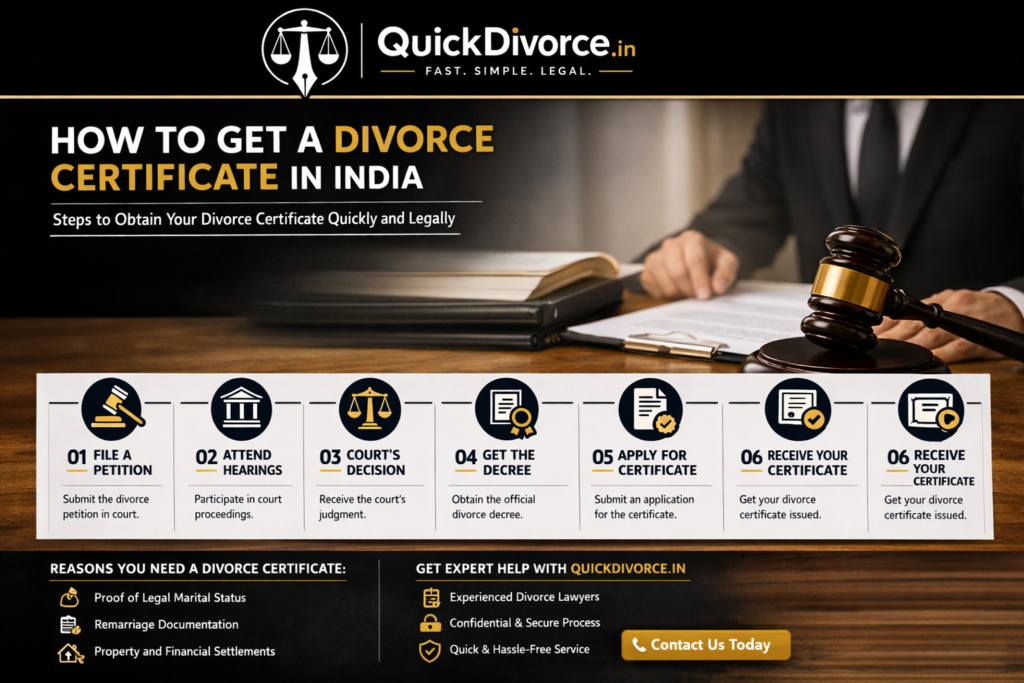
📋 How to Get a Divorce Certificate — Step by Step
Step 1: Identify the Correct Court
Confirm the name and location of the court that granted your divorce. If you are not certain — your advocate’s file from the divorce proceedings will show the court name and case number.
Step 2: Locate Your Case Details
You need the following to apply for a certified copy:
- Case number (the original petition number)
- Year of filing
- Names of both parties as they appear in the petition
- Date of the decree
If you do not have these details — the court’s record room can search by party names and approximate year, though this takes more time.
Step 3: Obtain the Application Form
Visit the court’s record room or reader’s office and obtain the prescribed application form for a certified copy of a court order or decree. In some courts this is a simple typed application — not a prescribed form.
Step 4: Pay the Prescribed Fee
The fee for certified copies is set by state court rules and varies by state. Typically:
- A stamp or court fee of ₹5 to ₹25 per page of the certified copy
- An additional copying fee of ₹1 to ₹5 per page
- In some states — a fixed fee per certified copy regardless of length
Apply for the number of certified copies you need — not just one. The cost of getting additional copies later is the same, but the process takes time. Getting 3 to 5 copies at once is strongly recommended.
Step 5: Submit the Application
Submit the completed application form with the required fee at the record room or reader’s office. You will receive an acknowledgment with a collection date.
Step 6: Collect the Certified Copies
Return on the collection date — or when notified — to collect the certified copies. Each copy will bear the court’s seal and the certification of the court reader or registrar confirming it is a true copy of the original.
Step 7: Verify the Certified Copies
Before leaving the court — verify that:
- The names of both parties are correctly spelled
- The date of the decree is correctly stated
- The court’s seal is clearly visible on every page
- The certification statement is complete and signed
- The case number matches your records
Any error on the certified copy must be corrected before you leave — corrections after the fact require a fresh application.
📁 Documents Required to Obtain a Divorce Certificate
The documentation requirements vary slightly by court but typically include:
For the Applicant (Either Party):
- Written application or prescribed form for certified copy
- Proof of identity — Aadhaar Card, Passport or Voter ID
- Case number and details of the divorce proceedings
- Court fee — paid in the form of court fee stamps or demand draft as prescribed by the court
If Applying Through an Advocate or Agent:
- Vakalatnama or authorisation letter from the party
- Identity proof of the advocate or authorised agent
If Applying for an Old Decree (More Than 5 Years):
- Additional documentation confirming the case details may be required
- Some courts require a formal search fee for locating older records
📑 How to Get a Certified Copy of a Divorce Decree
The process described above covers the standard application route. But there are variations worth knowing.
Urgent Certified Copies
Most courts have a provision for urgent certified copies — issued on a priority basis for an additional fee (typically 2 to 3 times the standard fee). If you need the certified copy urgently — for a remarriage, a visa application with a deadline or an imminent property transaction — apply for an urgent copy and specify the urgency in your application.
Applying Through an Advocate
You do not need to appear personally to obtain a certified copy — you can authorise an advocate or agent to apply on your behalf through a written authorisation or vakalatnama. Quick Divorce routinely obtains certified copies on behalf of clients who cannot attend court personally. Call 8595439395.
Online Applications (Where Available)
Some high courts and district courts have introduced online portals for certified copy applications. Availability varies by state. Where online applications are available — the application is submitted online, the fee is paid digitally and the certified copy is either downloaded or collected from the court.
⏱️ Timeline — How Long Does It Take?
| Type of Application | Typical Timeline |
|---|---|
| Standard certified copy application | 7 to 30 days depending on the court |
| Urgent certified copy application | 2 to 7 days |
| Application for a recent decree (within 1 to 2 years) | Faster — records are readily accessible |
| Application for an older decree (5 to 20 years old) | 15 to 60 days — record retrieval from archives takes longer |
| Application for a very old decree (20+ years) | Can take several months — records may be in deep archives or partially missing |
Quick Divorce’s experience: Courts in major cities such as Delhi, Mumbai, Bangalore, Chennai and Hyderabad generally process certified copy applications within 2 to 4 weeks for recent decrees. Courts in smaller towns may be slower. Quick Divorce follows up directly with court officials to expedite collection. Call 8595439395.
🗺️ State-Wise Differences in Obtaining Divorce Certificates
While the fundamental process is the same across India — there are practical differences between states in fees, forms and timelines.
Delhi
Family courts in Delhi (Saket, Dwarka, Tis Hazari, Rohini) process certified copy applications through the reader’s office of the relevant court. Fees follow Delhi High Court rules. Urgent applications can be processed in 3 to 5 working days.
Maharashtra (Mumbai, Pune)
Family courts in Maharashtra have relatively organised record rooms. Standard certified copies typically take 2 to 3 weeks. The Bombay High Court’s online portal allows some certified copy applications to be initiated online.
Karnataka (Bangalore)
Family courts in Bangalore process standard certified copy applications in 2 to 4 weeks. The Karnataka High Court has a digital record management initiative that is improving access to records.
Tamil Nadu (Chennai)
Family courts in Chennai process certified copy applications in 2 to 4 weeks for recent decrees. Older records may require more time.
Uttar Pradesh
Family courts across UP vary significantly in processing speed. Courts in larger cities (Lucknow, Noida, Agra) are generally faster than those in smaller districts.
General Principle
In every state — having an experienced local advocate or service like Quick Divorce who knows the specific court’s procedures, officials and timelines makes the process significantly faster and less frustrating. Call 8595439395.
💍 Divorce Certificate for Remarriage in India
Remarriage in India — whether through Arya Samaj, court marriage or a religious ceremony — requires proof that any previous marriage has been legally dissolved.
What Is Required for Remarriage
For Arya Samaj marriage: The Arya Samaj Mandir requires a certified copy of the divorce decree before conducting the ceremony.
For court marriage (Special Marriage Act): The Form I notice of intended marriage must disclose prior marriages, and the Marriage Officer requires a certified copy of the divorce decree.
For Hindu religious ceremony: A responsible pandit will ask for proof of divorce before solemnizing the remarriage.
For remarriage after a foreign divorce: A foreign divorce decree must be properly recognised in India — this is a more complex process. Quick Divorce advises on foreign divorce recognition. Call 8595439395.
Waiting Period for Remarriage
Under the Hindu Marriage Act — a divorced person can remarry after the divorce decree becomes absolute. For mutual consent divorce — the decree is typically final immediately upon grant. For contested divorce — there is a period during which the decree can be appealed; remarriage before the appeal period expires carries some risk.
Quick Divorce advises clients specifically on when their decree has become absolute and remarriage is legally safe. Call 8595439395.
🛂 Divorce Certificate for Passport and Name Change
Updating your passport after divorce — whether to revert to your maiden name or simply to update your marital status — requires specific documentation.
Documents Required by Passport Seva Kendra for Post-Divorce Name Change
- Certified copy of the divorce decree (mandatory)
- Existing passport
- Address proof in the new name (if reverting to maiden name)
- Self-attested copy of Aadhaar in the new name (if already updated)
- Completed passport application form with new name
The Name Change Process
The Passport Seva Kendra does not change your name on the basis of the divorce decree alone — you must also have supporting address proof and identity documents showing the new name. The recommended sequence:
- Obtain certified copy of divorce decree
- Apply for Aadhaar update (name change) using the decree copy
- Update PAN card with maiden name
- Apply for passport update with decree copy and updated Aadhaar
Quick Divorce guides clients through the complete post-divorce documentation update process. Call 8595439395.
🌍 Divorce Certificate for Visa and Immigration Abroad
Foreign visa and immigration applications almost universally require disclosure of marital history — including all divorces. The documentation requirements depend on the destination country.
For Most Countries — Apostille Is Required
India is a signatory to the Hague Convention Abolishing the Requirement of Legalisation for Foreign Public Documents (the Apostille Convention). This means that Indian court documents — including certified copies of divorce decrees — can be apostilled (authenticated) by the Ministry of External Affairs for recognition in Hague Convention member countries.
Countries that accept apostille: USA (for some purposes), UK, Australia, Canada (for some provinces), most EU countries, and many others.
The apostille process:
- Obtain a certified copy of the divorce decree from the court
- Get the certified copy notarised by a notary public
- Submit to the state Home Department or General Administration Department for state-level authentication
- Submit to the Ministry of External Affairs (MEA) for apostille
- The apostilled document is then ready for submission to foreign authorities
For Countries Not Party to the Apostille Convention
Documents must be legalised through the embassy — a process called consular legalisation or embassy attestation. The document goes through state authentication and MEA attestation before being submitted to the relevant embassy for final legalisation.
Quick Divorce handles the complete apostille and attestation process for divorce decree copies. Call 8595439395.
🌐 Divorce Certificate for NRIs — Special Considerations
NRIs face additional layers of complexity around divorce documentation — both for divorces obtained in India and for divorces obtained abroad.
NRI Divorced in India — Using the Decree Abroad
An NRI who obtained a divorce in an Indian family court and needs to use that decree in their country of residence needs:
- Certified copy of the decree from the Indian family court
- Apostille or embassy attestation depending on the country
- In some cases — a translation into the local language by an authorised translator
Quick Divorce handles certified copy procurement, apostille and translation coordination for NRI clients. Call 8595439395.
NRI Divorced Abroad — Using a Foreign Decree in India
An NRI who obtained a divorce in a foreign court — and needs that divorce recognised in India for remarriage, passport update or property transactions — faces the additional issue of foreign divorce recognition.
Indian courts do not automatically recognise all foreign divorces. The general principles:
- A foreign divorce is recognised in India where both parties were domiciled in the foreign country at the time of the divorce
- A foreign divorce obtained ex parte (without the Indian spouse being properly served) may not be recognised
- A foreign divorce may not be recognised where the Indian courts’ exclusive jurisdiction was invoked
Where a foreign divorce is recognised: The foreign decree copy — properly apostilled or legalised — can be used in India as proof of divorce for most purposes.
Where recognition is uncertain: An NRI may need to file a petition in the Indian family court for a declaration that the foreign divorce is valid and recognised — before proceeding with remarriage or other post-divorce steps in India.
Quick Divorce provides specific advice for NRIs on foreign divorce recognition and the Indian documentation steps required. Call 8595439395.
🚧 Divorce Certificate When the Other Party Is Uncooperative
A common concern — particularly after contested divorce — is whether the other party’s cooperation is required to obtain a certified copy of the divorce decree.
It is not. Either party to a divorce can independently apply for certified copies of the decree. The other party’s consent, cooperation or signature is not required. The divorce decree is a court record — either party has the right to obtain certified copies independently.
You do not need to contact your former spouse to get your certified copy. You apply directly to the court, pay the prescribed fee and collect the copies. Quick Divorce handles this on behalf of clients who want to avoid any direct interaction with their former spouse. Call 8595439395.
🔄 Lost or Damaged Divorce Certificate — How to Get a Duplicate
If you have lost or damaged your certified copy of the divorce decree — obtaining a replacement is straightforward.
Steps to Get a Duplicate Certified Copy
- Locate the court — identify the family court or civil court that issued the original decree
- Gather case details — case number, year, names of parties, date of decree
- File a fresh application — apply for a new certified copy exactly as you would for the first time
- Pay the prescribed fee — the fee is the same as for the original application
- Collect the new certified copy — this new copy has the same legal validity as the original
There is no concept of a “duplicate” in a special sense — every certified copy is an equally valid original. You are simply applying for an additional certified copy.
If You Have Lost All Case Details
If you cannot remember the case number, year or court — Quick Divorce can search court records to locate the case based on party names and approximate year and location of the divorce. Call 8595439395.
If the Court Has Lost Its Records
In rare cases — particularly for very old divorces — court records may have been damaged, lost or imperfectly archived. In these situations:
- Other documentary evidence of the divorce (correspondence, lawyer’s files, bank records updated post-divorce) may be used to support an application for reconstruction of the record
- A court may issue a certified copy from whatever record fragments remain
- In the most extreme cases — an application may need to be filed for a declaration of the divorce based on secondary evidence
This is unusual for recent divorces but does arise for divorces from the 1980s and earlier. Quick Divorce advises on these exceptional situations. Call 8595439395.
⚖️ Divorce Certificate for Marriages Registered Under Different Laws
The process for obtaining a certified copy is essentially the same regardless of which law governed the divorce — but the court from which you obtain it differs.
Hindu Marriage Act 1955
Decree granted by the family court or district court. Certified copy from the same court’s record room.
Special Marriage Act 1954
Decree granted by the family court or district court. Certified copy from the same court’s record room. The Special Marriage Act certificate has particularly clear international recognition given the secular, civil nature of the proceedings.
Muslim Personal Law (Dissolution of Muslim Marriages Act 1939)
Court-granted divorce decrees are obtained from the family court. Talaq outside of court (triple talaq, which is now criminally prohibited for instant triple talaq but where talaq-e-ahsan or talaq-e-hasan may still be used) requires registration — and for official purposes, a court-issued declaration may be the most reliable proof.
Christian Divorce (Indian Divorce Act 1869)
Decree from the district court. Certified copy from the district court’s record room.
Parsi Divorce (Parsi Marriage and Divorce Act 1936)
Decree from the Parsi matrimonial court. Certified copy from the same court.
Foreign Divorce
As discussed in the NRI section above — apostilled or attested copies of foreign divorce decrees, with recognition considerations for use in India.
🛡️ Can a Divorce Certificate Be Challenged?
A certified copy of a divorce decree can be challenged only in very limited circumstances — and the challenge is technically to the underlying decree, not the certificate itself.
Grounds on Which a Divorce Decree Can Be Challenged
Appeal — a divorce decree can be appealed to the High Court within the prescribed limitation period (typically 90 days from the date of the decree for first appeals). If successfully appealed — the decree is set aside and the marriage is legally restored.
Fraud on the court — where a decree was obtained by fraud (false addresses given to establish jurisdiction, forged signatures, false service of summons) — the aggrieved party can apply to have the decree set aside.
Void decree — a decree granted without jurisdiction is void and can be challenged at any time.
What Cannot Be Challenged
A decree that has become final — where no appeal was filed within the limitation period and no fraud is alleged — is virtually unassailable. A certified copy of such a decree is conclusive proof of the divorce.
⚠️ Common Problems and How to Solve Them
Problem: Court cannot locate the file This happens with older cases where records have been moved to archives. Solution — provide as much detail as possible (case number, year, names, date of decree), be patient and follow up persistently. Quick Divorce knows how to navigate court record rooms effectively. Call 8595439395.
Problem: Name spelling error on the certified copy The certified copy must exactly match the original decree. If your name is misspelled in the original decree — a correction application (Section 152 CPC for clerical errors) must be filed before the correct certified copy can be issued.
Problem: Certified copy not accepted by foreign authority due to missing apostille The certified copy requires MEA apostille for international use. Many people get the certified copy but do not get it apostilled before submitting to foreign authorities. Quick Divorce handles the complete apostille process. Call 8595439395.
Problem: Delay beyond the promised date Court record rooms are understaffed and applications are sometimes delayed beyond the collection date given. Follow-up visits or phone calls are necessary. Quick Divorce follows up directly with court officials to avoid unnecessary delays. Call 8595439395.
Problem: Certified copy in wrong language for foreign use Foreign authorities may require the decree in English — if the decree was issued in a regional language (Hindi, Marathi, Tamil, etc.) a certified translation is required. Quick Divorce coordinates certified translation services. Call 8595439395.
🚫 Common Myths About Divorce Certificates in India
Myth 1: India issues a separate “divorce certificate” like a marriage certificate False. India does not have a separate divorce certificate document issued by a registrar. The proof of divorce is a certified copy of the divorce decree from the family court.
Myth 2: Only the person who filed the divorce petition can get the certified copy False. Either party — petitioner or respondent — can independently apply for and obtain certified copies of the divorce decree. The other party’s involvement is not required.
Myth 3: The Arya Samaj or church can issue a divorce certificate False. Religious organisations have no authority to issue divorce documentation. Only the court that granted the divorce can issue certified copies of the decree.
Myth 4: One certified copy is sufficient for all purposes Practically false. Different authorities — passport office, bank, employer, embassy, sub-registrar — each retain the copy you submit. You need multiple certified copies for different purposes. Getting 3 to 5 copies at the time of the decree application is strongly recommended.
Myth 5: A certified copy is only valid for a limited time False. A certified copy of a divorce decree does not expire. It remains valid indefinitely as proof of the divorce. Some authorities may ask for a “recent” copy — but courts simply issue a fresh certified copy of the same permanent decree.
Myth 6: You need your ex-spouse’s signature on the certified copy application False. The application is made by you alone to the court. Your former spouse’s signature, consent or cooperation is not required.
Myth 7: A photocopy of the divorce decree is as good as a certified copy False. A plain photocopy — even a clear one — is not accepted by most authorities as proof of divorce. You specifically need a certified copy bearing the court’s seal and the court reader’s certification.
Myth 8: Getting a certified copy means you have to go back to the lawyer who handled the divorce False. You can apply for a certified copy directly at the court record room without involving your original advocate — though having professional assistance makes the process faster and less confusing.
🌟 How Quick Divorce Helps You Obtain Your Divorce Certificate
Quick Divorce provides complete, hassle-free assistance for obtaining certified copies of divorce decrees — whether your divorce was recent or years ago, whether you are in India or abroad.
Services for Obtaining Certified Copies
Case Record Search Where clients do not have complete case details — Quick Divorce searches court records using available information (party names, approximate year, location) to locate the case file.
Application Filing Quick Divorce prepares and files the certified copy application at the correct court — with all required details, the correct fee and any urgency designation required.
Follow-Up and Collection Quick Divorce follows up directly with the court’s record room to track the application status and collects the certified copies on the specified date — or sooner if available.
Verification Every certified copy collected by Quick Divorce is verified before delivery — checking that names are correct, the court seal is clearly visible, the certification is complete and the decree date is accurate.
Apostille and Attestation For clients who need the certified copy for use abroad — Quick Divorce manages the complete apostille process (notarisation, state authentication, MEA apostille) or consular legalisation for non-apostille countries.
Translation Where the decree is in a regional language and needs to be translated for foreign use — Quick Divorce coordinates certified translation by an authorised translator.
Post-Divorce Documentation Update Quick Divorce also assists with the subsequent use of the certified copy — passport name change applications, Aadhaar updates and guidance on the remarriage process.
Quick Divorce Services and Pricing
| Service | Price |
|---|---|
| Certified Copy Application and Collection (Recent Decree) | ₹1,999 onwards |
| Certified Copy Application and Collection (Old Decree — 5+ Years) | ₹2,999 onwards |
| Urgent Certified Copy (Express Processing) | ₹3,999 onwards |
| Apostille of Divorce Decree Copy | ₹4,999 onwards |
| Embassy/Consular Attestation of Divorce Decree Copy | ₹5,999 onwards |
| Certified Translation of Divorce Decree | ₹1,999 onwards |
| Foreign Divorce Recognition Advice (NRI) | ₹1,499 per consultation |
| Complete Post-Divorce Documentation Package | ₹6,999 onwards |
| Complete Mutual Divorce with Certified Copy Collection | ₹9,999 onwards |
📞 Call Quick Divorce: 8595439395
Get Your Divorce Certificate with Quick Divorce →
💰 Complete Cost Breakdown
| Cost Item | Approximate Amount |
|---|---|
| Court fee for certified copy (per page) | ₹5 to ₹25 per page |
| Copying fee (per page) | ₹1 to ₹5 per page |
| Typical total court fee for one certified copy (10 to 15 page decree) | ₹100 to ₹500 |
| Quick Divorce certified copy service | ₹1,999 onwards |
| Notarisation (for apostille) | ₹200 to ₅00 |
| State authentication (for apostille) | ₹50 to ₹300 |
| MEA apostille fee | ₹50 per document |
| Quick Divorce apostille service (end to end) | ₹4,999 onwards |
| Certified translation | ₹1,999 onwards |
| Total for India use (certified copy with assistance) | ₹2,500 to ₹3,500 |
| Total for foreign use (certified copy + apostille + translation) | ₹8,000 to ₹15,000 depending on country requirements |
❓ Frequently Asked Questions (FAQs)
Q1. What is a divorce certificate in India and how is it different from a divorce decree?
The divorce decree is the court’s original judgment dissolving the marriage — it stays in the court’s records. A certified copy of the divorce decree — stamped and sealed by the court — is what serves as your “divorce certificate” for all official purposes. India does not issue a separate divorce certificate document. Quick Divorce obtains certified copies of divorce decrees on behalf of clients. Call 8595439395.
Q2. How do I get a certified copy of my divorce decree if I don’t have the case number?
Quick Divorce can search court records using party names, approximate year of the divorce and the city or district where the divorce was obtained. Most courts can retrieve a case by party names even without the case number, though it may take longer. Call 8595439395 and provide whatever details you have.
Q3. How many certified copies of the divorce decree should I get?
Get at least 3 to 5 certified copies at the time of your initial application. You will need separate copies for different authorities — each authority retains the copy you submit. Having multiple copies avoids repeated trips to the court for additional copies later. Quick Divorce recommends applying for 5 copies initially. Call 8595439395.
Q4. How long does it take to get a certified copy of a divorce decree?
For a recent decree — 1 to 4 weeks depending on the court. For a decree more than 5 years old — 2 to 8 weeks. Urgent applications are processed in 3 to 7 days for an additional fee. Quick Divorce follows up with courts to minimise delays. Call 8595439395.
Q5. Do I need my ex-spouse’s consent or signature to get a certified copy of the divorce decree?
No. Either party to the divorce can apply for and obtain certified copies independently. Your former spouse’s consent, signature or involvement is not required in any way. Call 8595439395.
Q6. My divorce was obtained abroad — can I use it in India?
A foreign divorce may be recognised in India — but not automatically in all cases. The recognition depends on domicile at the time of the divorce, whether the other party was properly served and other factors. Quick Divorce advises specifically on foreign divorce recognition for use in India. Call 8595439395.
Q7. I need my divorce certificate apostilled for use in the UK — what is the process?
The process is: obtain a certified copy of the decree from the court → notarise it → state-level authentication → MEA apostille. The UK accepts MEA apostilled Indian court documents. Quick Divorce handles the complete apostille process for clients needing their divorce decree for use abroad. Call 8595439395.
Q8. My divorce decree has a spelling mistake in my name — what do I do?
A clerical error in the original decree requires a correction application (Section 152 CPC) to be filed in the court that issued the decree. Once corrected — a certified copy reflecting the correct name can be issued. Quick Divorce handles Section 152 correction applications. Call 8595439395.
🎯 Who Needs This Guide Right Now?
If you recently got divorced and need certified copies of your decree → Get 3 to 5 certified copies now while the case is fresh in the court’s records. Quick Divorce handles the application and collection. Call 8595439395.
If you are planning to remarry and need to prove your divorce → A certified copy of your divorce decree is mandatory before any new marriage. Quick Divorce obtains it quickly. Call 8595439395.
If you need to update your passport, Aadhaar or bank records after divorce → The certified copy is the foundation document for all post-divorce updates. Quick Divorce guides you through the complete sequence. Call 8595439395.
If you are an NRI who needs your Indian divorce decree apostilled → Quick Divorce handles the complete apostille process — certified copy procurement, notarisation, state authentication and MEA apostille. Call 8595439395.
If you had a divorce years ago and cannot find your decree copy → Quick Divorce searches court records and obtains certified copies of old decrees. Call 8595439395.
If your foreign divorce decree needs to be recognised in India → Quick Divorce advises specifically on foreign divorce recognition for use in India — for remarriage, property transactions and official documentation. Call 8595439395.
✅ Final Recommendation
A divorce certificate — in the Indian legal sense, a certified copy of your divorce decree — is one of the most practically important documents you will need after your marriage ends. Without it, you cannot remarry, cannot update your passport, cannot complete property transactions and cannot satisfy immigration and visa authorities abroad.
The most important things to remember:
- ✅ India does not issue a separate “divorce certificate” — the certified copy of the court’s divorce decree is your divorce certificate
- ✅ Apply for 3 to 5 certified copies at the earliest opportunity — each authority you deal with will retain the copy you submit
- ✅ Get the copies while the case records are fresh — older records are harder to retrieve
- ✅ For international use — apostille or embassy attestation is required in addition to the certified copy
- ✅ Your former spouse’s cooperation is not required — you can apply independently at any time
- ✅ Name errors in the decree must be corrected before the certified copy can be used
The process is straightforward but bureaucratic — knowing exactly which court to approach, what form to fill, what fee to pay and how to follow up makes the difference between getting your certified copy in 2 weeks and waiting 3 months.
Quick Divorce provides India’s most efficient and trusted service for obtaining certified copies of divorce decrees — recent and old, from courts across India — with complete apostille and attestation services for international use.
For ₹1,999 — have Quick Divorce obtain your certified copies without a single visit to the court on your part.
Your legal freedom after divorce is only complete when you have the paperwork to prove it. Quick Divorce makes sure you do.
📞 Call Quick Divorce: 8595439395
Get Your Divorce Certificate →
Get your Certificate now
🟡 QuickDivorce.in provides complete legal services — settlement negotiation, alimony structuring, property division, stridhan recovery, MoU drafting, court representation, and post-decree implementation: across all jurisdictions in India.
🟡Visit LegalTax.in for other Legal and Trademark related services as
👉 Money Recovery Cases
👉 Property Disputes
👉 Business & Licence Registrations
🟡Visit Business24hub for IT services
👉 Mutual Consent Divorce at QuickDivorce.in
👉 Contested Divorce Filing
👉 Child Custody and Maintenance
👉 Matrimonial Property Settlement
👉 NRI Divorce Services
👉 Alimony and Maintenance
🟡 Protect Your Rights
👉 Domestic Violence Legal Support at QuickDivorce.in
👉 Stridhan Recovery
📞 Call Now: +91 8595439395
🕐 Free Consultation: Monday to Saturday, 10 AM to 6 PM

Adv. Manish Kashyap is a Family Law & Divorce Lawyer with extensive experience in Mutual & Contested Divorce, NRI Divorce, Child Custody, Alimony, Domestic Violence, Judicial Separation, and Family Court matters, providing professional legal guidance to clients.

