

Views: 5
Table of Contents
- 1 Introduction
- 2 The Core Distinction: Role of the Neutral Third Party
- 3 What Is Mediation in Indian Divorce?
- 4 What Is Conciliation in Indian Divorce?
- 5 Conciliation Under the Family Courts Act: A Closer Look
- 6 Key Differences Between Mediation and Conciliation: A Structured Comparison
- 7 When Is Each Process Used in Indian Divorce Proceedings?
- 8 Mediation, Conciliation, and the Mutual Consent Divorce
- 9 Mediation and Conciliation for NRIs: Practical Guidance
- 10 Frequently Asked Questions
- 11 Conclusion
- 12 Expert Mediation, Conciliation, and Divorce Legal Services
Introduction
When a marriage breaks down in India, the path to legal dissolution rarely begins with a courtroom battle. Long before judges, cross-examinations, and contested hearings, Indian law — through statute, Supreme Court guidelines, and the daily practice of Family Courts — actively directs separating couples toward structured negotiation processes designed to reduce conflict, save time, and produce durable agreements.
Two of those processes are mediation and conciliation. Both are forms of Alternative Dispute Resolution (ADR). Both involve a neutral third party. Both aim to help divorcing spouses reach a settlement without the expense and acrimony of full-scale litigation. And both are frequently confused — by spouses, by the general public, and even occasionally by lawyers practising outside the family law space.
The confusion is understandable. In everyday speech, the words are often used interchangeably. In Indian statutory law, the distinction between them has historically been blurred — the Code of Civil Procedure groups them together, the Family Courts Act uses the term “conciliation” in a context that many practitioners treat as functionally equivalent to mediation, and even the Supreme Court’s early ADR jurisprudence was not always precise in distinguishing the two.
But the distinction matters — practically and legally. Mediation and conciliation differ in the role of the neutral third party, in the degree of intervention permitted, in the process structure, in the enforceability of outcomes, and in the contexts in which each is most commonly used in Indian matrimonial law.
This article explains both processes clearly and in full — what each is, how each works, how they differ, when each is used in Indian divorce proceedings, and which is more appropriate for different types of matrimonial disputes. It also addresses the impact of the Mediation Act, 2023 on the ADR landscape in Indian family law, and provides practical guidance for spouses — including NRIs — deciding which route best serves their situation.
For professional guidance on mediation, conciliation, mutual consent divorce, contested divorce, and all aspects of Indian matrimonial law, the family law team at QuickDivorce.in provides expert support across all jurisdictions.
The Core Distinction: Role of the Neutral Third Party
The single most important difference between mediation and conciliation is what the neutral third party does.
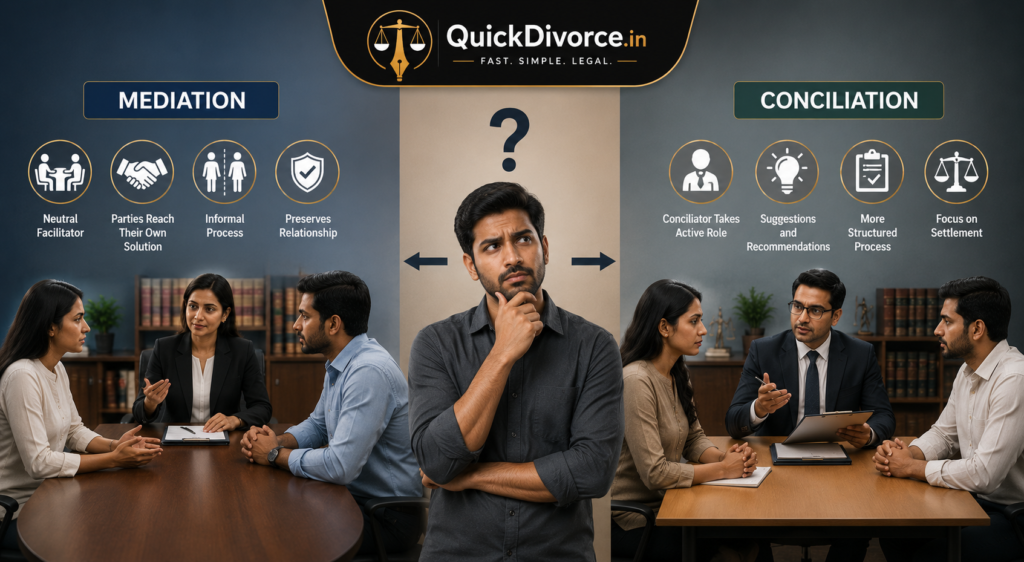
In mediation, the mediator is a facilitator. The mediator creates a structured environment for negotiation, helps the parties communicate, identifies common ground, and assists the parties in generating and evaluating options — but the mediator does not propose solutions, does not evaluate the merits of each party’s position, and does not recommend what the parties should accept. The outcome is entirely determined by the parties themselves. The mediator’s neutrality is absolute: the mediator has no stake in what the parties agree to, only in whether they are able to agree at all.
In conciliation, the conciliator plays a more active and evaluative role. The conciliator may — and typically does — propose settlement terms, suggest compromises, evaluate the relative strength of each party’s position, and recommend a resolution. The conciliator may offer an opinion on what is fair or reasonable. The parties are not bound to accept the conciliator’s proposals, but the conciliator’s active engagement in shaping the outcome is a defining feature of the process.
This distinction — facilitator versus active proposer — is the conceptual foundation from which all other differences flow.
What Is Mediation in Indian Divorce?
Mediation in Indian matrimonial law is a structured, voluntary, and confidential process in which a trained neutral mediator facilitates direct negotiation between the two spouses. The mediator uses techniques such as active listening, reframing, reality-testing, and separate private sessions (caucuses) to help the parties communicate more effectively and explore mutually acceptable solutions.
The mediator does not decide anything. The mediator does not tell the parties what is fair. The mediator does not take sides or advise either party. Everything that happens in mediation is driven by the parties — the mediator’s job is to create the conditions in which the parties can negotiate productively.
The legal framework for mediation in India has been significantly strengthened by the Mediation Act, 2023, which provides a comprehensive statutory basis for mediation across civil disputes, including matrimonial disputes. Key features of the Act include:
📋 Recognition of pre-litigation voluntary mediation — parties can mediate before filing any court petition 📋 Recognition of online mediation as fully valid — critically important for NRI cases 📋 A Mediation Council of India to regulate and accredit mediators 📋 Direct enforceability of mediated settlement agreements — a mediated settlement under the Act is enforceable as a court decree without requiring separate court proceedings
Mediation is also the process used in court-annexed mediation centres attached to Family Courts across India. When a Family Court refers a matrimonial dispute to its mediation centre under Section 89 CPC, the process that takes place is mediation — the mediator facilitates, the parties decide.
What Is Conciliation in Indian Divorce?
Conciliation is a process in which a neutral third party — the conciliator — takes a more active role in assisting the parties to reach a settlement. Unlike a mediator, a conciliator may:
📋 Meet the parties jointly and separately 📋 Propose specific settlement terms 📋 Evaluate the merits of each party’s position 📋 Recommend compromises that the conciliator considers fair and reasonable 📋 Express a view on what an appropriate settlement might look like
The parties retain the right to accept or reject the conciliator’s proposals — conciliation is not arbitration, and the conciliator does not impose a binding decision. But the conciliator’s active participation in shaping the proposed outcome is what distinguishes conciliation from pure facilitative mediation.
In Indian law, conciliation is most comprehensively regulated by Part III of the Arbitration and Conciliation Act, 1996 — a statute that was primarily designed for commercial disputes but whose conciliation provisions have been applied in matrimonial contexts as well. The 1996 Act closely follows the UNCITRAL Model Law on International Commercial Conciliation, and its provisions allow the conciliator to make settlement proposals and assist the parties in reaching agreement.
In the specific context of Indian family law, conciliation has a distinct statutory presence in Section 9 of the Family Courts Act, 1984, which requires a Family Court to make efforts toward conciliation at the first instance before proceeding to trial. Family Court conciliation is conducted by the court’s conciliation officers — trained counsellors and social workers attached to the court — who meet with both spouses individually and jointly, attempt to understand the root causes of the matrimonial breakdown, and actively work toward either reconciliation of the marriage or, where that is not possible, a consensual resolution of the dispute.
Conciliation Under the Family Courts Act: A Closer Look
The Family Courts Act’s conciliation mechanism deserves particular attention because it is the form of ADR that most divorcing couples in India encounter first — often before they have even engaged an advocate.
When a divorce petition is filed in a Family Court, the court typically refers the matter to the court’s conciliation and counselling service before the first substantive hearing. The conciliation officers:
📋 Meet with each spouse separately, in a confidential setting 📋 Attempt to understand the history of the marriage, the grounds for breakdown, and each party’s concerns and priorities 📋 Explore whether the marriage can be saved — whether reconciliation is possible 📋 Where reconciliation is not possible, attempt to facilitate a negotiated settlement of ancillary issues — alimony, custody, property 📋 Report to the court on the outcome of the conciliation efforts
The Family Court conciliation process is more than facilitation — the conciliation officers actively counsel the parties, may suggest compromises, and may recommend settlement terms to the court. This is closer to the conciliation model (active proposer) than the pure mediation model (neutral facilitator).
The distinction matters procedurally: if the Family Court conciliation process results in a settlement, the court can incorporate those terms into its order. If it does not result in a settlement, the court proceeds with the contested hearing — but the conciliation process has been completed as required by the Act.
Key Differences Between Mediation and Conciliation: A Structured Comparison
Role of the Neutral Third Party
In mediation, the mediator is a pure facilitator. The mediator assists communication, helps parties identify options, and supports the negotiation — but does not propose solutions, evaluate the merits, or recommend a specific outcome.
In conciliation, the conciliator actively participates in shaping the settlement. The conciliator may propose specific terms, evaluate each party’s position, recommend compromises, and express views on what is fair.
Source of the Settlement
In mediation, the settlement emerges entirely from the parties. The mediator creates the process; the parties create the outcome.
In conciliation, the settlement may reflect the conciliator’s proposals and recommendations. The parties have the final say on acceptance, but the conciliator’s active input shapes what is on the table.
Degree of Neutrality
Both processes require a neutral third party — neither mediator nor conciliator may take sides. However, in mediation, the mediator’s neutrality extends to the outcome: the mediator has no view on what the parties should agree to. In conciliation, while the conciliator must be impartial between the parties, the conciliator does form and express views on what settlement terms are appropriate — this is evaluative neutrality rather than pure process neutrality.
Statutory Framework
Mediation in India is primarily governed by the Mediation Act, 2023 (for civil disputes including matrimonial), and by Section 89 CPC for court-referred mediation. The Mediation Act provides a comprehensive framework for voluntary pre-litigation mediation, online mediation, and accreditation of mediators.
Conciliation in the commercial context is governed by Part III of the Arbitration and Conciliation Act, 1996. In the family law context, conciliation is specifically mandated by Section 9 of the Family Courts Act, 1984, and conducted by the court’s trained conciliation officers.
Enforceability of Outcome
Under the Mediation Act, 2023, a mediated settlement agreement is directly enforceable as a decree of the court — a significant strengthening of mediation’s legal status in India.
A settlement reached in Family Court conciliation is incorporated into a court order by the Family Court — equally enforceable, but through a different procedural mechanism. The enforceability is ultimately the same — a court decree — but the route to that decree differs.
Confidentiality
Both mediation and conciliation are confidential processes. Neither the parties nor the neutral third party may disclose what was said or offered during the process in subsequent court proceedings. This confidentiality protection is a critical feature of both mechanisms — it allows parties to negotiate freely without fear that their concessions will be used against them if the settlement attempt fails.
Suitability for NRI Cases
Both processes can in principle be used in NRI matrimonial disputes. However, online mediation under the Mediation Act, 2023 has a clear and explicit statutory framework for NRIs — the Act recognises online mediation as fully valid, and NRIs can participate from abroad. Family Court conciliation, by contrast, typically requires in-person attendance at the Family Court’s conciliation centre — making it logistically more challenging for NRIs abroad, though some courts have allowed video participation.
Typical Use in Indian Matrimonial Practice
Family Court conciliation under Section 9 of the Family Courts Act is typically the first ADR step encountered in a filed divorce petition — it happens automatically, before the first substantive hearing, and is conducted by the court’s own conciliation officers.
Court-referred mediation under Section 89 CPC typically happens at a later stage — after the conciliation process has been attempted and not resulted in a settlement, and once the petition is before the court. Private voluntary mediation under the Mediation Act, 2023 can happen at any time — including before any petition is filed.
When Is Each Process Used in Indian Divorce Proceedings?
The Typical Sequence in a Filed Divorce Petition
📋 Step 1 — Family Court conciliation (Section 9, Family Courts Act): Automatically triggered when a divorce petition is filed. Conducted by court conciliation officers. Attempts reconciliation first; settles ancillary issues if reconciliation is not possible. Active proposer model.
📋 Step 2 — Court-referred mediation (Section 89 CPC): If Family Court conciliation does not produce a settlement, the court may refer the matter to a mediation centre. A trained mediator facilitates structured negotiation between the parties. Pure facilitator model.
📋 Step 3 — Contested hearing: If both conciliation and mediation fail to produce a settlement, the court proceeds to a contested hearing in the normal way.
Pre-Litigation Voluntary Mediation
Under the Mediation Act, 2023, parties can choose to attempt mediation before filing any petition. This is particularly attractive for NRIs and for couples who wish to keep the dispute entirely out of the public court record. A successful pre-litigation mediation produces a settlement agreement that is directly enforceable without any court petition being filed.
Voluntary Conciliation
Parties can also agree to voluntary conciliation outside the court-mandated process — engaging an independent conciliator privately to propose and facilitate a settlement. This is less commonly used in matrimonial disputes than mediation, but is an available option particularly where the parties want a more evaluative process and are prepared to accept the conciliator’s proposed terms as a starting framework.
Mediation, Conciliation, and the Mutual Consent Divorce
Both mediation and conciliation can serve as the pathway to a mutual consent divorce under Section 13B of the Hindu Marriage Act (or its equivalents under other personal law statutes).
Where mediation or conciliation produces a comprehensive settlement — covering alimony, custody, property, and the parties’ consent to dissolution — that settlement can be implemented as a mutual consent divorce petition. The parties convert the ADR outcome into a joint petition, file it before the Family Court, attend the first and second motion hearings (with the cooling-off period waivable in appropriate cases following Amardeep Singh v. Harbheen Kaur, 2017), and obtain the divorce decree.
The ADR process — whether mediation or conciliation — effectively does the negotiating work that precedes the mutual consent divorce filing. The two processes are complementary: ADR produces the agreement; mutual consent divorce procedure converts it into the decree.
Mediation and Conciliation for NRIs: Practical Guidance
For NRIs navigating Indian matrimonial disputes from abroad, the choice between mediation and conciliation has practical implications beyond the conceptual distinction.
Online mediation under the Mediation Act, 2023 is the most accessible ADR route for NRIs. The Act’s explicit recognition of online mediation means NRIs can participate from the US, UK, UAE, Canada, Australia, or anywhere else, without travelling to India. The mediator can be selected jointly by both parties, sessions can be scheduled across time zones, and the resulting mediated settlement agreement is directly enforceable in India.
Family Court conciliation under Section 9 of the Family Courts Act is typically conducted in person at the court’s conciliation centre. For NRIs physically abroad, participation is logistically more challenging. Some Family Courts have allowed NRIs to participate via video link in conciliation sessions — this should be confirmed with the specific court and the appointed advocate before the first conciliation session is scheduled.
For NRIs, the combination of pre-litigation online mediation (to reach the settlement) followed by mutual consent divorce proceedings with video conference appearances (to convert the settlement into a decree) represents the most efficient and travel-minimising route to a legally valid Indian divorce decree — one that avoids the foreign decree recognition problems highlighted by the Supreme Court in Kishorekumar Mohan Kale v. Kashmira Kale (January 2026).
Frequently Asked Questions
1. What is the main difference between mediation and conciliation in divorce cases?
In mediation, the mediator primarily facilitates communication between spouses and helps them reach their own settlement. In conciliation, the conciliator may take a more active role by suggesting solutions and settlement terms to resolve the dispute.
2. Is the mediator allowed to give legal advice or propose a settlement?
A mediator generally remains neutral and focuses on guiding discussions rather than imposing solutions. While a mediator may help parties explore options, the final settlement must come from the spouses themselves.
3. Can a conciliator recommend specific terms for settlement?
Yes. Unlike a mediator, a conciliator may actively propose settlement options and suggest practical solutions to help the parties resolve their disagreements.
4. Are mediation and conciliation mandatory in Indian divorce proceedings?
Courts often encourage alternative dispute resolution methods, especially in family disputes. Whether mediation or conciliation is required depends on the nature of the case and the directions of the court.
5. Are settlements reached through mediation or conciliation legally binding?
A settlement becomes legally enforceable once it is reduced to writing, signed by the parties, and accepted or recorded by the court in accordance with applicable legal procedures.
6. Which is better for resolving divorce disputes—mediation or conciliation?
Neither process is universally better. Mediation is often preferred when spouses are willing to negotiate and maintain control over the outcome, while conciliation may be helpful when the parties need more guidance in reaching a settlement.
Conclusion
Mediation and conciliation are both valuable tools in India’s matrimonial ADR landscape — but they are not the same process, and understanding the distinction helps separating spouses make informed choices about which mechanism best serves their situation.
The essential difference is the role of the neutral third party: a mediator facilitates without proposing; a conciliator actively proposes and evaluates. In Indian divorce practice, Family Court conciliation — mandatory under the Family Courts Act — typically comes first; court-referred or voluntary mediation follows. Both can produce enforceable settlements. Both are confidential. Both are faster and less expensive than contested litigation.
For NRIs and for couples prioritising privacy and speed, voluntary pre-litigation mediation under the Mediation Act, 2023 — conducted online — is the most accessible and legally robust ADR route available in 2026. A mediated settlement converted into a mutual consent divorce decree is fully valid in India for all purposes, avoiding the foreign decree recognition risks that the January 2026 Supreme Court ruling in Kishorekumar Mohan Kale v. Kashmira Kale has made impossible to ignore.
Know your options. Choose the right process. Reach an agreement that holds.
Expert Mediation, Conciliation, and Divorce Legal Services
🟡 QuickDivorce.in provides comprehensive support for divorce mediation, conciliation, mutual consent divorce, contested divorce, NRI divorce, and all aspects of Indian matrimonial law across all jurisdictions.
🟡Visit LegalTax.in for other Legal and Trademark related services as 👉 Money Recovery Cases 👉 Property Disputes 👉 Business & Licence Registrations
🟡Visit Business24hub for IT services
👉 Mutual Consent Divorce at QuickDivorce.in 👉 Contested Divorce Filing 👉 Child Custody and Maintenance 👉 Matrimonial Property Settlement 👉 NRI Divorce Services 👉 Alimony and Maintenance
🟡 Protect Your Rights 👉 Domestic Violence Legal Support at QuickDivorce.in 👉 Stridhan Recovery
📞 Call Now: +91 8595439395 🕐 Free Consultation: Monday to Saturday, 10 AM to 6 PM

Adv. Manish Kashyap is a Family Law & Divorce Lawyer with extensive experience in Mutual & Contested Divorce, NRI Divorce, Child Custody, Alimony, Domestic Violence, Judicial Separation, and Family Court matters, providing professional legal guidance to clients.

