

Views: 0
Table of Contents
- 1 Quick Summary
- 2 📌 What Is the Core Difference Between Arya Samaj Marriage and Court Marriage?
- 3 🕌 What Is Arya Samaj Marriage?
- 4 🏛️ What Is Court Marriage?
- 5 📊 Arya Samaj Marriage vs Court Marriage — Complete Comparison Table
- 6 ⚖️ Legal Validity — Which Is More Legally Secure?
- 7 👥 Religion and Eligibility — Who Can Use Each?
- 8 📋 Procedure — Step by Step Comparison
- 9 📄 Documents Required — Side by Side
- 10 ⏱️ Time Required — Which Is Faster?
- 11 💰 Cost Comparison
- 12 📜 Certificate Issued — What Each Gives You
- 13 📜 Which Law Governs Each Marriage?
- 14 💔 Divorce — How Each Type Affects Future Proceedings
- 15 💑 Inter-Religion Couples — Which Is Better?
- 16 🌍 NRI Couples — Which Is Recommended?
- 17 🛡️ Family Opposition — Which Provides Better Protection?
- 18 🚫 Common Myths — Arya Samaj Marriage vs Court Marriage
- 19 🎯 Which Should You Choose — Decision Guide
- 20 🌟 How Quick Divorce Helps with Both
- 21 💰 Complete Cost Breakdown Comparison
- 22 ❓ Frequently Asked Questions (FAQs)
- 23 🎯 Who Needs This Guide Right Now?
- 24 ✅ Final Recommendation
- 25 Need Consutation
Quick Summary
The difference between Arya Samaj marriage and court marriage in India comes down to one fundamental distinction:
- Arya Samaj marriage is a religious ceremony — a Vedic Hindu wedding conducted by the Arya Samaj organisation — that must be separately registered with the government for full legal protection
- Court marriage is a civil registration — the government registration process itself IS the marriage — with no religious ceremony required
Here is what you need to know upfront:
- 🕌 Arya Samaj marriage — religious Vedic ceremony, one day, Arya Samaj certificate issued, government registration essential but separate
- 🏛️ Court marriage — civil solemnization before Marriage Officer, 30 day notice period, government certificate issued on the day
- ⚖️ Legal validity — both are fully legally valid when properly completed — but court marriage has stronger direct legal standing
- 👥 Inter-religion couples — court marriage is the recommended route — no conversion required
- 📋 Certificate — Arya Samaj gives a religious certificate; court marriage gives a government certificate directly
- ✅ Quick Divorce helps with both — complete assistance for Arya Samaj marriage registration and court marriage — Call 📞 8595439395
📌 What Is the Core Difference Between Arya Samaj Marriage and Court Marriage?
The single most important difference between Arya Samaj marriage and court marriage in India is this:
An Arya Samaj marriage is a religious ceremony that requires separate government registration.
A court marriage IS the government registration — no separate step needed.
In an Arya Samaj marriage — a Vedic Hindu ceremony is performed at an Arya Samaj Mandir by a trained Arya Samaj Pandit. The Arya Samaj issues a marriage certificate — but this certificate is issued by the religious organisation, not by the government. For complete legal protection — the couple must separately register their marriage with the government under the Hindu Marriage Act 1955 or the Special Marriage Act 1954.
In a court marriage — the couple appears before a government Marriage Officer (typically the Sub-Divisional Magistrate) after a mandatory 30 day notice period. The Marriage Officer solemnizes the marriage through a civil declaration process. The marriage certificate issued by the Marriage Officer IS the government registration — no separate step is required.
Both types of marriage — when properly completed — create legally valid marriages in India. But they serve different purposes, suit different couples and have different practical implications.
The simplest way to remember the difference: Arya Samaj marriage = religious ceremony first, government registration second. Court marriage = government registration IS the marriage, no religious ceremony.
🕌 What Is Arya Samaj Marriage?
Arya Samaj marriage is a Vedic Hindu marriage ceremony performed according to the rites prescribed by the Arya Samaj — the Hindu reform organisation founded by Swami Dayananda Saraswati in 1875.
The ceremony is centred around:
- Havan — the sacred fire ritual
- Saptapadi — the seven steps around the sacred fire — which legally completes the marriage under Section 7 of the Hindu Marriage Act 1955
- Vedic mantras — recited by the officiating Arya Samaj Pandit
Key Characteristics of Arya Samaj Marriage
Religious in nature: It is a Hindu Vedic ceremony — based on ancient scriptural tradition. Even though Arya Samaj is a reform movement that rejects caste discrimination — the ceremony itself is Hindu religious in character.
One day process: The actual ceremony can be completed in a few hours on a single day — making it significantly faster than the 30 day notice period required for court marriage.
Arya Samaj certificate issued: After the ceremony — the Arya Samaj issues a marriage certificate signed by the Pandit and office bearers. This certificate confirms the ceremony took place — but is NOT a government document.
Government registration essential: For complete legal protection — the marriage must be separately registered under the Hindu Marriage Act or Special Marriage Act. The Arya Samaj certificate alone is not sufficient for banks, passport offices, embassies or courts.
Shuddhi conversion available: The Arya Samaj performs the Shuddhi (conversion) ceremony for non-Hindus — allowing inter-religion couples where one party converts to Hinduism to marry through Arya Samaj. This creates legal complexities that need careful advice.
🏛️ What Is Court Marriage?
Court marriage — formally called marriage under the Special Marriage Act 1954 — is a civil marriage solemnized by a government appointed Marriage Officer, in the presence of three witnesses, without any religious ceremony.
The term “court marriage” is a popular misnomer — the marriage does not happen in a court of law. It happens at the Marriage Officer’s office — typically the Sub-Divisional Magistrate’s office — which is a government administrative office.
Key Characteristics of Court Marriage
Civil and religion-neutral: No religious ceremony, no religious rituals, no religious requirements of any kind. Completely secular — available to persons of any religion, any caste, any community.
30 day notice period mandatory: The couple must give 30 days’ advance written notice to the Marriage Officer before the marriage can be solemnized. This notice is displayed at the Marriage Officer’s office for 30 days to allow any valid legal objections.
Government certificate issued on the day: The Marriage Officer issues the marriage certificate immediately after solemnization — this IS the government registration certificate. No separate step required.
Inter-religion marriages specifically supported: Court marriage under the Special Marriage Act is the only legally clean route for inter-religion marriages in India — no conversion required by either party.
Applies to all religions: Any two eligible adults — Hindu, Muslim, Christian, Sikh, Buddhist, Jain, inter-religion, no religion — can get court married. The law does not discriminate.
📊 Arya Samaj Marriage vs Court Marriage — Complete Comparison Table
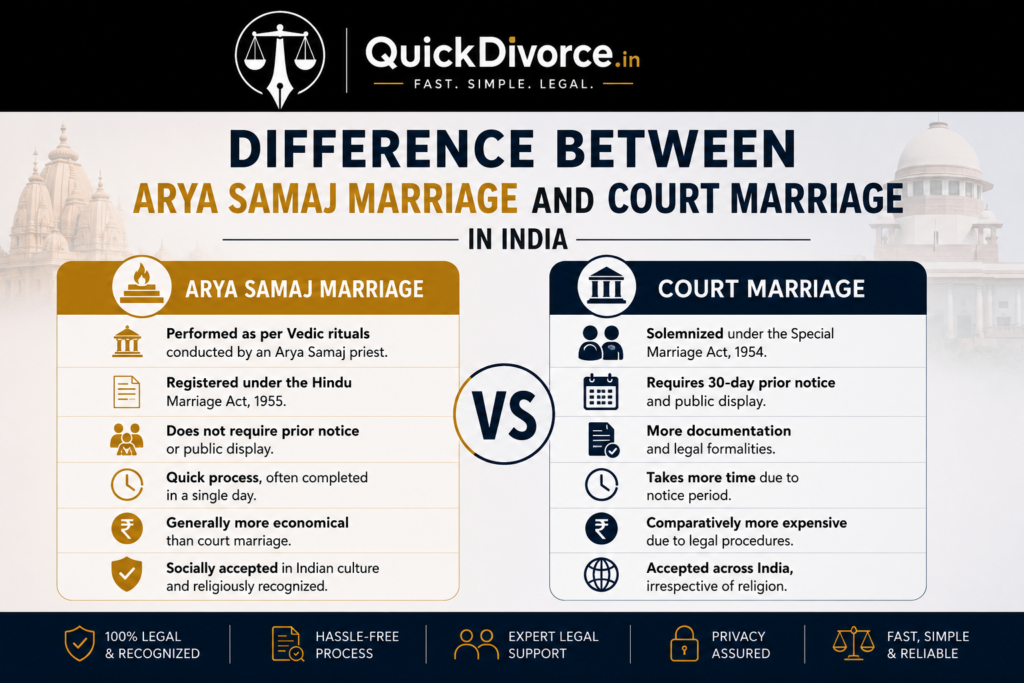
| Factor | Arya Samaj Marriage | Court Marriage |
|---|---|---|
| Nature | Religious ceremony (Hindu Vedic) | Civil registration — no religion |
| Governing law for ceremony | Hindu Marriage Act 1955 (Section 7) | Special Marriage Act 1954 |
| Certificate issued on ceremony day | Arya Samaj certificate (religious org) | Government marriage certificate |
| Government registration | Separate — must be done after ceremony | Integral — registration IS the marriage |
| Religion requirement | Both parties must be Hindu (or one converts via Shuddhi) | None — any religion or no religion |
| Caste requirement | None | None |
| Minimum age | Male 21, Female 18 | Male 21, Female 18 |
| Waiting period | No waiting period for ceremony — registration takes 15 to 30 days after | 30 day notice period before solemnization |
| Total time from decision to legal marriage | 1 day ceremony plus 15 to 30 days registration | Minimum 31 days |
| Witnesses required | 2 to 3 witnesses at ceremony | 3 witnesses at solemnization |
| Family consent required | Not legally required for adults | Not legally required for adults |
| Inter-religion couples | One party must convert via Shuddhi — legal complexities | Recommended — no conversion required |
| NRI couples | Possible — but registration essential before departure | Preferred — clean government certificate |
| Divorce law applicable | Hindu Marriage Act 1955 (if registered under it) | Special Marriage Act 1954 |
| Succession law applicable | Hindu Succession Act 1956 | Indian Succession Act 1925 |
| International recognition | Government registration certificate required | Government certificate directly accepted |
| Cost of ceremony | ₹3,000 to ₹10,000 (Arya Samaj fee) | ₹150 to ₹500 (government fee only) |
| Protection against family opposition | Moderate | Strong — legal mechanism cannot be stopped by family |
| Best for | Hindu couples wanting a Vedic ceremony with quick process | Inter-religion couples, NRIs, couples wanting civil marriage |
⚖️ Legal Validity — Which Is More Legally Secure?
This is the most important practical question — and the answer requires nuance.
Arya Samaj Marriage — Legal Validity
An Arya Samaj marriage ceremony — where both parties are Hindu and the Saptapadi is performed — creates a valid Hindu marriage under Section 7 of the Hindu Marriage Act 1955. The ceremony is legally sufficient to create the marriage.
However — without government registration:
- The marriage exists legally but proving it is difficult
- Banks, passport offices and courts require a government issued certificate
- The Arya Samaj certificate alone is not accepted for most official purposes
- In case of dispute — the marriage can be challenged or complicated by the other party
With government registration:
- A government certificate is issued under the Hindu Marriage Act or Special Marriage Act
- The marriage is fully documented in official government records
- Accepted by all authorities — banks, passport offices, courts, embassies
- Virtually unassailable as proof of marriage
Court Marriage — Legal Validity
Court marriage is inherently self-contained legally. The government certificate issued by the Marriage Officer IS the marriage registration — there is no gap between ceremony and registration.
Court marriage under the Special Marriage Act 1954:
- Creates an irrefutable government record immediately
- Is accepted by all Indian authorities without question
- Has the strongest international recognition — accepted by foreign embassies and immigration authorities
- Is the clearest and most unambiguous proof of marriage available in India
The Verdict on Legal Security
Both are equally valid when properly completed — but court marriage has a direct advantage in that the government certificate is issued on the same day as solemnization, with no gap or risk of the registration being delayed or incomplete.
An Arya Samaj marriage without government registration is legally vulnerable. An Arya Samaj marriage WITH government registration is as strong as a court marriage.
Quick Divorce’s recommendation: Whatever form of marriage you choose — ensure government registration is completed and the official certificate is in hand before the couple parts ways.
👥 Religion and Eligibility — Who Can Use Each?
Arya Samaj Marriage — Who Can Use It
Both parties must be Hindu — meaning both must be Hindu by birth or by Shuddhi conversion at the time of the ceremony.
Under Section 2 of the Hindu Marriage Act — “Hindu” includes:
- ✅ Hindu by religion
- ✅ Buddhist
- ✅ Sikh
- ✅ Jain
- ✅ Any person not Muslim, Christian, Parsi or Jew — who is not governed by any other law
- ✅ Person who has converted to Hinduism through Shuddhi
For inter-religion couples: One party (typically the non-Hindu) can undergo the Shuddhi conversion ceremony at the Arya Samaj — converting to Hinduism — after which the marriage ceremony can be performed. However this creates legal complexities regarding the genuineness of conversion and applicable personal law.
Court Marriage — Who Can Use It
Any two eligible adults regardless of religion:
- ✅ Hindu-Hindu couples
- ✅ Muslim-Muslim couples
- ✅ Christian-Christian couples
- ✅ Hindu-Muslim couples
- ✅ Hindu-Christian couples
- ✅ Any inter-religion combination
- ✅ Couples with no religion
- ✅ Any caste or community
No conversion required. No religious ceremony required. The law is completely neutral on religion.
The Clear Advantage for Inter-Religion Couples
Court marriage is unambiguously the better choice for inter-religion couples — it requires no conversion by either party, creates no questions about the genuineness of religious change and produces a clean government certificate under a religion-neutral law.
📋 Procedure — Step by Step Comparison
Arya Samaj Marriage — Procedure
Step 1: Contact the Arya Samaj Mandir in your city — confirm dates and documentation requirements (1 to 2 days)
Step 2: Prepare all documents for both parties — identity, age and address proof (2 to 3 days)
Step 3: Shuddhi ceremony if applicable — for non-Hindu party (on the ceremony day)
Step 4: Havan and Saptapadi ceremony — conducted by Arya Samaj Pandit (ceremony day — a few hours)
Step 5: Arya Samaj marriage certificate issued (same day as ceremony)
Step 6: Visit Sub-Registrar’s office for government registration under Hindu Marriage Act (within a few days to weeks after ceremony)
Step 7: Government registration certificate issued (15 to 30 days after application)
Total timeline: 1 day for ceremony + 15 to 30 days for government registration = approximately 20 to 35 days total
Court Marriage — Procedure
Step 1: Both parties confirm eligibility — age, no subsisting marriage, not within prohibited degrees (verification before filing)
Step 2: Prepare all documents for both parties (2 to 3 days)
Step 3: Submit Form I — Notice of Intended Marriage — to the Marriage Officer (Day 1)
Step 4: 30 day notice period — notice displayed at Marriage Officer’s office, any valid objections heard (30 days)
Step 5: Attend solemnization appointment at Marriage Officer’s office with 3 witnesses (Day 31 or after)
Step 6: Both parties make declaration before Marriage Officer — witnessed by 3 witnesses (ceremony takes 30 to 60 minutes)
Step 7: Government marriage certificate issued immediately (same day as solemnization)
Total timeline: Minimum 31 days — typically 35 to 45 days with appointment scheduling
📄 Documents Required — Side by Side
For Arya Samaj Marriage Ceremony
Both Parties:
- 🪪 Aadhaar Card or Passport (identity proof)
- 📜 Birth Certificate or Class 10 Marksheet (age proof)
- 🏠 Address Proof — utility bill, rental agreement (not older than 3 months)
- 📸 Passport size photographs (4 to 6 each)
- ✍️ If previously married — divorce decree or death certificate of spouse
For Shuddhi Conversion (if applicable):
- 📋 Written application to Arya Samaj for Shuddhi
- 🪪 Identity documents
For Witnesses (2 to 3 witnesses):
- 🪪 Identity proof
- 📷 Passport size photograph
For Court Marriage (Special Marriage Act)
Both Parties:
- 🪪 Aadhaar Card or Passport (identity proof)
- 📜 Birth Certificate or Passport (age proof)
- 🏠 Address Proof (showing 30 days residence in the district)
- 📸 Passport size photographs (4 to 6 each)
- ✍️ If previously married — divorce decree or death certificate of spouse
For Foreign National:
- 🛂 Valid Passport
- 📋 No Objection Certificate from their Embassy
For Three Witnesses:
- 🪪 Identity proof of each witness
- 📷 Passport size photograph of each
- ✅ Must be present in person on solemnization day
Key Document Difference
The document requirements are broadly similar. The key difference:
- Arya Samaj requires the documents on the ceremony day
- Court marriage requires documents for the initial notice filing — and then again on the solemnization day (which is the same set)
⏱️ Time Required — Which Is Faster?
For the Ceremony Alone
| Arya Samaj Marriage | Court Marriage | |
|---|---|---|
| Time for ceremony | 1 day | Minimum 31 days (due to mandatory notice period) |
For the ceremony itself — Arya Samaj marriage is dramatically faster.
For Complete Legal Registration
| Arya Samaj Marriage | Court Marriage | |
|---|---|---|
| Time for complete legal registration | 20 to 35 days (ceremony + government registration) | 31 to 45 days (notice period + solemnization) |
When the complete process — ceremony plus government registration — is considered, the timelines become comparable.
When Speed Matters Most
Choose Arya Samaj marriage when:
- You need a ceremony quickly — visa deadline, travel plans, family event
- Both parties are Hindu and want a Vedic ceremony
- You can complete government registration within 30 days after the ceremony
Choose court marriage when:
- The 30 day notice period is not a constraint
- You want the government certificate issued on the same day as solemnization
- You want a single integrated process — no separate registration step
💰 Cost Comparison
Arya Samaj Marriage — Total Cost
| Cost Item | Amount |
|---|---|
| Arya Samaj ceremony fee | ₹3,000 to ₹10,000 |
| Arya Samaj certificate | Included in ceremony fee |
| Government registration fee (Hindu Marriage Act) | ₹100 to ₹500 |
| Quick Divorce assistance for registration | ₹2,999 to ₹4,999 |
| Certified copies of government certificate | ₹50 to ₹100 per copy |
| Total (ceremony + registration with assistance) | ₹6,000 to ₹16,000 |
Court Marriage — Total Cost
| Cost Item | Amount |
|---|---|
| Government notice and solemnization fee | ₹150 to ₹500 |
| Quick Divorce assistance (complete court marriage) | ₹4,999 onwards |
| Certified copies of certificate | ₹50 to ₹100 per copy |
| Total (complete court marriage with assistance) | ₹5,500 to ₹7,000 |
Cost Verdict
Court marriage is significantly cheaper — government fees are only ₹150 to ₹500 compared to ₹3,000 to ₹10,000 for the Arya Samaj ceremony fee.
However — many couples choose Arya Samaj marriage because they want the religious ceremony itself — the cost of which they consider worthwhile as a meaningful cultural and spiritual event.
📜 Certificate Issued — What Each Gives You
Arya Samaj Marriage Certificate
Issued by: Arya Samaj Mandir (religious organisation) Signed by: Arya Samaj Pandit and office bearers Status: Religious organisation certificate — NOT a government document Accepted by: Some courts as supporting evidence of ceremony NOT accepted by: Banks, passport offices, embassies, UIDAI as primary marriage proof
Government Certificate After Arya Samaj + Registration
Issued by: Sub-Registrar of Marriages (government official) Signed by: Sub-Registrar, both parties, witness Status: Official government document — legally the strongest proof of marriage Accepted by: All authorities — banks, passport offices, courts, embassies, UIDAI
Court Marriage Certificate
Issued by: Marriage Officer — Sub-Divisional Magistrate or equivalent (government official) Signed by: Marriage Officer, both parties, three witnesses Status: Official government document — highest level of legal recognition Accepted by: All authorities — banks, passport offices, courts, embassies, UIDAI, foreign immigration authorities
Certificate Verdict
Both the government registration certificate after Arya Samaj marriage and the court marriage certificate are government issued documents with equivalent legal standing. The court marriage certificate has a slight practical advantage — it is issued directly under the Special Marriage Act which has clearer international recognition.
📜 Which Law Governs Each Marriage?
This is one of the most legally significant differences — and one that affects divorce proceedings and succession rights.
Arya Samaj Marriage — Applicable Law
Where the Arya Samaj marriage is registered under the Hindu Marriage Act 1955:
- Divorce is governed by the Hindu Marriage Act 1955
- Succession is governed by the Hindu Succession Act 1956
- Grounds for divorce — Section 13 grounds including cruelty, desertion, adultery, conversion, mental disorder
- Mutual consent divorce — Section 13B (1 year separation required)
Court Marriage — Applicable Law
Court marriage under the Special Marriage Act 1954:
- Divorce is governed by the Special Marriage Act 1954
- Succession is governed by the Indian Succession Act 1925 (NOT Hindu Succession Act)
- Grounds for divorce — Section 27 grounds (similar to but not identical to Hindu Marriage Act grounds)
- Mutual consent divorce — Section 28 (1 year separation required)
Why This Difference Matters
For divorce: The grounds for divorce under the Hindu Marriage Act and Special Marriage Act are broadly similar — but there are differences. Hindu Marriage Act divorce is generally more familiar to family courts and has more developed case law.
For succession: This is a significant practical difference. Where a marriage is registered under the Special Marriage Act — the Indian Succession Act 1925 governs succession — not the Hindu Succession Act 1956. This can affect how property is inherited by children and other relatives.
Quick Divorce specifically advises couples on the succession implications of choosing between Hindu Marriage Act and Special Marriage Act registration before they decide. Call 8595439395.
💔 Divorce — How Each Type Affects Future Proceedings
Arya Samaj Marriage — Divorce
Where registered under the Hindu Marriage Act:
- Mutual consent divorce under Section 13B — requires 1 year separation
- Quick Divorce handles mutual consent divorce for Arya Samaj marriages starting at ₹4,999
- Contested divorce under Section 13 — cruelty, desertion and other grounds
Court Marriage — Divorce
Where registered under the Special Marriage Act:
- Mutual consent divorce under Section 28 — requires 1 year separation
- Quick Divorce handles mutual consent divorce for Special Marriage Act marriages starting at ₹4,999
- Contested divorce under Section 27 — similar grounds to Hindu Marriage Act
Practical Divorce Difference
In practice — divorce proceedings for both types of marriage follow very similar processes in Indian family courts. The main differences are:
- The specific section of law under which the petition is filed
- Succession implications of the divorce settlement
Quick Divorce handles divorce for both Arya Samaj marriages and court marriages — providing the same high quality, affordable service regardless of which law applies. Call 8595439395.
💑 Inter-Religion Couples — Which Is Better?
For inter-religion couples — the choice between Arya Samaj marriage and court marriage is one of the most critical decisions they will make.
Arya Samaj Marriage for Inter-Religion Couples
One party — typically the non-Hindu — undergoes the Shuddhi conversion ceremony at Arya Samaj, converting to Hinduism. Then the marriage ceremony is performed.
Legal issues with this approach:
- The genuineness of the conversion can be challenged — particularly if it was done solely for marriage purposes
- Some courts have looked critically at conversions done purely to facilitate marriage
- The converted party’s rights under their original personal law (Muslim Personal Law, Christian personal law) may be affected by the conversion
- If the marriage breaks down and the converted party “reconverts” — questions arise about which personal law governs the divorce
When Arya Samaj conversion marriage works:
Where the conversion is genuine — the non-Hindu party sincerely wishes to embrace Hindu beliefs — Arya Samaj marriage is valid and legally sound. Quick Divorce advises on this specifically. Call 8595439395.
Court Marriage for Inter-Religion Couples
Court marriage under the Special Marriage Act requires absolutely no conversion by either party. Both parties retain their original religion. The marriage is governed by the Special Marriage Act — a completely religion-neutral law.
Advantages for inter-religion couples:
- No conversion required — no questions about genuineness
- Both parties retain their original religious identity
- Clean, unambiguous government certificate
- Clear legal framework — Special Marriage Act governs all aspects
- No complications if the marriage ends in divorce
The Clear Verdict for Inter-Religion Couples
Court marriage is almost always the recommended route for inter-religion couples. It is legally cleaner, requires no conversion and avoids the complexities associated with Shuddhi conversion marriages.
Quick Divorce specialises in court marriage for inter-religion couples — including Hindu-Muslim, Hindu-Christian, Hindu-Sikh and all other combinations. Call 8595439395.
🌍 NRI Couples — Which Is Recommended?
For NRI couples — the choice between Arya Samaj marriage and court marriage has practical implications for international recognition.
Arya Samaj Marriage for NRI Couples
Many NRI couples who visit India prefer Arya Samaj marriage for the ceremony — it is quick (one day) and culturally meaningful. However:
- Government registration is essential before the NRI departs India — the Arya Samaj certificate alone is not sufficient for foreign embassies, immigration authorities or Indian government purposes
- The NRI must not leave India before government registration is completed
- Government registration adds 15 to 30 days to the process
Court Marriage for NRI Couples
Court marriage has the advantage that:
- The government certificate is issued on the day of solemnization — no separate registration step
- The Special Marriage Act certificate has the clearest international recognition
- Foreign embassies and immigration authorities are most familiar with this type of certificate
The disadvantage for NRI couples:
- The 30 day notice period means the NRI must be in India for at least 31 days — which may not be feasible on a short visit
Quick Divorce’s Recommendation for NRI Couples
If the NRI can stay in India for 35 to 45 days — court marriage under the Special Marriage Act is the cleanest and most internationally recognised route.
If the NRI can only stay for 1 to 2 weeks — Arya Samaj ceremony on Day 1 followed by immediate government registration is the practical solution — but the NRI must not leave until registration is complete.
Quick Divorce coordinates both options for NRI couples — including Power of Attorney arrangements where needed. Call 8595439395.
🛡️ Family Opposition — Which Provides Better Protection?
For couples facing family opposition to their marriage — the legal protection provided by each type is an important consideration.
Arya Samaj Marriage and Family Opposition
The Arya Samaj ceremony itself can be disrupted — physically or through family pressure — because it takes place at a specific location on a specific day that families may learn about.
The 30 day notice requirement does not apply to Arya Samaj marriage — so there is no public notice period that creates advance warning. However the ceremony at the Arya Samaj Mandir is not entirely private — other families and Mandir visitors may be present.
Key point: Family members cannot legally stop an adult couple from marrying through Arya Samaj — but physical disruption of the ceremony is possible if the location becomes known.
Court Marriage and Family Opposition
Court marriage under the Special Marriage Act has one vulnerability — the 30 day public notice period. The notice is displayed at the Marriage Officer’s office — potentially alerting family members.
However:
- Only legally valid objections under the Act (subsisting marriage, prohibited relationship, underage, unsound mind) can stop the marriage
- A family member’s general disapproval is NOT a valid legal objection
- Even if an invalid objection is filed — the Marriage Officer must dismiss it if it has no legal basis
- The marriage proceeds regardless of family disapproval
The legal protection of adults’ right to marry:
Courts across India have consistently upheld adults’ constitutional right to marry their partner of choice — and have directed police protection for couples facing threats. Quick Divorce advises couples facing family opposition on accessing police protection and navigating the notice period safely. Call 8595439395.
Verdict on Family Opposition
Both types provide ultimate legal protection — adults cannot be legally prevented from marrying. However:
- For the 30 day waiting period — Arya Samaj marriage has a practical advantage (no notice period, ceremony can be done quickly and privately)
- For legal enforcement of the right to marry — court marriage has a slight advantage (the government officer conducts the process and the legal framework is crystal clear)
🚫 Common Myths — Arya Samaj Marriage vs Court Marriage
Myth 1: Arya Samaj marriage certificate is as valid as a government certificate False. The Arya Samaj certificate is issued by a religious organisation — not the government. It is supporting evidence — not the primary legal document. Government registration is essential.
Myth 2: Court marriage can be done the same day False. Court marriage under the Special Marriage Act requires a mandatory 30 day notice period. The minimum total time is 31 days. Anyone offering “same day court marriage” is either providing an Arya Samaj ceremony (which is possible in one day) or something that is not legally correct.
Myth 3: Arya Samaj marriage is only for people avoiding traditional families False. Arya Samaj marriage is a respected Vedic ceremony used by people from all Hindu backgrounds — including those with fully supportive families. Many educated urban couples choose it for its simplicity and dignity.
Myth 4: Court marriage is not a real marriage without a ceremony False. Court marriage under the Special Marriage Act is a complete, legally valid marriage. The civil solemnization before the Marriage Officer IS the ceremony — a declaration of marriage before a government official and witnesses. It is legally as real as any religious ceremony.
Myth 5: Inter-religion couples cannot have an Arya Samaj marriage Partially false. Inter-religion couples can have an Arya Samaj marriage if one party undergoes Shuddhi conversion. However the legal complexities are real — and court marriage is generally the better choice for inter-religion couples.
Myth 6: Arya Samaj marriage is faster overall than court marriage Partially true. The ceremony itself is one day — faster than the 30 day notice for court marriage. But the complete legally protected process (ceremony + government registration for Arya Samaj vs notice period + solemnization for court marriage) takes similar total time.
Myth 7: Court marriage is only for love marriages or elopements False. Court marriage is available to and used by couples of all types — including those with full family support who simply prefer a simple civil registration to an elaborate ceremony.
Myth 8: After court marriage you cannot have a religious ceremony False. Many couples get court married for the legal registration and separately have a religious or cultural ceremony for family and social purposes. Both can coexist — the legal marriage is the court marriage.
🎯 Which Should You Choose — Decision Guide
Use this guide to choose between Arya Samaj marriage and court marriage:
Choose Arya Samaj Marriage if:
✅ Both parties are Hindu (or one is genuinely converting to Hinduism)
✅ You want a Vedic religious ceremony — the mantras, the sacred fire, the Saptapadi are meaningful to you
✅ Speed of ceremony matters — you need the ceremony completed in one day
✅ Your family is supportive — and you want them present at a meaningful ceremony
✅ You are comfortable completing government registration within 30 days after the ceremony
✅ You want an affordable but meaningful ceremony before registering legally
Choose Court Marriage if:
✅ You are an inter-religion couple — no conversion required, cleanest legal route
✅ You want the government certificate issued on the same day as the marriage
✅ You are an NRI who can stay in India for 35 to 45 days and want the clearest international recognition
✅ You specifically want a civil, religion-neutral marriage with no religious element
✅ You are facing family opposition and want the strongest legal framework protecting your right to marry
✅ You want the simplest, most affordable process — government fees are minimal
✅ You want the marriage governed by the Special Marriage Act — particularly relevant for succession planning
Choose Both (Arya Samaj Ceremony PLUS Court Marriage Registration) if:
✅ You want both a religious ceremony and the clearest legal protection
✅ You want the cultural and spiritual significance of the Vedic ceremony AND the unambiguous government certificate
✅ Your families expect a Hindu ceremony but you also want the strongest possible legal documentation
This combined approach — Arya Samaj ceremony for family and spiritual purposes, followed by court marriage or Special Marriage Act registration for legal purposes — is increasingly popular among urban educated couples who value both tradition and legal certainty. Quick Divorce assists couples who choose this combined approach. Call 8595439395.
🌟 How Quick Divorce Helps with Both
Quick Divorce provides complete, expert assistance for both Arya Samaj marriage and court marriage — handling every step from eligibility assessment through ceremony coordination, registration and certificate collection.
Services for Arya Samaj Marriage
Eligibility Assessment Confirming both parties’ eligibility — age, no subsisting marriage, correct religion or Shuddhi conversion requirements.
Arya Samaj Mandir Coordination Identifying the right Arya Samaj Mandir, confirming dates and ensuring all documentation requirements are met for the ceremony.
Document Preparation Complete document checklist preparation and verification — ensuring everything is correct for both the ceremony and subsequent government registration.
Government Registration After Ceremony Complete registration under the Hindu Marriage Act — application preparation, filing with the Sub-Registrar and certificate collection.
Inter-Religion Arya Samaj Marriage Advice Specific legal advice for inter-religion couples considering Arya Samaj marriage through Shuddhi conversion — including honest assessment of legal complexities and recommendation of the safest route.
Services for Court Marriage
Eligibility Verification Confirming both parties meet all Special Marriage Act eligibility conditions before the process begins.
Form I Notice Drafting and Filing Correctly drafting and filing the Form I notice of intended marriage — ensuring no technical objections from the Marriage Officer.
30 Day Period Support Advising on navigating the notice period safely — particularly for couples facing potential family opposition.
Appointment Coordination Coordinating the solemnization appointment after the notice period.
Day of Solemnization Support Guiding the couple through the solemnization process — ensuring all documents and witnesses are ready.
Certificate Collection Obtaining the marriage certificate and certified copies immediately after solemnization.
Quick Divorce Services and Pricing
| Service | Price |
|---|---|
| Legal Consultation (Arya Samaj or Court Marriage) | ₹499 |
| Arya Samaj Marriage Complete Assistance | ₹4,999 onwards |
| Hindu Marriage Act Registration after Arya Samaj | ₹2,999 onwards |
| Court Marriage Complete Assistance | ₹4,999 onwards |
| Inter-Religion Marriage Advice and Assistance | ₹4,999 onwards |
| Combined Arya Samaj + Court Marriage Registration | ₹6,999 onwards |
| NRI Marriage Assistance (Either Type) | ₹9,999 onwards |
| Divorce After Arya Samaj Marriage | ₹4,999 onwards |
| Divorce After Court Marriage | ₹4,999 onwards |
📞 Call Quick Divorce: 8595439395
Get Complete Marriage Assistance from Quick Divorce →
💰 Complete Cost Breakdown Comparison
| Cost Item | Arya Samaj Marriage | Court Marriage |
|---|---|---|
| Ceremony fee | ₹3,000 to ₹10,000 | ₹0 (no separate ceremony) |
| Government fee | ₹100 to ₹500 | ₹150 to ₹500 |
| Quick Divorce assistance | ₹4,999 onwards | ₹4,999 onwards |
| Certified copies of certificate | ₹50 to ₹200 | ₹50 to ₹200 |
| Total with assistance | ₹8,000 to ₹16,000 | ₹5,500 to ₹7,000 |
| Time (total) | 20 to 35 days | 31 to 45 days |
❓ Frequently Asked Questions (FAQs)
Q1. Which is better — Arya Samaj marriage or court marriage?
Neither is universally “better” — it depends entirely on the couple’s specific situation. For Hindu couples who want a religious ceremony — Arya Samaj marriage followed by government registration is excellent. For inter-religion couples — court marriage is almost always the better choice. For NRIs wanting the clearest international recognition — court marriage is recommended if the timeline allows. Quick Divorce advises couples on which is better for their specific situation. Call 8595439395.
Q2. Can we do both — Arya Samaj ceremony and court marriage?
Yes — and many couples do exactly this. They have the Arya Samaj Vedic ceremony for its spiritual and cultural significance, and separately register under the Special Marriage Act for the most legally robust government certificate. Quick Divorce assists couples who choose this combined approach. Call 8595439395.
Q3. Is the Arya Samaj certificate valid for a passport application?
Generally no — as the primary marriage document. A government registered marriage certificate (under Hindu Marriage Act or Special Marriage Act) is required by the Passport Seva Kendra for name change after marriage. The Arya Samaj certificate may be accepted as supporting evidence alongside a government certificate. Quick Divorce handles government registration that produces the required certificate. Call 8595439395.
Q4. Can a Muslim and Hindu get married through Arya Samaj?
The Muslim party would need to undergo the Shuddhi conversion ceremony at Arya Samaj — converting to Hinduism — before the marriage ceremony can be performed. This raises significant legal complexities. For Hindu-Muslim couples, Quick Divorce strongly recommends court marriage under the Special Marriage Act — which requires no conversion by either party and creates a clean, legally unambiguous marriage. Call 8595439395 for specific advice.
Q5. How long does each type of marriage take to complete?
Arya Samaj ceremony: 1 day for the ceremony, plus 15 to 30 days for government registration — total approximately 20 to 35 days. Court marriage: Minimum 31 days (30 day notice period plus solemnization day) — typically 35 to 45 days with appointment scheduling. With Quick Divorce handling the process — both are completed as efficiently as possible. Call 8595439395.
Q6. Which type of marriage is better for an NRI who can only stay in India for 2 weeks?
If the NRI can only stay for 2 weeks — Arya Samaj ceremony on the first available day followed immediately by government registration application is the practical solution. However — the NRI must not leave India before the government registration certificate is issued. Quick Divorce coordinates the fastest possible process for NRI time-constrained situations. Call 8595439395.
Q7. Does it matter which type of marriage we have for divorce later?
Yes — it affects which law governs the divorce and succession. Arya Samaj marriage registered under the Hindu Marriage Act is governed by that Act for divorce (Section 13 grounds) and succession (Hindu Succession Act). Court marriage under the Special Marriage Act is governed by that Act for divorce (Section 27 grounds) and by the Indian Succession Act 1925 for succession. In practice — divorce grounds are broadly similar under both laws. The succession difference may be more significant. Quick Divorce explains these implications before you choose. Call 8595439395.
Q8. Can parents stop either type of marriage?
No. Adults — male above 21, female above 18 — have the absolute constitutional right to marry their partner of choice without parental consent. For Arya Samaj marriage — parents cannot legally stop the ceremony. For court marriage — even if parents file an objection during the 30 day notice period, a general objection based on disapproval is not a valid legal objection under the Special Marriage Act. Courts have consistently upheld adults’ right to marry and directed police protection for couples facing harassment. Quick Divorce advises couples facing family opposition. Call 8595439395.
🎯 Who Needs This Guide Right Now?
If you are a Hindu couple deciding between a Vedic ceremony and a civil marriage → Quick Divorce advises on which suits your specific situation. Call 8595439395.
If you are an inter-religion couple → Court marriage is almost certainly the recommended route. Quick Divorce specialises in court marriage for inter-religion couples. Call 8595439395.
If you had an Arya Samaj ceremony but never completed government registration → Register now — the Arya Samaj certificate alone is legally insufficient for most purposes. Quick Divorce handles retroactive registration. Call 8595439395.
If you are an NRI planning to marry during an India visit → Quick Divorce coordinates the most efficient process given your timeline — Arya Samaj or court marriage depending on how long you can stay. Call 8595439395.
If you are facing family opposition and want the strongest legal protection → Quick Divorce advises on the safest route and provides support throughout the process. Call 8595439395.
If you want to understand the legal implications before choosing → A ₹499 Quick Divorce consultation gives you complete clarity on all aspects — procedure, legal validity, divorce implications and succession rights. Call 8595439395.
✅ Final Recommendation
The difference between Arya Samaj marriage and court marriage in India is clear — one is a religious ceremony requiring separate government registration, the other IS the government registration with no religious element required.
Both are fully legally valid when properly completed. Both protect the same marital rights. Both provide the same legal status.
The right choice depends on your specific situation:
- Hindu couples wanting a meaningful Vedic ceremony → Arya Samaj marriage followed by government registration
- Inter-religion couples → Court marriage under the Special Marriage Act
- Couples wanting the simplest and most affordable process → Court marriage
- Couples wanting both religious meaning and legal clarity → Arya Samaj ceremony PLUS court marriage registration
- NRIs with limited India visit time → Arya Samaj marriage with immediate registration
Whatever you choose — the most important things are:
- ✅ Ensure government registration is completed and the certificate is in hand
- ✅ Get proper legal advice before choosing — the implications for divorce and succession are real
- ✅ Do not rely on the Arya Samaj certificate alone for any official purpose
- ✅ Do not depart India (for NRIs) before government registration is complete
Quick Divorce provides India’s most trusted, complete and affordable assistance for both Arya Samaj marriage and court marriage — from eligibility assessment and ceremony coordination through government registration, certificate collection and all post-marriage legal requirements.
For ₹499 — speak to a marriage specialist today who will explain both options in detail and help you choose what is right for your specific situation.
Your marriage deserves complete legal protection from Day 1. Quick Divorce makes sure you have it.
📞 Call Quick Divorce: 8595439395
Get Complete Marriage Assistance →
Need Consutation
🟡 QuickDivorce.in provides complete legal assistance for marriages — including documentation, affidavits, registration support, embassy attestation guidance, and legal compliance across India and abroad.
🟡Visit LegalTax.in for other Legal and Trademark related services as
👉 Money Recovery Cases
👉 Property Disputes
👉 Business & Licence Registrations
🟡Visit Business24hub for IT services
👉 Mutual Consent Divorce
👉 Contested Divorce Filing
👉 Child Custody and Maintenance
👉 Matrimonial Property Settlement
👉 NRI Divorce Services
👉 Alimony and Maintenance
🟡 Protect Your Rights
👉 Domestic Violence Legal Support
👉 Stridhan Recovery
📞 Call Now: +91 8595439395
🕐 Free Consultation: Monday to Saturday, 10 AM to 6 PM

Adv. Manish Kashyap is a Family Law & Divorce Lawyer with extensive experience in Mutual & Contested Divorce, NRI Divorce, Child Custody, Alimony, Domestic Violence, Judicial Separation, and Family Court matters, providing professional legal guidance to clients.

