

Views: 2
Table of Contents
- 1 Introduction
- 2 The Statutory Provision: Section 13 (1)(ia) of the Hindu Marriage Act
- 3 The Foundational Test: What Courts Ask
- 4 Cruelty Does Not Require Intention
- 5 Physical Cruelty: The Classical Form
- 6 Mental Cruelty: The Expanding Frontier
- 7 The May 2026 Supreme Court Ruling: Career Choices Are Not Cruelty
- 8 What Does Not Constitute Cruelty
- 9 Cruelty Is Assessed Cumulatively
- 10 Proving Cruelty: Evidence and Procedure
- 11 The Clean Hands Doctrine and Cruelty
- 12 Cruelty and the Condonation Bar
- 13 Cruelty Under Other Personal Laws
- 14 Frequently Asked Questions
- 15 Conclusion
- 16 Get Expert Cruelty-Based Divorce Legal Assistance
Introduction
Cruelty is the most frequently pleaded, most extensively litigated, and most judicially developed ground for divorce under Indian matrimonial law. It is invoked in more divorce petitions than any other ground — more than desertion, more than adultery, more than any of the other fault-based grounds available under Section 13 of the Hindu Marriage Act, 1955.
The reason for its prominence is straightforward: cruelty is the most expansive ground. Its statutory formulation — “treated the petitioner with cruelty” — is deliberately open-ended. The legislature chose not to define it, leaving courts the flexibility to apply the concept to the infinite variety of conduct that can make a marriage untenable. Over seven decades of judicial development, the Supreme Court and High Courts of India have built an elaborate jurisprudence around what cruelty means, what it covers, what it does not cover, how it must be proved, and when it justifies dissolving a marriage.
In 2026, that jurisprudence has reached a particularly significant moment. The Supreme Court’s May 2026 ruling that a wife’s career choices and professional independence cannot be branded as cruelty — delivered with frank and pointed language about how lower courts have failed to keep pace with constitutional values — marks the latest and most emphatic statement in an ongoing judicial effort to align the law of cruelty with the realities of contemporary Indian marriage and the constitutional framework that governs it.
This article explains the complete law of cruelty as a ground for divorce in India — the statutory provision, the foundational test, the distinction between physical and mental cruelty, every category of conduct recognised by courts as constituting cruelty, the conduct that does not constitute cruelty, the evidentiary requirements, the landmark cases, and the direction in which the law is moving.
For legal assistance on cruelty-based divorce petitions, evidence preparation, and court representation, the family law team at QuickDivorce.in provides expert support across all jurisdictions in India.
The Statutory Provision: Section 13 (1)(ia) of the Hindu Marriage Act
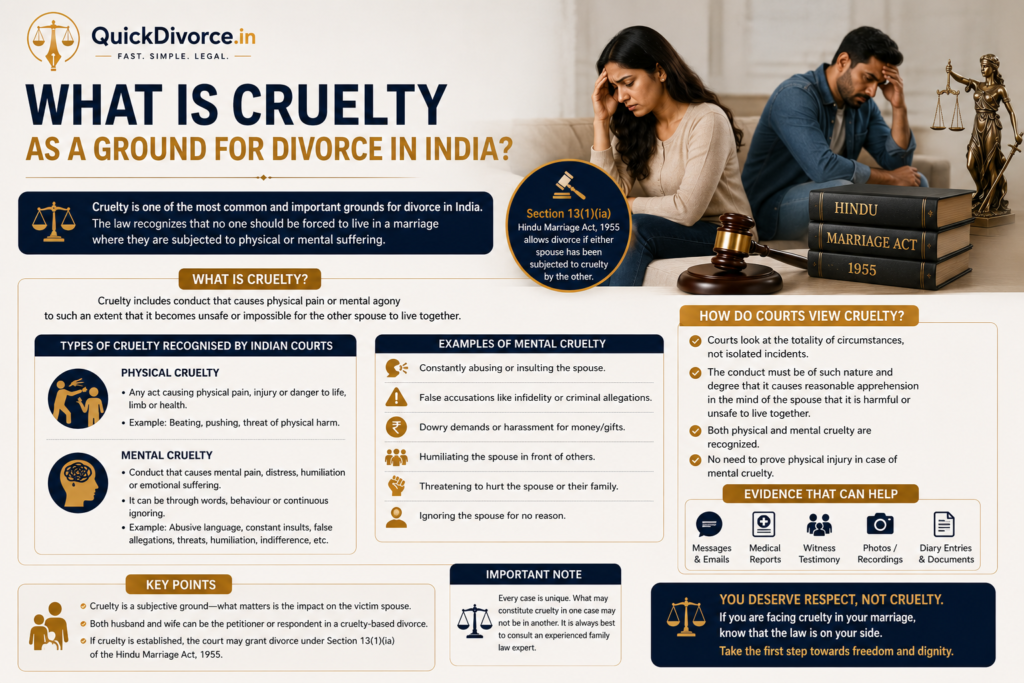
Section 13(1)(ia) of the Hindu Marriage Act, 1955 — introduced by the Marriage Laws (Amendment) Act, 1976 — provides that either spouse may petition for divorce on the ground that the other party has, after the solemnisation of the marriage, treated the petitioner with cruelty.
The provision is short — eight words in its operative part: “treated the petitioner with cruelty.” It contains no definition of cruelty. It does not specify whether the cruelty must be physical or mental, intentional or unintentional, a single act or a course of conduct. It does not prescribe any minimum duration or minimum threshold. It does not distinguish between different types of cruelty or rank their severity.
This deliberate legislative openness is not an oversight. The object of the legislature was to give a definition — exclusive or inclusive — which will amply meet every particular act or conduct and not fail in some circumstances. By the amendment the legislature must be understood to have left to the courts to spell out the types of conduct which amount to cruelty in the context of matrimonial law.
The courts have done precisely that — and the result is a body of law that is broad, nuanced, fact-specific, and continuously evolving.
The Foundational Test: What Courts Ask
Every cruelty case begins with the same question: does the conduct complained of make it unreasonable to expect the petitioner to continue living with the respondent?
The treatment accorded to the petitioner must be such as to cause an apprehension in the mind of the petitioner that cohabitation will be so harmful or injurious that she or he cannot reasonably be expected to live with the respondent, having regard to the circumstances of each case, keeping always in view the character and condition of the parties, their status, environments and social values, as also the customs and traditions governing them.
This test contains three important elements:
First — an apprehension of harm: The conduct must be of a nature that creates in the petitioner’s mind a genuine and reasonable apprehension that continued cohabitation will be harmful or injurious. This is not merely discomfort or unhappiness — it is apprehension of harm of a kind that makes the continuation of the marriage unreasonable.
Second — a reasonable person standard applied subjectively: The court does not apply a uniform abstract standard. It considers the particular petitioner — their education, background, social environment, sensitivity, and circumstances — and asks whether a person with those characteristics, in that situation, would reasonably find the conduct intolerable. Two spouses who experienced identical conduct might be affected differently, and courts acknowledge this.
Third — no straight-jacket formula: The Court highlighted that no straight-jacket formula can define cruelty — judges must look at the nature, gravity, impact, and the social background of the parties. Cruelty is inherently contextual. It is established or disproved by examining the totality of the relationship, not by applying a checklist.
Cruelty Does Not Require Intention
One of the most important features of cruelty as a matrimonial ground in India is that it does not require proof that the respondent intended to be cruel. The test is not whether the respondent meant to harm the petitioner — it is whether the respondent’s conduct, whatever its intent, caused harm of a nature that makes continued cohabitation unreasonable.
Cruelty can be physical or mental; physical violence is not essential. Cruelty need not be intentional; it is sufficient if the conduct amounts to cruelty regardless of the respondent’s intent.
This is practically significant because many forms of conduct that constitute cruelty are not maliciously intended — persistent neglect, emotional indifference, habitual disrespect, obsessive controlling behaviour, or severe incompatibility of temperament. A respondent who genuinely does not perceive their conduct as harmful — and would be shocked to learn that it is the basis of a divorce petition — can nonetheless be found guilty of cruelty if the conduct meets the test.
Physical Cruelty: The Classical Form
Physical cruelty — violence, assault, bodily harm — is the historical core of the cruelty ground and its most straightforward application. Courts have consistently held:
📋 A single serious act of violence can suffice: The cruelty need not be a pattern or course of conduct. A single act of physical violence of sufficient gravity — an attack with a weapon, a severe assault, conduct that causes serious injury — can constitute cruelty without the need to demonstrate repetition.
📋 Habitual violence is clearly cruelty: Where the respondent has subjected the petitioner to repeated physical violence — beating, slapping, kicking, using objects as weapons — the case for cruelty is straightforward. Medical records, police FIRs, hospital records, and witness testimony establish both the fact of violence and its impact.
📋 Domestic violence overlaps significantly: The Protection of Women from Domestic Violence Act, 2005 covers physical violence as a form of domestic violence. Physical conduct that constitutes domestic violence under that Act will almost always also constitute physical cruelty under Section 13(1)(ia) HMA — the two remedies are not mutually exclusive and are frequently pursued concurrently.
Evidence in physical cruelty cases:
📋 Medical records — doctor’s notes, emergency room records, discharge summaries — documenting injuries
📋 Photographs of injuries
📋 Police FIR records or NCR entries
📋 Testimony of witnesses who observed the violence or its aftermath
📋 The petitioner’s own testimony under oath, which — if credible and consistent — is itself evidence
Mental Cruelty: The Expanding Frontier
Mental cruelty is the area where Indian matrimonial law has developed most extensively and most dramatically over the past three decades. The Supreme Court has recognised that the harm a spouse can inflict without ever raising their hand is real, serious, and potentially more damaging than physical violence — because it may leave no visible trace while systematically destroying the petitioner’s dignity, mental health, and capacity to function.
The Supreme Court of India has expanded the scope of mental cruelty to reflect modern matrimonial realities. Non-physical conduct causing emotional suffering is now firmly recognised as a valid ground for divorce.
Mental cruelty can include indifference, abuse, denial of companionship, false accusations, and calculated silence.
The following categories of conduct have been specifically and repeatedly recognised by the Supreme Court and High Courts as constituting mental cruelty:
Category 1 — False and Baseless Allegations
False allegations and character assassination amount to mental cruelty. Baseless allegations of unchastity and extra-marital relationships constitute the worst form of cruelty in matrimonial disputes, as they severely harm the reputation and dignity of the spouse.
In Nagendra v. K. Meena, the Supreme Court held that baseless and reckless allegations of an extra-marital affair cannot be accepted and constitute cruelty under Section 13(1)(ia) of the Hindu Marriage Act, 1955.
The rationale is compelling: an allegation of infidelity or immoral conduct, made without foundation, strikes at the most intimate aspect of a person’s dignity. It is not merely offensive — it can destroy reputation, alienate family, affect employment, and cause profound psychological harm. The Supreme Court has called it “the worst form of cruelty” because it combines the harm of a false statement with the targeting of the most sensitive area of personal honour.
Category 2 — False Criminal Complaints
It is now beyond cavil that if a false criminal complaint is preferred by either spouse it would invariably and indubitably constitute matrimonial cruelty, such as would entitle the other spouse to claim a divorce.
In K. Srinivas Rao v. D.A. Deepa (2013), the wife filed false complaints under Section 498A IPC and the Dowry Prohibition Act, which led to police harassment of the husband and his family. The Supreme Court held that filing such false complaints constitutes mental cruelty.
A 2025 Supreme Court decision upheld a husband’s divorce decree on mental cruelty where the wife had levelled false allegations of fraud, dowry demand, harassment, and character assassination — the family court and High Court having both found these allegations to be without basis.
The courts draw a careful distinction: a spouse who files a genuine criminal complaint — for actual dowry harassment, real domestic violence, authentic financial fraud — has exercised their legal right and committed no cruelty. It is the filing of false, fabricated, or grossly exaggerated complaints — used as weapons in matrimonial litigation rather than as genuine reports of offences — that constitutes cruelty. The falsity must be established; the mere fact of a complaint being filed does not constitute cruelty.
Category 3 — Threats of and Attempts at Suicide
Where one spouse repeatedly threatens to commit suicide — using those threats as a means to control, manipulate, or coerce the other spouse — courts have recognised this as a form of mental cruelty. The impact on the spouse subjected to repeated suicide threats — the anxiety, the guilt, the impossibility of living normally under the shadow of such threats — is itself a form of serious psychological harm.
This is distinguished from genuine suicidal ideation arising from mental illness or distress — the cruelty lies in the weaponisation of suicide threats as a tool of control.
Category 4 — Humiliation Before Family and in Public
Persistent humiliation of the petitioner — in front of family members, in front of the petitioner’s children, at social gatherings, or in professional settings — constitutes mental cruelty. Repeated humiliation and disrespect in the matrimonial home has been held as cruelty by the Supreme Court.
The cumulative effect of systematic humiliation — the erosion of the petitioner’s self-respect and dignity over time — is central to these cases. Courts do not require a dramatic single incident; a sustained pattern of disrespect that makes the petitioner’s home a source of humiliation rather than security constitutes cruelty.
Category 5 — Sending Defamatory Letters and Notices
While staying away, a spouse can cause mental cruelty to the other spouse by sending vulgar and defamatory letters or notices or filing complaints containing indecent allegations or by initiating a number of judicial proceedings making the other spouse’s life miserable.
This category is particularly important because it establishes that cruelty does not require cohabitation. A spouse who has left the matrimonial home but continues to send threatening, defamatory, or harassing communications — to the petitioner, to their family, to their employer — is committing cruelty from a distance. The physical separation does not insulate the respondent from responsibility for the harm they continue to inflict.
Category 6 — Multiplicity of Vexatious Litigation
Where one spouse systematically initiates multiple judicial proceedings — criminal complaints, civil suits, maintenance applications — not for the purpose of pursuing genuine grievances but as a campaign of attrition to make the other spouse’s life miserable and drain their financial and emotional resources, the courts treat this as mental cruelty.
The distinction between genuine legal proceedings and vexatious litigation is fact-specific. A spouse who has real grievances and pursues them through available legal channels is not committing cruelty. A spouse who files complaint after complaint — each of which is rejected or disproved — in a pattern that demonstrates the intent to harass rather than to obtain justice, is.
Category 7 — Forcing Separation From Parents
In Narendra v. K. Meena (2016), the Supreme Court held that forcing a spouse to live separately from parents without just cause amounts to mental cruelty.
This is a context-specific recognition that in Indian families, where the marital home often includes or adjoins the husband’s parents, a spouse who persistently and unreasonably demands separation from the other’s parents — causing distress to the other spouse and their family — can be guilty of cruelty. Courts examine whether the demand for separation is reasonable (based on actual conflict or incompatibility with in-laws) or simply an expression of dominance and control.
Category 8 — Cyber Harassment and Digital Abuse
The Bharatiya Sakshya Adhiniyam, 2023 and the evolving jurisprudence of digital evidence have brought cyber harassment firmly within the scope of cruelty. Cyber harassment by a spouse — threatening messages, defamatory social media posts, surveillance through digital means — can constitute mental cruelty under Section 13(1)(ia).
Text message campaigns, WhatsApp harassment, defamatory social media posts, publishing private or intimate photographs without consent, and using digital surveillance tools to monitor a spouse’s movements are all forms of conduct that courts in 2025 and 2026 have been willing to recognise as cruelty when the evidence establishes that their purpose is to harm, humiliate, or control.
Category 9 — Calculated Indifference and Emotional Denial
Mental cruelty can include calculated silence — the sustained refusal to communicate, acknowledge, or engage with the spouse — where that silence is a deliberate instrument of harm rather than a product of incompatibility or depression.
This is perhaps the most subtle category. Courts have held that emotional denial — the deliberate withholding of affection, communication, and companionship, used as a weapon — can constitute cruelty even in the absence of any aggressive or overtly hostile conduct. The test, as always, is whether the conduct makes continued cohabitation unreasonable.
The May 2026 Supreme Court Ruling: Career Choices Are Not Cruelty
The most significant and most discussed cruelty judgment of 2026 was delivered by the Supreme Court in May, addressing a case where lower courts had branded a wife’s professional choices as acts of cruelty toward her husband.
The family court in 2022 reached a conclusion that the wife’s attempts to build her career constituted acts of cruelty toward her husband. The Supreme Court rejected this reasoning entirely through its complete judgment. The bench stated that a well-educated woman with professional qualifications must not limit her activities to her marital responsibilities, because marriage does not erase her personal identity.
What stands out about this judgment is not just its conclusion, but the frankness of its language. The Supreme Court has decided many cases since 2018 that have established women’s rights to property, spousal maintenance, and protection from domestic violence. However, family courts and high courts have failed to keep pace with these societal changes which have shaped matrimonial litigation processes.
The court was equally clear that the wife in the case was not guilty of any form of cruelty:
The wife in this case was not opposing the divorce — she was fighting to ensure that the legal record did not say she had been cruel to her husband simply for pursuing her profession.
The bench rejected the husband’s request for separate prosecution of his wife on perjury charges after concluding that the husband sought to bring charges against his wife out of personal revenge.
The practical implications of this ruling are significant. It establishes clearly — and at the highest judicial level — that:
📋 A wife’s professional independence is not a matrimonial offence
📋 A wife’s decision to pursue her career, including decisions that involve relocation or professional commitment that affects household routines, cannot be characterised as cruelty
📋 Marriage does not extinguish a woman’s right to a professional identity
📋 Lower courts that apply outdated social assumptions about women’s roles — treating professional ambition as a failure of marital duty — are wrong in law and will be corrected
What Does Not Constitute Cruelty
Understanding cruelty requires understanding equally what courts have held does not constitute cruelty — to prevent the ground from being stretched to cover every marital unhappiness:
Ordinary Marital Wear and Tear
The ordinary friction, irritation, and unhappiness of married life — the small arguments, the misunderstandings, the incompatibilities of daily living — do not constitute cruelty. Courts have consistently insisted that petitioners must demonstrate conduct that crosses a threshold, not merely conduct that is unpleasant or that has contributed to an unhappy marriage.
Frustration-Driven Allegations
The Madhya Pradesh High Court held in a 2025 ruling that an allegation of illicit relations, made by a wife who had been separated from her husband for nearly 19 years in sheer frustration, could not be taken as cruelty. The wife had not been taken by the husband to live with her — and her allegation of a romantic relationship between the husband and a woman colleague was found to be the product of prolonged frustration rather than malicious character assassination.
This distinction — between the deliberate, reckless, baseless allegation made as a weapon and the frustrated expression of a spouse who has been wronged themselves — is critical. Courts apply it carefully and contextually.
Genuine but Unproved Complaints
A spouse who files a complaint under Section 498A or the Domestic Violence Act, genuinely believing they have been wronged, but whose complaint is not ultimately proved or sustained, has not thereby committed cruelty. The falsity of the complaint — and the intent to harass rather than to seek genuine redress — must be established by the respondent who claims cruelty. The mere fact that a criminal complaint was filed and did not result in conviction is not, by itself, cruelty.
Incompatibility Alone
Incompatibility of temperament, different values, different life goals — however profound — do not constitute cruelty under Indian law as currently applied by Family Courts. This is one of the areas where Indian matrimonial law differs most significantly from the law of most western jurisdictions, where irretrievable breakdown (of which incompatibility is a manifestation) is itself a ground for divorce. In India, incompatibility must manifest in specific conduct that reaches the cruelty threshold. The subjective experience of being deeply unhappy in a marriage is not, of itself, a ground.
Cruelty Is Assessed Cumulatively
One of the most practically important principles in cruelty jurisprudence is that courts do not examine individual incidents in isolation — they assess the cumulative impact of the respondent’s conduct on the petitioner over time.
The instances of cruelty are not to be taken in isolation but the cumulative effect of the facts and circumstances emerging from the evidence on record must be examined, and then a fair inference must be drawn whether the plaintiff has been subjected to mental cruelty due to the conduct of the other spouse.
This means that a petitioner who cannot point to any single act of dramatic cruelty may still establish the ground through evidence of a sustained pattern of conduct — each element of which, individually, might seem minor, but which together constitute a course of treatment that makes continued cohabitation unreasonable. The accumulated effect of years of small humiliations, persistent disrespect, habitual emotional withdrawal, and recurring false accusations can establish cruelty even where no single incident would be sufficient on its own.
Proving Cruelty: Evidence and Procedure
The Standard of Proof
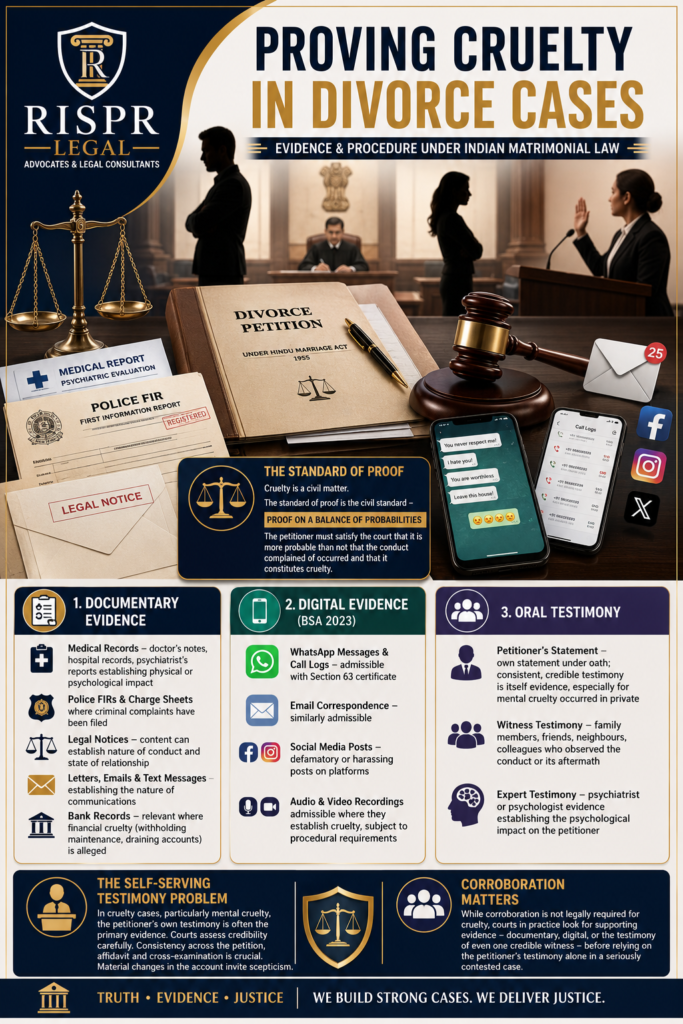
Cruelty in a matrimonial case is a civil matter. The standard of proof is the civil standard — proof on a balance of probabilities — not the criminal standard of proof beyond reasonable doubt. The petitioner must satisfy the court that it is more probable than not that the conduct complained of occurred and that it constitutes cruelty.
Types of Evidence
Documentary evidence:
📋 Medical records — doctor’s notes, hospital records, psychiatrist’s reports — establishing the physical or psychological impact of the respondent’s conduct
📋 Police FIR records and charge sheets where criminal complaints have been filed
📋 Legal notices sent by either party — their content can establish the nature of the conduct and the state of the relationship
📋 Letters, emails, and text messages — establishing the nature of communications between the parties
📋 Bank records — relevant where financial cruelty (withholding maintenance, draining joint accounts) is alleged
Digital evidence under BSA 2023:
📋 WhatsApp messages and call logs — admissible with a Section 63 certificate
📋 Email correspondence — similarly admissible
📋 Social media posts — defamatory or harassing posts on platforms
📋 Audio and video recordings — admissible where they establish cruelty, subject to procedural requirements
Oral testimony: 📋 The petitioner’s own statement under oath — consistent, credible personal testimony is itself evidence, particularly for mental cruelty that occurred in private
📋 Testimony of witnesses — family members, friends, neighbours, colleagues who observed the conduct or its aftermath
📋 Expert testimony — psychiatrist or psychologist evidence establishing the psychological impact of the respondent’s conduct on the petitioner
The Self-Serving Testimony Problem
In cruelty cases, particularly mental cruelty, the petitioner’s own testimony is often the primary evidence — because the conduct occurred in private. Courts assess the credibility of that testimony carefully. Consistency across the petition, the affidavit of evidence, and cross-examination is crucial. A petitioner whose account changes materially between the petition and examination will face scepticism.
Corroboration
While corroboration is not legally required for cruelty (as it is for certain other grounds), courts in practice look for evidence that supports the petitioner’s account — documentary evidence, digital evidence, or the testimony of even one credible witness — before acting on the petitioner’s testimony alone in a seriously contested case.
The Clean Hands Doctrine and Cruelty
As with all fault-based grounds, the petitioner in a cruelty case must come to court with clean hands — they must not themselves be guilty of conduct that constitutes cruelty toward the respondent.
A petitioner who has been cruel to their spouse — physically violent, emotionally abusive, or guilty of the same conduct they charge against the respondent — cannot obtain a divorce on the ground of cruelty. The court will examine the conduct of both parties and will refuse relief where the petitioner’s own conduct contributed to or provoked the respondent’s behaviour.
This does not mean that a petitioner who responds to provocation loses their case — but it does mean that a petitioner who has been systematically cruel throughout the marriage cannot present themselves as an innocent victim of the respondent’s cruelty.
Cruelty and the Condonation Bar
A petitioner who, with full knowledge of the cruelty, forgives the respondent and resumes normal marital relations has condoned the cruelty. Condoned cruelty cannot be revived as a ground for divorce unless the respondent commits the same or similar conduct after the condonation.
Condonation through resumption of sexual intercourse after the petitioner became aware of the cruelty is the clearest form of condonation in law. Courts examine carefully whether the petitioner’s post-knowledge conduct — returning to the matrimonial home, resuming cohabitation, continuing the marriage — constitutes condonation.
Cruelty Under Other Personal Laws
While this article has focused on Section 13(1)(ia) of the Hindu Marriage Act, cruelty is a recognised ground for divorce under all of India’s personal law statutes:
📋 Special Marriage Act, 1954: Section 27(1)(d) — cruelty is a ground for divorce for civil and inter-faith marriages
📋 Indian Divorce Act, 1869: Section 10 — cruelty (combined with adultery) is a ground for Christian divorce, though the requirement of combination has been substantially modified by courts
📋 Dissolution of Muslim Marriages Act, 1939: Section 2(viii) — cruelty is defined broadly to include physical violence, association with women of ill repute, forcing immorality on the wife, disposing of her property, and inequitable treatment of co-wives
Frequently Asked Questions
What does “cruelty” mean under Indian divorce law?
Cruelty refers to conduct by one spouse that causes physical or mental suffering to the other spouse, making it unreasonable or unsafe for them to continue living together. Indian courts recognize both physical and mental cruelty as valid grounds for divorce.
Is physical violence necessary to prove cruelty?
No. Physical violence is not required. Mental cruelty, such as constant humiliation, false allegations, emotional abuse, threats, or persistent harassment, can also constitute cruelty and justify a divorce.
What are some examples of mental cruelty?
Mental cruelty may include repeated insults, character assassination, false criminal complaints, denial of companionship, public humiliation, abusive behavior, or conduct that causes severe emotional distress to the spouse.
Can a single incident amount to cruelty?
In some cases, yes. A particularly serious act may be sufficient to constitute cruelty. However, courts usually examine the nature, severity, and impact of the conduct before reaching a conclusion.
How can cruelty be proved in court?
Cruelty can be established through witness testimony, medical records, photographs, messages, emails, social media communications, audio or video recordings, and other relevant evidence presented before the court.
Is cruelty a ground for divorce under the Hindu Marriage Act?
Yes. Cruelty is specifically recognized as a ground for divorce under Section 13 of the Hindu Marriage Act, 1955, and similar principles are applied under other personal laws governing marriage and divorce.
Conclusion
Cruelty as a ground for divorce in India is simultaneously the law’s most important matrimonial protection for spouses in harmful marriages and its most extensively tested and continuously evolving concept. From the relatively narrow physical cruelty that the courts addressed in the Act’s early years, through the progressive recognition of mental cruelty in all its modern forms, to the 2026 Supreme Court’s unambiguous statement that women’s professional independence is not a matrimonial offence — the law has moved steadily toward a framework that takes the full spectrum of marital harm seriously.
The foundational test — whether the conduct makes it unreasonable to expect continued cohabitation — remains constant. What has changed is the range of conduct the courts are willing to examine through that lens: the false allegation, the vexatious lawsuit, the harassing text message, the deliberate emotional withdrawal, the controlling demand that a spouse abandon their career. Each of these, examined cumulatively and contextually, can constitute cruelty.
The May 2026 ruling is particularly significant not just for its legal conclusion but for what it reveals about the gap between the law as the Supreme Court understands it and the law as it is applied at the ground level of Family Courts across India. The legislature has provided the framework. The Supreme Court has provided the principles. The challenge — acknowledged with unusual candour by the court itself — is ensuring that those principles are applied consistently throughout the judicial system, rather than selectively at the apex.
Know what cruelty covers. Document everything. Present the evidence — completely and in sequence.
Get Expert Cruelty-Based Divorce Legal Assistance
🟡 QuickDivorce.in provides complete legal assistance for cruelty-based divorce petitions — evidence preparation, petition drafting, digital evidence certification, Family Court representation, appeals, and cross-examination strategy — across all jurisdictions in India.
🟡Visit LegalTax.in for other Legal and Trademark related services as 👉 Money Recovery Cases
👉 Property Disputes 👉 Business & Licence Registrations
🟡Visit Business24hub for IT services
👉 Mutual Consent Divorce at QuickDivorce.in 👉 Contested Divorce Filing 👉 Child Custody and Maintenance 👉 Matrimonial Property Settlement 👉 NRI Divorce Services 👉 Alimony and Maintenance
🟡 Protect Your Rights 👉 Domestic Violence Legal Support at QuickDivorce.in 👉 Stridhan Recovery
📞 Call Now: +91 8595439395 🕐 Free Consultation: Monday to Saturday, 10 AM to 6 PM

Adv. Manish Kashyap is a Family Law & Divorce Lawyer with extensive experience in Mutual & Contested Divorce, NRI Divorce, Child Custody, Alimony, Domestic Violence, Judicial Separation, and Family Court matters, providing professional legal guidance to clients.

