

Views: 19
Meta Description: Is court marriage without parents’ consent legal in India? Get the complete guide on the Special Marriage Act 1954, eligibility, process, documents, Supreme Court judgments, and how to get a Protection Order.
Table of Contents
- 1 Introduction
- 2 Is Parental Consent Required for Court Marriage in India?
- 3 What Is the Special Marriage Act, 1954?
- 4 Step-by-Step Court Marriage Process
- 5 What Happens If Parents File an Objection?
- 6 Landmark Supreme Court Judgments
- 7 Article 21: The Right to Life and Personal Liberty
- 8 What to Do If You Face Threats or Pressure from Family
- 9 Inter-Caste and Inter-Religion Marriage: Extra Precautions
- 10 Live-In Relationship vs Court Marriage
- 11 Property and Inheritance Rights After Marriage Without Consent
- 12 Common Myths vs Facts About Court Marriage
- 13 Precautions to Take Before a Court Marriage
- 14 Frequently Asked Questions (FAQs)
- 15 Conclusion
- 16 Get Expert Advice for Court Marriage in India
Introduction
In India, love marriage remains a sensitive topic for many families. Because of caste, religion, community, and deep-rooted social norms, parents often refuse to accept a marriage of their child’s own choice. This raises the most common question among young couples: “Is court marriage without parents’ consent legal in India?”
This blog gives you a complete and accurate answer — covering Indian marriage law, the Special Marriage Act 1954, landmark Supreme Court judgments, and the full step-by-step court marriage process. This article is written for general legal awareness; for your specific situation, always consult a qualified lawyer.
Is Parental Consent Required for Court Marriage in India?
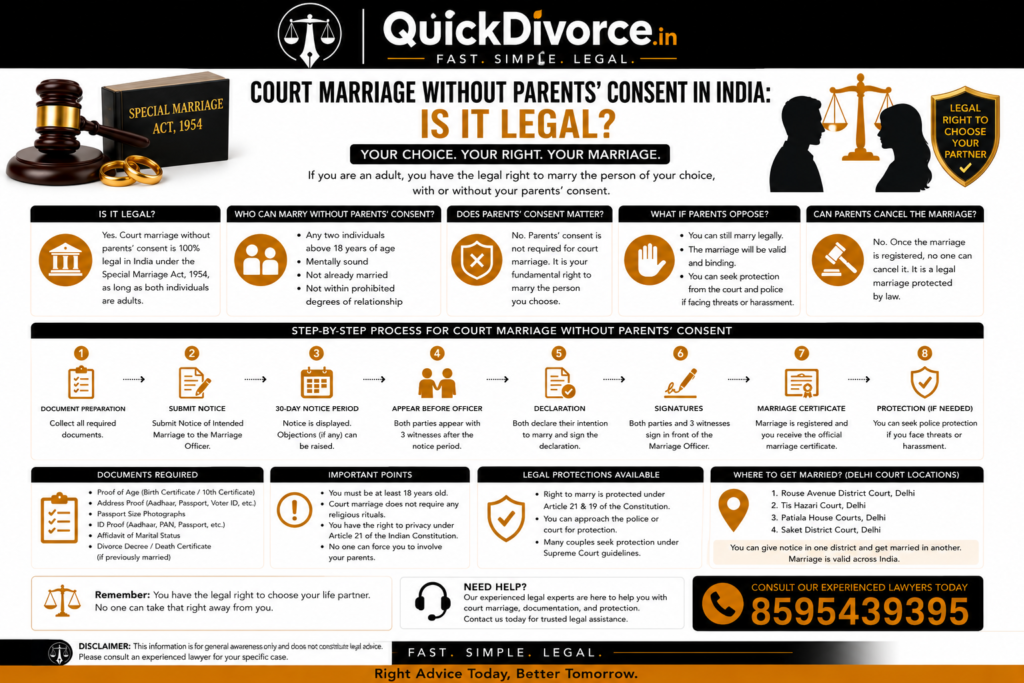
The straightforward answer is — No. Under Indian law, if both parties are adults (major) and satisfy the conditions laid down by law, there is no legal requirement to obtain the consent of parents or family members before getting married.
This right is protected under the Special Marriage Act, 1954, and is further reinforced by Article 21 of the Constitution of India, which guarantees the right to life and personal liberty. The Supreme Court of India has repeatedly held that choosing one’s own life partner is a fundamental right available to every adult citizen, regardless of whether the family approves or not.
Legal Conditions for a Valid Court Marriage
According to Section 4 of the Special Marriage Act, 1954, a court marriage is considered legally valid when the following conditions are satisfied:
- Age requirement — The groom must be at least 21 years old, and the bride must be at least 18 years old.
- Mental capacity — Both parties must be mentally sound and capable of giving valid, free consent to the marriage.
- No living spouse — Neither party should have a living spouse at the time of marriage (i.e., neither should already be married, unless a previous marriage has been legally dissolved).
- Not within a prohibited relationship — The parties should not fall within the degree of prohibited relationship as defined by law.
If all four conditions are met, the marriage is fully valid under Indian law — irrespective of whether the parents agree or not.
What Is the Special Marriage Act, 1954?
The Special Marriage Act, 1954 is a secular law that applies to every Indian citizen, regardless of religion, caste, or community. It was specifically designed for couples who:
- Belong to different religions or castes (inter-religion / inter-caste marriage)
- Want to marry purely as a civil contract, without religious rituals
- Wish to legally register their marriage
Under this Act, no religious ceremony, ritual, or “pheras” are required — only the free and valid mutual consent of both parties. This is exactly why couples who fear family opposition usually choose to marry under this law.
Step-by-Step Court Marriage Process
If you want to marry without your parents’ consent, here is the complete legal procedure you need to follow:
1. Filing the Notice of Intended Marriage
Both parties must first submit a written notice (Form 2) to the Marriage Officer at the Sub-Registrar Office. This notice must be filed in the district where at least one of the parties has resided for the preceding 30 days.
2. Documents Required
- Proof of age (birth certificate, passport, school leaving certificate)
- Proof of residence (Aadhaar card, utility bill, rent agreement)
- Passport-size photographs
- Signed affidavit from both parties confirming free and voluntary consent to marry
- Proof of divorce or death of previous spouse (if applicable)
3. The 30-Day Public Notice Period
After the notice is filed, the Marriage Officer publishes it publicly at the registrar’s office. During this period, any person — including parents — can raise an objection to the marriage, but such an objection is only valid if it is based on a legal ground, such as:
- One party is a minor
- One party is already married
- One party is mentally unfit to consent
Important: An objection based purely on emotional, caste-based, or social grounds cannot stop the marriage. If the objection has no legal basis, the Marriage Officer will reject it and the marriage will proceed as scheduled.
4. Solemnization and Registration of Marriage
If no valid objection is raised within 30 days, the Marriage Officer solemnizes the marriage in the presence of both parties and three witnesses, and issues a Marriage Certificate. This certificate is legally valid across India and internationally.
What Happens If Parents File an Objection?
Many couples fear that parents can approach the court and stop the marriage by filing an objection. Here’s how the law actually treats this:
- Parents or any third party can file an objection, but they must prove a valid legal ground.
- The Marriage Officer will give both parties an opportunity to respond.
- If the objection lacks any solid legal basis, the marriage will be solemnized without any obstruction.
- Even if parents approach the High Court, multiple Supreme Court rulings have made it clear that the validity of a marriage between two consenting adults cannot be decided by the family.
Landmark Supreme Court Judgments
Indian courts have consistently and firmly upheld the right of adults to choose their own life partner.
Lata Singh vs State of UP (2006)
The Supreme Court held that an adult has the complete right to marry a person of their choice, and if family members harass or threaten a couple over an inter-caste or inter-religion marriage, the police must take strict action against them.
Shafin Jahan vs Asokan K.M. (2018) — The Hadiya Case
In this widely followed case, the Supreme Court held that the validity of a marriage between two consenting adults cannot be decided by a court or by the family. The choice of a life partner is part of an individual’s personal autonomy, and interference by courts or families in this choice is unconstitutional.
Shakti Vahini vs Union of India (2018)
In this judgment, the Supreme Court declared honour killings and interference by khap panchayats in adult marriages to be illegal. The Court directed state governments to provide protection to couples who face threats from family or society due to their marriage choice.
Together, these judgments make it clear that Indian law recognizes the freedom of adults to marry as a fundamental right.
Article 21: The Right to Life and Personal Liberty
The Indian Constitution does not explicitly mention the right to marry, but the Supreme Court has repeatedly interpreted Article 21 — the right to life and personal liberty — broadly enough to include:
- The right to choose one’s own life partner as part of privacy and personal autonomy
- Protection from interference by the state, family, or society in an adult’s marriage choice
- Equal application of this right regardless of caste, religion, or social status
What to Do If You Face Threats or Pressure from Family
Many couples who marry without parental consent fear harassment, threats, or violence from their families. In such situations, the law provides several protective remedies:
- File a police complaint — Register a General Diary (GD) entry or a Non-Cognizable (NC) complaint at your nearest police station.
- Apply for a Protection Order — A protection petition can be filed before the local Magistrate’s Court or the High Court.
- File a Writ Petition in the High Court — Under Article 21, a couple can directly approach the High Court seeking protection of life and personal liberty.
- Seek legal aid — Contact recognized legal aid organizations or family law advocates immediately for support.
Several High Courts across India routinely grant immediate police protection to couples in such cases, especially when there is a genuine threat to life.
Inter-Caste and Inter-Religion Marriage: Extra Precautions
When a marriage takes place across castes or religions, the risk of social opposition tends to be higher. In such cases:
- Marrying under the Special Marriage Act is the safest and legally strongest option, since it does not require either party to convert their religion.
- Keep all documents (notice copy, marriage certificate, ID proofs, photographs) safely preserved — these serve as important legal protection later.
- If there is a genuine fear of threats, consider filing a protection petition with the police or High Court even before the marriage is solemnized.
Live-In Relationship vs Court Marriage
Some couples choose to live together first to avoid immediate family conflict. The Supreme Court has also recognized the right of consenting adults to live in a live-in relationship, but keep the following in mind:
- A live-in relationship does not automatically get the same legal recognition as marriage (such as inheritance or property rights), unless specific circumstances are proven in court.
- If you need long-term legal protection — such as inheritance rights, property claims, or formal social recognition — a registered Court Marriage is a much safer and more secure option.
Property and Inheritance Rights After Marriage Without Consent
Marrying without parental consent does not negatively affect the inheritance rights of children born from that marriage. Children born from such a marriage are considered legally legitimate and have full inheritance rights in ancestral property, exactly like children from any other legally valid marriage.
However, parents retain full control over their self-acquired property, and they are free to distribute or withhold it as they choose — this has no direct legal connection to the marriage itself.
Common Myths vs Facts About Court Marriage
| Myth | Fact |
|---|---|
| Marriage without parental consent is illegal | ✗ False — marriage between consenting adults is fully legal |
| Parents can go to court and stop the marriage | ✗ Only objections with a valid legal ground can be considered, not emotional ones |
| Court marriage requires religious rituals | ✗ No rituals are required under the Special Marriage Act |
| Inter-caste/inter-religion couples must convert religion | ✗ The Special Marriage Act does not require religious conversion |
| Both families must be present at the marriage | ✗ Only three witnesses are legally required |
Precautions to Take Before a Court Marriage
- Prepare all documents in advance — age proof, address proof, photographs, affidavits, etc.
- Consult an experienced lawyer — especially if you anticipate opposition from family.
- Plan for safety during the notice period — if you fear threats, consider applying for police protection in advance.
- Keep copies of all legal documents safe — preserve both original and photocopies of the marriage certificate, notice, and forms.
- Don’t rush the decision — marriage is a major life decision; move forward only after fully understanding the legal process.
Frequently Asked Questions (FAQs)
1. Is court marriage without parents’ consent legal in India?
Yes. Court marriage without parents’ consent is legal in India if both individuals are legally competent adults and fulfill the eligibility requirements under the applicable marriage law. Parental consent is generally not required for adults.
2. What is the minimum age for court marriage in India?
For a valid court marriage, the groom must generally be at least 21 years old and the bride must be at least 18 years old, along with meeting the other legal conditions prescribed under the applicable law.
3. Can inter-caste and inter-religion couples marry without parents’ consent?
Yes. Eligible inter-caste and inter-religion couples can legally marry without parents’ consent by following the procedure under the applicable marriage law, including the Special Marriage Act, 1954 where applicable.
4. What documents are required for court marriage without parents’ consent?
The required documents generally include identity proof, age proof, address proof, passport-size photographs, affidavits, and proof of marital status, such as a divorce decree or death certificate where applicable. Additional documents may be required based on the facts of the case.
5. Can parents legally stop a court marriage between two adults?
In general, parents cannot legally prevent a valid court marriage between two consenting adults who satisfy all legal requirements. However, authorities or courts may intervene if there are allegations of coercion, fraud, or any violation of the law.
6. Can couples seek police or court protection after marriage?
Yes. If an adult couple faces threats, harassment, or intimidation because of their marriage, they may approach the police or the appropriate court for protection in accordance with the law.
7. Is it necessary to hire a lawyer for court marriage without parents’ consent?
No. Hiring a lawyer is not mandatory. However, legal assistance can help ensure that all documents are correctly prepared, procedural requirements are followed, and any legal issues are addressed efficiently.
Conclusion
Court marriage without parents’ consent is completely legal in India, provided both parties are adults and satisfy all the conditions laid down under the Special Marriage Act, 1954. Through several landmark judgments, the Supreme Court has made it unambiguously clear that choosing one’s own life partner is a constitutional right available to every adult, and that neither family nor society can lawfully interfere with this choice.
That said, even with a strong legal right on your side, it is important to follow the correct legal process, keep all necessary documents ready, and seek legal protection where needed, given the social realities many couples still face. If you or someone you know is going through this situation, consulting an experienced family/matrimonial law advocate is always the wisest first step.
Get Expert Advice for Court Marriage in India
🟡QuickDivorce offers trusted online legal services across India, including mutual divorce, contested divorce, child custody, alimony, marriage registration, and expert family law consultation.
👉 Mutual Consent Divorce
👉 Contested Divorce Filing
👉 Child Custody and Maintenance
👉 Matrimonial Property Settlement
👉 NRI Divorce Services
👉 Alimony and Maintenance
🟡 Protect Your Rights
👉 Domestic Violence Legal Support
👉 Stridhan Recovery
🟡For other Legal and Trademark related services visit
👉 Money Recovery Cases
👉 Property Disputes
👉 Business & Licence Registrations
📞 Call Now: +91 8595439395
🕐 Free Consultation: Monday to Saturday, 10 AM to 6 PM

Adv. Manish Kashyap is a Family Law & Divorce Lawyer with extensive experience in Mutual & Contested Divorce, NRI Divorce, Child Custody, Alimony, Domestic Violence, Judicial Separation, and Family Court matters, providing professional legal guidance to clients.

