

Views: 2
Planning a court marriage in Delhi? Get the complete 2026 guide covering SDM office locations, step-by-step procedure, documents, fees, tatkal option, and certificate download.
Table of Contents
- 1 Introduction
- 2 Two Legal Routes for Court Marriage in Delhi
- 3 Eligibility Conditions
- 4 SDM Office Locations for Court Marriage in Delhi (2026)
- 5 Documents Required for Court Marriage in Delhi
- 6 Step-by-Step Procedure for Court Marriage in Delhi
- 7 Tatkal (Expedited) Option in Delhi
- 8 Fees for Court Marriage in Delhi (2026)
- 9 How to Download the Marriage Certificate After Registration in Delhi
- 10 Practical Tips That Make a Real Difference
- 11 Getting Police Protection for Court Marriages in Delhi
- 12 Common Mistakes That Delay Court Marriage in Delhi
- 13 How QuickDivorce.in Can Help
- 14 Frequently Asked Questions (FAQs)
- 15 Conclusion
- 16 Get Expert Advice for Court Marriage in Delhi
Introduction
Delhi is one of the most popular cities in India for court marriages — and not just for couples who live here. The combination of a well-organised e-District portal, clearly structured SDM office processes, DigiLocker integration for certificate download, and strong constitutional protections for consenting adults makes court marriage in Delhi a preferred choice for couples from across North India, for NRIs returning to formalise their union, and for inter-caste or inter-religion couples who need both legal recognition and administrative simplicity.
But despite all the improvements, the process for court marriage in Delhi in 2026 still has enough procedural nuance — different routes under different laws, specific SDM office jurisdictions, a mandatory 30-day notice under one Act but not the other, and a tatkal option that applies only to certain categories of couples — that going in unprepared routinely causes unnecessary delays. This guide breaks everything down: who can use which law, which SDM office to approach, exactly what documents to bring, what the step-by-step process looks like under both routes, what the fees are, and how to download the marriage certificate after it’s issued.
Two Legal Routes for Court Marriage in Delhi
The first decision every couple planning court marriage in Delhi must make is which law governs their registration. The answer depends on the religion of both parties.
Route 1: Hindu Marriage Act, 1955
This route is available when both parties are Hindu, Sikh, Jain, or Buddhist. The key features of this route:
- The marriage must first be solemnised through a recognised ceremony — either a traditional religious ceremony or at an Arya Samaj Mandir, which offers a structured, same-day ceremony followed immediately by a certificate that is then used for SDM registration
- No mandatory 30-day notice period — this is the single most significant procedural advantage of this route
- Registration is typically completed within 7–15 working days of the application date, and with the tatkal option, the certificate can be issued within 24 hours
- Two witnesses are required (compared to three under the Special Marriage Act)
- The fee is ₹100
For same-religion inter-caste couples — for example, a Hindu Rajput marrying a Hindu Dalit — this is the faster, simpler route, provided both parties genuinely belong to the eligible religious categories.
Route 2: Special Marriage Act, 1954
This route is mandatory for inter-religion couples and is also available to any couple — regardless of religion — who prefer a purely civil, secular marriage without any religious ceremony. Key features:
- No prior religious ceremony required — the marriage is solemnised before the Marriage Officer himself
- A mandatory 30-day public notice period applies, during which the notice is displayed on the SDM office notice board and objections may be raised
- Only legally prescribed objections — underage parties, an existing spouse, unsound mind, or prohibited degree of relationship — have any legal standing. Caste or religion-based objections are entirely invalid and must be rejected by the Marriage Officer
- Three witnesses are required on the day of solemnisation
- The fee is ₹150
- Total timeline: approximately 32–45 days from filing to certificate
Under the Delhi (Compulsory Registration of Marriage) Order, 2014, every marriage in Delhi — or where either spouse is a Delhi resident — must be registered, making the choice of route a matter of procedure rather than preference.
Eligibility Conditions
Before approaching any SDM office, both parties should confirm they meet the basic eligibility requirements applicable across both routes:
- The groom must be at least 21 years old and the bride at least 18 years old on the date of the application
- Neither party should have a living spouse — prior marriages must have ended through a valid divorce decree or the spouse’s death, with documentary proof
- Both parties must be mentally sound and capable of giving valid, free consent
- Neither party should fall within the prohibited degree of relationship
- At least one party must have resided within the jurisdiction of the SDM office where the application is being filed for a minimum of 30 days before filing
SDM Office Locations for Court Marriage in Delhi (2026)
Applications for court marriage must be filed at the office of the Sub-Divisional Magistrate in whose jurisdiction any of the husband or wife resides, during 9:30 a.m. to 1:00 p.m. on any working day.
Delhi is divided into 11 revenue districts, each with one or more SDM offices that function as Marriage Officer offices. The key SDM offices handling court marriage registrations across Delhi’s major districts in 2026 are:
| District | Primary SDM Office Location |
|---|---|
| Central Delhi | SDM Civil Lines, SDM Kotwali |
| North Delhi | SDM Model Town, SDM Narela, SDM Alipur |
| North East Delhi | SDM Seemapuri, SDM Shahdara |
| East Delhi | SDM Preet Vihar, SDM Vivek Vihar |
| New Delhi | SDM New Delhi (Mandir Marg area) |
| North West Delhi | SDM Rohini, SDM Kanjhawala, SDM Saraswati Vihar |
| West Delhi | SDM Rajouri Garden, SDM Uttam Nagar |
| South West Delhi | SDM Dwarka, SDM Kapashera, SDM Najafgarh |
| South Delhi | SDM Saket, SDM Hauz Khas, SDM Mehrauli |
| South East Delhi | SDM Kalkaji, SDM Tughlakabad |
| Shahdara | SDM Shahdara, SDM Vivek Vihar |
An important practical note: you are not required to file in the SDM office closest to your home — you can choose any SDM office in Delhi where one of the parties has resided for at least 30 days. This flexibility is especially relevant for couples who need some privacy around their application, since different offices have different notice board visibility and footfall levels.
The exact contact address and jurisdiction of each SDM office — including which residential colonies fall under each office — can be confirmed on the Delhi government’s Revenue Department website at revenue.delhi.gov.in, or through the e-District Delhi portal at edistrict.delhigovt.nic.in.
Documents Required for Court Marriage in Delhi
Preparing the correct documents is the step most likely to cause delays if done incorrectly. A lot of delays happen at the upload stage, not because the documents are wrong, but because the format is not accepted. Documents are generally uploaded in PDF or JPG/JPEG format.
For Both Parties (Individually):
Identity Proof (Any One)
- Aadhaar Card
- Voter ID Card
- Passport
Age Proof (Any One)
- Birth Certificate
- 10th Class Marksheet
- Passport
Residence Proof Confirming 30-Day Stay in Delhi District (Any One)
- Aadhaar Card with current Delhi address
- Passport
- Recent utility bill (not older than 2–3 months)
- Rent agreement
Affidavit (Mandatory for Both) Each party must submit a separately notarised affidavit confirming:
- Date and place of marriage (or intended marriage under SMA)
- Date of birth
- Marital status at the time of marriage (unmarried, divorced, or widowed)
- Nationality
- That the parties are not related within the prohibited degree of relationship
Separate affidavits in prescribed format from Husband and Wife giving date and place of marriage, date of birth, marital status at the time of marriage, and affirmation that the parties are not related to each other within the prohibited degree of relationship as per the Hindu Marriage Act.
Scanned copy of original Affidavit from both the bride and groom have to be uploaded while applying online and original Affidavit to be submitted to the concerned SDM by hand or speed post/registered post along with the Application/Acknowledgement number.
Photographs
- 4–6 passport-size photographs of each party
- At least one recent joint photograph of both parties pasted on white A4 paper (4×6 size)
Proof of Marriage Having Taken Place (Hindu Marriage Act Route Only)
- Wedding invitation card (if available)
- Wedding photographs showing the ceremony
- Certificate from the Arya Samaj or officiating priest
For Previously Married Applicants
- Certified copy of the divorce decree from the relevant court (if divorced)
- Death certificate of the former spouse (if widowed)
For Witnesses:
Under Hindu Marriage Act: Two witnesses required Under Special Marriage Act: Three witnesses required
Each witness must carry:
- Original government-issued photo ID (Aadhaar, Voter ID, or Passport)
- Two self-attested photocopies of their ID
- One passport-size photograph
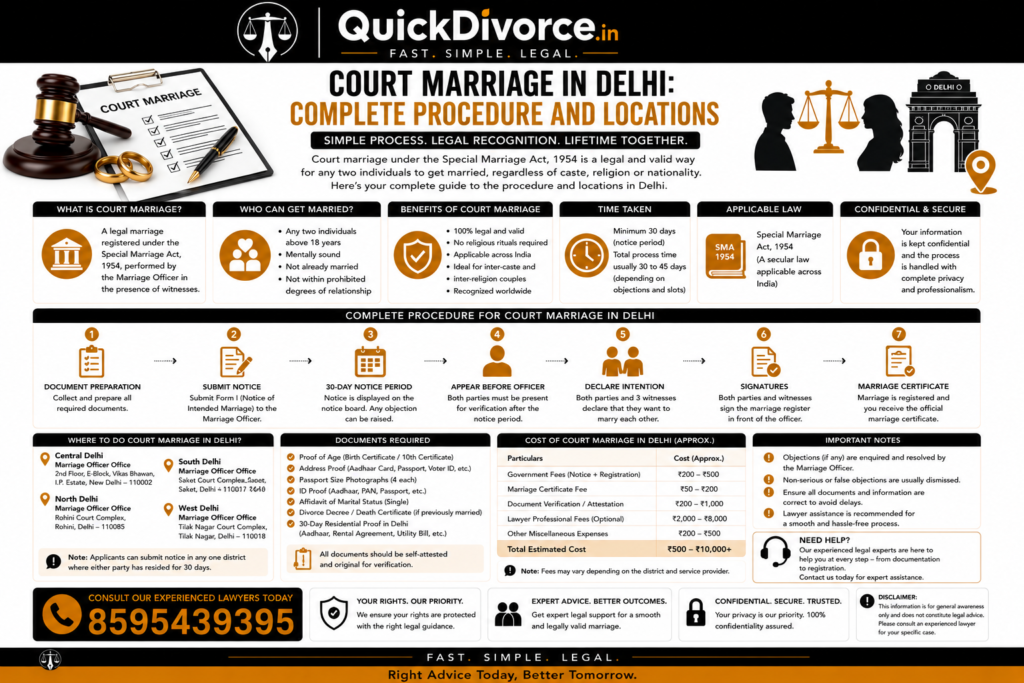
Step-by-Step Procedure for Court Marriage in Delhi
Under the Hindu Marriage Act, 1955 (Faster Route, Same-Religion Couples)
Step 1 — Complete the Marriage Ceremony First The marriage must be solemnised before registration. Couples who have already had a traditional wedding ceremony can proceed to Step 2 directly. Those who haven’t yet had a ceremony can visit an Arya Samaj Mandir in Delhi — many offer formalised, Vedic ceremony services followed by a certificate on the same day, which is then used for the SDM registration process.
Step 2 — Apply Online Through the e-District Portal Applications are generally handled through the Delhi e-District portal. Documents are uploaded, and an appointment is booked. Both parties usually appear with witnesses. Originals may be checked, and forms are signed before the Marriage Officer or Registrar.
Visit edistrict.delhigovt.nic.in, create an account using your mobile number and Aadhaar details, navigate to the “Registration of Marriages” section under Revenue Services, select “Hindu Marriage Act,” and choose your district.
In 2026, the Delhi e-District portal is integrated with DigiLocker. Use “Issued” documents for your application instead of manual uploads; this reduces physical verification scrutiny at the SDM office and can speed up your approval by 30%.
Step 3 — Upload Documents and Book SDM Appointment Upload all required documents in PDF or JPG/JPEG format as per the portal’s specifications. On successful upload, select an available appointment date and time slot at the chosen SDM office.
Step 4 — Appear at the SDM Office on the Appointed Date Verification of all the documents is carried out on the date of application and a day is fixed and communicated to the parties for registration. On the said day, both parties, along with a Gazetted Officer who attended their marriage, need to be present before the SDM. The Certificate is issued on the same day.
Both spouses, along with two witnesses, must be present at the SDM office between 9:30 a.m. and 1:00 p.m. on the scheduled working day with all original documents for verification.
Step 5 — Certificate Issued After verification and signing of the marriage register before the Marriage Officer, the marriage certificate is processed and — for standard registration — typically available for download within 7–15 working days.
Under the Special Marriage Act, 1954 (All Couples, Including Inter-Religion)
Step 1 — Apply Online and File the Notice of Intended Marriage Access the e-District portal, select “Special Marriage Act” under the Registration of Marriages section, and fill in both parties’ details. Both parties are required to be present after submission of documents for issuance of public notice inviting objections. One copy of notice is pasted on the notice board of the office and copy of the notice is sent by registered post to both parties as per address given by them.
Step 2 — 30-Day Notice Period Once the notice is filed, it is publicly displayed on the SDM office notice board. The 30-day clock begins on the date of filing. During this period:
- Any person may raise a formal, written objection — but only on specific legal grounds listed in Section 4 of the Act
- Objections based on caste, religion, or family disapproval have absolutely no legal standing and must be rejected by the Marriage Officer
- If a valid legal objection is filed, the Marriage Officer conducts an inquiry; if the objection is found baseless, the marriage proceeds
Step 3 — Solemnisation After 30 Days Registration is done 30 days after the date of notice after deciding any objection that may have been received during that period by the SDM. Both parties along with three witnesses are required to be present on the date of registration.
Both spouses and all three witnesses appear before the Marriage Officer on the scheduled solemnisation date. A declaration is read out and signed by both parties and the witnesses. The marriage is formally solemnised at this point — no religious ceremony required.
Step 4 — Marriage Certificate Issued After solemnisation, the marriage certificate is processed and made available for download through the e-District portal.
Tatkal (Expedited) Option in Delhi
Delhi’s e-District portal offers a tatkal processing option for marriage registration under the Hindu Marriage Act only. Under the tatkal route:
- The marriage certificate can be issued as fast as within 24 hours of the SDM appointment
- An additional tatkal processing fee applies, typically a few hundred rupees over and above the standard ₹100 registration fee
- All standard documents must still be in order — there is no relaxation in document requirements under tatkal
Same-day court marriage is NOT legally possible under the Special Marriage Act (mandatory 30-day notice). However, under the Hindu Marriage Act, eligible couples (Hindu/Sikh/Buddhist/Jain) can complete registration in 7–10 days — with no notice period.
Anyone claiming to offer same-day court marriage under the Special Marriage Act is either misrepresenting the process or proposing something legally invalid. The 30-day notice period is a statutory requirement that no payment, no advocate, and no court order can bypass under normal circumstances.
Fees for Court Marriage in Delhi (2026)
| Item | Amount |
|---|---|
| Hindu Marriage Act registration fee | ₹100 |
| Special Marriage Act registration fee | ₹150 |
| Notice filing fee (Special Marriage Act) | ₹15 (approx.) |
| Tatkal processing (HMA only) | Additional ₹500–₹2,000 (approx.) |
| Stamp duty on affidavits | ₹50–₹200 per affidavit |
| Notarisation of affidavits | ₹300–₹500 total |
| Photocopying and photographs | ₹200–₹500 |
| Advocate assistance (if engaged) | ₹7,000–₹20,000 depending on complexity |
How to Download the Marriage Certificate After Registration in Delhi
After registration, visit edistrict.delhigovt.nic.in, click “Print/Download Certificate,” enter your application number and date of birth, and download the digitally signed PDF. This certificate is fully valid for passport, visa, and all government purposes.
An important administrative detail specific to Delhi: Delhi Government does not provide any hard copy of approved marriage registration. Clients have to download the certificate and take a printout of the same.
Delhi now issues QR-coded certificates that can be verified by foreign embassies and banks. For couples planning international travel or immigration, this digital verification capability significantly streamlines the apostille and verification process with foreign authorities.
For apostille processing, the Delhi e-District portal now links with the MEA’s e-Sanad platform, which can help make Apostille processing quicker for Hague Convention countries.
Practical Tips That Make a Real Difference
1. Verify your SDM jurisdiction before filing Filing in the wrong SDM office — one where neither party meets the 30-day residency requirement — is one of the most common causes of application rejection. Confirm which SDM office covers your residential colony before applying, using the Revenue Department’s jurisdiction lookup at revenue.delhi.gov.in.
2. Match names across all documents before uploading Name spelling inconsistencies between Aadhaar, passport, and the application form are the most frequent reason for technical rejection at the document upload stage. The Passport Rule: Check that the name on your passport and the name on your marriage licence are the same. Spelling mistakes of any size can cause issues down the road, especially when it comes to spouse visas.
3. Use DigiLocker-issued documents where possible In 2026, the Delhi e-District portal is integrated with DigiLocker. Use “Issued” documents for your application instead of manual uploads; this reduces physical verification scrutiny at the SDM office and can speed up your approval by 30%.
4. Keep 3–4 photocopies of every document SDM offices routinely require multiple copies of each document — bringing insufficient copies is a common reason couples are turned away and asked to return on a different date.
5. Carry originals on the appointment date Scanned uploads are for the online application stage. On the physical SDM appointment date, originals of all documents must be brought for verification. Forgotten originals on the appointment date typically mean rescheduling.
6. Plan for the notice period if you’re under the SMA For Special Marriage Act applications, treat the 30-day notice period as a fixed, non-negotiable part of your timeline. Do not book a wedding venue, send invitations, or plan travel contingent on the marriage being solemnised before the 30-day period has genuinely lapsed.
Getting Police Protection for Court Marriages in Delhi
For inter-caste or inter-religion couples who face genuine threats from family or community during the court marriage process, the Delhi Police and Delhi High Court have established mechanisms for protective intervention:
- A written complaint to the relevant Deputy Commissioner of Police (DCP) or the Station House Officer (SHO) of the local police station, citing specific threats received, can trigger protective police presence during the notice period and on the solemnisation date
- A writ petition before the Delhi High Court under Articles 226 and 21 of the Constitution, seeking direction to the police to provide protection, is a fast and effective route — courts have issued such orders frequently and consistently in favour of consenting adults exercising their constitutional right to marry
- The Delhi High Court Legal Services Committee provides free legal assistance for such writ petitions to eligible applicants
Common Mistakes That Delay Court Marriage in Delhi
- Filing in the wrong district — one party must genuinely have resided in the relevant district for 30 days; choosing an office by convenience without meeting this requirement leads to rejection
- Uploading documents in the wrong format — the portal accepts PDF and JPG/JPEG only; other formats trigger automatic rejection
- Notarising affidavits but not in the prescribed format — the SDM office has a specific affidavit format requirement; generic affidavits are often rejected even if notarised
- Missing witnesses on the appointment date — witnesses must be physically present with original ID; a witness who sends their ID via photo or is unavailable on the day cannot be substituted at the last minute
- Not downloading the certificate promptly after approval — given that Delhi does not issue physical copies, delays in downloading the digital certificate can cause complications if the portal experiences technical downtime
- Assuming tatkal means same-day under the SMA — tatkal applies only to the Hindu Marriage Act route; no expedited option exists under the Special Marriage Act’s 30-day notice framework
How QuickDivorce.in Can Help
Court marriage in Delhi is straightforward in theory and sometimes frustrating in practice — particularly around document formatting for the portal, SDM office appointment availability, and navigating the 30-day notice period for inter-religion couples who also need protection coordination. At QuickDivorce.in, our Delhi-based family law team helps couples through every stage of the court marriage process — from confirming the right SDM jurisdiction and preparing correctly formatted documents, to monitoring the notice period, coordinating witnesses, and downloading the QR-coded marriage certificate — so your registration proceeds without avoidable delays or rejections.
Frequently Asked Questions (FAQs)
1. What is the procedure for court marriage in Delhi?
The procedure generally involves verifying eligibility, submitting the notice of intended marriage to the Marriage Officer, completing the required documentation, observing the statutory process under the applicable law, appearing before the Marriage Officer with witnesses, and obtaining the marriage certificate after successful solemnization or registration.
2. Where can couples apply for court marriage in Delhi?
Couples can apply for court marriage at the office of the Sub-Divisional Magistrate (SDM) or the designated Marriage Officer having jurisdiction over the area where at least one of the parties has resided for the required period.
3. What documents are required for court marriage in Delhi?
The required documents generally include identity proof, age proof, address proof, passport-size photographs, affidavits, and proof of marital status, such as a divorce decree or death certificate where applicable. Additional documents may be required depending on the circumstances of the case.
4. How long does the court marriage process take in Delhi?
The timeline depends on the applicable law and completion of all legal formalities. For marriages under the Special Marriage Act, the statutory notice period generally applies before solemnization can take place.
5. Can inter-caste and inter-religion couples have a court marriage in Delhi?
Yes. Eligible inter-caste and inter-religion couples can legally marry in Delhi under the Special Marriage Act, 1954, provided they satisfy the legal requirements and complete the prescribed procedure.
6. Is the presence of witnesses mandatory for court marriage in Delhi?
Yes. Witnesses are required at the time of solemnization or registration. They must be adults and provide valid identity proof as required by the Marriage Officer.
7. Is hiring a lawyer necessary for court marriage in Delhi?
No. Hiring a lawyer is not mandatory. Couples can complete the process themselves by following the prescribed legal procedure and submitting the required documents. However, many couples choose legal assistance to ensure that the documentation and formalities are completed correctly.
Conclusion
Court marriage in Delhi in 2026 is a well-structured, largely digital process — but one where procedural precision matters considerably. The choice between the Hindu Marriage Act and Special Marriage Act routes defines your timeline, your document requirements, and whether a tatkal option is available. The specific SDM office you file with determines your jurisdictional validity. And the quality of your document preparation determines whether your SDM appointment proceeds smoothly or requires a return visit.
For couples who approach it with clear information and correctly prepared documents, court marriage in Delhi can be completed efficiently, legally, and without the stress that poor preparation routinely creates. For those who need additional support — particularly inter-caste or inter-religion couples navigating the notice period with family opposition — knowing your legal rights and having professional guidance on hand makes the difference between a smooth registration and weeks of unnecessary delay.
For end-to-end court marriage assistance in Delhi — including document preparation, SDM appointment coordination, notice period monitoring, and certificate download — connect with the family law team at QuickDivorce.in.
Get Expert Advice for Court Marriage in Delhi
🟡QuickDivorce offers trusted online legal services across India, including mutual divorce, contested divorce, child custody, alimony, marriage registration, and expert family law consultation.
👉 Mutual Consent Divorce
👉 Contested Divorce Filing
👉 Child Custody and Maintenance
👉 Matrimonial Property Settlement
👉 NRI Divorce Services
👉 Alimony and Maintenance
🟡 Protect Your Rights
👉 Domestic Violence Legal Support
👉 Stridhan Recovery
🟡For other Legal and Trademark related services visit
👉 Money Recovery Cases
👉 Property Disputes
👉 Business & Licence Registrations
📞 Call Now: +91 8595439395
🕐 Free Consultation: Monday to Saturday, 10 AM to 6 PM

Adv. Manish Kashyap is a Family Law & Divorce Lawyer with extensive experience in Mutual & Contested Divorce, NRI Divorce, Child Custody, Alimony, Domestic Violence, Judicial Separation, and Family Court matters, providing professional legal guidance to clients.

