

Views: 3
Marital rape remains one of the most contested and unresolved questions in Indian criminal and constitutional law. This article traces every significant High Court and Supreme Court judgement on the subject — examining what courts have held, what remains undecided, and what legal protections women can pursue today.
Table of Contents
- 1 01 The Legal Position: Overview
- 2 02 Exception 2 to Section 375 IPC — The Marital Rape Exception
- 3 03 Supreme Court: Independent Thought v. Union of India (2017)
- 4 04 Delhi High Court Split Verdict (2022)
- 5 05 Other High Court Judgements
- 6 06 Supreme Court: The Pending Reference
- 7 07 Related Protection: Domestic Violence Act 2005
- 8 08 Right to Refuse and Divorce Rights
- 9 09 Timeline of Key Developments
- 10 10 Practical Legal Options for Women Today
01 The Legal Position: Overview
Under Indian law, sexual intercourse by a man with his own wife is expressly excluded from the definition of rape under Section 375 of the Indian Penal Code (IPC) — now re-enacted as Section 63 of the Bharatiya Nyaya Sanhita 2023 (BNS). This is known as the marital rape exception.
This exception traces its origin to the 18th century doctrine attributed to Sir Matthew Hale, Chief Justice of England, who wrote that a husband cannot be guilty of rape upon his wife because by their mutual matrimonial consent and contract, the wife gives irrevocable consent. This doctrine — widely rejected internationally — continues to have formal legal existence in India.
Current Legal PositionForced sexual intercourse by a husband upon his wife who is above 18 years of age is not an offence of rape under the BNS 2023 or the IPC 1860. However, it may constitute cruelty under Section 498A IPC, an act of domestic violence under the Protection of Women from Domestic Violence Act 2005, and may constitute a ground for divorce on grounds of cruelty.
02 Exception 2 to Section 375 IPC — The Marital Rape Exception
Section 375 of the IPC defined rape and contained Exception 2 which stated: “Sexual intercourse or sexual acts by a man with his own wife, the wife not being under fifteen years of age, is not rape.” The age was subsequently raised to eighteen years by the Supreme Court in 2017.
The Bharatiya Nyaya Sanhita 2023, which replaced the IPC, retains the marital rape exception. Section 63 BNS contains the same exception — a husband cannot be prosecuted for rape upon his wife who is above eighteen years of age.
Constitutional ChallengeThe marital rape exception has been challenged as violating Articles 14 (equality), 19 (freedom), and 21 (right to life and personal liberty including bodily autonomy) of the Constitution of India. Courts have been divided on whether the exception is constitutionally valid.
03 Supreme Court: Independent Thought v. Union of India (2017)
Supreme Court of India
Independent Thought v. Union of India & Anr.
Writ Petition (Civil) No. 382 of 2013 — Decided: 11 October 2017
A two-judge bench of the Supreme Court addressed whether Exception 2 to Section 375 IPC was constitutionally valid insofar as it permitted a husband to have sexual intercourse with a wife between the ages of fifteen and eighteen years — i.e., a child wife — without it constituting rape.
The Court held that Exception 2 to Section 375 IPC was partially unconstitutional and read it down to exclude child wives. The Court held that a man who has sexual intercourse with his wife below eighteen years of age commits rape — regardless of whether they are married.
However, the Court expressly did not address the position of adult wives — wives above eighteen years of age — and declined to strike down the marital rape exception in its entirety. The question of adult marital rape was left open.
Landmark — Child Marriage Addressed Adult Marital Rape — Not Decided
This judgement is significant because it established that marital status cannot override a child’s right to bodily integrity. The Court reasoned from the POCSO Act 2012 and the Convention on the Rights of the Child — holding that a child wife has the same right to protection as any other child.
04 Delhi High Court Split Verdict (2022)
Delhi High Court — Division Bench
RIT Foundation & Ors. v. Union of India & Ors.
W.P.(C) No. 284/2015 — Decided: 11 May 2022
A division bench of the Delhi High Court — comprising Justice Rajiv Shakdher and Justice C. Hari Shankar — delivered a split verdict on a challenge to the marital rape exception. The two judges disagreed fundamentally on the constitutional validity of Exception 2 to Section 375 IPC.
Justice Rajiv Shakdher — Struck down the marital rape exception as unconstitutional. His Lordship held that:
- The exception violates Article 14 (right to equality) because it creates an arbitrary and irrational classification between married and unmarried women
- The exception violates Article 21 (right to life and personal liberty) because it negates a married woman’s right to bodily autonomy, sexual autonomy and dignity
- Marriage does not result in a woman’s perpetual consent to sexual intercourse
- The exception is manifestly arbitrary and must be struck down
Justice C. Hari Shankar — Upheld the marital rape exception as constitutionally valid. His Lordship held that:
- Marriage is a unique and legally recognised institution that creates a different legal relationship between the parties
- The legislature — not the courts — is the appropriate forum to decide whether to criminalise marital rape
- The exception is a matter of legislative policy and cannot be struck down simply because it is contrary to one view of morality
- Existing remedies — Section 498A, the Domestic Violence Act — are adequate for marital sexual violence
Split verdict — Referred to Supreme Court
“A woman does not lose her right to bodily autonomy upon marriage. The law cannot proceed on the basis that a husband has an irrevocable licence to his wife’s body.”
— Justice Rajiv Shakdher, Delhi High Court, 2022
Because the two judges disagreed, the matter was referred to the Supreme Court. No order striking down or upholding the exception was operative following the split verdict.
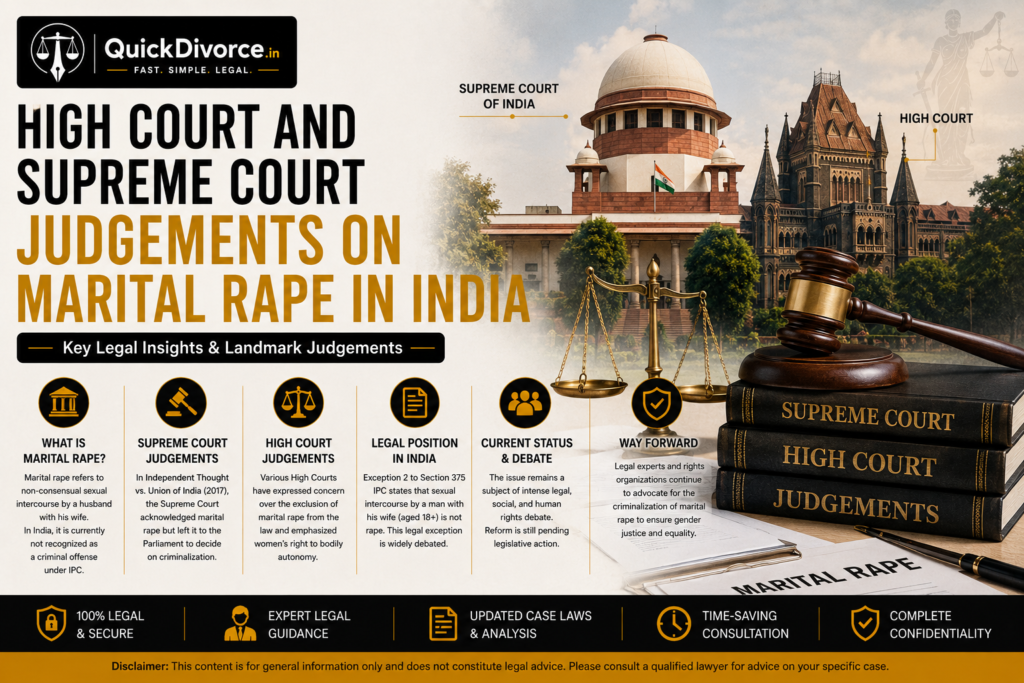
05 Other High Court Judgements
Karnataka High Court (2022): Husband can be prosecuted
Karnataka High Court
State of Karnataka v. Hrishikesh Sahoo
Criminal Petition No. 5297/2021 — Decided: 23 March 2022
In a significant ruling, the Karnataka High Court dismissed a husband’s petition seeking to quash a rape complaint filed by his wife. The husband argued that the marital rape exception under Section 375 IPC protected him from prosecution.
The Karnataka High Court rejected this argument and held that the marital rape exception is unconstitutional and a husband can be prosecuted for rape against his wife. The Court observed that a wife’s consent is not irrevocably given upon marriage and a husband has no right to forcibly subject his wife to sexual intercourse.
The Court’s order upholding the wife’s right to prosecute her husband was stayed by the Supreme Court pending the reference before it.
Exception held unconstitutional — Stayed by SC
Chhattisgarh High Court: Forced intercourse is cruelty
Chhattisgarh High Court
Nimeshbhai Bharatbhai Desai v. State of Gujarat
Criminal Revision — Decided: 2018
The Chhattisgarh High Court held that although marital rape is not an offence under Section 375 IPC, a husband who forces sexual intercourse upon his wife against her will commits cruelty under Section 498A IPC. The Court held that forcing a wife to engage in unnatural sex acts and treating her as an object for sexual pleasure without consent constitutes mental and physical cruelty.
This judgement is significant because it provides a criminal remedy — Section 498A — for forced intercourse within marriage even where the marital rape exception operates.
Forced intercourse = Cruelty under 498A
Gujarat High Court: Marital rape as ground for divorce
Gujarat High Court
Samar Ghosh v. Jaya Ghosh (applying the principle)
Multiple matrimonial cases — Ongoing
Several Gujarat High Court decisions have confirmed that forced sexual intercourse by a husband upon his wife — while not constituting the crime of rape — constitutes cruelty within the meaning of Section 13(1)(ia) of the Hindu Marriage Act 1955 and is a ground for divorce.
Courts have consistently held that a wife is entitled to divorce where the husband has subjected her to sexual acts without her consent, treated her as a means of sexual gratification without regard to her wishes, or engaged in perverse sexual practices despite her objection.
Ground for Divorce — Cruelty Established
Madhya Pradesh High Court: Penetration against will is cruelty
Madhya Pradesh High Court
Smt. Shyamlata v. Rajendra Prasad
Matrimonial case — First appeal
The Madhya Pradesh High Court affirmed that forced sexual intercourse and unnatural sexual acts by a husband against his wife’s will constitute cruelty — entitling the wife to divorce on grounds of cruelty under the Hindu Marriage Act. The Court held that no woman is obliged to submit to her husband’s sexual demands against her will and that repeated violations of her sexual autonomy amount to mental and physical cruelty.
Divorce on Cruelty Grounds — Upheld
06 Supreme Court: The Pending Reference
Supreme Court of India — Pending
Consolidated petitions on marital rape exception (including Delhi HC reference)
SLP (Crl) arising from Karnataka HC & Delhi HC split verdict — Pending as of 2026
The Supreme Court of India has before it multiple petitions challenging the marital rape exception — including the reference arising from the Delhi High Court split verdict and the special leave petition against the Karnataka High Court order.
A bench of the Supreme Court has been hearing these matters. The Union Government has at various stages taken differing positions — initially suggesting the matter should be left to Parliament, and later filing affidavits indicating a consultative process was underway.
As of June 2026, the Supreme Court has not delivered a final verdict on the constitutional validity of the marital rape exception. The matter continues to be listed before a Constitution Bench.
The outcome of this case will determine — for the first time definitively — whether a husband can be criminally prosecuted for rape upon his adult wife in India.
Final judgement awaited — Constitution Bench
Pending before SCConstitution BenchStatus: 2026
07 Related Protection: Domestic Violence Act 2005
While the criminal law position remains unresolved, the Protection of Women from Domestic Violence Act 2005 (PWDVA) provides civil remedies that explicitly cover sexual violence within marriage.
What the Domestic Violence Act providesSection 3 of the PWDVA defines domestic violence to include “sexual abuse” — which means any conduct of a sexual nature that abuses, humiliates, degrades or violates the dignity of the woman. This explicitly covers forced sexual intercourse within marriage. A wife can obtain protection orders, residence orders and monetary relief under the PWDVA even without a criminal prosecution for rape.
Several High Courts have confirmed that a husband’s forced sexual conduct towards his wife — including forced sexual intercourse — constitutes “sexual abuse” under the PWDVA and entitles the wife to civil remedies including protection orders and compensation.
08 Right to Refuse and Divorce Rights
Courts across India have consistently recognised that a wife’s right to refuse sexual intercourse is legally cognisable and that a husband’s violation of that right has legal consequences — even where it does not constitute criminal rape.
A wife who has been subjected to forced sexual intercourse within marriage can pursue:
Ground 1 — Divorce
Petition for divorce on grounds of cruelty under Section 13(1)(ia) of the Hindu Marriage Act 1955 — with forced sexual intercourse as a central act of cruelty. Courts have granted divorce on this basis consistently.
Ground 2 — Criminal complaint
Complaint under Section 498A IPC (cruelty to wife) where the forced intercourse forms part of a pattern of cruelty. The Chhattisgarh, Madhya Pradesh and other High Courts have confirmed this is valid.
Ground 3 — Domestic Violence Act
Application for protection orders, residence orders and compensation under the PWDVA 2005 — on the basis of sexual abuse within marriage. Available without proving criminal rape.
Ground 4 — Maintenance
Claim for maintenance under Section 125 CrPC / Section 144 BNSS — where the husband’s conduct (including sexual abuse) amounts to cruelty making it unreasonable for the wife to live with him.
Ground 5 — Criminal rape (post-SC verdict)
If the Supreme Court strikes down the marital rape exception — a direct complaint of rape under Section 63 BNS / Section 375 IPC will become available. This ground currently remains unavailable for adult wives in most jurisdictions pending the SC ruling.
09 Timeline of Key Developments
1860
Indian Penal Code enacted — Exception 2 to Section 375 codifies the marital rape exception, exempting husbands from rape prosecution.
2000
Law Commission of India (172nd Report) recommends abolition of the marital rape exception. The recommendation is not acted upon by Parliament.
2013
Post-Nirbhaya Criminal Law Amendment — Justice Verma Committee recommends abolishing the marital rape exception. Parliament amends criminal law but retains the marital rape exception — raising age of wife from 15 to 16 (later to 18 by SC).
2017
Supreme Court in Independent Thought v. Union of India strikes down the exception for child wives (below 18) — but expressly declines to address adult marital rape.
2022 (March)
Karnataka High Court holds the marital rape exception is unconstitutional — stays operation pending Supreme Court.
2022 (May)
Delhi High Court delivers split verdict — one judge strikes down the exception, one upholds it. Matter referred to Supreme Court.
2023
Bharatiya Nyaya Sanhita 2023 replaces IPC — the marital rape exception is retained in the new code (Section 63 BNS), notwithstanding the pending Supreme Court challenge.
2026
Supreme Court reference continues to be heard — final verdict awaited. India remains among a minority of countries that have not criminalised marital rape.
10 Practical Legal Options for Women Today
While the Supreme Court has not yet definitively resolved the marital rape question — women who have experienced sexual violence within marriage are not without legal remedies. The following options are available today:
File for divorce on grounds of crueltyForced sexual intercourse is consistently recognised by High Courts as cruelty under the Hindu Marriage Act, Special Marriage Act and other personal laws. A wife is entitled to seek divorce on this basis — and courts have granted it. QuickDivorce.in assists with contested divorce petitions based on sexual cruelty.
Domestic Violence Act complaintFile a complaint under the Protection of Women from Domestic Violence Act 2005. Sexual abuse — including forced intercourse — is expressly covered. You can obtain protection orders, residence orders and monetary relief without a criminal prosecution.
Section 498A — Cruelty to wifeWhere the forced sexual conduct is part of a pattern of cruelty — a criminal complaint under Section 498A IPC / Section 85 BNS is available. Several High Courts have confirmed that forced intercourse forming part of cruelty is prosecutable under this provision.
Maintenance and interim reliefA wife who has left the matrimonial home due to sexual violence can claim maintenance under Section 125 CrPC / Section 144 BNSS. Courts grant maintenance where the husband’s conduct makes it unreasonable for the wife to live with him — and sexual abuse within marriage falls squarely within this.
Need Legal Help?
QuickDivorce.in provides complete legal services for women facing domestic violence, sexual abuse within marriage, divorce, maintenance, stridhan recovery, and all matrimonial matters — across all jurisdictions in India.
Our specialists assist with contested divorce petitions (including cruelty-based), domestic violence complaints, maintenance claims, child custody, property settlements, MoU drafting, and court representation.
Mutual Consent Divorce
Contested Divorce Filing
Domestic Violence Legal Support
Alimony and Maintenance
Child Custody and Maintenance
Stridhan Recovery
Matrimonial Property Settlement
NRI Divorce Services
Also visit LegalTax.in for Money Recovery Cases, Property Disputes, and Business & Licence Registrations. Visit Business24hub for IT services.
Call now: +91 8595439395 ·
Mon–Sat, 10 AM–6 PM · Free Consultation

Adv. Manish Kashyap is a Family Law & Divorce Lawyer with extensive experience in Mutual & Contested Divorce, NRI Divorce, Child Custody, Alimony, Domestic Violence, Judicial Separation, and Family Court matters, providing professional legal guidance to clients.

