

Views: 32
Table of Contents
- 1 Quick Summary
- 2 📌 What Are Court Filing Requirements for Divorce in India?
- 3 ⚠️ Why Getting Your Divorce Documents Right Matters
- 4 ⚖️ Types of Divorce and Their Filing Requirements in India
- 5 ✅ Complete Document Checklist: Mutual Consent Divorce
- 6 ✅ Complete Document Checklist: Contested Divorce
- 7 💰 Court Fees for Filing Divorce in India
- 8 🏛️ Where to File Your Divorce Petition in India
- 9 📋 Step by Step Court Filing Process for Divorce in India
- 10 🚫 Common Mistakes That Get Divorce Petitions Rejected
- 11 🗺️ State Wise Filing Requirements: Key Differences
- 12 🌟 How Quick Divorce Handles All Court Filing Requirements for You
- 13 💰 Cost Breakdown: Filing Divorce in India
- 14 ❓ Frequently Asked Questions (FAQs)
- 15 🎯 Who Needs This Guide Right Now?
- 16 ✅ Final Recommendation
- 17 Need Help With Filing for any Legal Sevice in India ?
Quick Summary
Court filing requirements for divorce documents in India vary depending on your type of divorce, your personal law, and which state you are filing in. Getting it wrong means rejection, delays and wasted money.
Here is what you need to know upfront:
- 📄 Mutual Consent Divorce requires joint petition, marriage certificate, address proofs, photographs and identity documents
- ⚖️ Contested Divorce requires all of the above plus evidence supporting your specific grounds for divorce
- 🏛️ Filing location matters — wrong court means your petition gets returned
- 💰 Court fees range from ₹200 to ₹2,000 depending on state and court
- ✅ Quick Divorce handles all document preparation and court filing for you starting at ₹4,999
One missing document or incorrectly drafted petition can set your case back by months. This guide tells you exactly what you need.
📌 What Are Court Filing Requirements for Divorce in India?
Court filing requirements for divorce documents in India refer to the complete set of documents, formats, fees and procedural requirements that must be fulfilled before a family court will accept and register your divorce petition.
Every divorce in India goes through a family court. There is no administrative or online divorce that bypasses the court entirely. What online platforms like Quick Divorce do is handle all the preparation, drafting and filing on your behalf — but the final legal proceedings always involve the court.
Understanding court filing requirements for divorce documents in India matters because:
- An incomplete petition is returned by the court and the process restarts
- Incorrectly drafted petitions can be challenged by the other party
- Filing in the wrong court wastes months before the error is caught
- Missing supporting documents weaken your case from Day 1
The good news: When you use Quick Divorce, every one of these requirements is handled by experienced family law professionals who know exactly what each court in each city requires.
⚠️ Why Getting Your Divorce Documents Right Matters
Family courts in India receive hundreds of petitions every week. Court staff do a preliminary check on every petition before it is registered. If anything is missing, incorrect or improperly formatted, the petition is returned with objections.
This is not a minor inconvenience. A returned petition means:
- ❌ Your filing date is lost — the clock restarts
- ❌ You must correct and refile — additional time and cost
- ❌ The other party gains time advantage
- ❌ In custody or maintenance matters, delay directly harms your position
Beyond rejection, poorly prepared documents can:
- Give the opposing lawyer grounds to challenge the petition
- Create factual inconsistencies that damage your credibility with the judge
- Cause procedural complications that extend the case by months or years
Getting court filing requirements for divorce documents in India right the first time is not optional. It is essential.
⚖️ Types of Divorce and Their Filing Requirements in India
Before understanding specific document requirements, it is important to know which type of divorce you are filing — because each has different court filing requirements.
Mutual Consent Divorce
Both spouses agree to divorce. Filed under:
- Section 13B of the Hindu Marriage Act 1955 (for Hindus, Buddhists, Sikhs, Jains)
- Section 28 of the Special Marriage Act 1954 (for civil or inter religion marriages)
- Section 10A of the Indian Divorce Act 1869 (for Christians)
This is the simpler filing. Both parties sign the joint petition together.
Contested Divorce
One spouse files against the other on specific legal grounds. Filed under:
- Section 13 of the Hindu Marriage Act 1955
- Section 27 of the Special Marriage Act 1954
- Section 10 of the Indian Divorce Act 1869
- Dissolution of Muslim Marriages Act 1939 (for Muslim women)
This requires stronger documentation including evidence supporting the grounds claimed.
Divorce by Mutual Conversion (Less Common)
Where one party has converted to another religion. Specific documentation of conversion required.
✅ Complete Document Checklist: Mutual Consent Divorce
These are the standard court filing requirements for divorce documents in India for a mutual consent divorce petition:
Mandatory Documents (Both Parties)
Identity and Address Proof
- 🪪 Aadhaar Card of both husband and wife (self attested copies)
- 🗂️ PAN Card of both parties
- 🏠 Address proof of current residence — utility bill, rental agreement or bank statement (not older than 3 months)
Marriage Documents
- 📜 Original or certified copy of Marriage Certificate
- 📸 Wedding photographs (minimum 2 to 3 photographs showing both parties at the wedding)
- 💒 If registered marriage — copy of registration entry from marriage registrar
Residence and Separation Proof
- 📄 Proof of last matrimonial address (where both lived together)
- 📝 Proof that parties have been living separately for at least 1 year (required under Section 13B Hindu Marriage Act)
Photographs
- 📷 Recent passport size photographs of both parties (minimum 4 each)
The Joint Petition Itself
- 📋 Properly drafted joint petition under the applicable section of law
- ✍️ Signed by both parties
- 📑 Verification affidavit signed by both parties before a Notary or Magistrate
Supporting Affidavits
- Statement of assets and liabilities (required in many courts)
- Affidavit confirming no coercion or undue influence in consenting to divorce
Additional Documents (If Applicable)
- 👶 Birth certificate of children (if minor children are involved)
- 📃 Custody agreement signed by both parties (if children involved)
- 🏘️ Property documents if a settlement of jointly held property is part of the petition
- 💼 Income proof of both parties if maintenance is being agreed upon
- 🌍 Passport copies if either party is an NRI
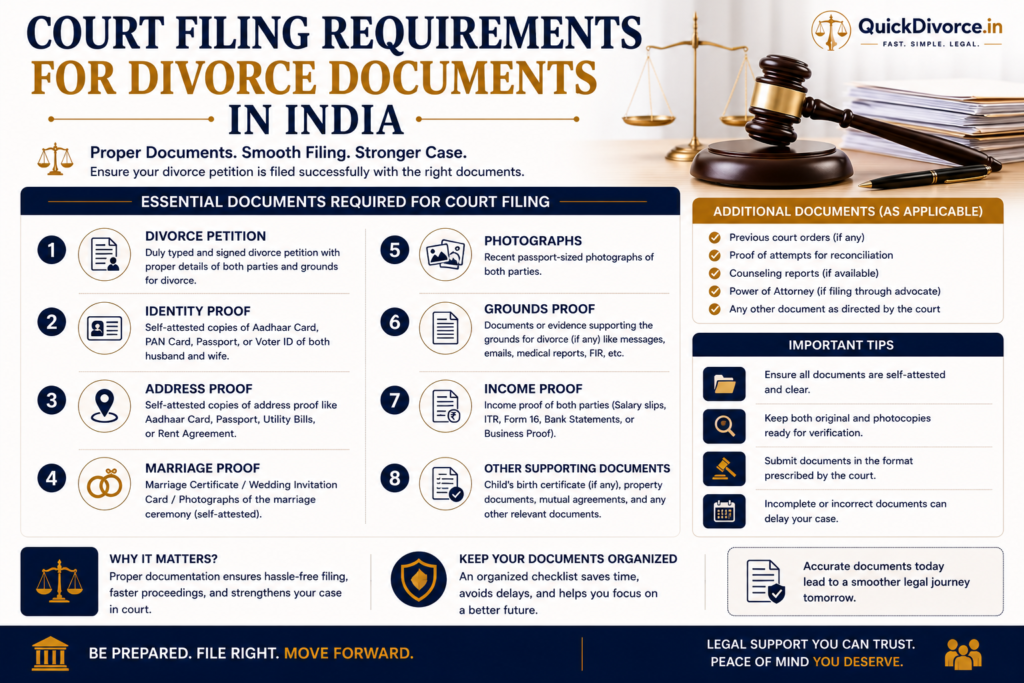
✅ Complete Document Checklist: Contested Divorce
Court filing requirements for divorce documents in India are more extensive for contested divorce because you must support your claimed grounds with evidence.
All Documents Required for Mutual Divorce (listed above) PLUS:
Grounds Specific Evidence
For Cruelty (Physical or Mental):
- 🏥 Medical reports, hospital records, photographs of injuries (for physical cruelty)
- 📱 Screenshots of threatening or abusive messages, emails or social media posts
- 📝 Written complaints made to police or domestic violence authorities
- 👥 Affidavits of witnesses who can testify to the cruelty
For Desertion:
- 📬 Evidence of attempts to contact the spouse (messages, letters, emails)
- 📄 Proof of last known address of deserting spouse
- 🗓️ Evidence establishing the date desertion commenced (must be at least 2 years)
For Adultery:
- 📸 Photographic or documentary evidence
- 📞 Call records, message records
- 🏨 Hotel records or other evidence of cohabitation
- 👥 Witness affidavits
For Mental Disorder:
- 🏥 Medical certificates from qualified psychiatrist or psychologist
- 📋 Hospital admission records if applicable
- 👨⚕️ Expert medical opinion
For Conversion to Another Religion:
- 📄 Proof of conversion — certificate, affidavit or other documentation
For NRI Contested Divorce Additional Requirements:
- 🌍 Passport copies and visa records establishing residence
- 📜 Power of Attorney (if filing through a representative in India)
- 🏛️ Any foreign court orders or notices already issued
💰 Court Fees for Filing Divorce in India
Court fees are a mandatory part of court filing requirements for divorce documents in India. They vary by state and court level.
| State or Court | Mutual Divorce Court Fee | Contested Divorce Court Fee |
|---|---|---|
| Delhi Family Court | ₹200 to ₹500 | ₹500 to ₹2,000 |
| Maharashtra (Mumbai) | ₹300 to ₹600 | ₹600 to ₹2,000 |
| Karnataka (Bangalore) | ₹200 to ₹500 | ₹500 to ₹1,500 |
| Tamil Nadu (Chennai) | ₹200 to ₹500 | ₹500 to ₹1,500 |
| Uttar Pradesh | ₹200 to ₹400 | ₹400 to ₹1,500 |
| West Bengal (Kolkata) | ₹200 to ₹500 | ₹500 to ₹2,000 |
| Gujarat | ₹200 to ₹500 | ₹500 to ₹1,500 |
| Rajasthan | ₹200 to ₹400 | ₹400 to ₹1,200 |
Note: Court fees are paid via court fee stamps or demand draft as specified by each court. They are separate from lawyer fees and platform fees.
🏛️ Where to File Your Divorce Petition in India
Jurisdiction — meaning which court has the legal authority to hear your case — is one of the most critical court filing requirements for divorce documents in India. Filing in the wrong court is one of the most common and costly mistakes people make.
Under the Hindu Marriage Act 1955 (Section 19), a divorce petition can be filed in the district court (family court) of the place where:
- ✅ The marriage was solemnized
- ✅ The respondent (the other spouse) currently resides
- ✅ The parties last resided together as husband and wife
- ✅ The petitioner (the person filing) currently resides — if the respondent is living outside India or their whereabouts are unknown
Practical Examples
Example 1: Married in Jaipur, currently both living in Delhi. You can file in either Delhi or Jaipur family court. Delhi is practically easier if both parties are there.
Example 2: Wife in Mumbai, husband in the USA. Wife can file in Mumbai family court since the respondent is outside India.
Example 3: Married in Chennai, wife now in Bangalore, husband in Hyderabad. Any of the three cities potentially has jurisdiction — a lawyer must advise on the most strategically appropriate court.
Quick Divorce advises on the correct jurisdiction for your specific situation as part of their consultation and filing service. This is one of the most valuable things they do.
📋 Step by Step Court Filing Process for Divorce in India
Understanding the complete process helps you know exactly what the court filing requirements for divorce documents in India lead to.
Step 1: Document Collection and Preparation
Gather all required documents. Get certified copies of marriage certificate. Get identity and address proofs in order.
Timeline: 3 to 7 days
Step 2: Petition Drafting
The divorce petition must be drafted in the correct legal format, in the language of the court (Hindi or English depending on jurisdiction), and must contain all required factual averments.
This is where most people need professional help. A poorly drafted petition is the single most common reason for rejection or delay.
Timeline: 2 to 5 days with Quick Divorce (48 hour turnaround guaranteed)
Step 3: Notarisation and Signing
The petition and supporting affidavits must be signed by both parties (in mutual divorce) or the filing party (in contested divorce) before a Notary Public or Executive Magistrate.
Timeline: 1 to 2 days
Step 4: Court Filing
The petition, along with all supporting documents and court fee payment, is physically filed at the family court. The court stamps the petition, assigns a case number and gives a first hearing date.
Timeline: 1 day (filing itself)
Step 5: Service of Notice
In a contested divorce, the court issues notice to the other party. They must be properly served and given time to respond.
Timeline: 2 to 8 weeks depending on mode of service
Step 6: First Hearing
Both parties (or their lawyers) appear before the family court judge. The judge may record statements, attempt conciliation or refer the matter to mediation.
Timeline: 4 to 12 weeks after filing for first hearing date
Step 7: Subsequent Proceedings
Mutual divorce: Second motion hearing after the cooling off period (minimum 6 months, waivable in some courts). Final decree granted.
Contested divorce: Evidence, cross examination, arguments and judgment. Timeline of 2 to 7 years.
🚫 Common Mistakes That Get Divorce Petitions Rejected
These are the most frequent errors in court filing requirements for divorce documents in India:
❌ Incorrect jurisdiction Filing in the wrong court. The petition is returned and the process restarts from scratch.
❌ Missing or expired address proof Many courts require address proof not older than 3 months. An old utility bill gets the petition rejected.
❌ Unsigned or improperly notarised affidavits Every affidavit must be signed before a notary. Unsigned or improperly witnessed affidavits invalidate the filing.
❌ Marriage certificate not certified A photocopy of the marriage certificate is not always accepted. Many courts require a certified copy from the registrar.
❌ Petition drafted in wrong format Each court has specific formatting requirements. A petition drafted for Delhi family court may not be in the correct format for a Mumbai family court.
❌ Incomplete details in the petition Missing dates, addresses, or factual averments. Courts return petitions that are factually incomplete.
❌ Insufficient evidence for grounds (contested divorce) Filing a contested divorce without adequate supporting evidence for the claimed grounds weakens the case from the start.
❌ Wrong court fees or incorrect payment mode Paying the wrong amount or paying by cash when a demand draft is required leads to rejection.
Quick Divorce’s preparation process specifically checks for all of the above before filing. Their rejection rate is among the lowest in India.
🗺️ State Wise Filing Requirements: Key Differences
While the core court filing requirements for divorce documents in India are consistent across states, there are important state level variations:
Delhi Family courts in Delhi have a specific cover page format requirement. Petitions must mention the correct police station jurisdiction. Hindi and English both accepted.
Maharashtra Mumbai family courts require a separate vakalatnama (power of attorney to advocate) in a specific format. Court stamps must be purchased from designated vendors.
Karnataka Bangalore family courts have recently updated their filing checklist. Digital copies of documents on CD are required alongside physical copies in some courts.
Tamil Nadu Chennai family courts conduct proceedings primarily in Tamil. While English petitions are accepted, having a Tamil translation attached expedites proceedings.
Uttar Pradesh Most UP family courts conduct proceedings in Hindi. Petitions in English must be accompanied by Hindi translation.
West Bengal Kolkata family courts require an additional affidavit confirming the parties are not related within prohibited degrees of relationship.
🌟 How Quick Divorce Handles All Court Filing Requirements for You
Navigating court filing requirements for divorce documents in India is exactly what Quick Divorce was built to do.
Here is what their service includes:
Document Checklist and Guidance Quick Divorce provides you with a personalised document checklist based on your type of divorce, your state and your personal law. You know exactly what to gather.
Professional Petition Drafting Experienced family law professionals draft your petition in the correct format for your specific court — covering all required averments, in the correct language, with no missing details.
Affidavit Preparation All required affidavits are prepared and you are guided through the notarisation process — ensuring everything is correctly executed.
Jurisdiction Advice Quick Divorce confirms the correct court for your specific situation — so you never file in the wrong place.
Court Filing Quick Divorce’s team physically files your petition at the correct family court, pays the correct court fees and obtains your case number and first hearing date.
Post Filing Support Quick Divorce tracks your case, keeps you updated on hearing dates and provides ongoing support throughout the process.
Quick Divorce Services and Pricing
| Service | Price |
|---|---|
| Initial Legal Consultation | Free |
| Mutual Divorce (Documentation and Filing) | ₹4,999 |
| Mutual Divorce with Court Representation | ₹14,999 |
| NRI Divorce Service | ₹14,999 onwards |
| Contested Divorce | Custom quote |
| Name Change after Divorce | ₹1,999 onwards |
Best for: Anyone who wants all court filing requirements for divorce documents in India handled correctly, professionally and affordably — without having to navigate the process alone.
Start Your Divorce Filing with Quick Divorce →
💰 Cost Breakdown: Filing Divorce in India
| Cost Item | DIY Approach | With Quick Divorce |
|---|---|---|
| Document preparation | Time intensive, risk of errors | Included in package |
| Petition drafting | ₹3,000 to ₹15,000 (local lawyer) | Included in package |
| Notarisation | ₹200 to ₹500 | Guided, included |
| Court fees | ₹200 to ₹2,000 | Assisted, pass through cost |
| Court filing | Travel, time, multiple trips | Handled by Quick Divorce |
| Post filing tracking | Manual, uncertain | Included in service |
| Total (mutual divorce) | ₹5,000 to ₹20,000 plus significant time | ₹4,999 all inclusive |
❓ Frequently Asked Questions (FAQs)
Q1. Can I file for divorce without a lawyer in India?
Technically yes — you can file a divorce petition yourself (called filing “in person”). However, given the complexity of court filing requirements for divorce documents in India, the risk of rejection or procedural errors is very high. For mutual divorce, Quick Divorce handles the entire process affordably, making professional assistance accessible to everyone.
Q2. How long does it take for the court to accept a divorce petition after filing?
If all documents are in order, most family courts in India register a divorce petition within 1 to 3 working days of filing. The first hearing is typically scheduled 4 to 12 weeks after registration depending on the court’s workload.
Q3. What happens if my marriage was not registered — can I still file for divorce?
Yes. In India, marriage registration is not mandatory for marriage to be legally valid. An unregistered marriage can still be dissolved through the courts. However, you will need alternative evidence of marriage — wedding photographs, invitation cards, joint photographs, witness affidavits, joint bank account or joint property documents.
Q4. Can I file for divorce online in India without going to court?
The petition preparation, drafting and initial filing coordination can be done online through Quick Divorce. However, at least one physical court appearance is legally required — for the final hearing and decree. Quick Divorce minimises the number of court visits required and handles everything else remotely.
Q5. What is the cooling off period in mutual consent divorce and can it be waived?
Under Section 13B of the Hindu Marriage Act, there is a mandatory 6 month cooling off period between the first and second motion in a mutual consent divorce. The Supreme Court of India has held that this period can be waived by the court where the parties have been separated for a long time and reconciliation is clearly not possible. Quick Divorce advises on waiver applications where applicable.
Q6. My spouse is refusing to sign the joint petition. What are my options?
If your spouse refuses to participate in a mutual consent divorce, you have two options. You can file a contested divorce petition on appropriate legal grounds. Alternatively, a mediator can sometimes help an unwilling spouse understand the practical and financial benefits of mutual consent. Quick Divorce’s consultation service can advise on the best approach for your specific situation.
Q7. How many copies of the petition and documents need to be filed?
Most family courts require 3 sets of the complete petition and supporting documents — one for the court record, one for the opposing party and one for the filing party’s file. Some courts require additional sets. Quick Divorce prepares all required sets as part of their filing service.
Q8. Can an NRI file for divorce in India without coming to India?
Yes. An NRI can file for divorce in India through a lawyer acting under a Power of Attorney. The Power of Attorney must be executed abroad before the Indian Consulate or Embassy and then sent to India. Quick Divorce specialises in NRI divorce filings and handles the entire India side process.
🎯 Who Needs This Guide Right Now?
If you are about to file for divorce and want to get it right the first time → Use this checklist and let Quick Divorce handle the preparation and filing.
If your petition was already rejected and you need to refile → Quick Divorce can identify what went wrong and prepare a corrected petition.
If you are an NRI filing in India from abroad → Quick Divorce specialises in Power of Attorney based NRI filings.
If you are unsure which court to file in → A Quick Divorce consultation (₹499) will confirm the correct jurisdiction for your case.
If your spouse is uncooperative or untraceable → Quick Divorce can advise on the correct contested divorce procedure and service of notice requirements.
✅ Final Recommendation
Court filing requirements for divorce documents in India are detailed, state specific and unforgiving of errors. One wrong document, one missing affidavit or one incorrectly identified court can set your case back by months.
Quick Divorce exists precisely to make sure this never happens to you.
Their team of experienced family law professionals handles every aspect of document preparation, petition drafting, notarisation and court filing — so that your petition is accepted the first time, every time.
For ₹4,999, you get:
- ✅ Complete personalised document checklist
- ✅ Professionally drafted petition in the correct court format
- ✅ All affidavits prepared and notarisation guided
- ✅ Correct jurisdiction identified and confirmed
- ✅ Physical court filing handled
- ✅ Case number obtained and first hearing date confirmed
- ✅ Post filing tracking and updates
- ✅ Hindi and English support throughout
Do not risk rejection. Do not navigate this alone. Let Quick Divorce handle your court filing requirements from Day 1.
Start Your Divorce Filing with Quick Divorce →
Need Help With Filing for any Legal Sevice in India ?
🟡 QuickDivorce.in provides complete divorce legal services and legal consultation — settlement negotiation, alimony structuring, property division, stridhan recovery, MoU drafting, court representation, and post-decree implementation: across all jurisdictions in India.
🟡Visit LegalTax.in for other Legal and Trademark related services as 👉 Money Recovery Cases
👉 Property Disputes 👉 Business & Licence Registrations
🟡Visit Business24hub for IT services
👉 Mutual Consent Divorce at QuickDivorce.in 👉 Contested Divorce Filing 👉 Child Custody and Maintenance 👉 Matrimonial Property Settlement 👉 NRI Divorce Services 👉 Alimony and Maintenance
🟡 Protect Your Rights 👉 Domestic Violence Legal Support at QuickDivorce.in 👉 Stridhan Recovery
📞 Call Now: +91 8595439395 🕐 Free Consultation: Monday to Saturday, 10 AM to 6 PM

Adv. Manish Kashyap is a Family Law & Divorce Lawyer with extensive experience in Mutual & Contested Divorce, NRI Divorce, Child Custody, Alimony, Domestic Violence, Judicial Separation, and Family Court matters, providing professional legal guidance to clients.

