

Views: 63
What is the Cost of Court Marriage in India in 2026? Complete breakdown of government fees, stamp duty, affidavit charges, advocate fees, tatkal costs, and city-wise estimates.
Table of Contents
- 1 Introduction
- 2 Why the Cost of Court Marriage Is Often Misunderstood
- 3 Component 1: Government Registration Fee
- 4 Component 2: Certificate Issuance Fee
- 5 Component 3: Stamp Duty on Affidavits and Documents
- 6 Component 4: Affidavit Preparation and Notarisation Charges
- 7 Component 5: Documentation and Miscellaneous Costs
- 8 Component 6: Advocate or Legal Assistance Fees
- 9 Component 7: Tatkal (Expedited) Processing Fees
- 10 Component 8: Witness-Related Costs
- 11 Component 9: Protection Orders (Where Applicable)
- 12 Component 10: Foreign National Additional Costs
- 13 Total Cost of Court Marriage: Consolidated Estimates for 2026
- 14 Hidden Costs Couples Often Miss
- 15 Is the Cost of Court Marriage Lower Than a Traditional Wedding?
- 16 Free Legal Aid — Can You Get Court Marriage Assistance at No Cost?
- 17 How QuickDivorce.in Can Help
- 18 Frequently Asked Questions (FAQs)
- 19 FAQs: Cost of Court Marriage in India: All Fees Explained (2026 Guide)
- 20 Conclusion
- 21 Get Expert Advice for Marriage Certificate in India
Introduction
One of the first questions any couple considering a civil marriage asks is a perfectly reasonable one: how much is this actually going to cost? The cost of court marriage in India is one of the most frequently searched yet most poorly answered questions in family law — partly because the government fee itself is surprisingly low, and partly because the total real-world cost involves several other components that most couples don’t account for until they’re already in the middle of the process.
Here is the headline figure that surprises almost everyone: the government registration fee for a court marriage in India is as low as ₹100 under the Hindu Marriage Act and ₹150 under the Special Marriage Act. The actual cost of court marriage, however, is the sum of government fees, stamp duty, affidavit preparation, notarisation, documentation, advocate charges, witness arrangements, and — where applicable — tatkal or expedited processing fees. Depending on your city, the complexity of your situation, and whether you engage professional legal assistance, the total cost of court marriage can range from a few hundred rupees handled entirely on your own to ₹15,000–₹20,000 or more in cases with legal assistance in metro cities.
This guide breaks down every single component of the cost of court marriage in India in 2026 — government fees, documentation charges, advocate fees, city-wise estimates, and the lesser-known charges that catch couples off guard — so you can budget accurately and avoid surprises.
Why the Cost of Court Marriage Is Often Misunderstood
The confusion around the cost of court marriage arises because there is no single, consolidated fee schedule published by a central authority. The government registration fee is fixed by each state under its own rules, while additional charges — for affidavits, stamp paper, notarisation, and professional assistance — are entirely separate and vary widely depending on the service provider and location.
Additionally, many couples conflate the government fee (which covers the formal filing and registration with the Marriage Officer) with the total practical cost (which includes all the preparatory documentation, professional assistance, and follow-up steps needed to actually complete the process smoothly).
Understanding these components individually is the clearest way to arrive at an accurate total.
Component 1: Government Registration Fee
This is the fee paid directly to the Sub-Divisional Magistrate (SDM) or Marriage Officer at the time of filing the notice and registration application. It is set by the relevant state or Union Territory government and is the smallest component of the total cost of court marriage.
The registration fee is approximately ₹100 under the Hindu Marriage Act and ₹150 under the Special Marriage Act.
These are the base rates that apply in most states for standard processing. Some states charge marginally more — particularly for marriages solemnised outside the registrar’s office, or where additional administrative steps are involved. A few states also levy a separate, small fee for the notice filing itself (distinct from the registration fee) and a further fee for issuing the marriage certificate after solemnisation.
State-Wise Registration Fee Snapshot (2026)
While exact figures should always be confirmed with the relevant SDM office or state portal, the prevailing structure across major states in 2026 looks broadly as follows:
| State / UT | Hindu Marriage Act Fee | Special Marriage Act Fee |
|---|---|---|
| Delhi | ₹100 | ₹150 |
| Maharashtra | ₹100 | ₹100–₹200 |
| Uttar Pradesh | ₹100 | ₹150 |
| Karnataka | ₹100 | ₹150 |
| Tamil Nadu | ₹100 | ₹100–₹150 |
| Rajasthan | ₹100 | ₹150 |
| West Bengal | ₹100–₹200 | ₹150–₹200 |
| Assam | ₹50 (notice) + ₹200 (RTPS fee) | ₹50 (notice) + ₹200 (RTPS fee) |
These are government fees only. All other costs — documentation, professional assistance, and miscellaneous charges — are separate and discussed below.
Component 2: Certificate Issuance Fee
After the marriage is solemnised, a formal marriage certificate is issued by the Marriage Officer. In most states, there is a small, separate fee for the issuance of this certificate — typically in the range of ₹100 to ₹200. Some states bundle the certificate issuance cost within the overall registration fee, while others charge for it separately at the time of collection. If you need additional certified copies of the certificate later, a further per-copy charge generally applies.
Component 3: Stamp Duty on Affidavits and Documents
Each party to a court marriage must submit a notarised affidavit confirming their date of birth, current marital status, nationality, and that the marriage does not violate any of the eligibility conditions under Section 4 of the Special Marriage Act (or the corresponding provision of the Hindu Marriage Act). For some states’ affidavits and related documents, nominal stamp duty of ₹10 to ₹100 is charged.
These affidavits must be prepared on non-judicial stamp paper of the value prescribed by the relevant state’s Stamp Act — typically ₹10, ₹20, or ₹50 per affidavit, depending on the state. This cost applies separately to each party’s individual affidavit, so the total stamp duty across both affidavits and any other attested declarations is generally in the range of ₹50 to ₹300 in total.
Several states have transitioned to e-Stamp systems through SHCIL or authorised banks, meaning couples can purchase stamp paper online rather than visiting a licensed stamp vendor — a practical convenience that doesn’t change the cost but simplifies procurement.
Component 4: Affidavit Preparation and Notarisation Charges
The cost of having the affidavits professionally drafted and notarised before a licensed notary public is a separate expense from the stamp paper itself. The preparation and notarisation of these documents is in the range of ₹500 to ₹2,000.
This range reflects:
- Simple affidavit preparation by a notary’s assistant: ₹100–₹300 per affidavit
- Notary’s attestation fee: ₹50–₹150 per affidavit
- Charges for more detailed declarations or where professional drafting is involved: up to ₹500–₹1,000 per document
Couples who engage an advocate to handle the entire documentation process will typically find the affidavit preparation cost folded into the overall advocate fee rather than charged separately.
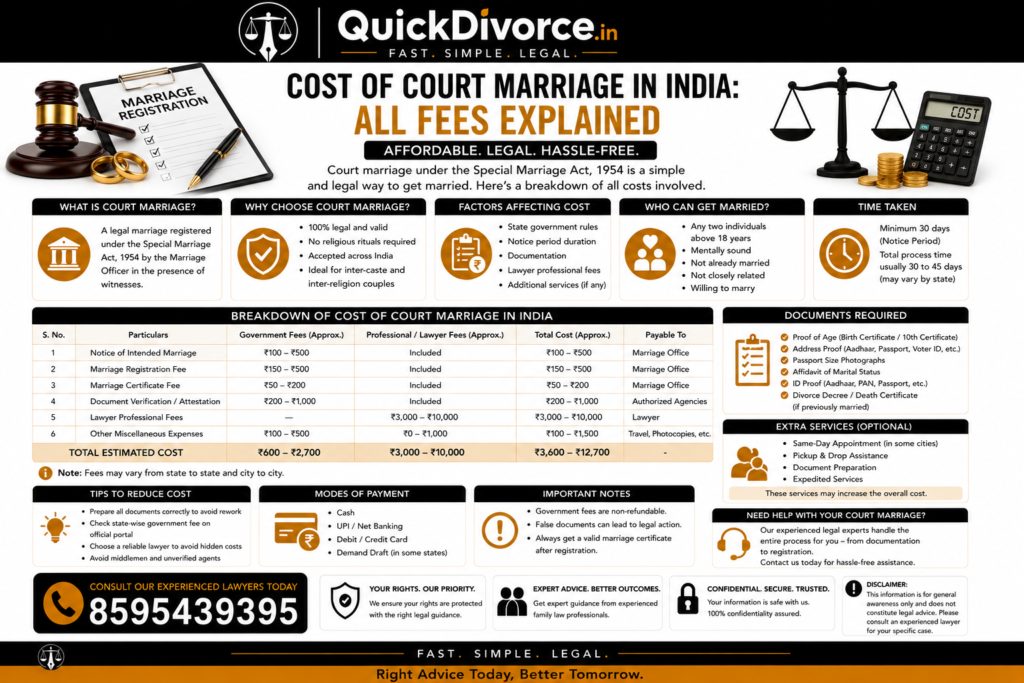
Component 5: Documentation and Miscellaneous Costs
Apart from the charges to be paid to the marriage officer, the parties must also pay for the required stamp fees, charges for photocopies of documents, charges for making an affidavit, other incidental expenses, and legal fees if they hire a legal practitioner.
Specific documentation-related costs that add up include:
- Photocopying and printing of documents — identity proofs, age proofs, address proofs, and affidavits all need certified copies submitted to the SDM office, typically ₹2–₹5 per page, with most applications requiring 10–20 pages total
- Passport-size photographs — both parties typically need 4–6 photographs each, costing ₹50–₹150 per set at a photo studio
- Joint photographs — most SDM offices require one or two joint photographs of both spouses, usually available at the same studio
- Courier or delivery charges — where documents need to be submitted or received by post in states with online or hybrid application processes
Realistically, documentation and miscellaneous costs add ₹200–₹800 to the total cost of court marriage, depending on the number of documents involved and whether original certificates need to be obtained or duplicated from issuing authorities.
Component 6: Advocate or Legal Assistance Fees
This is, for most couples, the largest variable in the total cost of court marriage. While it is not legally mandatory to engage an advocate — couples can file their own notice and appear personally before the Marriage Officer — most couples choose professional assistance because the process involves multiple document submissions, a scheduled SDM appearance, and in some cases, handling objections or coordinating with the police for protection during the notice period.
If you engage a lawyer for document verification, fees may go from as low as ₹3,000 to as high as ₹10,000, which will in turn depend on the case’s complexity and the city.
More specifically, advocate fees for a standard, uncomplicated court marriage in 2026 break down as follows depending on the nature of engagement:
Document Assistance Only (Limited Engagement)
₹2,000–₹5,000 — covers review and organisation of documents, affidavit drafting, and guidance on the filing process without the advocate appearing personally at the SDM office.
Full-Service Court Marriage Assistance
₹5,000–₹15,000 — covers preparation of all documents and affidavits, accompanying the couple to the SDM office for filing and for the solemnisation date, coordinating with the Marriage Officer, monitoring the 30-day notice period, and handling any procedural queries.
Complex or Special Cases
₹10,000–₹25,000 or more — where the court marriage involves inter-religion or inter-caste dynamics with active family opposition, where one party is a foreign national requiring additional documentation, or where legal protection applications to the police or High Court are needed alongside the registration process.
City-wise, advocate fees for court marriage in 2026 align broadly with the following ranges:
| City | Typical Advocate Fee (Full Service) |
|---|---|
| Delhi NCR | ₹8,000–₹20,000 |
| Mumbai | ₹8,000–₹18,000 |
| Bengaluru | ₹7,000–₹15,000 |
| Chennai | ₹6,000–₹12,000 |
| Hyderabad | ₹6,000–₹12,000 |
| Kolkata | ₹5,000–₹10,000 |
| Tier-2 cities | ₹3,000–₹8,000 |
Component 7: Tatkal (Expedited) Processing Fees
Under the Hindu Marriage Act route, where both parties are Hindu, Sikh, Jain, or Buddhist and their marriage has already been solemnised through a religious ceremony, most states offer a tatkal (expedited) processing option that can significantly reduce the waiting time for the certificate from the standard 7–15 working days to as little as 24 hours.
Some areas present what we may call a “Tatkal” or expedited service for a larger fee, which in turn will do away with the wait and allow for same-day registration. This may add up to a few thousand rupees to the total cost.
The tatkal charge varies by state and district, typically adding ₹500 to ₹2,000 over and above the standard processing fee. It’s important to note that tatkal is not available under the Special Marriage Act — the mandatory 30-day public notice period is a statutory requirement that cannot be abbreviated under any fee arrangement, regardless of urgency.
Component 8: Witness-Related Costs
A court marriage under the Special Marriage Act requires three adult witnesses with valid government-issued identity proof. For a Hindu Marriage Act registration, two witnesses are sufficient.
Where the couple provides their own witnesses — friends, family members, or colleagues — there is no cost involved. However, where couples either cannot arrange witnesses independently or prefer a more private process without family or friends involved, some legal service providers offer to arrange witnesses as part of a comprehensive court marriage package. This typically adds ₹500–₹2,000 to the total cost of court marriage, covering the witnesses’ time and travel.
Component 9: Protection Orders (Where Applicable)
For inter-caste or inter-religion couples facing active family opposition or genuine safety concerns, obtaining police protection during the 30-day notice period and on the solemnisation date may be necessary. Seeking protection through a writ petition before the High Court or a written complaint to the Superintendent of Police is itself a legal process that requires professional assistance.
Where a separate legal application is needed for protection — beyond the standard court marriage documentation — additional advocate fees typically apply, generally in the range of ₹5,000–₹15,000 depending on the nature and urgency of the application, the High Court involved, and whether the matter requires an appearance before a judge.
Component 10: Foreign National Additional Costs
Where one party is a foreign national, additional documentation is required: a valid passport with appropriate visa, and a Certificate of No Impediment or Single Status Certificate apostilled by the home country’s competent authority. Obtaining apostilled documentation involves the foreign government’s process and fees — which vary significantly by country — and may additionally require professional assistance for translation, since Indian authorities typically require documents in English. This component alone can add ₹3,000–₹10,000 or more to the overall cost of court marriage, depending on the country and the complexity of the documentation involved.
Total Cost of Court Marriage: Consolidated Estimates for 2026
Pulling all components together, here is a realistic, consolidated estimate of the total cost of court marriage across different scenarios in 2026:
Scenario 1: DIY Without Advocate Assistance (Simple Case, Same-Religion Couple, Hindu Marriage Act)
| Component | Estimated Cost |
|---|---|
| Government registration fee | ₹100 |
| Certificate issuance fee | ₹100–₹150 |
| Stamp duty on affidavits | ₹100–₹200 |
| Notarisation of affidavits | ₹300–₹500 |
| Photocopying and photographs | ₹200–₹400 |
| Total | ₹800–₹1,250 |
This is the genuinely minimum cost of court marriage in India — achievable only where both parties are confident handling the documentation independently, are familiar with the local SDM office’s procedures, and have all required documents readily available without any issues.
Scenario 2: With Standard Advocate Assistance (Same-Religion or Inter-Caste Couple, Metro City)
| Component | Estimated Cost |
|---|---|
| Government fees (registration + certificate) | ₹200–₹350 |
| Stamp duty and affidavit charges | ₹300–₹700 |
| Documentation and miscellaneous | ₹300–₹600 |
| Advocate fee (full-service) | ₹7,000–₹15,000 |
| Total | ₹8,000–₹17,000 |
Scenario 3: Inter-Religion Court Marriage With Active Family Opposition (Metro City, Special Marriage Act, With Protection Application)
| Component | Estimated Cost |
|---|---|
| Government fees | ₹200–₹350 |
| Stamp duty and affidavit charges | ₹500–₹1,000 |
| Documentation and miscellaneous | ₹400–₹800 |
| Advocate fee (court marriage + protection application) | ₹15,000–₹30,000 |
| Total | ₹16,000–₹32,000 |
Scenario 4: Court Marriage With One Foreign National Party
| Component | Estimated Cost |
|---|---|
| Government fees | ₹150–₹300 |
| Stamp duty and affidavit charges | ₹500–₹1,000 |
| Documentation and miscellaneous | ₹500–₹1,000 |
| Foreign documentation and apostille | ₹3,000–₹10,000 |
| Advocate fee (handling foreign documentation + filing) | ₹10,000–₹20,000 |
| Total | ₹14,000–₹32,000 |
Hidden Costs Couples Often Miss
1. Obtaining Originals of Missing Documents
If either party does not have their original birth certificate, school marksheet, or previous divorce decree readily available, obtaining certified copies or duplicates from issuing authorities adds both time and cost — typically ₹100–₹500 per document from most issuing authorities.
2. Travel and Logistics for the SDM Appointment
Both spouses, both families of witnesses, and the advocate (where engaged) must be physically present at the SDM office on both the application date and the solemnisation date. Travel, parking, and time off work are real costs that don’t appear in any fee schedule but affect the practical affordability of the process.
3. Apostille for International Use
Where the marriage certificate will be used abroad — for a spouse visa, for instance — it must be apostilled through the Ministry of External Affairs’ e-Sanad platform. The e-Sanad portal charges approximately ₹50 per document for e-apostille, though the physical submission and authentication process may involve additional service fees through authorised centres.
4. Name Change After Marriage
Where either spouse changes their surname after the court marriage — requiring updates to Aadhaar, PAN, passport, bank accounts, and other records — gazette notification fees, affidavit costs, and administrative charges for each document update add further to the overall cost. While not a “court marriage fee” per se, these are costs directly triggered by the marriage and should be budgeted for in advance.
Is the Cost of Court Marriage Lower Than a Traditional Wedding?
Without question, yes. The cost of court marriage is a fraction of what a traditional wedding ceremony typically costs in India. Even in the most expensive scenario — an inter-religion court marriage in a metro city with full legal assistance and a protection application — the total cost remains well under ₹35,000. Compare this to even a modest traditional wedding, which in most Indian families runs into several lakhs, and the financial advantage of a court marriage is immediately apparent.
This cost-effectiveness, combined with the legal certainty, nationwide recognition, and international validity of the marriage certificate, makes court marriage an increasingly popular choice — not just for inter-caste or inter-religion couples, but for any couple who values legal security over ceremonial elaborateness.
Free Legal Aid — Can You Get Court Marriage Assistance at No Cost?
Under the Legal Services Authorities Act, 1987, individuals below a specified income threshold are entitled to free legal assistance from the District Legal Services Authority (DLSA) in their district. Women are categorically eligible for free legal aid regardless of income, making this a genuinely accessible option for many couples who cannot afford private advocate fees.
Additionally, several NGOs — particularly those working with inter-caste and inter-religion couples — provide documentation assistance and legal support at no or reduced cost, especially where the couple faces family opposition or safety concerns.
How QuickDivorce.in Can Help
Navigating the cost of court marriage is easier when you have clarity on what each component involves and what you actually need for your specific situation. At QuickDivorce.in, our family law team offers transparent, fixed-fee court marriage assistance — covering documentation preparation, affidavit drafting and notarisation, SDM filing, notice period monitoring, and solemnisation coordination — so you know your total cost of court marriage upfront, with no hidden charges, and your wedding day proceeds without procedural anxiety.
Frequently Asked Questions (FAQs)
FAQs: Cost of Court Marriage in India: All Fees Explained (2026 Guide)
1. What is the Cost of Court Marriage in India in 2026?
The Cost of Court Marriage in India depends on the state, the applicable marriage law, government fees, documentation charges, and whether you hire a lawyer or legal consultant. Government fees are generally modest, while professional service charges vary. (Law4u)
2. What is included in the Cost of Court Marriage in India?
The Cost of Court Marriage in India may include government application fees, marriage registration fees, affidavit charges, stamp paper expenses, notarization fees (where applicable), document preparation costs, and professional legal fees if assistance is taken. (Law4u)
3. Does the Cost of Court Marriage in India vary from state to state?
Yes. The Cost of Court Marriage in India varies because each state may prescribe different government fees and administrative charges. Professional fees charged by advocates or consultants may also differ based on location and complexity. (Law4u)
4. Is hiring a lawyer mandatory for a court marriage?
No. Hiring a lawyer is not mandatory. Couples can complete the legal process themselves if they meet all legal requirements and submit the necessary documents. However, many couples choose professional assistance to simplify the procedure. (IndiaFilings)
5. What documents are required for a court marriage?
The required documents generally include identity proof, age proof, address proof, passport-size photographs, and proof of marital status, such as a divorce decree or death certificate where applicable. Additional documents may be required depending on the state and individual circumstances. (IndiaFilings)
6. Are there any hidden charges in the Cost of Court Marriage in India?
The official government fees are generally transparent. However, if you use legal or documentation services, additional charges for drafting affidavits, notarization, document verification, or legal consultation may apply. It is advisable to request a complete fee breakdown before proceeding. (Law4u)
7. Can the Cost of Court Marriage in India increase for special cases?
Yes. The Cost of Court Marriage in India may increase if additional legal documentation, translations, NRI-related formalities, or other special legal requirements are involved. Professional service charges may also vary depending on the complexity of the case. (NoBroker)
Conclusion
The cost of court marriage in India in 2026 is genuinely one of the most accessible and transparent costs in the entire spectrum of family law — the government fees alone are almost nominal, and even with full professional assistance in a metro city, the total cost of court marriage rarely exceeds ₹20,000 for a straightforward case. Understanding what each component costs, which ones are genuinely necessary for your situation, and where you can access free or subsidised assistance takes the guesswork out of budgeting for one of the most important legal steps of your life.
Whether you’re handling the documentation yourself or engaging professional support, knowing the full cost picture before you begin ensures that money never becomes an obstacle to a legally secure, properly registered marriage.
For transparent, fixed-fee court marriage assistance in India — with no hidden charges and complete documentation support — connect with the family law team at QuickDivorce.in.
Get Expert Advice for Marriage Certificate in India
🟡QuickDivorce offers trusted online legal services across India, including mutual divorce, contested divorce, child custody, alimony, marriage registration, and expert family law consultation.
👉 Mutual Consent Divorce
👉 Contested Divorce Filing
👉 Child Custody and Maintenance
👉 Matrimonial Property Settlement
👉 NRI Divorce Services
👉 Alimony and Maintenance
🟡 Protect Your Rights
👉 Domestic Violence Legal Support
👉 Stridhan Recovery
🟡For other Legal and Trademark related services visit
👉 Money Recovery Cases
👉 Property Disputes
👉 Business & Licence Registrations
📞 Call Now: +91 8595439395
🕐 Free Consultation: Monday to Saturday, 10 AM to 6 PM

Adv. Manish Kashyap is a Family Law & Divorce Lawyer with extensive experience in Mutual & Contested Divorce, NRI Divorce, Child Custody, Alimony, Domestic Violence, Judicial Separation, and Family Court matters, providing professional legal guidance to clients.

