

Views: 7
Table of Contents
- 1 Quick Summary
- 2 📌 What Is Marital Abuse in India?
- 3 ⚠️ Why Filing a Complaint Is So Important
- 4 📜 Laws That Protect Against Marital Abuse in India
- 5 🔍 Types of Marital Abuse Covered Under Indian Law
- 6 🛡️ Before You File — Safety Planning and Evidence Gathering
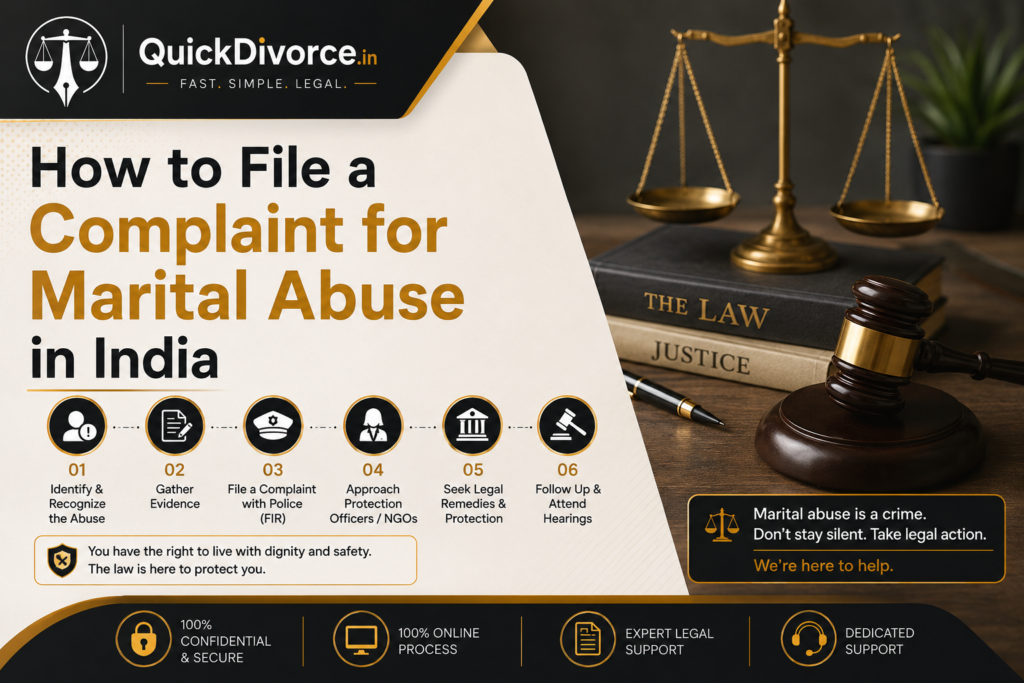
- 7 📋 Step by Step — How to File a Complaint for Marital Abuse in India
- 8 🚔 Filing an FIR Under Section 498A IPC
- 9 ⚖️ Filing Under PWDVA 2005
- 10 🔄 Filing Both Together — The Recommended Approach
- 11 📅 What Happens After You File
- 12 ⚡ Immediate Reliefs Available After Filing
- 13 🔍 Evidence Required for a Marital Abuse Complaint
- 14 👮 Role of Police, Protection Officers and Courts
- 15 💔 Marital Abuse and Divorce
- 16 👶 Marital Abuse and Child Custody
- 17 🌍 Complaint Filing for NRI Victims of Marital Abuse
- 18 🚫 Common Mistakes When Filing a Marital Abuse Complaint
- 19 🌟 How Quick Divorce Helps Marital Abuse Victims
- 20 💰 Cost Breakdown: Filing a Marital Abuse Complaint in India
- 21 ❓ Frequently Asked Questions (FAQs)
- 22 🎯 Who Needs This Guide Right Now?
- 23 ✅ Final Recommendation
- 24 Need Help With Domestic Voilence Cases?
Quick Summary
Filing a complaint for marital abuse in India is your legal right — and in 2026, Indian law provides powerful, fast and comprehensive remedies for every form of marital abuse.
Here is what you need to know upfront:
- 🔒 Two primary legal routes — Section 498A IPC (criminal) and PWDVA 2005 (civil) — both should be filed simultaneously
- 📋 Four types of abuse covered — physical, sexual, emotional and economic abuse are all legally recognised
- ⚡ Immediate relief available — protection orders can be granted the same day as filing in urgent cases
- 🏠 You cannot be evicted — PWDVA 2005 protects your right to remain in the shared household
- 💰 Financial support — maintenance and monetary relief can be claimed from the date of filing
- ✅ Quick Divorce helps marital abuse victims file complaints, obtain protection and initiate divorce — starting at ₹499
If you are experiencing marital abuse — this guide tells you exactly what to do, step by step, right now.
📌 What Is Marital Abuse in India?
Marital abuse in India refers to any form of physical, sexual, emotional, verbal or economic abuse perpetrated by a spouse or their family members within the matrimonial relationship.
For decades, marital abuse in India was treated as a private family matter — something to be handled within the home, something women were expected to endure, something the law largely stayed out of.
That has fundamentally changed.
Today, Indian law — through the Protection of Women from Domestic Violence Act 2005 and Section 498A of the Indian Penal Code — recognises marital abuse in all its forms as a serious legal wrong that carries criminal and civil consequences.
The legal definition of marital abuse under Indian law encompasses:
- Physical abuse — any act causing bodily harm, pain or danger to life and health
- Sexual abuse — any conduct of a sexual nature that abuses, humiliates or violates dignity
- Emotional and psychological abuse — insults, threats, humiliation, coercion and controlling behavior
- Economic abuse — controlling finances, withholding money, preventing employment, disposing of property
The most important point: You do not need to have been physically beaten to have a valid legal complaint for marital abuse in India. Emotional torture, financial control, sexual coercion and verbal degradation are all recognised forms of abuse under Indian law — and all are actionable.
⚠️ Why Filing a Complaint Is So Important
Many victims of marital abuse hesitate to file a formal legal complaint — held back by fear, shame, financial dependence, concern for children or hope that things will improve.
Understanding why filing matters helps overcome that hesitation:
It Creates Official Documentation
A filed complaint creates an official record of the abuse — a record that exists independently of what either party says later. This documentation is critical for divorce proceedings, custody cases, maintenance claims and all subsequent legal actions.
It Triggers Immediate Legal Protection
Filing a complaint under PWDVA 2005 triggers the court’s power to grant immediate protection orders — preventing the abuser from further contact, violence or harassment. This protection can be obtained the same day in urgent cases.
It Establishes Your Financial Rights
Filing for marital abuse initiates your claim to maintenance, monetary relief and residence protection — ensuring you and your children are not left financially vulnerable while legal proceedings continue.
It Protects Your Children
A filed complaint with documented evidence of abuse is powerful evidence in custody proceedings — protecting your children from being placed with an abusive parent.
It Sends a Clear Message
A formal legal complaint makes clear that the abuse will not be tolerated — which itself has a deterrent effect and often prompts a response (return of stridhan, withdrawal of threats, agreement to negotiate) that was not possible while the abuse was being absorbed silently.
It Protects Your Future Legal Position
Delay in filing is consistently used against abuse victims in court — “if it was really so bad, why did you wait so long?” Filing promptly after incidents strengthens your credibility and your legal case enormously.
📜 Laws That Protect Against Marital Abuse in India
Indian law provides multiple overlapping legal protections against marital abuse — each serving a different purpose and providing different remedies:
Protection of Women from Domestic Violence Act 2005 (PWDVA 2005)
India’s comprehensive civil law protecting women from all forms of domestic violence including marital abuse. Provides:
- Immediate protection orders
- Residence rights — you cannot be evicted from the shared household
- Monetary relief and maintenance
- Custody orders
- Compensation for harm suffered
Best used for: Immediate civil protection, financial relief, residence protection and custody while criminal proceedings and divorce are pending.
Section 498A of the Indian Penal Code 1860 (Now Section 85 BNS 2023)
The primary criminal law covering cruelty by husband and in-laws. Makes matrimonial cruelty — physical or mental harm, dowry harassment — a cognizable, non-bailable offence punishable with up to 3 years imprisonment.
Best used for: Criminal accountability, deterrence, arrest and prosecution of the abuser.
Section 354 IPC — Assault or Criminal Force Against a Woman
Criminal provision for physical assault — applicable where the husband physically attacks the wife. Cognizable offence — police can act immediately.
Section 323 IPC — Voluntarily Causing Hurt
Where physical injury has been caused — Section 323 IPC applies alongside Section 498A in cases of physical marital abuse.
Section 506 IPC — Criminal Intimidation
Where threats are made — to kill, physically harm, damage reputation or harm loved ones — Section 506 IPC applies.
Section 406 IPC — Criminal Breach of Trust
Where the wife’s stridhan has been withheld or disposed of — Section 406 IPC provides the criminal remedy for economic abuse.
Dowry Prohibition Act 1961
Where the abuse is connected to dowry demands — the Dowry Prohibition Act 1961 provides additional criminal remedies.
Section 125 CrPC — Maintenance
Independent of any criminal or civil proceedings — a wife who has been subjected to marital abuse can claim maintenance under Section 125 CrPC from the date of the application.
🔍 Types of Marital Abuse Covered Under Indian Law
Physical Abuse
The most visible form of marital abuse — and the one most commonly reported:
- 👊 Slapping, hitting, punching, kicking
- 🔥 Burning, scalding, use of objects as weapons
- 🏥 Any act causing bodily injury or endangering life
- 💊 Forcing consumption of alcohol or substances
- 🚗 Reckless driving endangering the wife
- 🔒 Physical confinement — locking the wife in the home
- 🚫 Strangulation, choking, smothering
Legal coverage: Section 498A IPC, PWDVA 2005, Section 323 IPC, Section 354 IPC
Sexual Abuse
Recognised as marital abuse under PWDVA 2005 — even though marital rape is not yet fully criminalised in India for all marriages:
- 🚫 Forced sexual intercourse against the wife’s will
- 🚫 Forcing degrading or humiliating sexual acts
- 🚫 Sexual coercion through threats or pressure
- 🚫 Using sexual denial as a tool of control and punishment
- 🚫 Forcing the wife to view or participate in pornographic acts
Legal coverage: PWDVA 2005 Section 3 (sexual abuse definition), Section 498A IPC
Emotional and Psychological Abuse
Often the most sustained and damaging form of marital abuse — leaving no physical marks but causing profound psychological harm:
- 🗣️ Constant insults, ridicule and public humiliation
- 😰 Threats — of physical harm, of taking children, of destroying reputation
- 🔇 Isolation — preventing contact with family and friends
- 😢 Gaslighting — making the wife doubt her own perception of reality
- 🚫 Constant criticism, name calling, verbal degradation
- 💔 Threats of suicide to manipulate the wife
- 👶 Threats related to children — using children as tools of control
Legal coverage: PWDVA 2005 Section 3 (emotional abuse definition), Section 498A IPC (mental cruelty), Section 506 IPC (criminal intimidation)
Economic Abuse
One of the most powerful and least recognised forms of marital abuse:
- 💰 Withholding household money — controlling all finances
- 🏦 Preventing the wife from working or pursuing a career
- 💍 Withholding or disposing of stridhan
- 📋 Forcing the wife to sign financial documents under duress
- 🏠 Threatening to sell matrimonial property to leave wife homeless
- 💳 Creating debt in the wife’s name without her knowledge
- 🚫 Denying money for children’s education or medical care
Legal coverage: PWDVA 2005 Section 3 (economic abuse definition), Section 406 IPC (stridhan withholding)
🛡️ Before You File — Safety Planning and Evidence Gathering
Step 1 — Ensure Immediate Safety First
Before any legal step — your physical safety is the absolute priority.
If you are in immediate danger:
- 🚨 Call 112 — National Emergency Number — immediately
- 🚨 Call 181 — Women Helpline — available in most states
- 🚨 Leave the home if it is safe to do so — go to a trusted family member, friend or shelter
- 🚨 Take your children with you if possible and safe to do so
Do not stay in a situation of immediate physical danger to file paperwork. Safety first — legal action second.
Step 2 — Reach a Safe Location
Once you are physically safe:
- Contact a trusted family member — parents, siblings — who can support you
- Contact a registered NGO or shelter — they provide immediate assistance, counseling and legal guidance
- Contact Quick Divorce for a confidential consultation — even before you have gathered evidence
Step 3 — Document Injuries Immediately
If you have been physically injured:
- 📸 Photograph injuries immediately — bruises, cuts, burns. Take photographs in good lighting with a timestamp
- 🏥 Visit a doctor or hospital immediately — the medical record documenting your injuries is critical evidence
- 📋 Ask the doctor to prepare a medicolegal certificate (MLC) — this is a formal medical record specifically designed for legal use
- 🏥 If injuries are severe — go to a government hospital. Government hospital MLCs carry greater weight in court than private clinic records
Step 4 — Preserve Digital Evidence
Before filing any complaint — preserve all available digital evidence:
- 📱 Screenshot all relevant WhatsApp messages — threats, abusive messages, acknowledgments of abuse
- 📧 Save all relevant emails
- 🎵 Save any audio recordings of threatening or abusive conversations
- 🎬 Save any video recordings
- 📸 Save photographs from social media that are relevant
- 📋 Export WhatsApp chat history (Settings > Chats > Export Chat) and store safely
Critical: Send copies of all screenshots and recordings to a trusted person’s phone or email — and to cloud storage. Abusers frequently delete conversations or take the wife’s phone.
Step 5 — Prepare a Written Record
Write down a detailed account of every incident of abuse you can remember:
- Date and approximate time of each incident
- Location — where it happened
- What exactly happened — what was said, what was done
- Who was present — witnesses
- What injuries or harm resulted
- Any follow-up — medical visit, complaint to family elders, attempt at reconciliation
This written record helps ensure nothing is forgotten when you give your statement to police or the Protection Officer — and demonstrates the pattern and severity of abuse.
Step 6 — Identify Witnesses
Think about who witnessed or has knowledge of the abuse:
- 👥 Neighbours who heard arguments or saw injuries
- 👨👩👧 Family members who witnessed incidents or were told about them
- 🏥 Doctors who treated your injuries
- 👶 Children who witnessed incidents (though courts are careful about using children as witnesses in parental disputes)
- 👮 Police officers who responded to earlier calls if any
Witness names and contact details should be noted before filing.
Step 7 — Gather Financial Information
Where economic abuse is involved:
- 🏦 Note details of all bank accounts — joint and individual
- 📈 Note details of investments, fixed deposits, property
- 💍 Prepare a list of stridhan items — jewellery, gifts
- 📋 Gather any financial documents you can access — bank statements, property papers, insurance documents
This information is critical for maintenance claims, stridhan recovery and property settlement.
📋 Step by Step — How to File a Complaint for Marital Abuse in India
Option 1 — Contact a Protection Officer
The easiest and most accessible first step for most women.
Protection Officers are government appointed officers available in every district in India — specifically tasked with helping women access their rights under PWDVA 2005.
How to find your Protection Officer:
- Contact the District Collector’s office in your district
- Contact the Women and Child Development department in your district
- Call 181 — Women Helpline — they will connect you with the Protection Officer
What the Protection Officer does:
- Listens to your complaint and helps you prepare a Domestic Incident Report (DIR)
- Files the application before the Magistrate on your behalf
- Connects you with shelter, legal aid and medical services
- Provides information about all available reliefs
- Their service is completely free
Option 2 — Contact a Registered Service Provider
Service Providers are NGOs and organisations registered with the state government under PWDVA 2005. They provide:
- Immediate shelter if needed
- Legal aid and complaint filing assistance
- Medical aid and documentation of injuries
- Psychological counseling
- They can file a complaint on your behalf
Option 3 — File Directly Before the Magistrate
You can approach the Judicial Magistrate of First Class directly — without going through a Protection Officer — and file an application under PWDVA 2005.
Quick Divorce assists in preparing and filing this application — ensuring it is complete, specific and structured to obtain maximum relief.
Option 4 — File an FIR at the Police Station
For criminal complaints under Section 498A IPC — go to the police station with jurisdiction over:
- The area where the matrimonial home is located
- The area where the cruelty occurred
- The area where the accused resides
Report the facts to the Station House Officer (SHO). The police are required to register an FIR for cognizable offences like Section 498A.
What if police refuse to register the FIR?
If police refuse:
- Ask for written reasons for refusal
- Write to the Superintendent of Police (SP) demanding registration
- File a complaint directly before the Judicial Magistrate under Section 156(3) CrPC — directing police to investigate
- Contact Quick Divorce — who assists with cases where police are initially reluctant
🚔 Filing an FIR Under Section 498A IPC
What Section 498A IPC Covers
Section 498A IPC — now mirrored in Section 85 of the Bharatiya Nyaya Sanhita 2023 — covers:
- Limb A: Any willful conduct likely to drive the wife to suicide or cause grave injury or danger to life, limb or health — physical or mental
- Limb B: Harassment for dowry or any unlawful demand for property
The FIR Filing Process
Step 1: Go to the police station with all available evidence — photographs of injuries, medical records, screenshots of messages, your written incident record.
Step 2: Give your statement to the Station House Officer. Be specific — specific dates, specific acts, specific injuries, specific demands.
Step 3: The police register the FIR under Section 498A IPC — and potentially other applicable sections:
- Section 323 IPC — hurt
- Section 354 IPC — assault on woman
- Section 506 IPC — criminal intimidation
- Section 406 IPC — criminal breach of trust (stridhan)
- Sections under Dowry Prohibition Act
Step 4: The police begin investigation — recording statements, visiting the matrimonial home, collecting evidence.
Step 5: The police file a charge sheet before the Magistrate — completing the criminal process initiation.
Section 498A — Nature of Offence
- Cognizable — police can arrest without warrant
- Non-bailable — bail is not a matter of right, must be sought from court
- Non-compoundable — cannot simply be withdrawn by the wife after filing
⚖️ Filing Under PWDVA 2005
What PWDVA 2005 Covers
PWDVA 2005 covers all four forms of marital abuse — physical, sexual, emotional and economic. It is a civil law providing protective reliefs rather than criminal punishment.
The PWDVA 2005 Filing Process
Step 1: Prepare a Domestic Incident Report (DIR) with the help of a Protection Officer or Quick Divorce — detailing the nature, frequency and impact of the abuse.
Step 2: Prepare the application under PWDVA 2005 before the Judicial Magistrate of First Class — specifying:
- The nature of the domestic relationship
- Details of the domestic violence experienced
- The reliefs sought — protection order, residence order, monetary relief, custody, compensation
Step 3: File the application before the Magistrate with all supporting documents.
Step 4: The Magistrate must hear the application within 3 days of filing.
Step 5: Where there is immediate danger — the Magistrate can grant an ex-parte interim protection order the same day — without first hearing the respondent.
Reliefs Available Under PWDVA 2005
- 🔒 Protection order — prohibiting the respondent from committing any further acts of abuse, contacting the applicant or approaching her workplace or children’s school
- 🏠 Residence order — protecting the wife’s right to remain in the shared household or directing the respondent to provide alternative accommodation
- 💰 Monetary relief — covering medical expenses, loss of earnings, loss of property and maintenance
- 👶 Custody order — interim custody of children with the wife
- 💍 Return of stridhan — as part of monetary relief
- ⚖️ Compensation — for mental suffering, emotional distress and harm caused by the domestic violence
🔄 Filing Both Together — The Recommended Approach
The most effective approach to filing a complaint for marital abuse in India in 2026 is to file both Section 498A IPC and PWDVA 2005 simultaneously.
Here is why:
| What Section 498A IPC Does | What PWDVA 2005 Does |
|---|---|
| Creates immediate criminal accountability | Provides immediate civil protection |
| Arrest without warrant — powerful deterrent | Protection order — stops further abuse legally |
| Police investigation — uncovers evidence | Residence order — prevents eviction |
| Non-bailable — accused must apply for bail | Monetary relief — financial support from Day 1 |
| Prosecution and potential imprisonment | Custody order — children protected |
| Sends the strongest possible message | Compensation for harm suffered |
Filing both simultaneously:
- Creates maximum legal pressure on the abuser immediately
- Ensures both criminal accountability and civil protection from Day 1
- Provides financial support while criminal proceedings are pending
- Protects the wife’s residence rights during the proceedings
- Protects children with interim custody orders
Quick Divorce files both Section 498A and PWDVA 2005 simultaneously as part of their comprehensive marital abuse legal package.
📅 What Happens After You File
Immediate Steps — First 48 Hours
Section 498A FIR filed:
- Police begin investigation — recording statements, visiting matrimonial home
- Accused may be arrested or summoned for questioning
- Anticipatory bail applications may be filed by the accused
- Police file case diary entries documenting investigation progress
PWDVA 2005 application filed:
- Magistrate must hear within 3 days
- Ex-parte interim protection order may be granted immediately
- Notice issued to respondent requiring appearance
- Protection Officer directed to submit home investigation report
Short Term — First 2 to 4 Weeks
- Respondent served with notice in PWDVA case
- Respondent appears before Magistrate
- Interim orders confirmed or modified after hearing both sides
- Police file or continue investigation in Section 498A case
- Anticipatory bail or regular bail hearings if accused has been arrested
Medium Term — 1 to 6 Months
- Full PWDVA hearings — evidence, arguments, final orders
- Section 498A charge sheet filed by police before Magistrate
- Trial proceedings commence
- Maintenance application hearings
- Divorce petition filed and first hearing scheduled
Long Term
- Final PWDVA orders — comprehensive protection, residence, monetary and custody relief
- Section 498A trial — potentially 2 to 5 years
- Divorce proceedings — 6 months to several years depending on type
⚡ Immediate Reliefs Available After Filing
One of the most important aspects of filing a complaint for marital abuse in India is the immediate reliefs available — which can be obtained within days of filing:
Same Day Relief — Ex-Parte Protection Order
Where there is immediate danger to life or safety — the Magistrate can pass an ex-parte protection order the same day as the PWDVA 2005 application is filed — without hearing the respondent first.
This order immediately:
- Prohibits the respondent from approaching or contacting the wife
- Prohibits further acts of violence
- Can require the respondent to leave the shared household
Within 3 Days — First Magistrate Hearing
The Magistrate must hear the PWDVA application within 3 days — and typically passes interim orders at this first hearing covering protection, residence and initial monetary relief.
Within 2 Weeks — Interim Maintenance
An interim maintenance order under PWDVA 2005 or Section 125 CrPC provides financial support from the date of application — ensuring the wife is not left financially helpless while proceedings continue.
Within 2 to 4 Weeks — Interim Custody
Where children are involved — interim custody orders under PWDVA 2005 or the Guardians and Wards Act can be obtained relatively quickly — protecting children from continued exposure to abuse.
🔍 Evidence Required for a Marital Abuse Complaint
Medical Evidence
- 🏥 Medicolegal certificates (MLC) from government hospital
- 📋 Doctor’s notes describing injuries
- 🏥 Hospital admission records
- 🧠 Psychiatrist or psychologist reports documenting psychological harm
- 💊 Prescription records for medication prescribed as a result of abuse
Photographic and Video Evidence
- 📸 Photographs of physical injuries — taken immediately after incidents with timestamps
- 🎬 Videos of abusive incidents
- 📸 Photographs of damaged property — furniture, household items broken during violent incidents
- 📸 Photographs of threatening notes or messages left by the abuser
Digital Evidence
- 📱 WhatsApp messages containing threats, abuse, dowry demands
- 📧 Emails with abusive or threatening content
- 📲 Call records showing frequency of threatening calls
- 🎵 Audio recordings of threatening or abusive conversations
- 📸 Screenshots of social media abuse
All digital evidence must be preserved with a Section 65B Indian Evidence Act certificate for admissibility in court. Quick Divorce assists clients in preparing the correct Section 65B certificates.
Documentary Evidence
- 📋 Previous police complaints — even if no FIR was registered at the time
- 📝 Letters or notes from the abuser containing threats or acknowledgment of abuse
- 💰 Bank records showing financial control or diversion of stridhan
- 📋 Evidence of dowry demands — receipts, transfer records, demand letters
Witness Evidence
- 👥 Affidavits from neighbours who witnessed abuse or its aftermath
- 👨👩👧 Affidavits from family members of the wife who witnessed incidents or received complaints
- 🏥 Testimony from treating doctors
- 👮 Statements from police officers who responded to earlier calls
- 👶 Teachers or school staff who noticed behavioral changes in children (indicating exposure to abuse at home)
Written Incident Record
- 📝 The wife’s own written diary of incidents — dates, times, what happened, witnesses
- 📋 Contemporaneous records — messages sent to trusted friends or family describing incidents as they happened
👮 Role of Police, Protection Officers and Courts
Police
Responsibilities in marital abuse cases:
- Register FIR under Section 498A IPC without requiring the wife to prove her case first
- Investigate the complaint — record statements, visit matrimonial home, collect evidence
- Arrest the accused where appropriate under Section 498A
- File charge sheet before the Magistrate
- Assist in serving PWDVA 2005 notices
- Assist in implementing protection orders — including by ensuring the respondent leaves the shared household if ordered
What to do if police are unresponsive:
Unfortunately, police responsiveness to marital abuse complaints varies significantly across states and districts. Where police are reluctant to register an FIR or investigate:
- Write to the Superintendent of Police (SP) with a copy of your complaint
- File a complaint before the Judicial Magistrate under Section 156(3) CrPC directing police investigation
- Contact the State Women’s Commission
- Contact Quick Divorce — who assists with cases where police are initially unhelpful
Protection Officers
Responsibilities:
- Free, accessible government officers dedicated to helping women access PWDVA 2005 rights
- Prepare Domestic Incident Reports
- File applications before Magistrates on behalf of women
- Connect women with shelter, medical aid and legal assistance
- Monitor compliance with court orders
- Report violations to the Magistrate
How to contact: Through the District Collector’s office or Women and Child Development department in your district.
The Magistrate
Powers in marital abuse cases:
- Grant immediate ex-parte protection orders where there is danger
- Issue notice to the respondent
- Direct the Protection Officer to investigate and report
- Pass interim and final orders under all PWDVA 2005 reliefs
- Hold the respondent in contempt and issue arrest warrant for breach of protection orders
- Direct police to implement court orders
💔 Marital Abuse and Divorce
Marital abuse and divorce are closely connected — and in most cases where a woman files a complaint for marital abuse, divorce proceedings are either already underway or soon follow.
Abuse as Ground for Divorce
Cruelty — which encompasses all forms of marital abuse — is a ground for divorce under:
- Section 13(1)(ia) Hindu Marriage Act 1955
- Section 27(1)(d) Special Marriage Act 1954
- Section 10 Indian Divorce Act 1869
Evidence from marital abuse proceedings — police records, medical records, PWDVA orders, witness statements — directly strengthens a divorce petition on grounds of cruelty.
Filing Abuse Complaint and Divorce Simultaneously
Quick Divorce strongly recommends filing both the marital abuse complaint and the divorce petition simultaneously — or in very close succession. The advantages:
- PWDVA 2005 provides immediate financial support and residence protection while the divorce case proceeds
- Evidence gathered in abuse proceedings is used directly in the divorce case
- Interim custody orders under PWDVA 2005 protect children while the divorce custody case is heard
- The overall legal strategy is coordinated — maximum protection at every stage
Mutual Consent Divorce After Abuse Complaint
In many cases, the filing of a marital abuse complaint prompts the respondent to negotiate a settlement — including a mutual consent divorce on terms favourable to the wife. Quick Divorce helps women evaluate and negotiate such settlements — ensuring they do not give up rights in exchange for an end to proceedings.
👶 Marital Abuse and Child Custody
Where children are present in a marital abuse situation — their protection is both the most urgent priority and a significant factor in all legal proceedings.
Immediate Protection for Children
PWDVA 2005 Section 21 allows the Magistrate to grant immediate interim custody orders — placing children with the wife and restricting the respondent’s access — as part of the domestic violence proceedings.
This provides urgent protection for children without waiting for the full custody case to be heard.
Impact of Abuse Evidence on Custody
Courts in India consistently hold that:
- A parent with a history of domestic violence poses a risk to children’s safety and wellbeing
- Children who witness domestic violence are themselves victims of abuse
- Custody should not be granted to an abusive parent without substantial safeguards
- Visitation by an abusive parent should be supervised until safety is established
Evidence of marital abuse is therefore powerful evidence in the custody hearing — significantly strengthening the wife’s custody application.
Children’s Own Testimony
Where children are old enough — courts may hear from them about what they witnessed. This is done carefully and sensitively — often in camera (privately) without the parents present.
Quick Divorce advises on how to protect children during marital abuse and custody proceedings — ensuring their welfare is central to every legal step taken.
🌍 Complaint Filing for NRI Victims of Marital Abuse
NRI women experiencing marital abuse face unique challenges — particularly where the abuse occurred abroad or where the abuser is now abroad.
Where the Abuse Occurred in India
Where the marital abuse occurred while both parties were in India — Indian courts have clear jurisdiction regardless of whether the abuser has subsequently moved abroad.
A complaint can be filed in India and proceedings commenced even if the accused is abroad. Summons can be issued to the accused abroad. An arrest warrant can be issued — which affects the accused’s ability to travel to or through India.
Where the Abuse Occurred Abroad
Where marital abuse occurred abroad — the victim has two options:
- File a complaint in the country where the abuse occurred — under that country’s domestic violence laws
- File in India — Indian courts can take cognizance of cruelty by Indian nationals toward Indian wives even where some incidents occurred abroad
Where the Husband Is Abroad and the Wife Is in India
Where the wife is in India and the husband is abroad:
- PWDVA 2005 application can be filed in India based on the wife’s current residence
- Maintenance application under Section 125 CrPC can be filed in India
- Divorce petition on grounds of cruelty can be filed in India
- The husband’s absence from India does not prevent these proceedings
Quick Divorce specialises in NRI marital abuse cases — handling all India-side proceedings through Power of Attorney where the wife is also abroad, and managing cross-border legal strategy for NRI victims.
🚫 Common Mistakes When Filing a Marital Abuse Complaint
❌ Waiting too long to file Delay is used against victims in court. The longer the gap between incidents and the complaint — the more difficult it is to explain why you waited. File as soon as possible after incidents.
❌ Filing without gathering evidence first Filing immediately before securing available evidence. Take a day or two to photograph injuries, screenshot messages and visit a doctor for a medicolegal certificate before filing — the evidence gathered before filing is the strongest evidence you will have.
❌ Filing only a police complaint and not PWDVA 2005 A Section 498A FIR without a simultaneous PWDVA 2005 application leaves you without immediate civil protection, residence rights, maintenance and custody orders. Always file both.
❌ Giving a vague statement to police A statement to police that says “my husband has been cruel to me” without specific incidents, dates and details results in a weak FIR that does not hold up. Be specific about every incident.
❌ Not preserving digital evidence before filing Once the husband learns a complaint has been filed — he will delete messages. Preserve all digital evidence before filing and send copies to cloud storage or a trusted person’s device.
❌ Going back to the matrimonial home without legal advice after filing Once a PWDVA complaint has been filed and a protection order granted — returning to the matrimonial home without legal advice or court direction can complicate your case. Consult Quick Divorce before any return.
❌ Accepting out-of-court settlement pressure without legal advice After filing, the abuser or his family often exerts enormous pressure — through family members, through mutual friends, through emotional appeals — to withdraw the complaint in exchange for promises. Never withdraw without independent legal advice from Quick Divorce.
❌ Not including all incidents in the initial complaint Once a complaint is filed, adding new incidents is possible but administratively complex. Try to include all relevant incidents — going back as far as is relevant — in the initial filing.
❌ Not informing trusted family members Going through the process alone without the support of parents or siblings. You will need their support — emotional and as potential witnesses. Tell trusted family members what is happening.
❌ Using children to gather information or as messengers Involving children in the legal process — asking them to report what their father says, using them to carry messages — causes lasting harm to children and is viewed very unfavourably by courts.
🌟 How Quick Divorce Helps Marital Abuse Victims
Quick Divorce provides comprehensive, confidential and affordable legal assistance to marital abuse victims in India — from the first consultation through to complete legal protection, financial support and divorce.
Services for Marital Abuse Victims
Confidential Legal Consultation A ₹499 confidential consultation with an experienced family law specialist — explaining your rights, advising on the correct legal strategy and giving you a clear action plan. Your safety and confidentiality are protected at every step.
Safety Planning Advice Quick Divorce advises on practical safety planning — how to gather and preserve evidence, how to secure financial documents, how to prepare for different scenarios before taking legal action.
PWDVA 2005 Application Quick Divorce drafts and files your PWDVA 2005 application — structured to obtain immediate protection orders, residence orders, monetary relief and custody orders.
Urgent Ex-Parte Protection Order Application Where there is immediate danger — Quick Divorce assists with urgent ex-parte applications for same-day or next-day protection orders.
Section 498A IPC FIR Filing Quick Divorce assists in filing the Section 498A FIR — including cases where police are initially reluctant to register. Where necessary — Quick Divorce files the complaint directly before the Magistrate under Section 156(3) CrPC.
Both Filed Simultaneously Quick Divorce files Section 498A and PWDVA 2005 simultaneously — providing maximum legal protection from Day 1.
Divorce Petition on Grounds of Cruelty Quick Divorce prepares and files the divorce petition using the evidence and orders from the abuse proceedings — providing comprehensive legal action on all fronts together.
Maintenance and Financial Relief Quick Divorce files maintenance applications under PWDVA 2005 and Section 125 CrPC — ensuring financial support from the earliest possible date.
Stridhan Recovery Quick Divorce handles stridhan recovery — formal demand notice, Section 406 IPC complaint and civil suit — as part of the comprehensive marital abuse legal package.
Child Custody Protection Quick Divorce files urgent interim custody applications under PWDVA 2005 and the Guardians and Wards Act — ensuring children are protected from the abusive environment immediately.
NRI Marital Abuse Cases Quick Divorce specialises in NRI marital abuse cases — handling cross-border legal strategy, Power of Attorney arrangements and coordination with foreign counsel where necessary.
Quick Divorce Services and Pricing
| Service | Price |
|---|---|
| Confidential Initial Consultation | ₹499 |
| PWDVA 2005 Application | ₹4,999 onwards |
| Urgent Protection Order Application | ₹3,999 onwards |
| Section 498A FIR Filing Assistance | ₹2,999 onwards |
| Both Section 498A and PWDVA 2005 Together | ₹6,999 onwards |
| Divorce on Grounds of Cruelty | ₹9,999 onwards |
| Maintenance Application | ₹2,999 onwards |
| Stridhan Recovery | ₹1,999 onwards |
| Child Custody Application | ₹4,999 onwards |
| Complete Marital Abuse Legal Package | ₹14,999 onwards |
| NRI Marital Abuse Case | ₹14,999 onwards |
Book Your Confidential Marital Abuse Consultation with Quick Divorce →
💰 Cost Breakdown: Filing a Marital Abuse Complaint in India
| Legal Action | With Quick Divorce | Traditional Lawyer |
|---|---|---|
| Initial consultation | ₹499 | ₹3,000 to ₹10,000 |
| PWDVA 2005 application | ₹4,999 onwards | ₹15,000 to ₹50,000 |
| Section 498A assistance | ₹2,999 onwards | ₹5,000 to ₹20,000 |
| Both filed together | ₹6,999 onwards | ₹20,000 to ₹70,000 |
| Divorce petition | ₹9,999 onwards | ₹25,000 to ₹1,00,000 |
| Maintenance application | ₹2,999 onwards | ₹10,000 to ₹30,000 |
| Stridhan recovery | ₹1,999 onwards | ₹5,000 to ₹20,000 |
| Complete package | ₹14,999 onwards | ₹75,000 to ₹3,00,000 |
❓ Frequently Asked Questions (FAQs)
Q1. Can I file a complaint for marital abuse if I have no physical injuries?
Yes absolutely. Indian law recognises emotional, psychological, verbal and economic abuse as forms of marital abuse — none of which leave physical marks. PWDVA 2005 specifically covers emotional and economic abuse. Section 498A IPC covers mental cruelty. You do not need to have been physically hit to have a valid complaint. Document the specific acts of non-physical abuse — screenshots of threatening messages, a diary of incidents, witness statements — and Quick Divorce will help you build a legally complete complaint.
Q2. What if my husband threatens to take the children if I file a complaint?
File the PWDVA 2005 application immediately — and include a specific request for interim custody orders under Section 21 of the Act. The Magistrate can grant immediate interim custody placing the children with you and restricting the father’s access. Quick Divorce assists with urgent interim custody applications in exactly this situation. Threats to take children are themselves a form of emotional abuse — document and include them in your complaint.
Q3. Will filing a complaint automatically lead to divorce?
No. A PWDVA 2005 application is a civil protection action — it does not automatically initiate divorce proceedings. A Section 498A FIR is a criminal complaint — it does not initiate divorce proceedings. Both protect you and create evidence — but divorce requires a separate petition before the family court. Quick Divorce advises on filing all actions simultaneously where appropriate to your situation.
Q4. Can I withdraw my Section 498A complaint after filing?
Section 498A IPC is non-compoundable — meaning you cannot simply withdraw it by giving consent. Once an FIR is registered — the State becomes a party to the prosecution. However, where there has been a genuine settlement — comprehensive divorce, financial agreement, return of stridhan — a joint petition for quashing can be filed before the High Court. Quick Divorce assists with quashing applications as part of comprehensive settlement management.
Q5. What if my in-laws are involved in the abuse — can I name them too?
Yes. Section 498A IPC specifically covers “relatives of the husband” — including parents-in-law, siblings-in-law and other family members. PWDVA 2005 also allows female relatives to be named as respondents in appropriate circumstances. Where in-laws have actively participated in cruelty — physical abuse, dowry demands, emotional harassment — they should be named as co-accused. Specific evidence of each person’s individual role must be presented.
Q6. I am financially completely dependent on my husband. How will I manage legally and financially after filing?
This is one of the most common and most valid concerns. The answer is that filing a PWDVA 2005 application simultaneously with a maintenance application under Section 125 CrPC triggers the court’s power to grant immediate interim maintenance — financial support paid by the husband from the date of application. Quick Divorce specifically prioritises maintenance applications for financially dependent women to ensure financial support is flowing as quickly as possible.
Q7. My husband is very influential and has political or police connections. Will my complaint be taken seriously?
This is a real concern in some situations. Where local police are unresponsive due to the husband’s connections — the PWDVA 2005 route through the Magistrate’s court provides an alternative that does not depend on police cooperation. Additionally, complaints can be escalated to the Superintendent of Police, the State Women’s Commission or the National Commission for Women. Quick Divorce advises on the correct approach for cases involving influential respondents.
Q8. Can I file a complaint for abuse that happened years ago?
Yes — though delay weakens the case. Courts accept historical abuse evidence particularly where the pattern of abuse was ongoing. The key is explaining why the complaint was filed now rather than earlier — fear, financial dependence, hope of reconciliation, concern for children are all valid explanations that courts understand. Include both historical incidents and recent incidents in your complaint. Quick Divorce advises on how to present historical abuse effectively.
🎯 Who Needs This Guide Right Now?
If you are experiencing any form of marital abuse right now → Call 112 if in immediate danger. Then book a ₹499 confidential Quick Divorce consultation today. You have more legal rights and more immediate remedies available than you may know. Act today — not tomorrow.
If your husband has threatened to throw you out of the home → File a PWDVA 2005 application immediately. Your right to remain in the shared household is legally protected. Quick Divorce can file an urgent residence order application.
If your husband controls all the money and you have no financial access → Economic abuse is domestic violence under Indian law. You are entitled to immediate monetary relief and maintenance. Quick Divorce files maintenance applications with urgency for financially dependent women.
If you are afraid your husband will take the children → File an urgent interim custody application under PWDVA 2005 immediately. Quick Divorce assists with urgent custody protection applications.
If you are an NRI experiencing marital abuse → Quick Divorce specialises in NRI marital abuse cases. You have rights under Indian law regardless of where the abuse occurred or where your husband is now.
If you want to understand your options before deciding whether to file → A ₹499 confidential Quick Divorce consultation gives you complete clarity on your rights, options and realistic outcomes — with no obligation to take any particular action.
✅ Final Recommendation
Filing a complaint for marital abuse in India in 2026 is not just your right — it may be the most important step you take to protect yourself, your children and your future.
Indian law in 2026 provides powerful, fast and comprehensive remedies for every form of marital abuse — physical, emotional, sexual and economic. Immediate protection orders. Residence rights. Financial support. Custody protection. Criminal accountability.
These remedies exist because of you — and for you.
The most important steps to take right now:
- 🚨 If in immediate danger — call 112 right now
- 📸 Photograph any injuries and preserve all digital evidence today
- 🏥 Visit a doctor and get a medicolegal certificate
- 📝 Write down a record of every incident you remember
- ⚖️ Get legal advice before filing — so everything is done correctly from Day 1
Quick Divorce provides India’s most trusted, affordable and confidential legal assistance for marital abuse victims — from the first consultation through complete legal protection including PWDVA 2005, Section 498A, divorce, maintenance, stridhan recovery and child custody.
For ₹499, speak to a marital abuse legal specialist today — in complete confidence — who will listen, explain your rights and give you a clear action plan.
You deserve to be safe. You deserve justice. You deserve a life without abuse. Quick Divorce helps you take the first step toward all three.
Book Your Confidential Marital Abuse Consultation with Quick Divorce →
Need Help With Domestic Voilence Cases?
🟡 QuickDivorce.in provides complete legal services — settlement negotiation, alimony structuring, property division, stridhan recovery, MoU drafting, court representation, and post-decree implementation: across all jurisdictions in India.
🟡Visit LegalTax.in for other Legal and Trademark related services as
👉 Money Recovery Cases
👉 Property Disputes
👉 Business & Licence Registrations
🟡Visit Business24hub for IT services
👉 Mutual Consent Divorce at QuickDivorce.in
👉 Contested Divorce Filing
👉 Child Custody and Maintenance
👉 Matrimonial Property Settlement
👉 NRI Divorce Services
👉 Alimony and Maintenance
🟡 Protect Your Rights
👉 Domestic Violence Legal Support at QuickDivorce.in
👉 Stridhan Recovery
📞 Call Now: +91 8595439395
🕐 Free Consultation: Monday to Saturday, 10 AM to 6 PM

Adv. Manish Kashyap is a Family Law & Divorce Lawyer with extensive experience in Mutual & Contested Divorce, NRI Divorce, Child Custody, Alimony, Domestic Violence, Judicial Separation, and Family Court matters, providing professional legal guidance to clients.

