

Views: 7
Can husband claim alimony from his wife in India? Yes — here is the complete legal guide covering laws, conditions, eligibility, court judgments, how to apply, and FAQs for 2025–26.
Table of Contents
- 1 Introduction
- 2 What Is Alimony and How Is It Different from Maintenance?
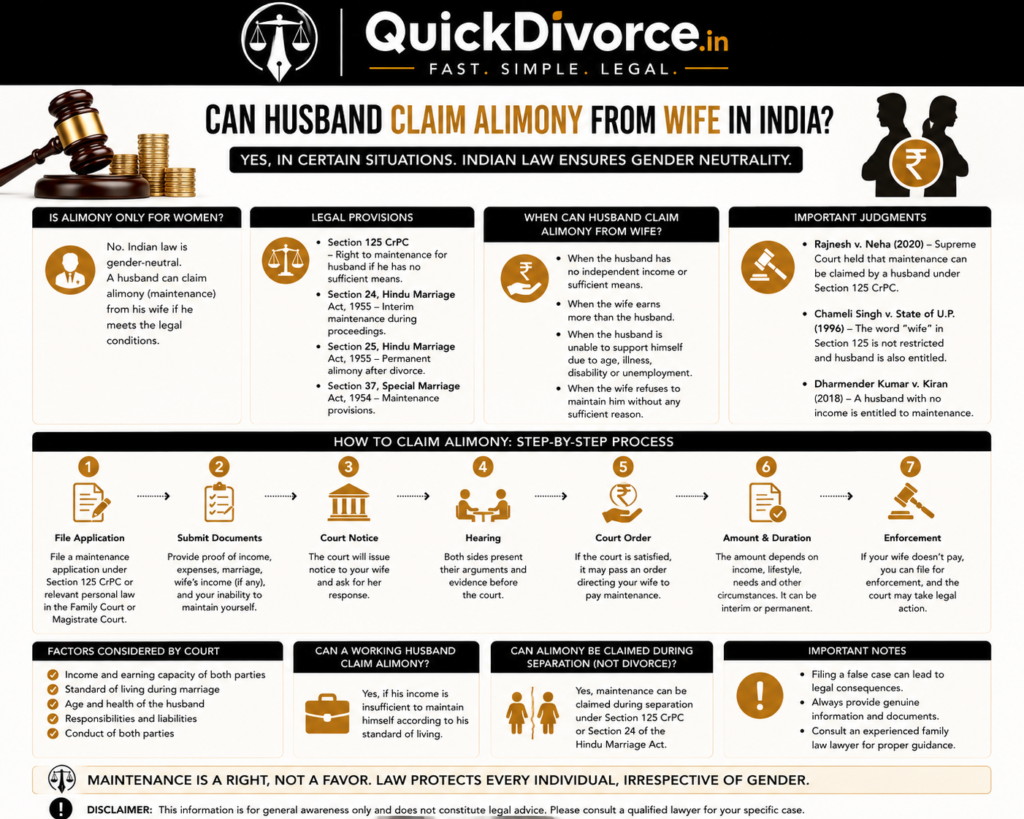
- 3 The Short Answer: Yes, a Husband Can Claim Alimony from His Wife in India
- 4 Laws That Allow a Husband to Claim Alimony from His Wife
- 5 When Will the Court Actually Grant Alimony to a Husband?
- 6 When Will the Court Reject a Husband’s Alimony Claim?
- 7 Key Factors Courts Consider When Deciding Alimony Amount
- 8 Types of Alimony a Husband Can Claim
- 9 Important Supreme Court Judgments on Alimony in India (2024-2025)
- 10 How to Claim Alimony as a Husband — Step by Step
- 11 Social Reality: The Practical Challenges Husbands Face
- 12 Frequently Asked Questions (FAQs)
- 13 Conclusion: The Law Is Clear — The Stigma Is Changing
- 14 Get Expert Legal Solutions on : Can Husband Claim Alimony?
Introduction
When most people in India think of alimony, they automatically picture the husband paying the wife. That assumption is deeply rooted in tradition — but it is not what the law says.
The truth is that Indian law on alimony is gender-neutral. A husband can legally claim alimony from his wife. If he is financially dependent, unemployed, ill, or earning significantly less than his wife, he has the legal right to approach the court and seek maintenance. Whether the court grants it is a different question — but the legal right exists clearly and unambiguously.
This is a topic that is increasingly relevant in modern India, where wives are now often higher earners, breadwinners, or professionals while husbands may be students, artists, caregivers, or individuals dealing with health conditions. Understanding this right — what the law says, when courts grant it, and how to claim it — is essential for both men and women navigating a separation or divorce.
This blog covers everything you need to know.
What Is Alimony and How Is It Different from Maintenance?
Before diving into whether a husband can claim it, it is important to understand the difference between two terms that are often used interchangeably — alimony and maintenance.
Maintenance is a broader legal concept. It refers to the financial support one spouse provides to the other during the subsistence of marriage, during separation, or after a final court decree. It can also include support for children and dependent parents.
Alimony is a specific type of financial support given after divorce. It is meant to ensure that neither spouse faces severe financial hardship after the marriage is dissolved. Alimony can be awarded as a monthly payment or as a one-time lump sum.
In India, the terms are often used interchangeably in everyday language. For the purpose of this guide, we will use both terms together — understanding that maintenance can be claimed even without divorce, while alimony is typically associated with post-divorce financial support.
The Short Answer: Yes, a Husband Can Claim Alimony from His Wife in India
Many people think only wives can ask for maintenance, but under Indian law, even husbands can claim it in certain situations.
Any spouse — husband or wife — can claim alimony under Indian laws if they are unable to maintain themselves after divorce. The court considers multiple factors before granting alimony, including the financial status of both spouses, the duration of the marriage, age and health condition, standard of living during marriage, and custody of children.
Under Sections 24 and 25 of the Hindu Marriage Act, men can also claim alimony if they are financially dependent, their spouse has a significantly higher income, or they have no sufficient means to maintain the marital standard of living. Courts evaluate the husband’s health, qualifications, and income disparity before granting support.
This is a settled position in Indian law. The statutes are gender-neutral. The practical challenge is proving that the husband genuinely needs financial support — because courts are understandably cautious about granting maintenance to a man who is capable of earning but chooses not to.
Laws That Allow a Husband to Claim Alimony from His Wife
India’s alimony law is scattered across multiple statutes depending on the religion of the parties and the nature of the marriage. Here is a complete breakdown of the relevant laws.
Section 24 of the Hindu Marriage Act, 1955 — Interim Maintenance
Section 24 is for interim maintenance — meaning support during ongoing divorce or separation cases. If the husband does not have enough income to take care of himself and the wife is earning well, he can ask the court for maintenance. The law is not gender-specific, so it applies to both husband and wife.
Under Section 24, a husband can also claim the cost of litigation expenses — meaning the legal fees needed to fight the divorce case — from his wife if she earns significantly more than him. This is particularly relevant when the wife has hired expensive lawyers and the husband lacks the financial resources to adequately defend himself.
Section 25 of the Hindu Marriage Act, 1955 — Permanent Alimony
Section 25 is for permanent alimony — money given after divorce is final. If the husband is unemployed, sick, or earning very little, and the wife has enough income, he can request long-term financial support. The court looks at things like income, lifestyle, and health before making a decision.
Permanent alimony under Section 25 can be awarded as a monthly recurring amount or as a lump sum payment. Courts also have the power to modify or revoke a maintenance order if the circumstances of either spouse change significantly after the award — for instance, if the husband gets a good job or the wife loses her income.
Section 144 of the Bharatiya Nagarik Suraksha Sanhita (BNSS), 2024 — Replacing Section 125 CrPC
There is a shift towards a gender-neutral and a need-based approach while granting maintenance or alimony, as quantum is not just about numbers, but it is also about fairness, balance, and survival.
The Bharatiya Nagarik Suraksha Sanhita, which came into force in July 2024, replaced the Code of Criminal Procedure. Section 144 of the BNSS corresponds to Section 125 of the old CrPC. This law is for everyone, no matter which religion they follow. If a husband cannot maintain himself due to illness, job loss, or any valid reason, and his wife can afford to support him, he can apply for maintenance under this section.
This is significant because Section 144 BNSS applies across all religions — Hindus, Muslims, Christians, Sikhs, and others. A husband of any religion can invoke it.
Special Marriage Act, 1954 — Sections 36 and 37
For couples who marry under the Special Marriage Act — usually inter-religion or civil marriages — Sections 36 and 37 allow both husband and wife to claim maintenance. Just like the Hindu Marriage Act, it covers both interim and permanent maintenance depending on the situation.
Muslim Law
Under Muslim personal law, a husband is the traditional provider and a wife’s claim to maintenance (Mehr and Iddat) is well-established. However, a Muslim husband seeking maintenance from his wife would need to approach through the secular route — Section 144 of the BNSS — rather than through Muslim personal law, which does not provide for this scenario.
Christian Law
Christian women can claim maintenance under Section 36 during divorce proceedings and Section 37 for post-divorce support. Either spouse can claim maintenance under Sections 39 and 40, depending on financial status and conduct during marriage.
When Will the Court Actually Grant Alimony to a Husband?
Knowing the law is one thing. Knowing what conditions a court actually looks for before granting alimony to a husband is entirely different — and this is where the real practical guidance lies.
Courts in India apply a need-based test. The husband must demonstrate that he genuinely cannot support himself. The following conditions, when proven, significantly increase the chances of a husband successfully claiming alimony.
The husband has no independent income or source of livelihood. The husband is suffering from a serious illness or physical disability that prevents him from working. The husband has been unemployed for a sustained period due to circumstances beyond his control — such as a business failure, layoff, or medical condition. The wife has a significantly higher income and the couple enjoyed a certain standard of living during marriage that the husband cannot maintain on his own. The husband has sacrificed his career or education for the benefit of the family or the wife’s career — for example, a husband who gave up his job to care for children or elderly parents at the wife’s request. The husband has custody of the children and needs financial support to raise them.
If a husband files for maintenance, the court considers the financial capability of both spouses, the husband’s earning capacity, health conditions preventing employment, the wife’s income, assets, and liabilities, and the standard of living during the marriage.
When Will the Court Reject a Husband’s Alimony Claim?
Courts are equally clear about the situations where a husband’s claim will not succeed.
Courts do not encourage idleness. If a husband is capable of earning but chooses not to, his claim for alimony will likely be rejected.
Even if the wife is earning well, if the man can work, the court may deny his claim.
A claim will also be rejected if the husband is found to have hidden assets or income to appear financially dependent when he is not. Courts require full and transparent disclosure — both spouses must submit detailed affidavits of their income, assets, and liabilities, as mandated by the Supreme Court in Rajnesh v. Neha (2021).
If the husband has been found guilty of cruelty, adultery, or desertion — the very grounds on which the divorce is being sought — courts may deny or significantly reduce his maintenance claim. If a spouse is proven guilty of adultery, courts may deny or reduce their alimony claim.
Additionally, in the landmark case of Nivya V M v. Shivaparsad M K (2017), the Kerala High Court ruled that a financially capable husband cannot seek maintenance from his wife, as it would promote idleness. This reasoning has been consistently applied by courts across India.
Key Factors Courts Consider When Deciding Alimony Amount
When a court does decide to grant alimony to a husband, the following eight factors — reiterated by the Supreme Court in 2024 and 2025 — guide the quantum:
The conduct of the parties, including cruelty, desertion, or infidelity, is the first factor considered. Courts also look at the income and assets of both parties, the standard of living maintained during the marriage, the needs of the claimant, and the ability of the paying spouse to provide support.
Additional factors include the age and health of both spouses, the duration of the marriage, whether there are dependent children, and the future earning potential of the person claiming maintenance.
There is no fixed formula. Courts decide the amount based on several factors. The Supreme Court has observed that 25% of the net salary of the paying spouse may be a fair benchmark in some cases. However, this is not a strict rule and varies based on circumstances.
Types of Alimony a Husband Can Claim
Understanding the different types of alimony helps a husband decide what to ask for based on his specific situation.
Interim Alimony — This is temporary maintenance paid during the pendency of divorce proceedings. A husband can claim this under Section 24 of the Hindu Marriage Act to cover his day-to-day expenses and legal costs while the case is going on in court.
Permanent Alimony — This is long-term financial support paid after the divorce is finalised. It can be monthly or as a lump sum. A husband can claim this under Section 25 of the Hindu Marriage Act if he can demonstrate sustained financial need.
Rehabilitative Alimony — This is a time-bound form of alimony, typically given for a fixed period of three to seven years, to allow the financially weaker spouse to become self-sufficient. This is particularly relevant for a husband who needs time to retrain, find employment, or recover from an illness.
Compensatory Alimony — This applies when one spouse has sacrificed their career, education, or professional growth for the benefit of the marriage or the other spouse. If a husband gave up his career to support his wife’s professional ambitions or to raise the children, compensatory alimony acknowledges that sacrifice financially.
Lump Sum Alimony — Instead of monthly payments, a court can award a single, one-time lump sum payment that settles the alimony obligation permanently. This is often preferred in situations where ongoing monthly disputes are likely.
Important Supreme Court Judgments on Alimony in India (2024-2025)
Rakhi Sadhukhan v. Raja Sadhukhan (May 2025)
In a precedent-setting judgment, India’s Supreme Court significantly increased permanent alimony for a divorced but unmarried wife from Rs 20,000 to Rs 50,000 per month, along with a 5% hike every two years. The court also upheld the transfer of her ex-husband’s house to her name. While this case involved a wife claiming alimony, it established critical principles that apply equally to any alimony claim — inflation adjustment, standard of living during marriage as the benchmark, and the fact that a remarriage does not cancel the duty toward the first spouse.
ABC v. State of Maharashtra (August 2025)
The Supreme Court refused to grant alimony to the wife in this case, holding that where the husband is genuinely unemployed, the claim for alimony is not justified. The key takeaway is that alimony in India is about the ability to pay. If the husband is unemployed and genuinely unable to earn, courts will not impose alimony — even if the wife claims she needs it. The reverse principle applies equally — if a wife is genuinely unable to pay, a husband’s claim for alimony will also not succeed.
Shakti v. Anita (2025)
In Shakti v. Anita (2025), stark educational and financial disparities between spouses influenced the quantum of alimony, reflecting equity-based reasoning. This judgment reinforces that courts look at the actual financial gap between spouses — not just whether one person technically earns something.
Parveen Kumar Jain v. Anju Jain (January 2025)
In Parveen Kumar Jain v. Anju Jain (2025), the Supreme Court imposed a one-time settlement of several crores, stressing full income disclosure and fair rehabilitation of the dependent spouse. This establishes that courts take a serious view of non-disclosure of income and can award significant amounts when the paying spouse has hidden their true financial position.
How to Claim Alimony as a Husband — Step by Step
If you are a husband who believes you have a valid claim for alimony from your wife, here is the practical process to follow.
Step 1 — Consult a Family Law Advocate. Alimony cases involving a husband claiming from a wife are relatively uncommon in Indian courts, and they require careful and strategic legal handling. An experienced family law advocate will assess whether your case has merit and advise you on the best approach.
Step 2 — Gather All Financial Documentation. Prepare comprehensive documentation of your financial position. This includes your bank statements for the last 12 to 24 months, income tax returns or proof of lack of income, medical records if illness is a factor, proof of assets and liabilities, and documentation of your wife’s income — salary slips, business records, bank statements, or tax returns.
Step 3 — File a Petition in Family Court. You need to file a petition in the Family Court having jurisdiction over your case — typically where you last resided together as a couple or where the divorce case is being heard. Under Section 24 of the Hindu Marriage Act, you can seek interim maintenance as part of the main divorce proceedings. Under Section 144 BNSS, you can file a separate maintenance application regardless of whether a divorce petition has been filed.
Step 4 — Submit Income Affidavit. Both you and your wife will be required to submit detailed affidavits disclosing your income, assets, liabilities, and expenses. Honesty in this affidavit is critical — courts have consistently penalised parties who are found to have misrepresented their financial position.
Step 5 — Attend Hearings and Present Evidence. Be prepared to attend multiple court hearings. Your lawyer will present evidence of your financial need and your wife’s ability to pay. Cross-examination of witnesses and documentary evidence will be critical to the court’s decision.
Step 6 — Court Order and Enforcement. If the court grants maintenance, it will issue a formal order specifying the amount and the schedule of payment. If your wife does not comply with the court’s order, you can file an application for execution of the decree. Courts can enforce payment through attachment of property, salary garnishment, or contempt of court proceedings.
Social Reality: The Practical Challenges Husbands Face
It is important to be honest about the practical landscape. While the law is gender-neutral, the social and judicial reality is more complex.
India is still largely a society where men are expected to earn and provide. If a husband asks for alimony, society starts judging him — calling him weak, useless, or dependent. This pressure stops many men from even thinking about claiming what is legally theirs.
For a husband to get maintenance, he has to prove that he genuinely cannot support himself. This is not easy. Courts look at his past jobs, education, assets, and even his potential to earn in the future. Even if the wife is earning well, if the man can work, the court may deny his claim.
This is the honest reality. The law gives husbands the right. But the courts apply a high standard of proof, and societal assumptions still influence how these cases are viewed. That said, with increasing financial independence among women, the law must continue to evolve towards a need-based and gender-neutral approach, recognising that husbands may also be entitled to maintenance in deserving cases.
The trend is moving in the right direction. Cases are being decided on financial facts rather than gender assumptions. A husband with a genuine case, properly presented, has a real chance of succeeding.
Frequently Asked Questions (FAQs)
1. Can a husband claim alimony from his wife in India?
Yes. In certain circumstances, a husband may claim maintenance or alimony from his wife under applicable Indian laws if he is unable to maintain himself and the legal requirements are satisfied. Whether such a claim succeeds depends on the facts of each case and the relevant legal provisions.
2. Under what circumstances can a husband seek alimony?
A husband may seek alimony if he is financially dependent, unable to earn due to genuine reasons such as illness or disability, or if other legal conditions are met. The court considers the facts and evidence before deciding the claim.
3. Does a husband automatically get alimony from his wife?
No. A husband does not automatically become entitled to alimony. The court examines factors such as the financial condition of both spouses, their income, earning capacity, liabilities, and the circumstances of the case before granting any relief.
4. What factors do courts consider while deciding a husband’s alimony claim?
Courts generally consider the income and assets of both spouses, their standard of living, financial needs, employment status, health, age, and other relevant circumstances before deciding whether maintenance or alimony should be awarded.
5. Can a working husband claim alimony from his wife?
A working husband may still seek alimony in certain cases if he can establish that his income is insufficient to maintain himself and the legal requirements are met. The court decides each case based on its specific facts.
6. Is permanent alimony available to husbands in India?
Depending on the applicable law and the circumstances of the case, a court may grant permanent alimony or maintenance to a husband if he is legally entitled to such relief. The decision is based on the evidence presented before the court.
7. Should a husband consult a lawyer before filing an alimony claim?
Yes. Consulting an experienced family law advocate is advisable before filing an alimony claim. A lawyer can assess the facts, explain the applicable legal provisions, help prepare the required documents, and guide the husband through the legal process.
Conclusion: The Law Is Clear — The Stigma Is Changing
A husband’s right to claim alimony from his wife in India is not a loophole or an exception. It is a clearly stated, well-established legal right that exists under multiple statutes. The shift toward gender-neutral, need-based alimony is not a future ambition — it is already reflected in recent Supreme Court judgments from 2024 and 2025.
That said, the practical path for a husband seeking alimony is harder than for a wife. The proof standard is high. The social stigma is real. And courts are rightly cautious about granting maintenance to someone who has the ability to earn but simply prefers not to.
The guiding principle is simple: alimony in India follows financial need, not gender. If you are a husband who genuinely cannot support yourself, the law is on your side. Get proper legal advice, gather your evidence, and approach the court with a clear, honest, and well-documented case.
Get Expert Legal Solutions on : Can Husband Claim Alimony?
🟡QuickDivorce offers trusted online legal services across India, including mutual divorce, contested divorce, child custody, alimony, marriage registration, and expert family law consultation.
👉 Mutual Consent Divorce
👉 Contested Divorce Filing
👉 Child Custody and Maintenance
👉 Matrimonial Property Settlement
👉 NRI Divorce Services
👉 Alimony and Maintenance
🟡 Protect Your Rights
👉 Domestic Violence Legal Support
👉 Stridhan Recovery
🟡For other Legal and Trademark related services visit
👉 Money Recovery Cases
👉 Property Disputes
👉 Business & Licence Registrations
📞 Call Now: +91 8595439395
🕐 Free Consultation: Monday to Saturday, 10 AM to 6 PM

Adv. Manish Kashyap is a Family Law & Divorce Lawyer with extensive experience in Mutual & Contested Divorce, NRI Divorce, Child Custody, Alimony, Domestic Violence, Judicial Separation, and Family Court matters, providing professional legal guidance to clients.

