

Views: 6
Table of Contents
- 1 Quick Summary
- 2 📌 What Is Bigamy in India?
- 3 📜 IPC Section 494 — The Exact Legal Definition
- 4 ✅ Essential Elements of Bigamy Under Indian Law
- 5 🔒 What Is the Punishment for Bigamy in India?
- 6 🕌 Which Personal Laws Govern Bigamy in India?
- 7 🚫 Exceptions to Bigamy Law in India
- 8 💔 Bigamy and Divorce — The Critical Connection
- 9 📋 How to File a Bigamy Complaint in India
- 10 🔍 Evidence Required to Prove Bigamy in India
- 11 ⚖️ Bigamy vs Void and Voidable Marriages in India
- 12 📰 Notable Bigamy Cases in India
- 13 🛡️ Common Defences Used in Bigamy Cases
- 14 🌟 How Quick Divorce Helps Victims of Bigamy in India
- 15 💰 Cost Breakdown: Bigamy Case in India
- 16 ❓ Frequently Asked Questions (FAQs)
- 17 🎯 Who Needs This Guide Right Now?
- 18 ✅ Final Recommendation
- 19 Need Help With Legal services ?
Quick Summary
Bigamy in India means marrying a second time while the first marriage is still legally valid and subsisting. It is a criminal offence under Section 494 of the Indian Penal Code.
Here is what you need to know:
- ⚖️ Definition — Bigamy is contracting a second marriage while the first spouse is alive and the first marriage has not been legally dissolved
- 🔒 Punishment — Up to 7 years imprisonment and fine under IPC Section 494
- 👥 Who it applies to — Hindus, Christians, Parsis and others governed by personal laws that prohibit polygamy. Muslims are a notable exception under personal law
- 📋 Proof required — Two valid marriages must be proven beyond reasonable doubt
- 🚨 How to act — File an FIR or complaint before a magistrate with documentary evidence of both marriages
- ✅ Quick Divorce helps victims of bigamy with legal consultation, complaint filing and divorce proceedings
If your spouse has secretly married again without divorcing you, this guide tells you exactly what your rights are and what to do.
📌 What Is Bigamy in India?
Bigamy in India is the act of a person contracting a second marriage while their first marriage is still legally subsisting — meaning the first spouse is alive and no legal divorce has been obtained.
The word bigamy comes from the Latin words “bi” (two) and “gamos” (marriage). In simple terms — it is being married to two people at the same time.
In India, bigamy is both:
- A criminal offence — punishable under IPC Section 494 with imprisonment up to 7 years
- A ground for divorce — the aggrieved first spouse can file for divorce on the ground of bigamy
Bigamy in India is particularly significant because India is a country with multiple personal laws governing marriage. What constitutes bigamy — and whether it is an offence at all — depends significantly on the religion of the parties involved.
The core principle: Under Indian law, a valid second marriage cannot be contracted while the first marriage is legally subsisting. Attempting to do so is a criminal offence and voids the second marriage.
📜 IPC Section 494 — The Exact Legal Definition
Section 494 of the Indian Penal Code 1860 defines bigamy as follows:
“Whoever, having a husband or wife living, marries in any case in which such marriage is void by reason of its taking place during the life of such husband or wife, shall be punished with imprisonment of either description for a term which may extend to seven years, and shall also be liable to fine.”
Breaking this down into plain language:
“Having a husband or wife living” — The first spouse must be alive. Bigamy requires the first spouse to be living at the time the second marriage is contracted.
“Marries” — A second marriage ceremony must actually take place. Merely living with another person or having an affair does not constitute bigamy.
“In any case in which such marriage is void” — The second marriage is legally void — meaning it has no legal validity whatsoever — precisely because the first marriage is still subsisting.
“Shall be punished with imprisonment…which may extend to seven years” — The maximum punishment is 7 years imprisonment plus fine. The minimum is at the court’s discretion.
Section 495 — Bigamy with Concealment of Former Marriage
Section 495 IPC is an aggravated form of the offence:
“Whoever commits the offence defined in the last preceding section having concealed from the person with whom the subsequent marriage is contracted, the fact of the former marriage, shall be punished with imprisonment of either description for a term which may extend to ten years, and shall also be liable to fine.”
This means: if the bigamist hid the existence of the first marriage from the second spouse — the punishment increases to up to 10 years imprisonment.
Section 495 protects the second spouse (who was deceived) in addition to the first spouse.
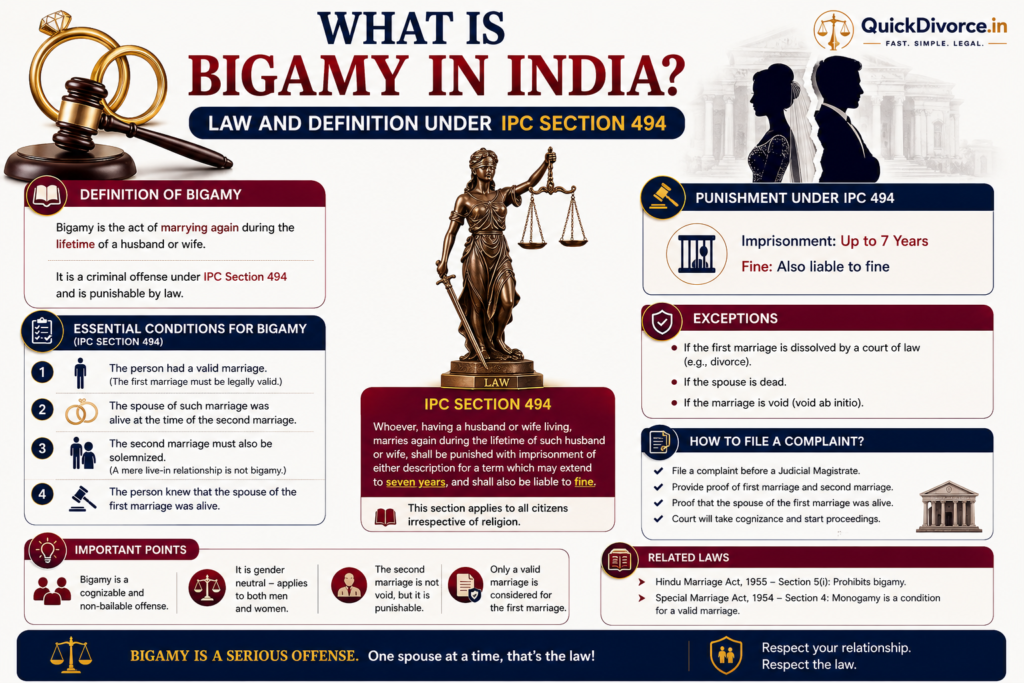
✅ Essential Elements of Bigamy Under Indian Law
For bigamy in India to be legally established and a conviction to follow, all of the following elements must be proven beyond reasonable doubt:
Element 1: A Valid First Marriage Must Have Existed
The first marriage must have been legally valid under the applicable personal law. An invalid or void first marriage cannot ground a bigamy charge.
This means:
- The first marriage must have been performed according to the required ceremonies and rituals under the applicable law
- Both parties must have had the legal capacity to marry at the time of the first marriage
- The first marriage must have been duly solemnized
Element 2: The First Spouse Must Be Alive
Bigamy requires the first spouse to be living at the time the second marriage is contracted.
If the first spouse has died — there is no bigamy. A widower or widow is free to remarry.
If the first spouse has been missing for 7 or more years and is legally presumed dead under Section 108 of the Indian Evidence Act — this provides a defence to bigamy (discussed further below).
Element 3: No Valid Divorce or Annulment
The first marriage must still be legally subsisting. If the first marriage has been legally dissolved by:
- A court divorce decree under the applicable personal law
- A court annulment
Then there is no bigamy — the person is legally free to remarry.
Critical point: A divorce that is not legally recognised in India does not count. Merely going through a customary separation, an informal “agreement to divorce” or obtaining a divorce decree from a foreign court that is not recognised in India does not dissolve the first marriage for the purpose of bigamy law.
Element 4: A Second Marriage Must Have Been Contracted
A second marriage ceremony must have actually taken place. The prosecution must prove that a second marriage was performed with the required ceremonies.
Merely cohabiting with another person, having an affair or entering into a live-in relationship does not constitute bigamy under IPC Section 494.
However, courts have held that the second ceremony need not be legally perfect — it only needs to have been performed in a form recognizable as a marriage under the applicable law.
Element 5: Both Marriages Must Involve the Same Person
The same person must have contracted both marriages. This sounds obvious but is sometimes relevant where identity is disputed.
🔒 What Is the Punishment for Bigamy in India?
Under IPC Section 494
| Aspect | Details |
|---|---|
| Maximum imprisonment | 7 years |
| Type of imprisonment | Simple or rigorous (court’s discretion) |
| Fine | Yes, in addition to imprisonment |
| Minimum imprisonment | No mandatory minimum — court’s discretion |
| Nature of offence | Non-cognizable, bailable |
| Trial | By Magistrate of First Class |
Under IPC Section 495 (With Concealment)
| Aspect | Details |
|---|---|
| Maximum imprisonment | 10 years |
| Type of imprisonment | Simple or rigorous (court’s discretion) |
| Fine | Yes, in addition to imprisonment |
| Applicable when | First marriage concealed from second spouse |
| Nature of offence | Non-cognizable, bailable |
Important Procedural Point — Non-Cognizable Offence
Bigamy under IPC Section 494 is a non-cognizable offence. This means:
- Police cannot arrest the accused without a warrant
- Police cannot investigate without a magistrate’s order
- The aggrieved party must file a complaint directly before a Magistrate of First Class (not just an FIR at a police station)
This is a critical procedural point that many victims of bigamy are unaware of. Filing an FIR at a police station is often not the correct first step — filing a complaint before a magistrate is.
🕌 Which Personal Laws Govern Bigamy in India?
Bigamy in India is governed by a combination of IPC Section 494 and the applicable personal laws. The position varies significantly by religion:
Hindus, Buddhists, Sikhs and Jains
Governed by: Hindu Marriage Act 1955
Position: Bigamy is absolutely prohibited. Section 5 of the Hindu Marriage Act makes monogamy a mandatory condition of valid marriage. Section 17 of the Hindu Marriage Act specifically makes bigamy an offence punishable under IPC Sections 494 and 495.
A second marriage contracted by a Hindu while the first subsists is void ab initio — meaning it never had any legal existence from the beginning.
Christians
Governed by: Indian Christian Marriage Act 1872 and Indian Divorce Act 1869
Position: Bigamy is prohibited and constitutes an offence under IPC Section 494. Christian personal law requires monogamy.
Parsis
Governed by: Parsi Marriage and Divorce Act 1936
Position: Bigamy is prohibited. The Parsi Marriage and Divorce Act specifically prohibits polygamy. Bigamy is an offence under IPC Section 494.
Muslims
Governed by: Muslim Personal Law (Shariat) Application Act 1937
Position: This is the most significant exception. Under Muslim personal law as applied in India, a Muslim man is permitted to have up to four wives simultaneously — subject to conditions including equal treatment of all wives.
As a result: IPC Section 494 does not apply to Muslim men marrying a second, third or fourth wife, provided this is done in accordance with Muslim personal law.
However:
- A Muslim woman cannot have more than one husband — polyandry is prohibited
- A Muslim man who converts to Islam solely to contract a second marriage (having previously been Hindu or of another religion) does not get the benefit of this exception — the Supreme Court has addressed such cases
Special Marriage Act
Governed by: Special Marriage Act 1954
Position: Monogamy is mandatory. Any marriage under the Special Marriage Act (regardless of the religion of the parties) prohibits bigamy. If either party was previously married under the Special Marriage Act and that marriage subsists, a second marriage is an offence.
🚫 Exceptions to Bigamy Law in India
There are specific situations in which what appears to be bigamy is legally excused:
Exception 1: First Spouse Presumed Dead (Section 108 Indian Evidence Act)
If a person has not been heard of for 7 years or more by those who would naturally have heard from them, they are presumed dead under Section 108 of the Indian Evidence Act.
In such cases, the surviving spouse can remarry without committing bigamy — because the first spouse is legally presumed to be dead.
Important: This presumption can be rebutted. If the first spouse later reappears alive, the situation becomes legally complex and requires specialist legal advice.
Exception 2: Marriage Declared Void by Court
If the first marriage has been declared void by a competent court through a decree of nullity — the person is free to remarry. This is not bigamy because the first marriage legally never existed (once annulled).
Exception 3: Valid Divorce Decree
If a valid divorce decree has been granted by a competent court and has become final — the person is free to remarry. There is no bigamy because the first marriage has been legally dissolved.
Critical warning: The divorce decree must be legally valid and final. A divorce that is under appeal, a foreign divorce not recognized in India, or a customary divorce not recognized under the applicable personal law does not dissolve the marriage for bigamy purposes.
💔 Bigamy and Divorce — The Critical Connection
Bigamy and divorce are closely intertwined in Indian law.
Bigamy as a Ground for Divorce
Under most Indian personal laws, bigamy by one spouse gives the other spouse a ground to file for divorce.
Under Hindu Marriage Act 1955 (Section 13): A spouse can petition for divorce on the ground that the respondent “has, after the solemnisation of the marriage, married again.”
Under Special Marriage Act 1954: Similar provision — bigamy is a ground for divorce.
Under Indian Divorce Act 1869: A Christian wife can file for divorce on the ground of bigamy combined with cruelty or desertion.
Sequence Matters: Divorce First, Then Remarriage
One of the most common situations that gives rise to bigamy charges is a spouse who:
- Separates from their first spouse
- Believes the marriage is “effectively over”
- Remarries without obtaining a legal divorce decree
This is bigamy — regardless of how long the separation has been, how hostile the relationship is or how “agreed” the separation was between the parties. Without a court divorce decree, the first marriage is still legally subsisting.
The rule is simple and non-negotiable: Divorce decree first. Second marriage after. Any other sequence is bigamy.
📋 How to File a Bigamy Complaint in India
Since bigamy is a non-cognizable offence, the process for filing a complaint is different from most criminal cases.
Step 1: Consult a Family Law Specialist
Before filing anything, get legal advice. Quick Divorce offers a ₹499 consultation with experienced family law specialists who can assess your case, confirm whether the elements of bigamy are established and advise on the correct legal strategy.
Step 2: Gather Evidence
Collect all evidence establishing:
- The validity of your first marriage (marriage certificate, photographs, witnesses)
- That your first marriage has not been legally dissolved (no divorce decree)
- That your spouse has contracted a second marriage (marriage certificate of second marriage, photographs, witnesses, testimony)
Step 3: Send a Legal Notice (Optional but Recommended)
In many cases, Quick Divorce recommends sending a formal legal notice to the bigamist spouse before filing a criminal complaint. This:
- Creates a formal record
- Sometimes resolves the matter without litigation
- Establishes a timeline that strengthens the subsequent complaint
Step 4: File a Complaint Before a Magistrate
Since bigamy is non-cognizable, you file a private complaint under Section 200 of the Code of Criminal Procedure before a Judicial Magistrate of First Class in the jurisdiction where the second marriage took place or where the accused resides.
The complaint must:
- State all the facts establishing the elements of bigamy
- Be accompanied by supporting documents
- Be sworn and signed before the magistrate
Step 5: Magistrate’s Inquiry
The magistrate examines the complaint and may:
- Take cognizance immediately
- Direct an inquiry by a magistrate
- Direct a police investigation under Section 202 CrPC
Step 6: Issue of Process
If the magistrate is satisfied that the case merits proceeding, they issue summons or warrant to the accused.
Step 7: Trial
The case proceeds to trial before the magistrate. Evidence is led, witnesses are examined and cross examined, and judgment is delivered.
🔍 Evidence Required to Prove Bigamy in India
Evidence is the foundation of any successful bigamy case. Here is exactly what is needed:
Evidence of the First Marriage
- 📜 Marriage certificate of the first marriage
- 📸 Wedding photographs and video recordings
- 💒 Marriage invitation card
- 👥 Testimony of witnesses present at the first marriage ceremony
- 📋 Marriage registration records from the registrar
Evidence That First Marriage Is Still Subsisting
- 📄 Confirmation that no divorce decree has been obtained — this can be established by the absence of any divorce court record
- ✅ Affidavit confirming the first spouse is alive
- 📝 Any recent communication between the parties establishing the first spouse’s existence
Evidence of the Second Marriage
- 📜 Marriage certificate of the second marriage
- 📸 Photographs and videos of the second marriage ceremony
- 💒 Second marriage invitation card
- 👥 Testimony of witnesses present at the second marriage
- 📋 Any registration or documentation of the second marriage
Supporting Evidence
- 📱 WhatsApp messages, emails or other communications in which the accused acknowledges the second marriage
- 📰 Newspaper announcements of the second marriage
- 🏡 Evidence of cohabitation with the second spouse
- 💰 Financial records — joint bank accounts, property documents, insurance nominations in the name of the second spouse
- 👶 Birth certificates of children born of the second marriage (if any)
⚖️ Bigamy vs Void and Voidable Marriages in India
Understanding the distinction between void and voidable marriages is important in the context of bigamy:
Void Marriage
A marriage contracted in violation of Section 5 of the Hindu Marriage Act (including the prohibition on bigamy) is void ab initio — it never had any legal existence.
This means:
- The second spouse has no legal marital status
- Children of a void bigamous marriage may still have rights of inheritance in some circumstances (as clarified by the Supreme Court)
- The bigamist cannot claim any matrimonial rights from the second marriage
Voidable Marriage
Some marriages are voidable — meaning they are valid until one party seeks to have them annulled. Bigamous marriages are void, not merely voidable — meaning they do not require a court order to be invalid. They are invalid from the moment they are contracted.
Impact on the Second Spouse
The second spouse — if they were deceived about the existence of the first marriage — is an innocent victim. They have:
- No valid marriage (the marriage is void)
- A potential claim under Section 495 IPC if they were deceived
- The right to file for maintenance in some circumstances depending on the facts
📰 Notable Bigamy Cases in India
Sarla Mudgal vs Union of India (1995)
This landmark Supreme Court judgment addressed the practice of Hindu men converting to Islam solely to contract a second marriage without divorcing their first Hindu wife.
The Supreme Court held that a Hindu husband who converts to Islam and remarries without dissolving his first marriage under the Hindu Marriage Act is guilty of bigamy under IPC Section 494. Conversion to Islam does not automatically dissolve a Hindu marriage.
This judgment is one of the most significant on bigamy in India and firmly closed the loophole of religious conversion as a tool to circumvent bigamy law.
Lily Thomas vs Union of India (2000)
The Supreme Court reaffirmed the Sarla Mudgal ruling and held that the conversion of a Hindu to Islam for the purpose of contracting a second marriage does not have the effect of dissolving the first marriage under Hindu law. The second marriage is void and the accused is guilty of bigamy.
Yamunabai Anantrao Adhav vs Anantrao Shivram Adhav (1988)
The Supreme Court held that a marriage contracted in violation of Section 5 of the Hindu Marriage Act is void — and a void marriage does not give rise to the rights of a legally wedded wife. This case highlighted the harsh consequences for second wives in bigamous marriages.
🛡️ Common Defences Used in Bigamy Cases
Accused persons in bigamy cases in India commonly raise the following defences:
Defence 1: The First Marriage Was Not Valid Arguing that the first marriage was not properly solemnized, lacked the required ceremonies or was otherwise invalid. Courts examine this carefully — if the first marriage was genuinely invalid, there is no bigamy.
Defence 2: The First Spouse Was Presumed Dead Arguing that the first spouse had been missing for 7 or more years and was presumed dead under Section 108 of the Indian Evidence Act. This is a valid legal defence if properly established.
Defence 3: A Valid Divorce Had Been Obtained Arguing that a valid divorce decree had been obtained before the second marriage. This requires producing the actual court divorce decree. Courts scrutinize the validity and timing of divorce decrees carefully in bigamy cases.
Defence 4: The Second “Marriage” Was Not a Legal Marriage Arguing that the second ceremony was not a legally valid marriage — merely a religious ceremony, a customary function or a social event. Courts assess whether what took place constituted a legally recognizable marriage.
Defence 5: Personal Law Exception (Muslim Law) For Muslim accused, arguing that the second marriage was validly contracted under Muslim personal law which permits up to four wives.
🌟 How Quick Divorce Helps Victims of Bigamy in India
Quick Divorce provides comprehensive assistance to victims of bigamy in India — both for the criminal proceedings under IPC Section 494 and for the connected divorce proceedings.
Services for Bigamy Victims
Legal Consultation A ₹499 consultation with an experienced family law specialist who assesses your case, confirms whether the elements of bigamy are made out and advises on the correct legal strategy — criminal complaint, divorce or both.
Evidence Assessment Quick Divorce reviews the evidence you have, identifies what additional evidence is needed and guides you on how to obtain it.
Legal Notice to Bigamist Spouse A formal legal notice drafted and sent to the bigamist spouse — putting them on notice that their bigamy has been discovered and demanding appropriate action. This often prompts a quick settlement.
Magistrate Complaint Preparation and Filing Quick Divorce prepares and assists in filing the complaint before the appropriate magistrate — ensuring it is correctly drafted, factually complete and supported by all required evidence.
Divorce Petition on Ground of Bigamy Quick Divorce prepares and files a divorce petition on the ground of bigamy — allowing the first spouse to legally dissolve the marriage and move forward with their life.
Maintenance and Alimony Claims In addition to divorce, the first spouse may be entitled to maintenance and alimony. Quick Divorce includes these claims in the divorce petition.
Stridhan Recovery Where the bigamist has also withheld the first wife’s stridhan, Quick Divorce handles stridhan recovery alongside the bigamy proceedings.
Quick Divorce Services and Pricing
| Service | Price |
|---|---|
| Initial Legal Consultation | ₹499 |
| Legal Notice to Bigamist Spouse | ₹1,999 |
| Magistrate Complaint Assistance | ₹4,999 onwards |
| Divorce on Ground of Bigamy | ₹9,999 onwards |
| Combined Bigamy Complaint and Divorce | ₹12,999 onwards |
| Full Legal Representation | Custom quote |
Book Your Bigamy Case Consultation with Quick Divorce →
💰 Cost Breakdown: Bigamy Case in India
| Cost Item | Estimated Cost |
|---|---|
| Initial legal consultation | ₹499 |
| Legal notice to bigamist | ₹1,999 |
| Magistrate complaint drafting and filing | ₹4,999 onwards |
| Court fees | ₹500 to ₹2,000 |
| Divorce petition (ground of bigamy) | ₹9,999 onwards |
| Full legal representation | Based on complexity |
| Typical total (notice to divorce filing) | ₹12,000 to ₹25,000 |
❓ Frequently Asked Questions (FAQs)
Q1. Is bigamy a cognizable or non-cognizable offence in India?
Bigamy under IPC Section 494 is a non-cognizable offence. This means the police cannot arrest the accused without a warrant and cannot investigate without a magistrate’s order. The correct procedure is to file a private complaint before a Judicial Magistrate of First Class — not simply an FIR at a police station.
Q2. Can a wife file a bigamy case against her husband even if she is still married to him?
Yes. The first wife is the aggrieved party and has the right to file a complaint under IPC Section 494 against her husband for contracting a second marriage. She can simultaneously file for divorce on the ground of bigamy and claim maintenance and stridhan.
Q3. What happens to the children of a bigamous second marriage?
While the second bigamous marriage is void, children born of such a marriage are not necessarily illegitimate under Indian law. Section 16 of the Hindu Marriage Act provides that children of void and voidable marriages are legitimate. Such children have inheritance rights in the properties of their parents — though the Supreme Court has placed some limitations on their right to inherit ancestral Hindu Undivided Family property.
Q4. If a Hindu man converts to Islam and marries a second time, is that bigamy?
Yes — as held by the Supreme Court in Sarla Mudgal vs Union of India 1995. A Hindu marriage can only be dissolved under the Hindu Marriage Act. Converting to Islam does not dissolve a Hindu marriage. A second marriage contracted after such conversion without dissolving the first marriage under the Hindu Marriage Act is void and constitutes bigamy under IPC Section 494.
Q5. My husband married again without telling me. He claims he got a “court divorce” abroad. What should I do?
A foreign divorce decree is not automatically valid in India. It is valid in India only if it meets the conditions under Section 13 of the Code of Civil Procedure — including that both parties had an opportunity to be heard. If you were not served or did not participate in the foreign divorce proceedings, the decree is likely not recognised in India and your husband may have committed bigamy. Consult Quick Divorce immediately for an assessment.
Q6. Can the second wife file a bigamy complaint against the husband?
Yes. The second wife — if she was deceived about the existence of the first marriage — is a victim under IPC Section 495 (bigamy with concealment). She can file a complaint against the husband for deceiving her into a void marriage. She is also entitled to seek maintenance in some circumstances despite the void nature of the marriage.
Q7. What is the limitation period for filing a bigamy complaint?
Under Section 468 of the Code of Criminal Procedure, the limitation period for offences punishable with imprisonment up to 3 years is 3 years. However, bigamy is punishable with up to 7 years imprisonment — which means there is no specific short limitation period. Generally, the complaint should be filed within 3 years of the aggrieved party having knowledge of the second marriage. Consult Quick Divorce on the specific limitation position in your case.
Q8. Does a talaq (Muslim divorce) by the husband dissolve the marriage so he can remarry?
For Muslim parties, a valid talaq under Muslim personal law does dissolve the marriage. However, the Supreme Court in Shayara Bano vs Union of India 2017 declared instant triple talaq (talaq-e-biddat) unconstitutional and void. A valid talaq must follow the proper process under Muslim personal law. If the talaq was not validly pronounced, the first marriage subsists and a second marriage by the husband could raise legal complications even under Muslim personal law.
🎯 Who Needs This Guide Right Now?
If you have discovered your spouse has secretly married someone else → Book a ₹499 Quick Divorce consultation immediately. You have rights under IPC Section 494 and under personal law divorce grounds. Act now.
If your spouse converted religion and remarried without divorcing you → The Sarla Mudgal judgment protects you. Contact Quick Divorce for immediate assistance.
If you are the second wife and discovered the husband had a first wife → You are a victim under Section 495 IPC. Your marriage may be void but you have legal rights. Quick Divorce can advise you.
If your husband claims he has a foreign divorce decree you were not informed of → That decree may not be valid in India. Consult Quick Divorce before taking any step.
If you want to understand your rights before confronting your spouse → A confidential ₹499 Quick Divorce consultation will tell you exactly where you stand.
✅ Final Recommendation
Bigamy in India is a serious criminal offence under IPC Section 494 — punishable with up to 7 years imprisonment. More importantly, it is a profound betrayal that leaves the first spouse in legal limbo and the second spouse in a void marriage.
If you are a victim of bigamy in India, you have clear legal rights:
- ⚖️ The right to file a criminal complaint under IPC Section 494 or 495
- 💔 The right to file for divorce on the ground of bigamy
- 💰 The right to claim maintenance and alimony
- 💍 The right to recover your stridhan
Quick Divorce provides India’s most affordable and expert legal assistance for bigamy victims — from the first consultation to complaint filing, divorce proceedings and beyond.
For ₹499, speak to a family law specialist today who will assess your case, confirm your legal rights and give you a clear action plan.
You deserve the truth. You deserve justice. Quick Divorce helps you get both.
Book Your Bigamy Case Consultation on Quick Divorce →
Need Help With Legal services ?
🟡 QuickDivorce.in provides complete legal services — settlement negotiation, alimony structuring, property division, stridhan recovery, MoU drafting, court representation, and post-decree implementation: across all jurisdictions in India.
🟡Visit LegalTax.in for other Legal and Trademark related services as 👉 Money Recovery Cases
👉 Property Disputes 👉 Business & Licence Registrations
🟡Visit Business24hub for IT services
👉 Mutual Consent Divorce at QuickDivorce.in 👉 Contested Divorce Filing 👉 Child Custody and Maintenance 👉 Matrimonial Property Settlement 👉 NRI Divorce Services 👉 Alimony and Maintenance
🟡 Protect Your Rights 👉 Domestic Violence Legal Support at QuickDivorce.in 👉 Stridhan Recovery
📞 Call Now: +91 8595439395 🕐 Free Consultation: Monday to Saturday, 10 AM to 6 PM

Adv. Manish Kashyap is a Family Law & Divorce Lawyer with extensive experience in Mutual & Contested Divorce, NRI Divorce, Child Custody, Alimony, Domestic Violence, Judicial Separation, and Family Court matters, providing professional legal guidance to clients.

