

Views: 4
Table of Contents
- 1 Quick Summary
- 2 📌 What Is Arya Samaj Marriage in India?
- 3 📜 History and Background of Arya Samaj
- 4 ⚖️ Is Arya Samaj Marriage Legally Valid in India?
- 5 🔄 Arya Samaj Marriage vs Court Marriage — Key Differences
- 6 👥 Who Can Have an Arya Samaj Marriage?
- 7 ✅ Eligibility Conditions for Arya Samaj Marriage
- 8 📋 Step by Step Procedure for Arya Samaj Marriage
- 9 📄 Documents Required for Arya Samaj Marriage
- 10 📜 The Arya Samaj Marriage Certificate — What It Is and What It Is Not
- 11 🏛️ Registering Arya Samaj Marriage Under Hindu Marriage Act
- 12 🏛️ Registering Arya Samaj Marriage Under Special Marriage Act
- 13 💑 Arya Samaj Marriage for Inter-Religion Couples
- 14 🌍 Arya Samaj Marriage for NRIs
- 15 ⚖️ Legal Rights After Arya Samaj Marriage
- 16 💔 Arya Samaj Marriage and Divorce
- 17 🚫 Common Myths About Arya Samaj Marriage in India
- 18 🚨 Common Mistakes in Arya Samaj Marriage
- 19 🌟 How Quick Divorce Helps with Arya Samaj Marriage
- 20 💰 Cost Breakdown: Arya Samaj Marriage in India
- 21 ❓ Frequently Asked Questions (FAQs)
- 22 🎯 Who Needs This Guide Right Now?
- 23 ✅ Final Recommendation
- 24 Need Consultation
Quick Summary
Arya Samaj marriage in India is a Hindu Vedic marriage ceremony conducted by the Arya Samaj — a Hindu reform movement — and is one of the most popular ways for couples to get quickly and legitimately married in India.
Here is what you need to know upfront:
- ⚖️ Legal validity — An Arya Samaj marriage ceremony is legally valid as a Hindu marriage under the Hindu Marriage Act 1955 — provided all eligibility conditions are met
- 📋 Certificate issued — The Arya Samaj issues a marriage certificate — but this is NOT a government registration. Separate government registration is essential
- 🏛️ Must be registered — For full legal protection, the marriage must be separately registered under the Hindu Marriage Act or the Special Marriage Act
- 👥 Inter-religion marriages — Arya Samaj performs marriages for inter-religion couples where one or both parties convert — but the legal validity of such marriages requires careful analysis
- ⚡ Quick process — The Arya Samaj ceremony itself can be completed in one day
- ✅ Quick Divorce helps with complete Arya Samaj marriage registration and legal advice — Call 📞 8595439395
📌 What Is Arya Samaj Marriage in India?
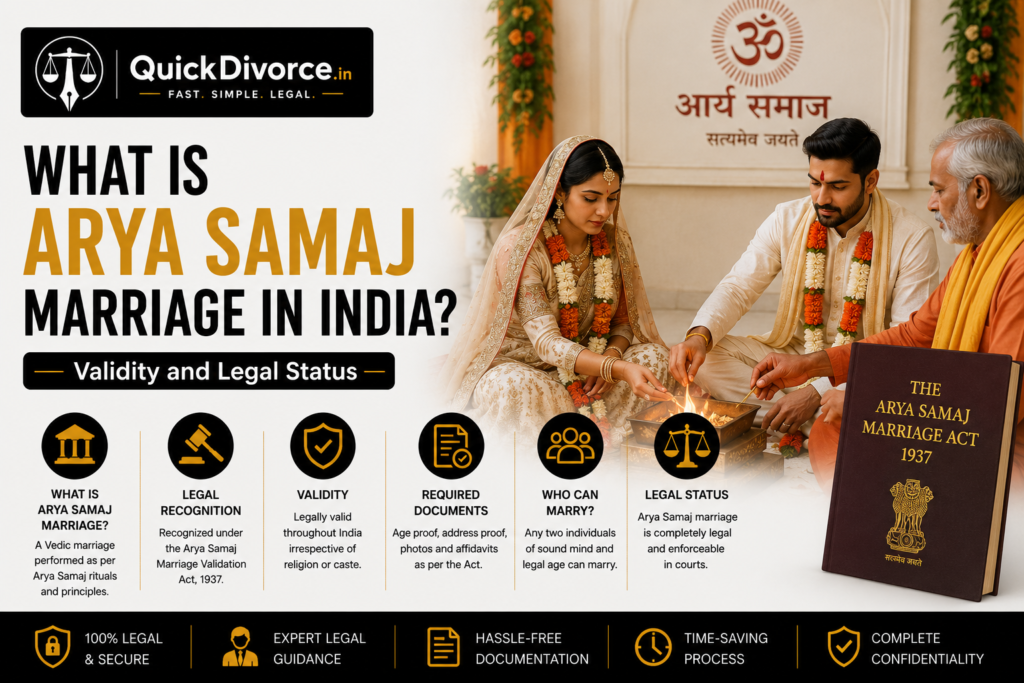
Arya Samaj marriage in India is a Vedic Hindu marriage ceremony performed according to the rites and rituals prescribed by the Arya Samaj — a Hindu reform organisation founded in 1875 by Swami Dayananda Saraswati.
The ceremony is based on the ancient Vedic tradition of marriage — centred around the Saptapadi (seven steps around the sacred fire) and other Vedic rituals — conducted by an Arya Samaj priest (Pandit) at an Arya Samaj Mandir (temple).
Unlike a traditional Hindu wedding — which can involve elaborate multi-day ceremonies, extensive rituals and significant expense — an Arya Samaj marriage is:
- Simple and focused — based on core Vedic ceremonies without elaborate additions
- Quick — the entire ceremony can be completed in a few hours on a single day
- Affordable — significantly less expensive than a traditional Hindu wedding
- Accepting — Arya Samaj accepts people from all Hindu backgrounds without caste discrimination
After the ceremony — the Arya Samaj issues a Marriage Certificate signed by the Arya Samaj Pandit and office bearers. However — and this is the most critical point — this Arya Samaj certificate is NOT a government issued document. It is a certificate issued by the religious organisation confirming the ceremony was performed.
For complete legal protection — the marriage must be separately registered with the government under either:
- The Hindu Marriage Act 1955 — for couples who are both Hindu
- The Special Marriage Act 1954 — for inter-religion couples or those preferring civil registration
The single most important thing to know about Arya Samaj marriage in India: The Arya Samaj certificate alone is not sufficient for most legal purposes. Government registration is essential and must be done separately.
📜 History and Background of Arya Samaj
Understanding the history of Arya Samaj helps explain why its marriage ceremony holds the legal significance it does.
Founding and Philosophy
Arya Samaj was founded on April 10, 1875 in Bombay (now Mumbai) by Swami Dayananda Saraswati — one of the most influential Hindu reformers of the 19th century.
The core philosophy of Arya Samaj is:
- Return to the Vedas as the foundation of Hindu belief and practice
- Rejection of idol worship, caste discrimination and social inequality
- Emphasis on education, rational inquiry and social reform
- Universal brotherhood — the principle that all humans are equal before God
Arya Samaj and Marriage Reform
One of Arya Samaj’s most significant social contributions was in marriage reform:
- Against child marriage — Arya Samaj was among the earliest and most vocal opponents of child marriage in India
- Against caste-based marriage restrictions — Arya Samaj performs marriages regardless of the caste of the parties
- Supporting widow remarriage — Arya Samaj was a strong advocate for the right of widows to remarry
- Shuddhi ceremony — Arya Samaj developed the Shuddhi (purification) ceremony — allowing people from other religions to convert to Hinduism and then marry through Arya Samaj
Legal Recognition of Arya Samaj Marriage
The Arya Marriage Validation Act 1937 — a pre-independence legislation — specifically validated Arya Samaj marriages. This was later superseded by the Hindu Marriage Act 1955 — which recognises marriages performed according to customary Hindu rites and ceremonies, including those of the Arya Samaj, as valid Hindu marriages.
⚖️ Is Arya Samaj Marriage Legally Valid in India?
This is the most important question — and the answer requires a careful, nuanced explanation.
The Arya Samaj Ceremony Is Legally Valid as a Hindu Marriage
Under Section 7 of the Hindu Marriage Act 1955 — a Hindu marriage may be solemnized in accordance with the customary rites and ceremonies of either party. Where the Saptapadi (seven steps) is a customary ceremony — the marriage is complete and binding when the seventh step is taken.
The Arya Samaj’s Vedic marriage ceremony — which includes the Saptapadi — constitutes a valid solemnization of marriage under Section 7 of the Hindu Marriage Act 1955.
Therefore — yes, an Arya Samaj marriage ceremony is legally valid as a Hindu marriage.
The Critical Condition — Both Parties Must Be Hindu
The Hindu Marriage Act 1955 applies where both parties are Hindu — including Buddhists, Jains and Sikhs under Section 2 of the Act.
Where one or both parties are not Hindu — the Hindu Marriage Act does not apply to the ceremony. The legal validity of the marriage for inter-religion couples is more complex (discussed separately below).
Registration Is Separate and Essential
Legal validity of the ceremony is not the same as legal registration. Under Section 8 of the Hindu Marriage Act 1955 — the state governments may make rules for registration of Hindu marriages. Registration is important evidence of the marriage but the marriage’s validity does not depend solely on registration.
However — for practical legal purposes — an unregistered Arya Samaj marriage faces serious difficulties:
- Banks and financial institutions require registered marriage certificates
- Passport offices require registered marriage certificates
- Visa applications require registered marriage certificates
- Courts may require registered marriage certificates in legal proceedings
- Property and inheritance disputes are much more difficult without registration
The Arya Samaj certificate alone is NOT sufficient for these purposes.
The correct legal position in plain language: The Arya Samaj ceremony creates a valid Hindu marriage between two Hindu parties — but without government registration, proving and enforcing that marriage is enormously difficult in practice. Always register.
🔄 Arya Samaj Marriage vs Court Marriage — Key Differences
| Aspect | Arya Samaj Marriage | Court Marriage (Special Marriage Act) |
|---|---|---|
| Nature | Religious ceremony — Hindu Vedic | Civil registration — no religious element |
| Certificate issued | Arya Samaj organisation certificate | Government issued marriage certificate |
| Government registration | Separate — done after the ceremony | Integral — the registration IS the marriage |
| Religion requirement | Both parties must be Hindu (or one converts) | Any religion — completely religion neutral |
| Duration of process | Ceremony in one day — registration takes 15 to 30 days | 30 day notice period mandatory |
| Legal validity | Valid under Hindu Marriage Act if both are Hindu | Valid under Special Marriage Act for all |
| Applicable divorce law | Hindu Marriage Act 1955 | Special Marriage Act 1954 |
| Cost | Arya Samaj fee plus registration fee | Government fee of approx ₹150 |
| Best for | Hindu couples wanting a quick Vedic ceremony | Inter-religion couples or those wanting civil marriage |
| Recognition abroad | Government registration certificate required | Government issued certificate directly accepted |
👥 Who Can Have an Arya Samaj Marriage?
Both Parties Are Hindu
The most straightforward case. Both parties being Hindu — including Buddhists, Jains and Sikhs — can have an Arya Samaj marriage which is fully valid under the Hindu Marriage Act 1955.
One Party is Non-Hindu — The Conversion Scenario
Arya Samaj is well known for performing the Shuddhi (conversion/purification) ceremony — through which a person from a non-Hindu religion converts to Hinduism. After the Shuddhi ceremony — the converted person is considered Hindu and the Arya Samaj can then perform the marriage.
This is frequently used by inter-religion couples — particularly Hindu-Muslim or Hindu-Christian couples — where one party converts to Hinduism before the Arya Samaj ceremony.
The legal status of such marriages is complex and has been extensively litigated:
- Several High Courts have held that a marriage performed by Arya Samaj after a Shuddhi conversion is valid under the Hindu Marriage Act — as the party is now Hindu
- However other courts have examined whether the conversion was genuine and voluntary
- The Supreme Court has addressed this in multiple cases
Critical advice for inter-religion couples: If you are considering Arya Samaj marriage through conversion — get proper legal advice before proceeding. Quick Divorce provides specific guidance for inter-religion couples on the safest legal route. Call 8595439395.
Same Community Hindu Couples
Any two Hindu adults regardless of caste, community or sub-sect can have an Arya Samaj marriage. The Arya Samaj explicitly rejects caste discrimination and performs marriages for couples of any Hindu caste combination.
✅ Eligibility Conditions for Arya Samaj Marriage
For an Arya Samaj marriage to be valid under the Hindu Marriage Act 1955 — the following conditions under Section 5 of the Act must be met:
Condition 1 — Both Parties Must Be Hindu
Both parties must be Hindu at the time of the ceremony — by birth, by religion or through Shuddhi conversion. A person is Hindu under Section 2 of the Hindu Marriage Act if they are:
- Hindu by religion in any of its forms or developments — including Virashaiva, Lingayat, Brahmo, Prarthana or Arya Samaj follower
- Buddhist, Jain or Sikh by religion
- Any person who is not Muslim, Christian, Parsi or Jew — and is not governed by any other law
- Any person converted to Hinduism through Shuddhi or other accepted conversion process
Condition 2 — Minimum Age
- 👨 Male party must be at least 21 years of age
- 👩 Female party must be at least 18 years of age
Condition 3 — Sound Mind
Both parties must be capable of giving valid consent — of sound mind and not suffering from mental disorder that makes them unfit for marriage or procreation.
Condition 4 — No Subsisting Marriage
Neither party must have a living spouse at the time of the Arya Samaj marriage. Both must be unmarried, divorced or widowed.
Condition 5 — Not Within Prohibited Degrees of Relationship
The parties must not be related within the degrees of prohibited relationship — unless custom or usage governing either party specifically permits such a relationship.
Condition 6 — Not Sapindas
The parties must not be sapindas (related within the family lineage) of each other — unless the custom or usage governing either party specifically permits such a marriage.
📋 Step by Step Procedure for Arya Samaj Marriage
Step 1 — Identify and Contact the Arya Samaj Mandir
Arya Samaj Mandirs are present in most cities and towns across India. Contact the Arya Samaj Mandir in your city:
- Inform them of your intention to marry
- Inquire about their specific documentation requirements — these can vary slightly between different Arya Samaj offices
- Confirm the available dates for the ceremony
Step 2 — Prepare All Required Documents
Gather all documents required by the specific Arya Samaj Mandir — as well as documents that will be needed for subsequent government registration. (Complete document list in the next section.)
Step 3 — Arya Samaj Verification
The Arya Samaj office typically verifies documents before the ceremony:
- Age and identity verification of both parties
- Confirmation that neither party has a subsisting marriage
- Confirmation that neither party is related within prohibited degrees
Step 4 — Shuddhi Ceremony (If Applicable)
Where one or both parties are not Hindu — the Shuddhi (conversion) ceremony is performed before the marriage ceremony. This involves:
- Recitation of Vedic mantras
- Acceptance of Hindu principles
- Assignment of a Hindu name (optional)
- Issuance of a Shuddhi certificate by the Arya Samaj
Step 5 — Havan (Sacred Fire)
The marriage ceremony begins with a Havan — the lighting of a sacred fire. Vedic mantras are recited by the Pandit with both parties participating.
Step 6 — Saptapadi (Seven Steps)
The most legally significant ritual — the Saptapadi — involves both parties taking seven steps together around the sacred fire, reciting Vedic vows with each step. Under Section 7 of the Hindu Marriage Act — the marriage is complete and binding when the seventh step is taken.
Step 7 — Other Rituals
The ceremony may include:
- Kanyadan — the formal giving of the bride by her family
- Sindoor application and Mangalsutra tying
- Other Vedic rituals as prescribed by the officiating Pandit
Step 8 — Arya Samaj Marriage Certificate Issued
After the ceremony — the Arya Samaj issues their marriage certificate, signed by:
- The officiating Pandit
- Office bearers of the Arya Samaj Mandir
- Witnesses present at the ceremony
Remember — this certificate is issued by the Arya Samaj organisation, not by the government. It must be followed up with government registration.
Step 9 — Government Registration (Essential)
Within a reasonable time after the ceremony — register the marriage with the government under:
- The Hindu Marriage Act 1955 — at the office of the Sub-Registrar or Marriage Officer in your district, or
- The Special Marriage Act 1954 — if preferred or if one party is non-Hindu
(Detailed registration process in the sections below.)
📄 Documents Required for Arya Samaj Marriage
Documents Required from Both Parties
Identity Proof (any one)
- 🪪 Aadhaar Card
- 🛂 Passport
- 🗳️ Voter ID Card
- 🚗 Driving License
Age Proof (any one)
- 📜 Birth Certificate
- 🛂 Passport (showing date of birth)
- 📚 School Leaving Certificate or Class 10 Marksheet
- 🏥 Hospital Birth Record
Address Proof (any one)
- 🪪 Aadhaar Card
- 🏠 Utility Bill (not older than 3 months)
- 🏦 Bank Passbook with address
- 📋 Rental Agreement
Photographs
- 📸 Passport size photographs — typically 4 to 6 each
Additional Documents for Specific Situations
If Previously Married (Divorced)
- ⚖️ Divorce decree — certified copy from the competent court
If Previously Married (Widowed)
- 📜 Death certificate of the deceased spouse
If Non-Hindu Party (Shuddhi Conversion)
- 📋 Some Arya Samaj offices require a written application for Shuddhi
- 🪪 Identity documents as above
If Foreign National
- 🛂 Valid Passport
- 📋 No Objection Certificate from their country’s Embassy
Documents for Witnesses
- Two to three witnesses are typically required
- 🪪 Identity proof of each witness
- 📷 Passport size photograph of each witness
- ✍️ Physical presence at the ceremony
📜 The Arya Samaj Marriage Certificate — What It Is and What It Is Not
What the Arya Samaj Certificate IS
The Arya Samaj marriage certificate is:
- ✅ A document issued by the Arya Samaj religious organisation
- ✅ Confirmation that a Vedic marriage ceremony was performed
- ✅ Signed by the Arya Samaj Pandit and office bearers
- ✅ Useful as supporting evidence of the marriage ceremony
- ✅ Admissible in court as evidence of the marriage ceremony having taken place
- ✅ Accepted by some government offices as supporting documentation alongside other evidence
What the Arya Samaj Certificate Is NOT
The Arya Samaj marriage certificate is NOT:
- ❌ A government issued document
- ❌ A substitute for registration under the Hindu Marriage Act or Special Marriage Act
- ❌ Sufficient by itself for passport name change
- ❌ Sufficient by itself for visa applications at most foreign embassies
- ❌ Sufficient by itself for bank account changes or insurance nominations
- ❌ Sufficient by itself for property registration or mutation
- ❌ The equivalent of a government marriage registration certificate
The Arya Samaj certificate proves the ceremony happened. The government registration certificate proves the legal marriage. You need both.
🏛️ Registering Arya Samaj Marriage Under Hindu Marriage Act
Why Register Under Hindu Marriage Act?
Where both parties are Hindu — registration under the Hindu Marriage Act 1955 is the natural and recommended route. It:
- Produces a government issued marriage certificate
- Is processed relatively quickly — typically 15 to 30 days
- Does not require the 30 day advance notice period (unlike Special Marriage Act)
- Is the legally cleanest route for two Hindu parties
Procedure for Registration Under Hindu Marriage Act
Step 1: Visit the office of the Sub-Registrar of Marriages or the Marriage Officer in the sub-district where:
- The marriage was solemnized, or
- Either party has resided for at least 6 months before the application
Step 2: Submit the registration application along with:
- Application form (as prescribed by the state)
- Arya Samaj marriage certificate (as evidence of ceremony)
- Identity proof of both parties
- Age proof of both parties
- Address proof of both parties
- Two passport size photographs of each party
- Court fee stamps as prescribed
Step 3: Both parties must appear in person before the Registrar — along with at least one witness who was present at the ceremony.
Step 4: The Registrar verifies all documents and records the statements of both parties and the witness.
Step 5: The marriage is entered in the Marriage Register and a Marriage Certificate under the Hindu Marriage Act is issued — signed by the Registrar.
Timeline: Typically 15 to 30 days from application to certificate.
Cost: Government fee varies by state — typically ₹100 to ₹500.
🏛️ Registering Arya Samaj Marriage Under Special Marriage Act
When to Choose the Special Marriage Act for Registration
Some couples prefer to register their Arya Samaj marriage under the Special Marriage Act 1954 rather than the Hindu Marriage Act. Reasons include:
- The couple prefers the legal framework of the Special Marriage Act
- The couple wants a marriage registration that is explicitly religion-neutral for international purposes
- One party has subsequently changed religion and the couple wants a registration that reflects their current situation
- The couple wants the divorce provisions of the Special Marriage Act to apply to their marriage
Important Legal Consequence
Registering under the Special Marriage Act has a significant legal consequence — the marriage and any subsequent divorce will be governed by the Special Marriage Act, not the Hindu Marriage Act or Hindu personal law. This affects:
- Divorce grounds available
- Succession and inheritance — Indian Succession Act applies instead of Hindu Succession Act
- Maintenance provisions
Quick Divorce advises couples on the choice between Hindu Marriage Act and Special Marriage Act registration — ensuring they understand the legal implications. Call 8595439395.
Procedure for Registration Under Special Marriage Act
The registration under the Special Marriage Act requires the 30 day notice procedure — the same as court marriage. Quick Divorce handles this complete process.
💑 Arya Samaj Marriage for Inter-Religion Couples
Inter-religion couples are one of the most common groups seeking Arya Samaj marriage — and this is also where the legal complexity is greatest.
The Common Scenario
A Hindu party and a Muslim, Christian or other non-Hindu party want to marry quickly. The non-Hindu party undergoes the Shuddhi ceremony at Arya Samaj — converting to Hinduism. The Arya Samaj then performs the marriage ceremony and issues a certificate.
The Legal Issues
Does Shuddhi conversion create valid Hindu status?
Courts have generally accepted that a person who undergoes Shuddhi has converted to Hinduism — and can therefore marry under the Hindu Marriage Act. However:
- The genuineness and voluntariness of the conversion is sometimes challenged
- Some courts have looked carefully at whether the conversion was a genuine religious act or merely a formal step to facilitate marriage
- A conversion done purely for marriage purposes — without any genuine religious intent — has been challenged in some cases
Sarla Mudgal Principle:
The Supreme Court in Sarla Mudgal vs Union of India (1995) — while addressing Muslim conversion for bigamy — established the principle that conversion does not automatically dissolve the earlier marriage if it still subsists under the earlier personal law. This principle has implications for inter-religion couples considering Arya Samaj marriage.
The Safe Legal Path for Inter-Religion Couples
The legally safest route for inter-religion couples is court marriage under the Special Marriage Act 1954 — which does not require conversion by either party and provides unambiguous legal validity regardless of religion.
Quick Divorce specifically advises inter-religion couples on the safest and most legally certain route for their marriage. The team at Quick Divorce has extensive experience with inter-religion marriage cases.
Call 8595439395 for confidential advice on inter-religion marriage.
🌍 Arya Samaj Marriage for NRIs
NRIs frequently seek Arya Samaj marriage when visiting India — particularly for the combination of religious ceremony and quick process.
Important Points for NRI Arya Samaj Marriage
Time constraint: Many NRIs visit India for limited periods. The Arya Samaj ceremony can be completed in one day. However government registration adds time — and the Arya Samaj certificate alone is not sufficient for most NRI purposes.
Government registration essential for NRI purposes: For visa applications, immigration processes, foreign bank account changes and most overseas official purposes — a government registered marriage certificate is required. The Arya Samaj certificate alone will typically not be accepted.
Special Marriage Act may be preferred: Many NRIs prefer to register under the Special Marriage Act — as the resulting certificate has clearer international recognition and does not raise questions about religious law applicability.
Apostille may be required: For use in many foreign countries, the government marriage certificate will need to be Apostilled through the Ministry of External Affairs.
Quick Divorce handles complete NRI Arya Samaj marriage assistance — including ceremony coordination, registration and Apostille guidance. Call 8595439395.
⚖️ Legal Rights After Arya Samaj Marriage
Once an Arya Samaj marriage is properly registered — all legal rights of a valid marriage under the applicable personal law apply:
Rights Under Hindu Marriage Act (Where Both Parties Hindu)
Maintenance and alimony: Both parties have rights to maintenance during and after the marriage under Section 24 (interim maintenance) and Section 25 (permanent alimony) of the Hindu Marriage Act.
Property rights: Both parties have rights to jointly acquired matrimonial property. The wife retains absolute rights over her stridhan — all gifts received before, during and after marriage.
Inheritance and succession: Under the Hindu Succession Act 1956 — a legally married Hindu wife has inheritance rights in her husband’s property. A husband has corresponding rights in his wife’s property.
Child custody and maintenance: Children of the marriage have rights to maintenance from both parents. Courts determine custody based on the welfare principle.
Right to matrimonial home: The wife has the right to reside in the matrimonial home under Section 19 of the Protection of Women from Domestic Violence Act 2005.
💔 Arya Samaj Marriage and Divorce
Where an Arya Samaj marriage has been registered under the Hindu Marriage Act 1955 — divorce is governed by the Hindu Marriage Act.
Divorce Grounds Under Hindu Marriage Act
Section 13 grounds include:
- Adultery
- Cruelty
- Desertion for 2 years
- Conversion to another religion
- Unsoundness of mind
- Leprosy or venereal disease
- Renunciation of the world
- Presumption of death — not heard of for 7 years
Mutual Consent Divorce
Section 13B of the Hindu Marriage Act — mutual consent divorce after at least 1 year of separation — is available for Arya Samaj marriages registered under the Act.
Quick Divorce handles both Arya Samaj marriage registration AND mutual consent divorce — providing complete legal assistance throughout the marriage journey. Call 8595439395.
🚫 Common Myths About Arya Samaj Marriage in India
Myth 1: The Arya Samaj certificate is sufficient legal proof of marriage False. The Arya Samaj issues an organisational certificate — not a government registration. Government registration under the Hindu Marriage Act or Special Marriage Act is separately required and is the document accepted by banks, passport offices, embassies and courts.
Myth 2: Arya Samaj marriage can be done secretly without anyone knowing Partially false. The ceremony itself is at an Arya Samaj Mandir and is relatively private. However government registration — which is essential — creates a public record. For couples seeking privacy — understand that registration creates a government record.
Myth 3: Non-Hindu parties cannot have an Arya Samaj marriage False — with nuance. The Arya Samaj performs the Shuddhi conversion ceremony for non-Hindus who wish to convert. After conversion — the marriage ceremony can be performed. However the legal implications of conversion for marriage purposes are complex and professional legal advice should be obtained.
Myth 4: Arya Samaj marriage is faster than court marriage overall Partially true. The Arya Samaj ceremony itself is one day — faster than court marriage’s 30 day notice period. However the subsequent government registration adds time. For the complete legally protected process — timelines are comparable.
Myth 5: Arya Samaj marriage is only for lower castes or those rejected by traditional priests Completely false. Arya Samaj marriage is used by people from all Hindu communities and all social backgrounds. Many educated urban couples choose it specifically for its simplicity, affordability and dignity.
Myth 6: Arya Samaj marriage cannot be divorced False. An Arya Samaj marriage registered under the Hindu Marriage Act can be dissolved through divorce under the Hindu Marriage Act — including through mutual consent divorce which Quick Divorce handles affordably and efficiently.
Myth 7: Foreign embassies accept the Arya Samaj certificate Generally false. Most foreign embassies require a government issued marriage certificate — not an Arya Samaj organisational certificate. Always ensure government registration is completed before applying for any foreign visa or immigration benefit based on marriage.
🚨 Common Mistakes in Arya Samaj Marriage
❌ Not registering with the government after the ceremony The most critical and most common mistake. Relying on the Arya Samaj certificate alone leaves the marriage legally unprotected for most practical purposes. Always register with the government immediately after the ceremony.
❌ Assuming the Arya Samaj certificate is sufficient for visa purposes Foreign embassies and immigration authorities require government registered marriage certificates. The Arya Samaj certificate is not accepted as the primary marriage document.
❌ Not verifying that both parties meet eligibility conditions before the ceremony If a party has a subsisting marriage that was not disclosed — the Arya Samaj marriage is void. Verify eligibility thoroughly before the ceremony.
❌ Not getting proper legal advice for inter-religion marriages Inter-religion Arya Samaj marriages through Shuddhi conversion are legally complex. Not getting proper advice before proceeding can result in a legally uncertain marriage. Quick Divorce specifically advises on this — call 8595439395.
❌ Delaying government registration too long While there is no strict time limit for registration in all states — long delays create practical and evidentiary difficulties. Register as soon as possible after the ceremony.
❌ Not keeping multiple copies of both the Arya Samaj certificate and government registration certificate Both certificates should be kept in multiple certified copies — stored separately. Both documents may be required for different purposes.
❌ Choosing the wrong registration route without understanding implications Registering under the Hindu Marriage Act vs the Special Marriage Act has different legal implications for divorce and succession. Get advice before choosing. Quick Divorce advises on this choice.
🌟 How Quick Divorce Helps with Arya Samaj Marriage
Quick Divorce provides complete end-to-end assistance for Arya Samaj marriage — from eligibility assessment through ceremony coordination, government registration and all post-marriage legal requirements.
Services for Arya Samaj Marriage
Eligibility Assessment and Legal Consultation A ₹499 consultation confirming both parties’ eligibility, advising on the correct legal route — Hindu Marriage Act vs Special Marriage Act registration — and identifying any specific issues that need to be addressed before proceeding.
Arya Samaj Mandir Coordination Quick Divorce coordinates with Arya Samaj Mandirs across India — helping couples identify the right Mandir for their location, confirm dates and ensure all Arya Samaj documentation requirements are met.
Document Preparation and Verification Quick Divorce prepares a complete, personalised document checklist for both the Arya Samaj ceremony and government registration — and verifies all documents for completeness and consistency before submission.
Government Registration Under Hindu Marriage Act Quick Divorce handles the complete registration process under the Hindu Marriage Act — from application preparation and filing through certificate collection.
Government Registration Under Special Marriage Act For couples preferring Special Marriage Act registration — Quick Divorce handles the complete 30 day notice and registration process.
Inter-Religion Couple Specialist Advice Quick Divorce provides specific legal advice for inter-religion couples considering Arya Samaj marriage through Shuddhi conversion — including an honest assessment of the legal risks and the safest legal route for their specific situation.
NRI Arya Samaj Marriage Assistance Quick Divorce handles NRI Arya Samaj marriages — including ceremony coordination during India visits, registration and Apostille guidance for international use.
Arya Samaj Marriage Plus Divorce Services For couples who have an Arya Samaj marriage and subsequently need divorce assistance — Quick Divorce provides both services — making them the complete legal partner for the entire marriage journey.
Quick Divorce Services and Pricing
| Service | Price |
|---|---|
| Legal Consultation | ₹499 |
| Arya Samaj Marriage Complete Assistance | ₹4,999 onwards |
| Hindu Marriage Act Registration | ₹2,999 onwards |
| Special Marriage Act Registration | ₹4,999 onwards |
| Inter-Religion Marriage Advice and Assistance | ₹4,999 onwards |
| NRI Arya Samaj Marriage Assistance | ₹9,999 onwards |
| Arya Samaj Marriage plus Divorce Package | ₹9,999 onwards |
📞 Call Quick Divorce: 8595439395
Get Complete Arya Samaj Marriage Assistance from Quick Divorce →
💰 Cost Breakdown: Arya Samaj Marriage in India
| Cost Item | Amount |
|---|---|
| Arya Samaj ceremony fee | ₹3,000 to ₹10,000 (varies by Mandir) |
| Arya Samaj certificate | Included in ceremony fee typically |
| Government registration fee (Hindu Marriage Act) | ₹100 to ₹500 |
| Quick Divorce professional assistance | ₹4,999 onwards |
| Certified copies of government certificate | ₹50 to ₹100 per copy |
| Apostille (if required for foreign use) | ₹500 to ₹2,000 |
| Total with Quick Divorce assistance | ₹8,000 to ₹15,000 approximately |
❓ Frequently Asked Questions (FAQs)
Q1. Is an Arya Samaj marriage certificate valid for a passport application?
The Arya Samaj certificate alone is generally not accepted by the Passport Seva Kendra as sufficient proof of marriage for a passport name change. A government registered marriage certificate — under the Hindu Marriage Act or Special Marriage Act — is required. Quick Divorce handles the government registration that produces this certificate. Call 8595439395.
Q2. Can a Muslim person marry through Arya Samaj?
A Muslim person can undergo the Shuddhi conversion ceremony at Arya Samaj — converting to Hinduism — and then marry through the Arya Samaj ceremony. However this raises significant legal complexities — including the question of whether the earlier Muslim marriage (if any) has been validly dissolved, and whether the conversion is genuine. For Muslim-Hindu inter-religion couples, Quick Divorce strongly recommends obtaining legal advice before proceeding — and may recommend court marriage under the Special Marriage Act as a legally cleaner alternative. Call 8595439395.
Q3. How long does the complete Arya Samaj marriage process take — including registration?
The Arya Samaj ceremony itself takes one day. Government registration under the Hindu Marriage Act typically takes an additional 15 to 30 days. The complete process — ceremony plus government registration — typically takes 20 to 40 days with Quick Divorce’s assistance.
Q4. Is Arya Samaj marriage valid abroad?
The Arya Samaj ceremony creates a valid Hindu marriage in India — provided eligibility conditions are met and the marriage is registered with the government. The government issued registration certificate (Hindu Marriage Act or Special Marriage Act) is what foreign countries recognise. The Arya Samaj certificate alone is generally not accepted. For use in specific foreign countries — an Apostille authentication of the government certificate may additionally be required. Quick Divorce advises on country-specific requirements. Call 8595439395.
Q5. Can a divorced person remarry through Arya Samaj?
Yes — a divorced person can remarry through Arya Samaj marriage, provided they produce their divorce decree as documentation. The divorce decree must be from a competent Indian court. Quick Divorce assists divorced persons with Arya Samaj marriage and government registration.
Q6. What is the difference between the Arya Samaj marriage certificate and the government marriage certificate?
The Arya Samaj certificate is issued by the Arya Samaj organisation — confirming that the Vedic ceremony was performed. The government marriage certificate is issued by a government official (Sub-Registrar or Marriage Officer) after registration under the Hindu Marriage Act or Special Marriage Act — confirming the legal registration of the marriage. Both are important but they serve different purposes. The government certificate is what most official processes require.
Q7. Can we have both an Arya Samaj ceremony and a traditional Hindu wedding?
Yes — many couples have both. The Arya Samaj ceremony provides the legally valid marriage ceremony and generates the Arya Samaj certificate. A traditional family wedding ceremony can additionally be held for social and family reasons. The government registration that follows produces the official marriage certificate. Quick Divorce advises on how to structure this for maximum legal clarity.
Q8. If we have an Arya Samaj marriage, which law governs our divorce?
Where the Arya Samaj marriage is registered under the Hindu Marriage Act 1955 — divorce is governed by the Hindu Marriage Act. Where it is registered under the Special Marriage Act 1954 — divorce is governed by the Special Marriage Act. The choice of registration act therefore directly affects your future divorce options. Quick Divorce explains these implications fully before you decide on the registration route. Call 8595439395.
🎯 Who Needs This Guide Right Now?
If you are a Hindu couple wanting a quick and affordable marriage ceremony → Arya Samaj marriage is an excellent option. Quick Divorce coordinates the complete process — ceremony and government registration. Call 8595439395.
If you are an inter-caste Hindu couple facing family opposition → Arya Samaj does not discriminate by caste. Quick Divorce assists couples facing family opposition. Call 8595439395 for confidential advice.
If you are an inter-religion couple considering Arya Samaj marriage through Shuddhi conversion → Get legal advice before proceeding. The legal complexities are real and Quick Divorce has the expertise to advise correctly. Call 8595439395.
If you had an Arya Samaj ceremony but never registered with the government → Register now. Quick Divorce handles retrospective government registration of Arya Samaj marriages. Call 8595439395.
If you are an NRI needing a legally recognised marriage certificate → Quick Divorce handles NRI Arya Samaj marriage and registration — including Apostille guidance for international use.
If you want to understand the legal implications before deciding between Arya Samaj marriage and court marriage → A ₹499 Quick Divorce consultation provides complete clarity on the choice.
✅ Final Recommendation
Arya Samaj marriage in India is a time-honoured, legally recognised and practically valuable route to a valid Hindu marriage — combining a dignified Vedic ceremony with a relatively quick and affordable process.
However — the single most important message of this entire guide is:
The Arya Samaj certificate alone is not sufficient. Government registration is essential.
An Arya Samaj marriage without government registration is legally vulnerable — difficult to prove, not accepted by most official bodies and potentially damaging to your rights in any subsequent legal dispute.
The complete Arya Samaj marriage process must include:
- ✅ Eligibility verification before the ceremony
- ✅ Proper documentation prepared and verified
- ✅ Arya Samaj ceremony conducted correctly with proper witnesses
- ✅ Arya Samaj certificate obtained and preserved
- ✅ Government registration under Hindu Marriage Act or Special Marriage Act
- ✅ Government marriage certificate obtained and multiple copies kept
Quick Divorce handles every step of this complete process — from the first consultation through ceremony coordination, government registration and certificate collection — at transparent, affordable pricing.
For ₹499, speak to a court marriage and Arya Samaj marriage specialist today. For ₹4,999, get your complete Arya Samaj marriage process handled correctly from start to finish.
Your marriage deserves complete legal protection from Day 1. Quick Divorce ensures you have it.
📞 Call Quick Divorce: 8595439395
Get Complete Arya Samaj Marriage Assistance from Quick Divorce →
Need Consultation
🟡 QuickDivorce.in provides complete legal services — settlement negotiation, alimony structuring, property division, stridhan recovery, MoU drafting, court representation, and post-decree implementation: across all jurisdictions in India.
🟡Visit LegalTax.in for other Legal and Trademark related services as 👉 Money Recovery Cases
👉 Property Disputes 👉 Business & Licence Registrations
🟡Visit Business24hub for IT services
👉 Mutual Consent Divorce at👉 Contested Divorce Filing 👉 Child Custody and Maintenance 👉 Matrimonial Property Settlement 👉 NRI Divorce Services 👉 Alimony and Maintenance
🟡 Protect Your Rights 👉 Domestic Violence Legal Support👉 Stridhan Recovery
📞 Call Now: +91 8595439395 🕐 Free Consultation: Monday to Saturday, 10 AM to 6 PM

Adv. Manish Kashyap is a Family Law & Divorce Lawyer with extensive experience in Mutual & Contested Divorce, NRI Divorce, Child Custody, Alimony, Domestic Violence, Judicial Separation, and Family Court matters, providing professional legal guidance to clients.

