

Views: 18
Facing arrest in a matrimonial criminal case in India? Learn everything about anticipatory bail under Section 482 BNSS — who can apply, how to get it, Supreme Court judgments, and FAQs for 2025–26.
A matrimonial dispute in India can escalate into a criminal case in a matter of hours. One complaint under Section 85 of the Bharatiya Nyaya Sanhita (BNS) — formerly Section 498A of the IPC — and the police are legally empowered to arrest the husband, his parents, his siblings, and even distant relatives named in the FIR, without a warrant, because it is a cognizable and non-bailable offence.
For hundreds of thousands of families across India, this is not a hypothetical scenario. It is a lived reality.
The moment a complaint is filed, or even before an FIR is registered and a person has genuine reason to fear arrest, the most critical legal remedy available is anticipatory bail. Understanding what it is, how it works, when courts grant it, and how to apply for it can mean the difference between protecting your liberty and spending weeks in judicial custody before your case even goes to trial.
This guide explains everything you need to know about anticipatory bail in matrimonial criminal cases in India, updated for the new legal framework under the Bharatiya Nagarik Suraksha Sanhita (BNSS) 2023, which replaced the Criminal Procedure Code from July 1, 2024.
Table of Contents
- 1 What Is Anticipatory Bail?
- 2 Why Anticipatory Bail Matters So Much in Matrimonial Cases
- 3 The Legal Framework: Key Sections You Must Know
- 4 The Arnesh Kumar Guidelines: The Most Important Safeguard for Accused Persons
- 5 Rajesh Sharma Guidelines: Family Welfare Committees
- 6 Who Can Apply for Anticipatory Bail?
- 7 Grounds on Which Courts Grant Anticipatory Bail in Matrimonial Cases
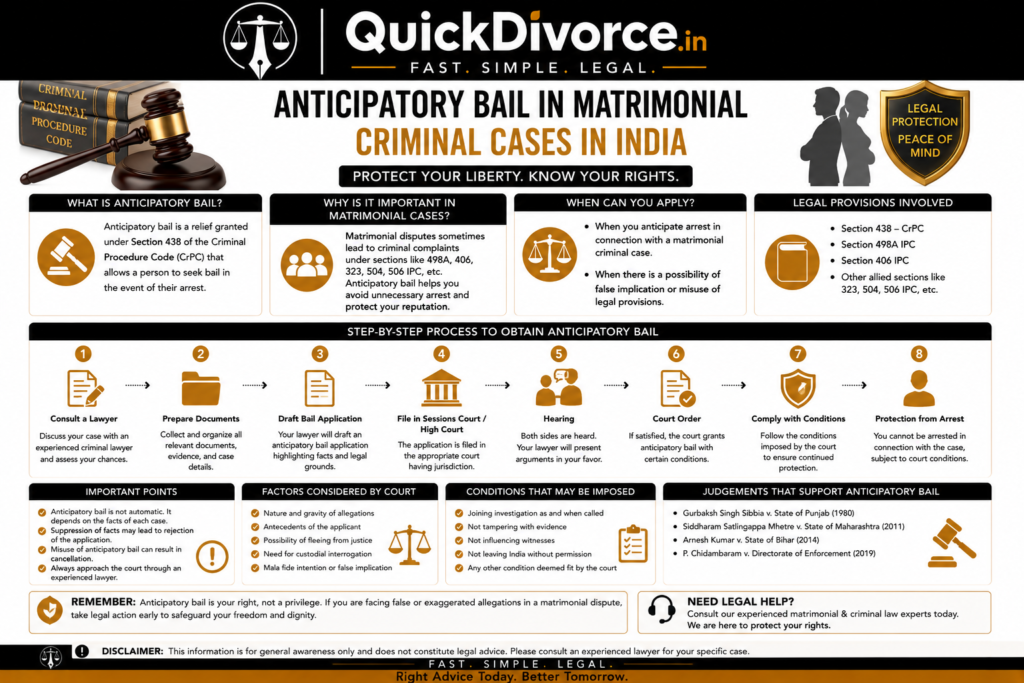
- 8 Step-by-Step Process to Apply for Anticipatory Bail
- 9 Conditions Courts Impose When Granting Anticipatory Bail
- 10 Common Mistakes That Weaken an Anticipatory Bail Application
- 11 When Courts Reject Anticipatory Bail in Matrimonial Cases
- 12 Frequently Asked Questions (FAQs)
- 13 Final Word: Act Before Arrest, Not After
- 14 Get Expert Guidance for Anticipatory Bail Cases
What Is Anticipatory Bail?
Anticipatory bail is a legal safeguard that allows a person to seek protection from arrest when they reasonably believe they may be arrested for a non-bailable offence. Unlike regular bail — which is sought after a person has already been arrested and is in custody — anticipatory bail is obtained before arrest. It is, in essence, a pre-arrest protection order from the court.
The provision is contained in Section 482 of the Bharatiya Nagarik Suraksha Sanhita (BNSS), 2023, which replaced Section 438 of the Code of Criminal Procedure (CrPC). The legal framework has changed with the new law, but the core purpose remains the same — protecting personal liberty where there are reasonable grounds to believe that the accused will neither abscond nor misuse the concession of bail.
When a court grants anticipatory bail, it means that if the applicant is arrested, they must be immediately released on bail on the conditions specified by the court. The applicant does not need to actually be in custody before the order takes effect.
Why Anticipatory Bail Matters So Much in Matrimonial Cases
Matrimonial criminal cases in India occupy a uniquely sensitive space in the legal system. Offences like cruelty under Section 85 BNS (formerly 498A IPC), criminal breach of trust under Section 316 BNS (formerly 406 IPC), and dowry-related offences are classified as cognizable and non-bailable. This gives the police wide powers to arrest without a warrant.
The problem that courts — including the Supreme Court — have repeatedly acknowledged is that these provisions are sometimes used as weapons rather than shields. A criminal complaint alleging cruelty or dowry harassment can be filed by a disgruntled spouse not necessarily to seek justice, but to use the threat of arrest as leverage in a matrimonial dispute over divorce, alimony, child custody, or property.
Courts across India routinely grant anticipatory bail in matrimonial disputes where the circumstances justify protection from arrest. The legal system recognises that immediate arrest in a domestic dispute, without application of mind by the police, causes irreparable damage to reputations, careers, and families — particularly when innocent elderly parents or siblings are named in the FIR.
This is the landscape in which anticipatory bail operates in matrimonial cases. It is not about helping the guilty escape — it is about ensuring that the state’s coercive power is not weaponised against innocent individuals while a court has not yet heard the full facts.
The Legal Framework: Key Sections You Must Know
Section 482 of BNSS (Formerly Section 438 CrPC) — Anticipatory Bail
This is the provision under which anticipatory bail is sought. Under Section 482 of the BNSS, both the Sessions Court and the High Court have the power to grant anticipatory bail. A person who reasonably apprehends arrest in connection with a non-bailable offence can file an application before either of these courts seeking direction that in the event of their arrest, they shall be released on bail.
Section 85 of BNS (Formerly Section 498A IPC) — Cruelty by Husband or Relatives
Section 85 BNS makes cruelty by a husband or his relatives toward a wife a criminal offence punishable with imprisonment of up to three years and a fine. It is cognizable, non-bailable, and non-compoundable — meaning the police must register an FIR on receiving a complaint, can arrest without a warrant, and the case cannot be privately settled between the parties without court permission. Anticipatory bail is the primary remedy for persons accused under this section.
Section 316 of BNS (Formerly Section 406 IPC) — Criminal Breach of Trust
Section 316 BNS deals with criminal breach of trust — including the retention of Stridhan. This is routinely clubbed with Section 85 BNS complaints. It is punishable with imprisonment up to three years. Anticipatory bail is available and frequently sought alongside Section 85 BNS applications.
Section 80 of BNS (Formerly Section 304B IPC) — Dowry Death
In cases where death has occurred within seven years of marriage in suspicious circumstances, a charge of dowry death under Section 80 BNS may be added. This is a far more serious charge, attracting a minimum sentence of seven years. While anticipatory bail is technically available even in such cases, courts exercise extreme caution and grant it only in rare circumstances where the evidence clearly does not support the allegation.
Section 84 and 86 BNS — Related Provisions
Several other provisions under BNS dealing with cruelty, harassment, and dowry-related offences are routinely invoked in matrimonial criminal complaints. The same anticipatory bail framework under Section 482 BNSS applies to all of them.
The Arnesh Kumar Guidelines: The Most Important Safeguard for Accused Persons
No discussion of anticipatory bail in matrimonial cases is complete without understanding the landmark judgment in Arnesh Kumar v. State of Bihar (2014) 8 SCC 273.
In this case, the Supreme Court expressed serious concern over the mechanical and indiscriminate arrests being made in Section 498A IPC cases. The Court observed that Section 498A had lent it a dubious place of pride amongst the provisions that are used as weapons rather than shields by disgruntled wives. This is what courts have termed “legal terrorism” in the context of matrimonial disputes.
The Supreme Court in Arnesh Kumar issued strict guidelines that continue to apply under the BNSS framework:
Police officers must not automatically arrest when a case under Section 498A IPC or Section 85 BNS is registered. Before arresting any accused, the police officer must be satisfied that arrest is necessary based on the parameters under Section 41 of the CrPC (now Section 35 of the BNSS). Every police officer must maintain a checklist with specific reasons justifying the need for arrest. When producing the accused before a Magistrate, the officer must provide written reasons why the arrest was necessary. If the police fail to comply with these requirements, the arrest is illegal and the Magistrate must release the accused.
These guidelines remain binding. They significantly strengthen the position of a person seeking anticipatory bail because they establish that arrest in matrimonial cases is not automatic — it must be justified.
Rajesh Sharma Guidelines: Family Welfare Committees
The Supreme Court went further in Rajesh Sharma v. State of UP (2017) and issued additional guidelines to prevent misuse of Section 498A IPC. These included:
Every district must have one or more Family Welfare Committees constituted by the District Legal Services Authority. Every complaint under Section 498A IPC received by the police or a Magistrate must be referred to and examined by this Committee first. The Committee must submit its report within 30 days of receiving the complaint. No arrest should ordinarily be made until the Committee submits its report and the police have examined it. Personal appearance of all family members, particularly outstation members, may not be required — courts should grant exemption from personal appearance or permit appearance by video conferencing. These directions apply to all offences punishable with imprisonment for up to seven years.
These guidelines further tightened the protection available to persons facing matrimonial criminal complaints before they are even arrested.
Who Can Apply for Anticipatory Bail?
Any person who reasonably fears arrest can seek anticipatory bail. In matrimonial criminal cases, the following categories of people typically seek anticipatory bail:
The husband named in the FIR under Section 85 BNS. The husband’s parents — father-in-law and mother-in-law. Siblings of the husband. Other relatives named in the FIR.
Indian courts have repeatedly expressed concern over the tendency to implicate an entire family in matrimonial disputes. Elderly parents and siblings who had no role in the matrimonial dispute are often named simply to create additional pressure. Courts are particularly sensitive to applications by such family members and frequently grant them anticipatory bail, especially when there are no specific allegations against them in the FIR.
Anticipatory bail can also be filed before an FIR is even registered, if there is credible apprehension of arrest based on a complaint or police inquiry. This is strategically important — you do not need to wait for an FIR to be filed before approaching the court.
Grounds on Which Courts Grant Anticipatory Bail in Matrimonial Cases
Courts in India consider several factors when deciding whether to grant anticipatory bail in a matrimonial criminal case. The following grounds, when established, significantly improve the chances of success.
Vague and general allegations with no specific details about the individual accused’s role. Courts are far more likely to grant anticipatory bail when the FIR contains blanket allegations against multiple family members without specifying what each person did.
No prior criminal history. A person with a clean record presents lower risk of flight or repeat offending, which is a major factor in bail decisions.
The accused is a permanent resident with strong community ties, meaning there is no risk of absconding or tampering with evidence.
The complainant is still living in the matrimonial home, which indicates the situation has not escalated to the point where custodial interrogation is necessary.
The accused has cooperated with the police investigation, attending when called, and has not attempted to influence witnesses or destroy evidence.
The allegations relate only to the matrimonial dispute and do not involve any independent criminal conduct, physical injury, or serious violence.
Accused persons who are elderly, ill, or have significant family responsibilities — such as dependent children — are also looked upon more sympathetically by courts.
Courts also note when the criminal complaint appears to have been filed in direct response to a civil or family court proceeding — for example, immediately after a divorce petition or maintenance application was filed by the accused — as this suggests retaliatory motivation rather than genuine grievance.
Step-by-Step Process to Apply for Anticipatory Bail
Here is the practical procedure to follow if you need to apply for anticipatory bail in a matrimonial criminal case.
Step 1 — Consult a Criminal Lawyer Immediately. Do not wait. The moment you become aware of a complaint or FIR against you in a matrimonial matter, consult an experienced criminal lawyer. Anticipatory bail applications must be filed urgently. Early filing allows the court to grant interim protection before any arrest is made.
Step 2 — Gather All Relevant Documents. Collect all documents that support your application — marriage certificate, documents showing your residence and community ties, evidence of your cooperation with police if any inquiry was conducted, bank statements, your identity documents, proof of employment or business, and any evidence that contradicts the specific allegations in the complaint.
Step 3 — Draft and File the Application in Sessions Court. It is always good to file anticipatory bail before the Sessions Court first. The Sessions Court can also grant a pre-arrest notice of five to seven days before or after registration of an FIR, allowing the accused to be served notice before any coercive action is taken. Filing directly in the High Court first is generally not appropriate, as the High Court will typically direct the applicant to approach the Sessions Court first.
Step 4 — Obtain Interim Protection. Courts may grant interim protection — a temporary stay on arrest — while the full anticipatory bail application is being heard. This interim protection is crucial because it prevents arrest while the court is still examining the application.
Step 5 — Attend the Hearing and Present Arguments. Your lawyer will argue the merits of your application before the court. The prosecution will also be heard. The court will examine the nature of the allegations, the evidence presented, the necessity of custodial interrogation, your personal background, and whether you are a flight or tampering risk.
Step 6 — Comply with All Conditions. Anticipatory bail, when granted, always comes with conditions. The most common conditions include appearing before the investigating officer when required, not leaving India without court permission, surrendering your passport, not tampering with evidence or influencing witnesses, and cooperating fully with the investigation. Violation of any condition can result in cancellation of the anticipatory bail.
Step 7 — If Sessions Court Rejects, Approach the High Court. If the Sessions Court rejects the application, the next step is to file a fresh anticipatory bail application before the High Court. If the High Court also rejects it, the applicant can approach the Supreme Court in extraordinary cases.
Conditions Courts Impose When Granting Anticipatory Bail
Courts almost always attach conditions to anticipatory bail in matrimonial cases. Standard conditions include:
Cooperating with the police investigation and appearing before the investigating officer whenever called. Not leaving India without prior permission of the court. Surrendering your passport to the court or the investigating officer. Not tampering with evidence or approaching or attempting to influence the complainant or any witnesses. Providing a personal bond and surety as directed by the court.
An important and settled legal position on this issue is that courts cannot impose arbitrary or unreasonable conditions. The Supreme Court, in a December 2023 judgment, ruled that arbitrary and unreasonable conditions cannot be imposed while granting anticipatory bail pertaining to Section 498A IPC offences. In that case, the High Court had directed the husband to take his wife back to the matrimonial home and maintain her with full dignity as a condition of anticipatory bail. The Supreme Court set aside this condition as impermissible — bail conditions must be about ensuring the accused’s availability for trial and investigation, not about resolving the underlying matrimonial dispute.
Common Mistakes That Weaken an Anticipatory Bail Application
Many otherwise strong anticipatory bail applications fail because of avoidable mistakes. These include:
Not filing quickly enough. Delay after an FIR is registered significantly weakens the urgency of the application and reduces the court’s sympathy. Incomplete disclosure. Concealing material facts — prior complaints, previous bail rejections, criminal history — is counterproductive. Courts expect full and honest disclosure. Vague applications. An application that does not clearly set out the specific facts, the specific allegations in the FIR, and the specific grounds on which protection is sought will not persuade a court. Aggressive or confrontational communication with the complainant after the FIR is filed. This can be cited as evidence of the need for custodial interrogation. Not preserving evidence. If you have messages, emails, financial records, or any documentation that contradicts the allegations, preserve them from the moment you become aware of the complaint.
When Courts Reject Anticipatory Bail in Matrimonial Cases
Anticipatory bail is not granted automatically. Courts will reject the application or impose very strict conditions in the following circumstances:
The allegations involve specific and credible accusations of serious physical violence or injury. There is evidence that the accused has already tried to tamper with evidence or influence witnesses. The accused has a prior criminal record. The accused has already evaded lawful process or failed to cooperate with police inquiry. The charges include dowry death under Section 80 BNS, which attracts a minimum seven-year sentence. The court is satisfied that custodial interrogation is genuinely necessary to recover Stridhan or other property.
Frequently Asked Questions (FAQs)
Q1. Can anticipatory bail be filed before an FIR is registered?
Yes. If there is credible apprehension of arrest based on a complaint or police inquiry, a person can apply for anticipatory bail even before an FIR is formally registered. Courts regularly grant interim protection in such pre-FIR situations.
Q2. Can elderly parents and siblings also get anticipatory bail in a Section 85 BNS case?
Yes. Any person named in the FIR can apply for anticipatory bail. Courts are particularly sympathetic to elderly parents and siblings where there are no specific allegations against them. Many courts grant them anticipatory bail on the first hearing itself.
Q3. How long does anticipatory bail last?
Under Section 482 BNSS, anticipatory bail typically continues until the conclusion of the trial, unless specifically limited by the court. The court can limit the duration or impose review conditions, but in matrimonial cases, it generally remains in operation throughout the case.
Q4. Can anticipatory bail be cancelled?
Yes. If the accused violates any of the conditions attached to the anticipatory bail — such as tampering with evidence, influencing witnesses, or failing to appear before the investigating officer — the prosecution can apply for cancellation. Cancellation requires a separate judicial determination and is not automatic.
Q5. Does the accused need to be present in court for the anticipatory bail hearing?
In most cases, courts require the presence of the applicant at least at some stage of the hearing, though they may grant exemptions for outstation or NRI applicants. Courts can also permit appearance through video conferencing in appropriate cases.
Q6. What is the difference between anticipatory bail and regular bail?
Regular bail is sought after a person has been arrested and is in custody. Anticipatory bail is sought before arrest to prevent it. Anticipatory bail is strategically superior in matrimonial cases because it prevents the arrest from occurring at all, avoiding the stigma and disruption of even temporary custody.
Q7. Can an NRI facing a matrimonial FIR in India apply for anticipatory bail?
Yes. NRIs can apply for anticipatory bail through a power of attorney authorising a lawyer to act on their behalf. Courts may also permit appearance through video conferencing. Courts are generally cautious about travel restrictions and passport impounding for NRIs in matrimonial cases unless there is a specific flight risk.
Q8. What documents are typically required for an anticipatory bail application?
The key documents include the FIR copy or the complaint, your identity and address proof, documents establishing community and professional ties, any evidence contradicting the specific allegations, evidence of prior cooperation with police if any, your passport if travel restrictions are likely, and the vakalatnama (power of attorney) for your lawyer.
Q9. Can the complainant oppose the anticipatory bail application?
Yes. The prosecution — representing the state — will typically oppose the application. In matrimonial cases, the complainant-wife’s lawyer may also appear and argue against the grant of bail. The court considers both sides before passing its order.
Q10. Is it true that Section 85 BNS cases are routinely dismissed? Should I still worry about arrest?
It is true that acquittal rates in Section 498A/85 BNS cases are relatively high due to evidentiary challenges. However, the process itself is the punishment — an arrest, even a brief one, causes irreparable damage to reputation, employment, and family standing. This is precisely why anticipatory bail is so important. Do not rely on eventual acquittal as a reason to delay seeking anticipatory bail.
Final Word: Act Before Arrest, Not After
The single most important message in this entire guide is this — do not wait for arrest before seeking legal protection.
In matrimonial criminal cases, the first few hours and days after an FIR is registered are decisive. If anticipatory bail is obtained promptly, the accused avoids arrest entirely, retains their liberty throughout the proceedings, and is in a far stronger position to mount an effective legal defence. If arrest happens first, the process of getting regular bail, appearing before the Magistrate, and seeking release from custody is far more difficult, time-consuming, and damaging.
Consult a competent criminal lawyer the moment you become aware of a complaint or FIR against you. Preserve your evidence. Cooperate with the investigation. And use the legal safeguards — from the Arnesh Kumar guidelines to Section 482 BNSS — that the law has put in place to protect your liberty.
The law is on your side. But only if you act in time.
Get Expert Guidance for Anticipatory Bail Cases
🟡QuickDivorce offers trusted online legal services across India, including mutual divorce, contested divorce, child custody, alimony, marriage registration, and expert family law consultation.
👉 Mutual Consent Divorce
👉 Contested Divorce Filing
👉 Child Custody and Maintenance
👉 Matrimonial Property Settlement
👉 NRI Divorce Services
👉 Alimony and Maintenance
🟡 Protect Your Rights
👉 Domestic Violence Legal Support
👉 Stridhan Recovery
🟡For other Legal and Trademark related services visit
👉 Money Recovery Cases
👉 Property Disputes
👉 Business & Licence Registrations
📞 Call Now: +91 8595439395
🕐 Free Consultation: Monday to Saturday, 10 AM to 6 PM

Adv. Manish Kashyap is a Family Law & Divorce Lawyer with extensive experience in Mutual & Contested Divorce, NRI Divorce, Child Custody, Alimony, Domestic Violence, Judicial Separation, and Family Court matters, providing professional legal guidance to clients.

