

Views: 5
Learn the complete process of getting an online consultation for mutual divorce in India — from initial advice to e-filing, virtual hearings, and receiving your decree digitally in 2026.
Table of Contents
- 1 Introduction
- 2 What Is Online Consultation for Mutual Divorce?
- 3 The Legal Basis: Mutual Divorce Under Section 13B, Hindu Marriage Act
- 4 Is Online Consultation for Mutual Divorce Fully Digital?
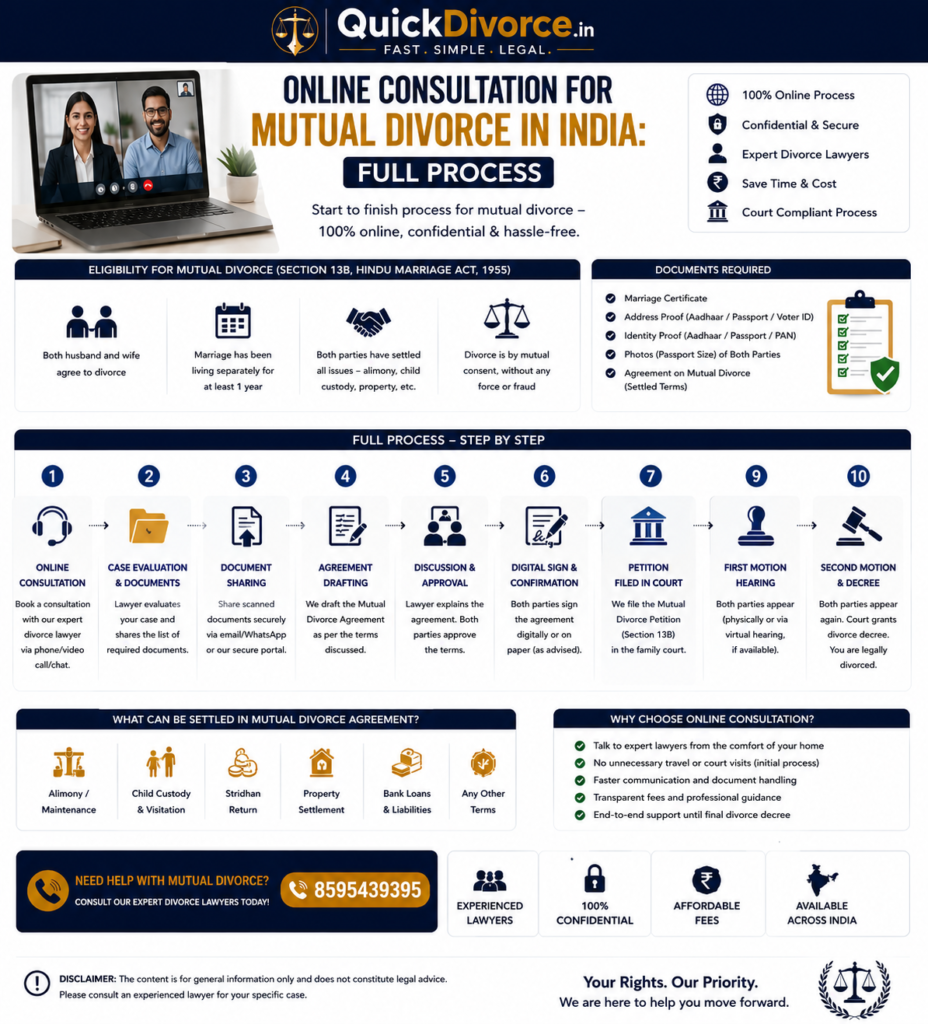
- 5 Step-by-Step: The Full Process of Online Consultation for Mutual Divorce
- 6 Timeline for Online Mutual Divorce in India (2026)
- 7 What Online Consultation for Mutual Divorce Costs in 2026
- 8 How NRIs Can Complete Mutual Divorce Online
- 9 Common Mistakes to Avoid in Online Mutual Divorce
- 10 How QuickDivorce.in Can Help
- 11 Frequently Asked Questions (FAQs)
- 12 Conclusion
- 13 Get Expert Guidance For Legal Services
Introduction
A few years ago, separating couples in India had little choice but to physically visit a lawyer’s chamber, queue at a Family Court filing counter, and appear in person at every hearing — often travelling across cities, taking leave from work, and enduring the anxiety of being seen in a court corridor during one of the most private crises of their lives. In 2026, much of that has changed. Online consultation for mutual divorce has become not just available but genuinely effective, with technology enabling couples to complete most of the process — from the first legal conversation to document preparation, e-filing, and even court hearings — without stepping outside their homes.
Mutual consent divorce can now be filed online in many cities across India. The e-filing system on the District Court websites or High Court portals allows you to upload petitions, pay court fees, and track the progress of your case digitally. Several established legal platforms and experienced family law advocates now offer structured online consultation for mutual divorce that guides couples through every stage of the process with the same quality of advice they would receive in person — and with considerably less logistical strain.
This guide explains exactly how online consultation for mutual divorce works in India in 2026 — from the very first conversation to the final decree — including what can genuinely be done online, what still requires a physical appearance, how e-filing works, how virtual hearings are conducted, and what couples need to prepare at each stage.
What Is Online Consultation for Mutual Divorce?
Online consultation for mutual divorce refers to the process of engaging a family law advocate remotely — through video call, phone, email, or secure messaging — to understand your legal position, structure your settlement, prepare your petition and supporting documents, file the case with the court, and manage the hearing process, all without requiring the couple to visit the lawyer’s physical office for most of these steps.
Divorce petitions — especially for mutual consent divorces — can be filed online in India through the eCourts portal or respective State High Court websites. The process includes e-filing the petition, uploading documents, paying court fees digitally, and attending virtual hearings.
Online consultation for mutual divorce is most widely used by:
- Couples living in different cities who find it impractical to meet physically before the actual hearings
- NRIs based abroad who want to finalise a mutual divorce without travelling to India, using a Power of Attorney and/or virtual hearing facilities
- Working professionals who find repeated office visits disruptive and prefer the efficiency of a structured digital process
- Couples who value the privacy of consulting from home rather than being seen in a lawyer’s office or court premises
- Those in cities with significant travel time and traffic, where a 45-minute commute for a 30-minute consultation is an unreasonable burden
The Legal Basis: Mutual Divorce Under Section 13B, Hindu Marriage Act
Before understanding the online process, a clear picture of the legal framework is essential. Online consultation for mutual divorce in India is most commonly used for proceedings under:
- Section 13B, Hindu Marriage Act, 1955 — for Hindus, Sikhs, Jains, and Buddhists. Requires both spouses to have lived separately for at least one year, mutual agreement on all terms, and two court appearances — the First Motion and the Second Motion — with a statutory six-month gap between them.
- Section 28, Special Marriage Act, 1954 — for couples married under a civil or interfaith ceremony. The procedure is substantively similar to Section 13B.
- Section 10A, Indian Divorce Act, 1869 — for Christian couples. Requires two years of separation before filing a mutual consent petition.
Mutual divorce is available across religions in India but governed by different laws. Hindus, Sikhs, Jains, and Buddhists file under Section 13B of the Hindu Marriage Act, requiring one year of separation. Christians file under Section 10A of the Indian Divorce Act, which requires two years of separation. Parsis file under the Parsi Marriage and Divorce Act. Interfaith couples married under a civil ceremony use the Special Marriage Act.
The six-month cooling-off period between First and Second Motion can be waived where the couple has been separated for a significantly longer period and there is no possibility of reconciliation, following the Supreme Court’s ruling in Amardeep Singh v. Harveen Kaur (2017), and the Court’s subsequent reaffirmation in Shilpa Sailesh v. Varun Sreenivasan (2023).
Is Online Consultation for Mutual Divorce Fully Digital?
This is the most important clarification to make upfront — and one that many couples misunderstand.
The entire process of mutual divorce cannot be completed online. Both spouses are required to physically sign the Mutual Divorce Petition and appear before the Family Court for hearings.
That said, what can be done online is substantial:
- The initial legal consultation and eligibility assessment
- Settlement negotiation and structuring of consent terms
- Document preparation — petition drafting, affidavit preparation, and financial disclosures
- Document signing — physical signatures required on the petition itself, but preparatory documents can often be reviewed and confirmed digitally
- E-filing of the petition through the eCourts portal or state-specific portals
- Court fee payment online
- Case status tracking and hearing date monitoring
- Virtual hearings for First and Second Motion — in courts that permit video conferencing
Fully digital: In some metro family courts (Delhi, Mumbai, Bengaluru), mutual consent divorces can be filed, processed, and heard online through video conferencing. Hybrid model: Filing and fee payment online; hearings and mediation conducted in person.
The hybrid model — where consultation and filing are online but physical appearance is still required at hearings — applies to most courts outside the major metros. For couples who genuinely cannot appear physically due to NRI status, inter-city separation, or health constraints, courts can and do grant virtual hearing permissions on a case-by-case basis at the judge’s discretion.
Step-by-Step: The Full Process of Online Consultation for Mutual Divorce
Stage 1: Initial Online Consultation and Eligibility Check
The process begins with both spouses — or initially just one — contacting a family law advocate or legal platform that offers online consultation for mutual divorce. During this first session, the advocate:
- Verifies the basic eligibility requirements: one year of separation, genuine mutual consent, absence of a living spouse from a prior undissolved marriage
- Identifies the applicable personal law and the correct Family Court jurisdiction — where the marriage was solemnised, where the couple last resided together, or where the respondent currently resides
- Explains the full timeline and what will be required at each stage
- Assesses whether the cooling-off period waiver is applicable and worth applying for
The couple consults a family lawyer to understand their rights and how to draft a fair settlement. The lawyer asks for basic details, prepares a settlement agreement, and explains the next steps.
This consultation is typically conducted via video call and lasts 30–60 minutes. Both spouses can be present simultaneously, or — particularly in sensitive early stages — each may consult separately before proceeding together.
Stage 2: Consent Verification
One practical concern in online consultation for mutual divorce is verifying that both spouses are genuinely and independently consenting, rather than one spouse being coerced or pressured into the process by the other. Reputable legal platforms handle this systematically.
Within a few minutes of form submission, a confirmation email for consent will be sent to both husband and wife. We do not initiate phone calls to either spouse at this stage.
This independent consent verification — through separate emails, separate video call sessions with each spouse, or a structured online intake form requiring individual responses — is an important safeguard and a standard part of professional online consultation for mutual divorce services.
Stage 3: Document Collection and Preparation
Once eligibility is confirmed and consent verified, the advocate requests the couple’s documents. For an online process, these are typically submitted via email, WhatsApp, or a secure client portal in scanned or photographed form. Required documents generally include:
- Marriage certificate
- Identity proof of both spouses (Aadhaar, Passport, or Voter ID)
- Address proof of both spouses
- Proof of separation — separate residence proofs, rent agreements, or utility bills in individual names
- Financial disclosure affidavits (mandatory per Supreme Court’s Rajnesh v. Neha directions) covering income, assets, property, and liabilities
- Children’s birth certificates (where applicable)
- Any prior court orders or pending proceedings to be addressed in the settlement
Both parties must submit ID proofs, marriage certificate, address proof, and mutual consent agreement. The legal expert drafts the online legal petition and related documents.
Documents are typically shared digitally via email or a secure upload link. The advocate or their team reviews them, flags any deficiencies, and requests corrections or additional documents before proceeding to drafting.
Stage 4: Settlement Structuring and Consent Terms Drafting
This is often the most time-consuming stage of online consultation for mutual divorce, and rightly so — the consent terms document is the legal backbone of the entire process. The advocate facilitates settlement discussions over video calls or through structured written exchanges, covering:
- Alimony — amount, form (lump sum or monthly), timeline, and full and final release language
- Child custody — primary custody, visitation schedule, holiday arrangements, and communication rights
- Child maintenance — monthly amounts, educational expenses, and medical cost responsibilities
- Property division — each immovable and movable asset, how it is transferred, and any outstanding loans
- Withdrawal of pending legal proceedings — listing all cases to be withdrawn and the timeline for doing so
- Mutual release clause — confirming no further claims after the decree
Even though mutual divorce sounds simple, every couple’s case is different. There may be children involved, joint assets, bank accounts, loans, or even future alimony to be discussed.
The draft consent terms are shared digitally for review, revisions are made through the online platform, and the final version is approved by both spouses before it is formalised.
Stage 5: Petition Drafting and Document Signing
The advocate drafts the joint petition under Section 13B of the Hindu Marriage Act (or applicable provision), incorporating the agreed consent terms. This draft is shared with both spouses for review via the digital platform.
Once finalised, the petition must be physically signed by both spouses — this remains a non-negotiable requirement. For couples in the same city, signatures can be coordinated easily. For those in different cities or abroad, the signed petition can be exchanged via courier. For NRI clients, a notarised Special Power of Attorney appointing a representative in India — or a court-approved digital signature in jurisdictions that accept it — may substitute for physical presence at this stage, subject to court discretion.
Stage 6: E-Filing the Petition
Once documents are ready, the lawyer files the joint petition on the official e-filing portal of the respective family court.
E-filing is done through the eCourts Integrated Mission Mode Project portal at filing.ecourts.gov.in, or through the state-specific High Court portals where Family Courts operate under them. The advocate:
- Creates or uses an existing registered account on the e-filing portal
- Uploads the petition, consent terms, affidavits, and supporting documents in the required PDF format (generally under 20MB per file)
- Pays the applicable court fee digitally through the portal’s integrated payment gateway
- Receives a case number and acknowledgment receipt digitally, which confirms the petition has been accepted by the court’s system
Not all courts offer full online hearings. In some cases, couples still need to appear physically for counselling and statement recording.
The e-filing portal is available across most Family Courts in Delhi, Mumbai, Bengaluru, Chennai, Hyderabad, Pune, Kolkata, and several other cities. Availability in smaller cities and district courts varies and should be confirmed with your advocate before assuming the digital route is available.
Stage 7: First Motion Hearing
After the petition is accepted and a hearing date is assigned, both spouses must appear before the Family Court for the First Motion — the first of the two mandatory court appearances in mutual consent divorce proceedings.
In metro Family Courts that permit virtual hearings, this appearance can be made via video conferencing — both spouses joining the hearing remotely from wherever they are, with the advocate either physically present in court or appearing virtually as well.
Virtual Court Hearing (First Motion): The court schedules an online hearing where both spouses confirm their decision to divorce.
At the First Motion hearing:
- The judge reads out the joint petition and consent terms
- Both spouses confirm, on record, that their decision to divorce is voluntary and free from coercion
- The court may refer the couple for a brief counselling session before or at this hearing
- Statements are recorded
- The court may pass a First Motion order, after which the statutory six-month cooling-off period begins — or the waiver application is filed and argued if applicable
Stage 8: Cooling-Off Period or Waiver Application
After the First Motion, the six-month waiting period serves as a mandatory reflection interval. During this time, the couple may reconcile — in which case the petition can be withdrawn — or proceed toward the Second Motion.
In mutual consent divorce, waiver of the six-month cooling period can be sought if separation is over a year (Amardeep Singh case). For NRI or inter-state marriages, filing can be done through Power of Attorney with notarisation.
Where a waiver application is filed, the advocate argues before the court that the parties have been separated for a substantial period, all issues are resolved, and no possibility of reconciliation exists. If the court grants the waiver, the Second Motion can be heard immediately or shortly after the First Motion without waiting six months.
Stage 9: Second Motion Hearing
The Second Motion hearing is the final appearance before the Family Court. Both spouses again confirm their decision to divorce — reaffirming the same consent they expressed at the First Motion. At this stage, the court is satisfied that the decision remains mutual and voluntary, and that the six-month (or waived) period has not changed anything.
After the Second Motion, the judge passes the divorce decree — the final, official order dissolving the marriage. This is a permanent judicial order with lifetime validity, recognised across India and internationally.
Stage 10: Receiving the Divorce Decree
Following the passing of the decree, a certified copy is issued by the court. In courts integrated with the eCourts portal, this can be downloaded digitally. In others, physical collection from the court registry or a courier request through the advocate is the standard process.
After both motions (in case of mutual consent) or after trial (in contested divorce), the Family Court issues a decree of divorce. We assist with certified copies and post-divorce documentation.
The divorce decree is the document you will need for every subsequent legal or administrative step — including passport name changes, bank account updates, insurance nominations, property transfers, and any future remarriage.
Timeline for Online Mutual Divorce in India (2026)
The entire procedure usually takes 6–12 months, costing between ₹5,000–₹50,000, depending on complexity and representation.
More specifically, the typical timeline breaks down as follows:
| Stage | Time Required |
|---|---|
| Initial consultation and eligibility check | 1–3 days |
| Document collection and preparation | 1–2 weeks |
| Settlement drafting and approval | 1–3 weeks |
| Petition signing and e-filing | 3–7 days after signing |
| First Motion hearing (after court scheduling) | 2–6 weeks post-filing |
| Cooling-off period | 6 months (or waived) |
| Second Motion hearing | 1–4 weeks after cooling-off |
| Decree issuance and copy collection | 1–2 weeks |
Where the cooling-off period waiver is granted, the entire process from filing to decree can potentially be completed in as little as 2–4 months. Where the full six months must be observed, the minimum realistic timeline is 7–9 months.
What Online Consultation for Mutual Divorce Costs in 2026
The total cost of online consultation for mutual divorce — including advocate fees, court fees, and documentation charges — varies by city, case complexity, and the nature of professional assistance engaged.
A realistic consolidated range for 2026:
| Cost Component | Estimated Range |
|---|---|
| Court fee for mutual divorce petition | ₹100–₹300 |
| Stamp duty on affidavits and documents | ₹200–₹600 |
| Notarisation of affidavits | ₹300–₹600 |
| Advocate fee (full-service online mutual divorce) | ₹15,000–₹50,000 |
| NRI-specific charges (PoA notarisation, courier) | ₹5,000–₹15,000 additional |
| Total (approximate) | ₹16,000–₹65,000 |
These ranges are indicative. The entire procedure usually takes 6–12 months, costing between ₹5,000–₹50,000, depending on complexity and representation. Advocate fees in metro cities tend toward the higher end of any published range, while tier-2 cities are generally more affordable.
How NRIs Can Complete Mutual Divorce Online
In most cases, yes. NRIs can complete the mutual divorce process without travelling to India through a Special Power of Attorney (sPOA) — appointing a trusted person in India to represent them — or via video conferencing for court hearings, subject to the judge’s approval. We have handled cases for clients in the USA, UK, UAE, Canada, and Australia entirely online.
For NRI couples, the online consultation for mutual divorce process typically involves:
- Document notarisation in the country of residence, followed by apostille through the relevant government authority, before the documents are accepted by Indian courts
- A Special Power of Attorney (sPOA) executed abroad, notarised, apostilled, and registered in India, authorising a representative in India to sign the petition on the NRI’s behalf
- Virtual hearing appearances where the court grants permission — increasingly available in metro Family Courts for genuine NRI cases
- Coordination between the Indian advocate and the NRI clients across time zones via video call and secure document sharing
Common Mistakes to Avoid in Online Mutual Divorce
Filing under incorrect jurisdiction. Uploading incomplete or unsigned petitions. Ignoring mandatory waiting period under Section 13B(2). Failing to appear for virtual hearings (can cause dismissal). Not verifying uploaded documents’ clarity or format (PDF under 20 MB).
Additional mistakes specific to the online process include:
- Assuming everything can be done without any physical appearance — both spouses must sign the petition physically, and court appearances (in person or virtually) are mandatory at both motions
- Not verifying the e-filing portal’s availability for your specific Family Court — not all courts have activated e-filing; confirm with your advocate before assuming the digital filing route is available
- Using unregistered websites or unverified legal platforms — always choose reputed legal tech platforms or government portals like eCourts
- Treating “online” as meaning “no physical signatures needed” — digital signing is not yet universally accepted for divorce petitions across Indian Family Courts; physical signatures remain standard
- Not preparing financial disclosures accurately — courts scrutinise financial affidavits carefully, and concealment or inaccuracy creates complications even in seemingly straightforward mutual consent cases
How QuickDivorce.in Can Help
At QuickDivorce.in, our online consultation for mutual divorce service covers every stage of the process — from the initial eligibility assessment and settlement structuring through video or phone call, to petition preparation, e-filing, hearing coordination, and decree collection — all managed remotely so you can complete most of the process from wherever you are. Our team handles cases across Delhi, Mumbai, Bengaluru, Chennai, Hyderabad, Pune, Kolkata, and other major cities, as well as NRI matters requiring cross-border coordination. Every consultation is confidential, every fee is transparent upfront, and every step is managed with the discretion this process deserves.
Frequently Asked Questions (FAQs)
What Is an Online Consultation for Mutual Divorce?
An online consultation for mutual divorce allows both spouses to discuss their case with a legal professional through a phone call or video meeting. It helps them understand the legal process, eligibility, required documents, and expected timeline without visiting an office.
Who Can Book an Online Mutual Divorce Consultation?
Any married couple considering a mutual divorce can book an online consultation to receive legal guidance, clarify doubts, and understand the next steps involved in the process.
What Documents Should I Keep Ready for the Consultation?
You should keep basic documents such as your marriage certificate (if available), identity proof, address proof, and any information related to children, property, or financial settlements that may be relevant to your case.
How Long Does an Online Divorce Consultation Usually Take?
Most online consultations last between 20 and 45 minutes, depending on the complexity of the case and the number of questions discussed.
Can Both Husband and Wife Attend the Online Consultation Together?
Yes. Both spouses can attend the consultation together or separately, depending on their convenience and comfort.
Is an Online Consultation Confidential?
Yes. Information shared during the consultation is generally treated as confidential and is discussed only for the purpose of providing legal advice.
Can I Start the Mutual Divorce Process After the Consultation?
Yes. If both spouses agree to proceed, the legal professional can guide you through document preparation, petition filing, court procedures, and the remaining steps of the mutual divorce process.
Is Physical Presence Required for an Online Consultation?
No. The consultation itself can be completed remotely through a phone call or video conference. However, court appearances may still be required depending on the applicable legal procedure.
What Questions Can I Ask During the Consultation?
You can ask about eligibility, court procedures, document requirements, child custody, alimony, property settlement, legal fees, timelines, and any other concerns related to your mutual divorce.
Why Should I Choose an Online Consultation Before Filing for Mutual Divorce?
An online consultation helps you understand your legal rights, avoid common mistakes, estimate the overall timeline, and prepare the necessary documents before initiating the mutual divorce process.
Conclusion
Online consultation for mutual divorce in India in 2026 has transformed what was once an exclusively in-person, court-centric process into a predominantly digital journey — accessible from home, manageable remotely, and often faster than the traditional approach precisely because scheduling, document exchange, and communication no longer depend on physical proximity.
The key is understanding what the digital process genuinely enables — consultation, settlement drafting, document preparation, e-filing, and in many courts, virtual hearings — and what it still requires in person — physical signatures on the petition and mandatory court appearances. Within those boundaries, online consultation for mutual divorce offers a genuinely efficient, private, and effective route to legal dissolution of a marriage for couples who have made their decision and simply need the process to match the clarity of that decision.
For a confidential, end-to-end online consultation for mutual divorce — including settlement structuring, e-filing, and hearing coordination across India and for NRI clients — connect with the family law team at QuickDivorce.in.
Get Expert Guidance For Legal Services
🟡QuickDivorce offers trusted online legal services across India, including mutual divorce, contested divorce, child custody, alimony, marriage registration, and expert family law consultation.
👉 Mutual Consent Divorce
👉 Contested Divorce Filing
👉 Child Custody and Maintenance
👉 Matrimonial Property Settlement
👉 NRI Divorce Services
👉 Alimony and Maintenance
👉 Court Marraige
👉 Stridhan Recovery
🟡For other Legal and Trademark related services visit
👉 Money Recovery Cases
👉 Property Disputes
👉 Business & Licence Registrations
📞 Call Now: +91 8595439395
🕐 Free Consultation: Monday to Saturday, 10 AM to 6 PM

Adv. Manish Kashyap is a Family Law & Divorce Lawyer with extensive experience in Mutual & Contested Divorce, NRI Divorce, Child Custody, Alimony, Domestic Violence, Judicial Separation, and Family Court matters, providing professional legal guidance to clients.

