

Views: 9
Complete guide to marriage registration under the Hindu Marriage Act 1955 — eligibility, documents, process, fees, and timeline in 2026.
Table of Contents
- 1 Introduction
- 2 1. What Is the Hindu Marriage Act, 1955?
- 3 2. Who Can Register Under the Hindu Marriage Act?
- 4 3. Eligibility Conditions
- 5 4. Why Registration Is Still Necessary After a Religious Wedding
- 6 5. Documents Required
- 7 6. Step-by-Step Registration Process
- 8 7. Role of the Gazetted Officer Witness
- 9 8. Fees for Registration
- 10 9. Timeline for Certificate Issuance
- 11 10. Hindu Marriage Act vs Special Marriage Act
- 12 11. Important Legal Conditions
- 13 12. Advantages and Limitations
- 14 13. Common Mistakes to Avoid
- 15 14. Expert Tips
- 16 15. Quick Checklist
- 17 16. Real-Life Example
- 18 17. Latest 2026 Updates
- 19 18. Frequently Asked Questions
- 20 19. Conclusion
- 21 Get Expert Advice for Marriage Registration in India
Introduction
If you were married through Hindu rituals — such as saptapadi around the sacred fire — your wedding is already legally valid the moment those rites are complete. But without registering it, you won’t have a certificate that banks, embassies, or courts will accept as proof. Marriage registration under the Hindu Marriage Act, 1955 is how that ceremony gets converted into an official legal record.
This guide covers everything you need: who can register under this Act, the exact documents required, the step-by-step process, fees, timelines, and the mistakes that most often delay applications. Whether you’re applying online through your state portal or visiting the SDM office directly, this walkthrough will help you get it right the first time.
1. What Is the Hindu Marriage Act, 1955?
The Hindu Marriage Act, 1955 is the central legislation governing marriages between Hindus, Buddhists, Jains, and Sikhs in India. It defines the conditions for a valid marriage, sets out grounds for divorce and judicial separation, and — under Section 8 — enables states to make rules for registering marriages that have already been solemnised.
Unlike the Special Marriage Act, which creates a civil marriage independent of religion, the Hindu Marriage Act assumes the marriage has already taken place through recognised religious rites. Registration under this Act is essentially a documentation step, not the act of marrying itself.
2. Who Can Register Under the Hindu Marriage Act?
You can register your marriage under this Act if:
- Both parties are Hindu, Buddhist, Jain, or Sikh by religion, or have converted to one of these faiths
- The marriage has already been solemnised through recognised religious ceremonies
- Both parties meet the eligibility conditions set out in the Act
If either spouse belongs to a different religion and has not converted, the couple would instead need to register under the Special Marriage Act, 1954, which does not require any religious ceremony or conversion.
3. Eligibility Conditions
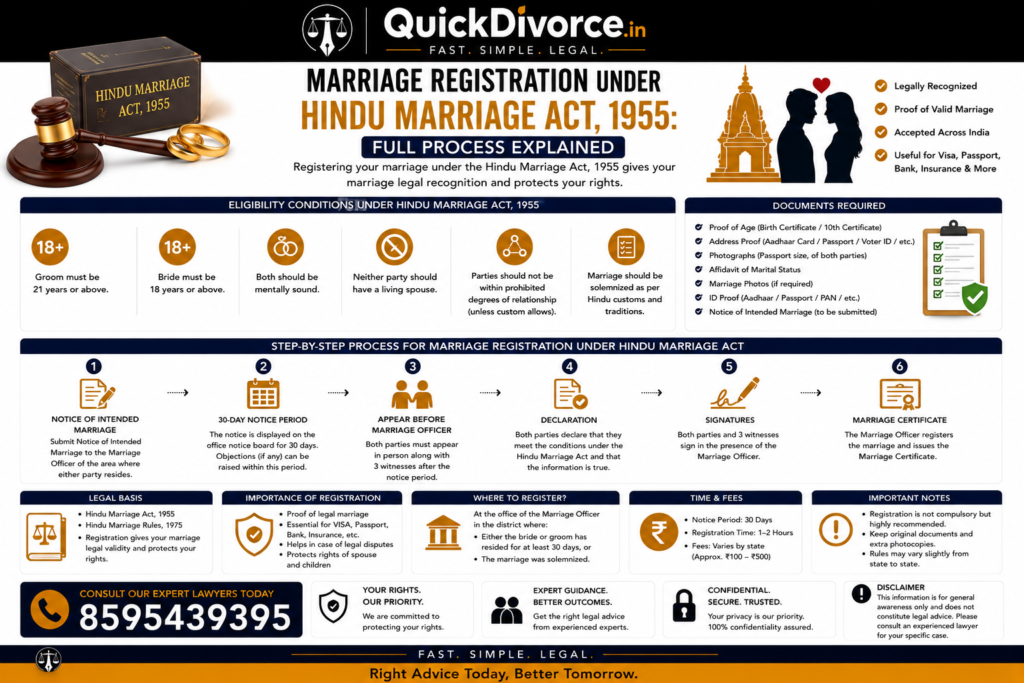
Section 5 of the Hindu Marriage Act lays out the conditions for a valid marriage:
- Age: The bride must be at least 18 and the groom at least 21 at the time of marriage.
- Monogamy: Neither party should have a living spouse at the time of the marriage.
- Sound mind: Both parties must be capable of giving valid consent and free from any mental disorder that would make them unfit for marriage.
- Free consent: Consent must be given without coercion, fraud, or undue influence.
- Prohibited relationships: The parties must not fall within the degrees of prohibited relationship, unless permitted by custom.
- Ceremony: The marriage must have been solemnised in accordance with the customary rites and ceremonies of at least one of the parties (such as the saptapadi, where applicable).
4. Why Registration Is Still Necessary After a Religious Wedding
A common misconception is that a Hindu wedding doesn’t need registration since it’s already valid under religious custom. While that’s technically true for the marriage’s validity, registration matters for entirely practical reasons:
- Proof for institutions: Banks, passport offices, and embassies require an official certificate, not a wedding invitation or photographs.
- Legal protection: A registered marriage strengthens a spouse’s position in maintenance, inheritance, or domestic dispute cases.
- International recognition: Foreign countries and visa authorities generally only recognise a government-issued marriage certificate.
- Avoiding fraud: Registration creates an official record that helps prevent bigamy and false marital claims.
Without registration, couples often discover the gap only when they urgently need the certificate — for instance, during a visa application deadline.
5. Documents Required
For registration under the Hindu Marriage Act, you’ll generally need:
- Duly filled and signed application form
- Proof of age of both parties (birth certificate, school certificate, or passport)
- Proof of residence (Aadhaar, voter ID, utility bill)
- Identity proof (Aadhaar, PAN, or passport)
- Wedding invitation card, if available
- Marriage photographs showing the ceremony/rituals
- Passport-size photographs of both spouses (usually two copies each)
- Affidavit confirming date and place of marriage, and marital status of both parties
- Affirmation that parties are not within the prohibited degree of relationship
- Divorce decree or death certificate of a previous spouse, if applicable
Warning Box: Aadhaar or voter ID alone is often not accepted as sole proof of age — carry a birth certificate or passport as backup.
6. Step-by-Step Registration Process
- Confirm eligibility — both parties Hindu/Buddhist/Jain/Sikh, marriage already solemnised.
- Collect documents listed above, along with photocopies and originals.
- Fill the application form, either online through your state’s portal or offline at the SDM/registrar’s office.
- Submit the application along with the registration fee.
- Document verification is carried out by the registrar/SDM on the date of application or a scheduled date.
- Appear in person with your spouse and a gazetted officer who attended the wedding.
- Certificate issuance — in most cases, issued the same day once verification is complete.
7. Role of the Gazetted Officer Witness
One requirement unique to Hindu Marriage Act registration is that a gazetted officer who was present at the wedding must appear before the registrar to confirm that the ceremony took place. This officer must carry valid identification proving their gazetted status.
If no gazetted officer attended the original wedding, some states allow an attested photograph certificate as an alternative, though requirements vary — it’s best to check with your specific SDM office in advance to avoid a last-minute issue on your appointment date.
8. Fees for Registration
| Component | Approximate Cost (INR) |
|---|---|
| Application/registration fee | ₹100 – ₹500 |
| Certified copy (if original lost) | ₹50 per copy |
| Tatkal/expedited service (where available, e.g., Delhi) | ₹10,000 and above |
Fees vary slightly by state; always confirm the exact amount through your local registrar’s office or state portal before applying.
9. Timeline for Certificate Issuance
| Scenario | Approximate Timeline |
|---|---|
| Standard application, no objections | Same day to 15 working days |
| Delayed due to missing documents | Add 1–4 weeks for resubmission |
| Tatkal/expedited service (where offered) | 24 hours |
Since there’s no mandatory notice or waiting period under the Hindu Marriage Act (unlike the Special Marriage Act), registration is typically much faster once documents are verified.
10. Hindu Marriage Act vs Special Marriage Act
| Feature | Hindu Marriage Act, 1955 | Special Marriage Act, 1954 |
|---|---|---|
| Who can use it | Hindus, Buddhists, Jains, Sikhs | Any two Indian citizens |
| Religious ceremony | Required (already performed) | Not required |
| Notice period | None | Mandatory 30 days |
| Witnesses | 1 gazetted officer who attended wedding | 3 witnesses |
| Certificate issue time | Same day to 15 days | 30–60 days |
| Best suited for | Same-faith couples with a solemnised wedding | Interfaith/inter-caste or civil marriages |
11. Important Legal Conditions
- Registration alone does not validate a Hindu marriage if the required rituals, such as saptapadi, were never performed — courts have held that mere registration cannot confer marital status without a valid ceremony.
- Marriage registration has been made compulsory across India following the Supreme Court’s 2006 ruling in Seema v. Ashwani Kumar.
- States have their own rules implementing Hindu marriage registration — for example, the Hindu Marriage Registration Rules, 1958 (as amended), used in states like West Bengal.
- A registered marriage certificate is treated as conclusive documentary proof in Indian courts.
12. Advantages and Limitations
Advantages
- Fast processing — often same-day certificate issuance
- No mandatory notice or waiting period
- Straightforward documentation compared to the Special Marriage Act
- Strong legal proof for visas, banking, and inheritance matters
Limitations
- Only applicable if both parties are Hindu, Buddhist, Jain, or Sikh
- Requires a gazetted officer witness from the original wedding, which can be inconvenient years later
- Cannot be used by interfaith couples without conversion
13. Common Mistakes to Avoid
- Submitting Aadhaar as the sole proof of age
- Missing the gazetted officer witness on the appointment date
- Providing unattested or unclear wedding photographs
- Applying under the wrong Act if one spouse isn’t Hindu, Buddhist, Jain, or Sikh
- Delaying registration for years, making it harder to arrange a witness from the original ceremony
14. Expert Tips
- Register as soon as possible after the wedding, while witnesses and documents are easy to arrange.
- Keep multiple certified copies of your marriage certificate for future use — visa applications, bank KYC, and insurance nominations all require it.
- If your original wedding didn’t have a gazetted officer present, check with your local registrar in advance about alternative documentation.
- Double-check your name spelling matches exactly across Aadhaar, PAN, and passport before submitting, since mismatches are a common cause of rejection.
15. Quick Checklist
- [ ] Confirmed both parties are Hindu/Buddhist/Jain/Sikh
- [ ] Marriage already solemnised with proper rituals
- [ ] Application form filled and signed
- [ ] Age and residence proof ready
- [ ] Wedding photographs and invitation card ready
- [ ] Gazetted officer witness arranged
- [ ] Registration fee paid
- [ ] Appeared in person for verification
- [ ] Certificate collected/downloaded
16. Real-Life Example
A couple in Delhi married with full Hindu rituals but delayed registration for two years. When they finally applied, they struggled to locate a gazetted officer who had attended their wedding, since none of the original guests held gazetted status. After consulting the SDM office, they were advised to submit an attested photograph certificate from a PAN-holding witness instead, along with an affidavit. Their certificate was issued within a week once this alternative documentation was accepted. The takeaway: registering soon after the wedding avoids this kind of complication entirely.
17. Latest 2026 Updates
- States including Delhi, Maharashtra, Karnataka, and Tamil Nadu now issue QR-coded digital marriage certificates, downloadable through their respective online portals.
- Registrars are increasingly strict about primary age-proof documents, following continued enforcement efforts tied to the Prohibition of Child Marriage (Amendment) Act, 2021.
- Several states have expanded online application submission for Hindu Marriage Act registrations, requiring only a short in-person visit for final verification.
18. Frequently Asked Questions
1. Is Marriage Registration Under the Hindu Marriage Act compulsory?
Yes. Following the Supreme Court’s 2006 directive, marriage registration has been made compulsory by all states and union territories. Couples who marry under Hindu customs should complete Marriage Registration Under the Hindu Marriage Act to obtain legal proof of their marriage.
2. Does Marriage Registration Under the Hindu Marriage Act make a marriage valid if no ceremony was performed?
No. Marriage Registration Under the Hindu Marriage Act only records a marriage that has already been validly solemnised according to Hindu customs and ceremonies. Registration cannot replace the essential religious rituals required under the Act.
3. Who is eligible for Marriage Registration Under the Hindu Marriage Act?
Marriage Registration Under the Hindu Marriage Act is available to couples where both spouses are Hindus, Buddhists, Jains, or Sikhs, and the marriage has already been solemnised in accordance with the applicable religious customs.
4. Is there a notice period for Marriage Registration Under the Hindu Marriage Act?
No. Unlike the Special Marriage Act, 1954, Marriage Registration Under the Hindu Marriage Act does not require a mandatory 30-day public notice period. Eligible couples can apply directly after their marriage ceremony.
5. Who must be present during Marriage Registration Under the Hindu Marriage Act?
Both spouses must appear before the Marriage Registrar for verification. Depending on the state’s rules, witnesses who attended the marriage ceremony, including a gazetted officer where required, may also need to be present during the registration process.
6. How long does Marriage Registration Under the Hindu Marriage Act take?
The processing time generally ranges from the same day to around 15 working days, depending on document verification, appointment availability, and the procedures followed by the concerned state authority.
7. What if I do not have a gazetted officer as a witness?
Some states may accept alternative witnesses or supporting documents if a gazetted officer is unavailable. Applicants should confirm the witness requirements with the local Marriage Registrar or SDM office before submitting the application.
8. Can interfaith couples apply for Marriage Registration Under the Hindu Marriage Act?
No. Marriage Registration Under the Hindu Marriage Act is generally available only when both parties belong to communities covered under the Act. Interfaith couples usually need to register their marriage under the Special Marriage Act, unless one party has legally converted before the marriage.
9. Can I apply online for Marriage Registration Under the Hindu Marriage Act?
Yes. Many state governments allow applicants to begin Marriage Registration Under the Hindu Marriage Act through their official online portals by submitting the application form and uploading documents. However, both spouses are usually required to appear in person for document verification and final registration.
10. What documents prove that the marriage ceremony was performed?
To complete Marriage Registration Under the Hindu Marriage Act, applicants are generally required to provide evidence that the marriage ceremony took place. Commonly accepted proof includes wedding photographs, the marriage invitation card, priest’s certificate (where applicable), and witness statements or other supporting documents as prescribed by the concerned authority.
19. Conclusion
Registering your marriage under the Hindu Marriage Act is usually the faster and simpler of India’s two major registration routes — provided you have your documents, witness, and eligibility details in order. Since there’s no mandatory notice period, most couples can expect their certificate within days rather than weeks.
The key is not to delay: registering soon after your wedding makes it far easier to arrange a gazetted officer witness and keeps your documentation fresh, avoiding the complications that come with registering years later.
Get Expert Advice for Marriage Registration in India
🟡QuickDivorce offers trusted online legal services across India, including mutual divorce, contested divorce, child custody, alimony, marriage registration, and expert family law consultation.
👉 Mutual Consent Divorce
👉 Contested Divorce Filing
👉 Child Custody and Maintenance
👉 Matrimonial Property Settlement
👉 NRI Divorce Services
👉 Alimony and Maintenance
👉 Court Marraige
👉 Stridhan Recovery
🟡For other Legal and Trademark related services visit
👉 Money Recovery Cases
👉 Property Disputes
👉 Business & Licence Registrations
📞 Call Now: +91 8595439395
🕐 Free Consultation: Monday to Saturday, 10 AM to 6 PM

Adv. Manish Kashyap is a Family Law & Divorce Lawyer with extensive experience in Mutual & Contested Divorce, NRI Divorce, Child Custody, Alimony, Domestic Violence, Judicial Separation, and Family Court matters, providing professional legal guidance to clients.

