

Views: 2
Discover why Is Marriage Registration Important in India is legally vital in 2026 — benefits, documents, process, and rights every couple must know
Table of Contents
- 1 Introduction
- 2 1. What Is Marriage Registration in India?
- 3 2. Why is Marriage Registration Important
- 4 3. Key Legal Benefits of a Registered Marriage
- 5 4. Hindu Marriage Act vs Special Marriage Act
- 6 5. Eligibility Criteria for Marriage Registration
- 7 6. Documents Required for Marriage Registration
- 8 7. Step-by-Step Registration Process for Marriage Registration
- 9 8. Marriage Registration Fees
- 10 9. Timeline for Getting a Certificate
- 11 10. Important Legal Conditions and Government Rules
- 12 11. Advantages and Disadvantages
- 13 12. Common Mistakes to Avoid
- 14 13. Expert Tips and Best Practices
- 15 14. Quick Checklist
- 16 15. Real-Life Example
- 17 16. Latest 2026 Updates
- 18 17. Industry Insights
- 19 18. Frequently Asked Questions
- 20 19. Conclusion
- 21 Get Expert Advice for Marriage Registration in India
Introduction
In India, a wedding is often treated as complete once the rituals, the saptapadi, the nikah, or the church vows are performed. But marriage registration in India is a separate legal step that many couples overlook — until they need a marriage certificate for a visa, a joint bank account, or a property transfer. Since the Supreme Court’s 2006 ruling in Seema v. Ashwani Kumar, registering a marriage has effectively become mandatory across every state.
This guide explains, in plain language, why registering your marriage matters, what legal protections it unlocks, which law applies to you, and exactly how to complete the process without confusion or delay. By the end, you’ll know precisely what documents you need, what it costs, and how to avoid the mistakes that get applications rejected.
1. What Is Marriage Registration in India?
Marriage registration is the process of officially recording a marriage with a government authority — usually the Sub-Divisional Magistrate (SDM), District Registrar, or Marriage Officer — so that the union is entered into public record. The outcome is a marriage certificate, a legal document that proves two people are married under Indian law.
It is important to understand one distinction clearly: registration does not create the marriage. A Hindu wedding performed with proper rituals, a Muslim nikah, a Christian church wedding, or a Parsi ceremony is legally valid the moment it is solemnised. Registration simply produces the paperwork that government departments, banks, employers, courts, and embassies will actually accept as proof.
India does not follow one single marriage law for everyone. Depending on religion and personal choice, a couple can register under:
- The Hindu Marriage Act, 1955 (Hindus, Buddhists, Jains, Sikhs)
- The Special Marriage Act, 1954 (any two Indian citizens, regardless of religion)
- The Indian Christian Marriage Act, 1872
- The Parsi Marriage and Divorce Act, 1936
- Muslim personal law, along with respective state registration rules
Most metro cities also allow online marriage registration, where couples fill an application digitally and only visit the registrar’s office for document verification and the final appointment.
2. Why is Marriage Registration Important
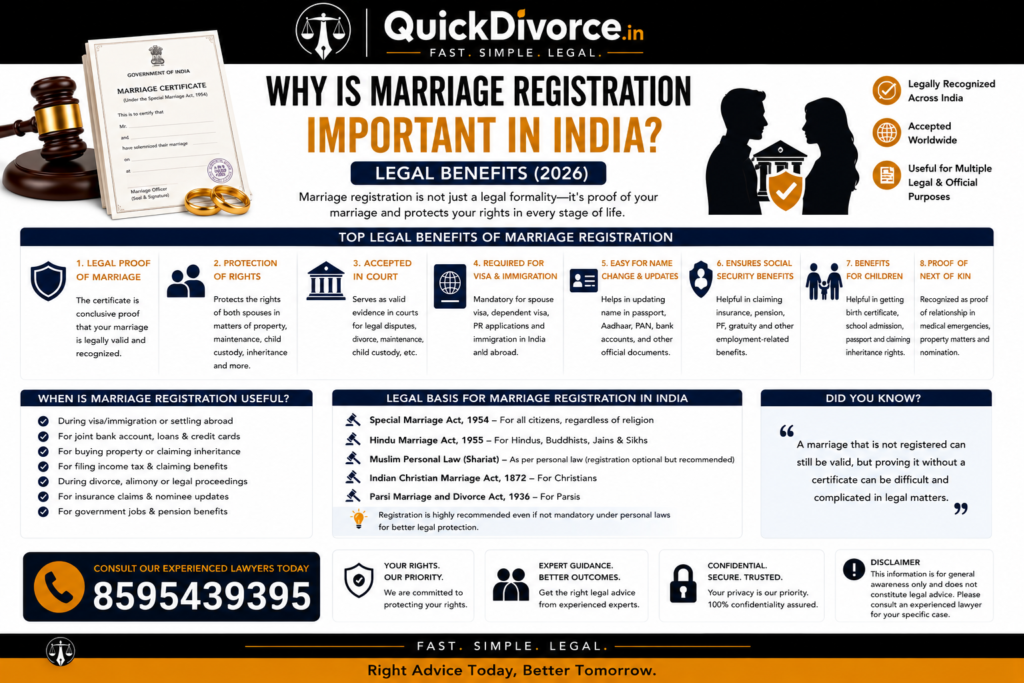
Many couples in India assume that a wedding album, invitation card, or family photographs are enough proof of marriage. They are not. Government departments, courts, and financial institutions recognise only an official marriage certificate as valid legal proof.
Marriage registration matters for several practical reasons:
- Legal identity as a married couple — required for name changes, joint accounts, and family status updates.
- Protection during disputes — a registered marriage gives both spouses standing to claim rights under maintenance, inheritance, or domestic violence laws.
- Mandatory for many government processes — passport applications, visa sponsorship, and spousal immigration all ask for a marriage certificate.
- Prevents fraud — registration creates an official record that discourages bigamy and fraudulent marriage claims.
- Simplifies future paperwork — buying property jointly, applying for a home loan, or listing a spouse as a nominee in insurance and provident fund accounts all become far easier.
Without registration, couples often find themselves stuck mid-process — for example, a bank refusing to add a spouse as a joint account holder, or a passport office rejecting a spouse-name change — simply because there is no certificate to submit.
3. Key Legal Benefits of a Registered Marriage
A marriage certificate is more than a formality; it is a legal shield. Here are the concrete benefits it provides:
| Benefit | How It Helps |
|---|---|
| Spousal visa & immigration | Embassies require a marriage certificate to process dependent or spouse visas |
| Property & inheritance rights | Establishes legal spouse status for succession claims |
| Bank & financial documentation | Needed to add a spouse as joint holder, nominee, or beneficiary |
| Passport name change | Required to update surname or marital status on a passport |
| Maintenance & alimony claims | Courts require proof of marriage before granting maintenance |
| Adoption applications | Most adoption agencies mandate a registered marriage certificate |
| Insurance & PF nominations | Confirms spousal relationship for claim settlement |
| Protection under domestic laws | Strengthens legal standing under maintenance and protection laws |
Did You Know? Many foreign embassies, including those of the US, UK, Canada, and Gulf countries, will not process a spouse visa application without an original, government-issued marriage certificate — a wedding invitation or photographs are not accepted as substitutes.
4. Hindu Marriage Act vs Special Marriage Act
Choosing the right law depends on your religion and whether your wedding already happened.
| Feature | Hindu Marriage Act, 1955 | Special Marriage Act, 1954 |
|---|---|---|
| Applicable to | Hindus, Buddhists, Jains, Sikhs | Any two Indian citizens, any religion |
| Religious ceremony required | Yes (must be already solemnised) | No — purely civil marriage |
| Notice period | Not required | Mandatory 30-day public notice |
| Certificate issue time | Same day to 15 days | 30–60 days |
| Best suited for | Couples of the same faith who already married with rituals | Interfaith, inter-caste, or couples wanting a court marriage |
| Witnesses required | One gazetted officer who attended the wedding | Three witnesses |
Interfaith and inter-caste couples almost always use the Special Marriage Act because it does not require conversion or religious rites — each partner retains their own religion, and succession is governed accordingly (Hindu Succession Act for Hindu-born parties, Indian Succession Act for others).
5. Eligibility Criteria for Marriage Registration
Eligibility conditions are largely consistent across both major Acts:
- Age: The bride must be at least 18 and the groom at least 21 on the date of marriage.
- Sound mind: Both parties must be capable of giving valid, informed consent.
- Free consent: No coercion, fraud, or undue influence.
- No living spouse: Neither party can have a spouse who is still living, unless legally divorced or widowed.
- Prohibited relationships: Parties must not fall within degrees of prohibited relationship, unless local custom permits it.
- Residency: At least one party must reside within the jurisdiction of the registrar’s office for a minimum period (commonly 30 days).
Pro Tip: If you are a divorcee or widow/widower, keep your decree absolute or spouse’s death certificate ready at the application stage — missing this is one of the most common reasons applications get delayed.
6. Documents Required for Marriage Registration
While requirements vary slightly by state, the standard document list includes:
- Duly filled application form (signed by both spouses)
- Proof of age — birth certificate, school leaving certificate, or passport (Aadhaar/voter ID alone is often not accepted as primary age proof)
- Proof of residence — Aadhaar card, voter ID, passport, or utility bill
- Passport-size photographs of both spouses (usually 2 copies each)
- Wedding invitation card (if solemnised, for Hindu Marriage Act cases)
- Marriage photographs of the ceremony
- Identity proof of both parties (Aadhaar, PAN, passport)
- Affidavit affirming marital status and that parties are not within prohibited relationship
- Divorce decree or death certificate of previous spouse, if applicable
- ID proofs of witnesses (typically 2–3, depending on the Act)
Warning Box: Do not submit photocopies without originals for verification. Most registrar offices reject applications outright if originals aren’t produced alongside self-attested copies.
7. Step-by-Step Registration Process for Marriage Registration
- Choose the correct Act based on your religion and circumstances.
- Fill the application form online (where available) or collect it from the local registrar/SDM office.
- Upload or attach supporting documents listed above.
- Pay the applicable fee at the counter or online payment gateway.
- Book/receive an appointment date communicated by the registrar’s office.
- Under the Special Marriage Act, a 30-day public notice is issued, and objections (if any) are examined.
- Visit the registrar’s office on the appointed date with your spouse and witnesses.
- Document verification is carried out by the marriage officer.
- Certificate issuance — signed and sealed on the spot (Hindu Marriage Act) or after the notice period concludes (Special Marriage Act).
- Download or collect the certificate; many states now issue QR-coded digital certificates for online verification.
8. Marriage Registration Fees
Fees are nominal and vary by state and by which Act is used.
| Component | Approximate Cost (INR) |
|---|---|
| Application/registration fee | ₹100 – ₹500 |
| Solemnisation fee (Special Marriage Act) | ₹150 – ₹500 |
| Certified copy (if original lost) | ₹50 per copy |
| Total average cost | ₹350 – ₹1,500 |
Costs can be somewhat higher in cities like Jaipur or Mumbai depending on local rules, so it’s worth checking your specific state portal before applying.
9. Timeline for Getting a Certificate
| Act | Typical Timeline |
|---|---|
| Hindu Marriage Act | Same day to 15 working days |
| Special Marriage Act | 30 days minimum (notice period) + a few days for solemnisation |
| If objections are raised | Add 30–60 days for inquiry |
| If refusal is appealed in court | Add 90–180 days |
Registering promptly after your wedding avoids the extra paperwork (late-fee declarations, additional affidavits) that many states impose once a certain grace period has passed.
10. Important Legal Conditions and Government Rules
- Registration is compulsory in every Indian state following the Supreme Court’s 2006 directive, regardless of religion.
- Under the Hindu Marriage Act, registration is proof of marriage only where proper rituals (such as saptapadi) were actually performed — registration alone cannot substitute for a solemnised ceremony.
- The Special Marriage Act’s 30-day notice cannot be waived or backdated; attempting to do so is a punishable offence.
- Several states have their own local marriage acts (for example, Tamil Nadu, Delhi, Karnataka, Maharashtra, Gujarat, and West Bengal), each with slightly different registration procedures and portals.
- Registered marriages carry conclusive legal weight in Indian courts without further attestation once the certificate is issued.
11. Advantages and Disadvantages
Advantages
- Provides indisputable legal proof of marriage
- Simplifies visa, banking, and property processes
- Protects spousal rights in disputes or inheritance
- Required for many government and legal procedures
- Digital, QR-coded certificates now available in several states
Disadvantages
- Notice period under the Special Marriage Act can expose couples to family interference or objections
- Bureaucratic delays possible if documents are incomplete
- Fees, procedures, and processing time vary by state, causing confusion
- Late registration may attract additional fines or requirements
12. Common Mistakes to Avoid
- Submitting Aadhaar or voter ID as the only age proof (often insufficient)
- Skipping or attempting to backdate the Special Marriage Act’s mandatory notice
- Missing witness documentation on the day of registration
- Not declaring a late-registration period where a state requires it, resulting in outright rejection
- Choosing the wrong Act for an interfaith or inter-caste marriage
- Forgetting to carry originals alongside photocopies for verification
13. Expert Tips and Best Practices
- Apply for registration soon after the wedding to avoid late fees and added documentation.
- Choose the Special Marriage Act if either partner belongs to a different religion — it avoids the need for religious conversion.
- Keep at least two extra certified copies of your marriage certificate for future use (visa, bank, insurance).
- Check whether your state offers online applications; it significantly reduces waiting time and repeat visits.
- If your application is refused without valid reason, an RTI request or appeal to the district court can help resolve it.
14. Quick Checklist
- [ ] Confirmed eligibility (age, consent, no living spouse)
- [ ] Selected correct Act (Hindu Marriage Act or Special Marriage Act)
- [ ] Gathered age and residence proof
- [ ] Arranged witness documentation
- [ ] Filled and submitted application (online/offline)
- [ ] Paid applicable fee
- [ ] Attended verification/solemnisation appointment
- [ ] Collected or downloaded marriage certificate
15. Real-Life Example
Consider an interfaith couple — one Hindu, one Muslim — who wanted a legally recognised marriage without either partner converting religion. They registered under the Special Marriage Act, submitted their 30-day notice, and faced a minor objection from a distant relative. The registrar’s office reviewed the objection, found no valid legal ground, and issued the certificate once the notice period ended. Because both partners retained their birth religion, their inheritance continues to be governed by their respective personal succession laws — a detail many interfaith couples aren’t aware of until registration.
16. Latest 2026 Updates
- Several states — including Delhi, Maharashtra, Karnataka, and Tamil Nadu — now issue QR-coded digital marriage certificates that can be verified and downloaded online using an application reference number and Aadhaar-based authentication.
- The push to raise the minimum marriage age for women to 21, under the Prohibition of Child Marriage (Amendment) Act, 2021, is still being implemented unevenly across states as of 2026, and registrars increasingly ask for stronger age-proof documents like birth certificates or passports rather than Aadhaar alone.
- Digitisation of state marriage registries continues to expand, cutting down in-person visits for document submission in most major cities.
17. Industry Insights
Family lawyers frequently point out that couples underestimate marriage registration until they hit a bureaucratic wall — a passport renewal, a joint home loan, or an inheritance dispute. Registering early, rather than treating it as an afterthought, consistently saves couples time, legal fees, and stress later. Legal experts also note that interfaith couples benefit most from understanding the Special Marriage Act early, since it protects their choice without forcing conversion or altering succession rights.
18. Frequently Asked Questions
1. Is marriage registration compulsory in India?
Yes. Following the 2006 Supreme Court ruling, all Indian states have introduced rules that make marriage registration compulsory, regardless of the couple’s religion. Registration serves as an official legal record of the marriage and helps protect the rights of both spouses.
2. Does marriage registration alone make a Hindu marriage legally valid?
No. Under the Hindu Marriage Act, 1955, a Hindu marriage becomes legally valid only after it has been solemnised according to the prescribed religious customs and ceremonies. Registration merely provides official legal documentation of an already valid marriage.
3. Which law applies to interfaith or inter-religious marriages in India?
Interfaith or inter-religious couples should register their marriage under the Special Marriage Act, 1954. This law allows two individuals of different religions to marry without converting their faith and provides a secular legal framework for marriage.
4. How long does the marriage registration process take under the Special Marriage Act?
The process usually takes at least 30 days because the Marriage Officer is required to publish a public notice inviting objections. If no valid objections are received, the marriage can be solemnised, and the marriage certificate is generally issued shortly thereafter.
5. Can a marriage be registered several years after the wedding?
Yes. A marriage can generally be registered even years after the wedding, provided the couple can submit the required documents, proof of marriage, and witnesses. Depending on the state, a late registration fee or additional verification may be applicable.
6. Which documents are accepted as proof of age for marriage registration?
Accepted age-proof documents usually include a Birth Certificate, Passport, School Leaving Certificate, or Matriculation Certificate. While Aadhaar Card and Voter ID may be accepted as identity or address proof, they are not always sufficient as standalone proof of age.
7. Is a religious ceremony required under the Special Marriage Act, 1954?
No. The Special Marriage Act, 1954 provides for a civil marriage. No religious rituals, customs, or ceremonies are required. The marriage is solemnised before the Marriage Officer in the presence of three witnesses.
8. Can foreign nationals register their marriage in India?
Yes. Foreign nationals can register their marriage in India under the Special Marriage Act, subject to fulfilling the legal requirements. They may also need additional documents such as a valid passport, visa, proof of residence, and a No Objection Certificate (NOC) or equivalent document from their embassy or home country.
9. What happens if someone objects during the 30-day notice period?
If an objection is filed during the mandatory notice period, the Marriage Officer conducts an inquiry to determine whether the objection has any legal basis. If the objection is found to be invalid, the marriage registration process continues after the inquiry is completed.
10. Can a rejected marriage registration application be challenged?
Yes. If a Marriage Officer unjustifiably refuses to register a marriage, the applicant has the right to challenge the decision by approaching the appropriate District Court or other competent authority as provided under the applicable law.
19. Conclusion
Marriage registration in India is far more than a bureaucratic checkbox — it is the legal foundation that protects a couple’s rights in nearly every important life event, from a spousal visa application to a property dispute. Whether you register under the Hindu Marriage Act or the Special Marriage Act depends on your religion and personal circumstances, but the underlying benefit is the same: a certificate that stands as undisputable proof of your marriage anywhere in India, and often abroad.
Registering promptly, choosing the correct Act, and preparing the right documents in advance can turn what feels like a complicated legal process into a straightforward formality completed within days.
Get Expert Advice for Marriage Registration in India
🟡QuickDivorce offers trusted online legal services across India, including mutual divorce, contested divorce, child custody, alimony, marriage registration, and expert family law consultation.
👉 Mutual Consent Divorce
👉 Contested Divorce Filing
👉 Child Custody and Maintenance
👉 Matrimonial Property Settlement
👉 NRI Divorce Services
👉 Alimony and Maintenance
👉 Court Marraige
👉 Stridhan Recovery
🟡For other Legal and Trademark related services visit
👉 Money Recovery Cases
👉 Property Disputes
👉 Business & Licence Registrations
📞 Call Now: +91 8595439395
🕐 Free Consultation: Monday to Saturday, 10 AM to 6 PM

I’m Aryan Yadav, passionate about SEO and Digital Marketing with a strong interest in helping businesses grow online. I enjoy learning new strategies, exploring digital trends, and creating ideas that deliver value. I believe in continuous growth, creativity, and building meaningful results through smart work and dedication.

