

Views: 2
Learn how to get a court marriage certificate in India — eligibility, documents, step-by-step process, fees, Tatkal option, and the top ways this certificate is legally used, from passports to property.
Table of Contents
- 1 Introduction
- 2 What Is a Court Marriage Certificate?
- 3 Which Laws Govern Marriage Registration in India?
- 4 Eligibility Criteria for Court Marriage Registration
- 5 Documents Required for a Court Marriage Certificate
- 6 Step-by-Step Process to Get a Court Marriage Certificate
- 7 Applying for a Marriage Certificate Online
- 8 Fees and Tatkal (Urgent) Marriage Certificate
- 9 How Long Does It Take to Get the Marriage Certificate?
- 10 Marriage Certificate for Indian and Foreign National Couples
- 11 How to Use a Court Marriage Certificate in India
- 12 Common Mistakes to Avoid
- 13 How to Get a Duplicate or Corrected Marriage Certificate
- 14 Frequently Asked Questions (FAQs)
- 15 Conclusion
- 16 Get Expert Advice for Marriage Certificate in India
Introduction
A Court Marriage Certificate is one of the most important legal documents a married couple in India can hold. It is official government proof that two people are legally married, and it is required for almost every major life event — from opening a joint bank account to applying for a spouse visa. Yet, many people remain confused about how the certificate is issued, which law governs it, what documents are needed, and where it can actually be used.
This guide answers all of that in detail — covering the legal process, required paperwork, fees, timelines, and the most important real-world uses of a court marriage certificate in India.
What Is a Court Marriage Certificate?
A court marriage certificate is an official document issued by a Marriage Registrar or Marriage Officer, confirming that a marriage has been legally solemnized and registered under Indian law. It records key details such as:
- Full names of both spouses
- Date and place of marriage
- Ages of both parties
- Names of witnesses
- Registration number and date
Unlike a wedding invitation card or a religious marriage certificate issued by a priest or temple, a court marriage certificate is a legally binding government record, admissible as proof of marriage in any court, government office, or private institution.
Which Laws Govern Marriage Registration in India?
In India, a marriage certificate can be obtained under two main laws, depending on how the marriage was solemnized:
1. Hindu Marriage Act, 1955
This applies to couples who are Hindus, Sikhs, Jains, or Buddhists and have already married through traditional religious rituals (such as saptapadi/pheras). Here, the certificate simply registers a marriage that has already taken place with customary rites.
2. Special Marriage Act, 1954
This is a secular law applicable to all citizens of India, regardless of religion or caste. It allows couples to marry as a pure civil contract, without any religious ceremony, and is commonly used for:
- Inter-caste and inter-religion marriages
- Couples who prefer a civil marriage without rituals
- Marriages between an Indian citizen and a foreign national
If you marry under the Special Marriage Act, the certificate is issued right after solemnization before the Marriage Officer — there is no separate “registration” step required afterward, since the marriage itself is a civil registration.
Eligibility Criteria for Court Marriage Registration
Before applying, make sure the following conditions under Section 4 of the Special Marriage Act (or the equivalent conditions under the Hindu Marriage Act) are met:
- The groom must be at least 21 years old, and the bride at least 18 years old.
- Both parties must be mentally capable of giving valid consent.
- Neither party should have a living spouse at the time of marriage.
- The parties should not fall within a prohibited degree of relationship.
- Both parties must give free and voluntary consent to the marriage.
Documents Required for a Court Marriage Certificate
The exact document list can vary slightly by state, but generally you will need:
- Proof of age — Birth certificate, matriculation certificate, or passport
- Proof of address — Aadhaar card, voter ID, passport, utility bill, or rent agreement
- Passport-size photographs of both bride and groom
- Marriage invitation card, if the marriage has already been solemnized (for Hindu Marriage Act registration)
- Affidavits from both parties stating date of birth, marital status, and confirmation that they are not within a prohibited relationship
- Identity proof of three witnesses, along with their photographs
- Divorce decree (for divorcees) or death certificate of spouse (for widows/widowers), if applicable
- Conversion certificate, if one party has converted religion for the marriage
- For a foreign national: passport copy with valid visa, proof of stay in India for at least 30 days, and a No Objection Certificate (NOC) or marital status certificate from their embassy/consulate
Step-by-Step Process to Get a Court Marriage Certificate
Step 1: File the Notice of Intended Marriage
Both parties must submit a Notice of Intended Marriage (Form 2) to the Marriage Officer in the district where at least one party has resided for the preceding 30 days. Many states now allow this notice to be filed online through the state’s e-district or marriage registration portal.
Step 2: Publication of Notice
The Marriage Officer publishes the notice publicly at the office and, in several states, also on the online portal, inviting objections from the public.
Step 3: 30-Day Objection Period
Anyone can raise an objection within 30 days, but only on valid legal grounds (such as underage marriage, existing spouse, or lack of mental capacity). If an objection is filed, the Marriage Officer investigates it and gives both parties a chance to respond before deciding.
Step 4: Solemnization of Marriage
If no valid objection is received (or objections are rejected), the marriage is solemnized before the Marriage Officer in the presence of three witnesses. Both parties and the witnesses sign the marriage register.
Step 5: Issuance of the Marriage Certificate
Once the marriage is solemnized and entered into the Marriage Certificate Book, the Marriage Certificate is issued — this is your final legal proof of marriage.
Note: If registering a marriage that was already solemnized under the Hindu Marriage Act (i.e., you already had a religious wedding), the certificate is often issued on the same day as the application, once documents and a gazetted officer’s attestation are verified — there is no 30-day notice period in that case.
Applying for a Marriage Certificate Online
Several states — including Delhi, Maharashtra, Gujarat, and others — allow couples to apply for marriage registration through their respective e-district or e-Nagar portals. The general online process looks like this:
- Register on the state’s marriage registration portal.
- Fill in the online application with personal and marriage details.
- Upload scanned copies of required documents (usually under 5 MB each).
- Complete Aadhaar-based identity verification, if applicable.
- Pay the applicable notice/application fee online.
- Book an appointment for physical verification and solemnization/registration at the Marriage Office.
- Visit the office in person with your witnesses on the appointed date to complete the process and collect the certificate.
Keep in mind that even with online applications, physical presence is mandatory for solemnization or final registration in almost every state, as biometric and document verification cannot be fully completed online.
Fees and Tatkal (Urgent) Marriage Certificate
- The basic marriage registration application fee usually ranges between ₹100 and ₹150.
- Court fee stamps and additional charges vary by state, typically ranging from a few hundred rupees up to around ₹2,100 for expedited processing.
- Some states offer a Tatkal (urgent) marriage certificate service for an additional fee, which can significantly reduce processing time for couples who need the certificate quickly — for example, for an upcoming visa or passport application.
It’s advisable to check the exact fee structure with your local Sub-Registrar or Marriage Officer, since charges differ from state to state.
How Long Does It Take to Get the Marriage Certificate?
- Under the Special Marriage Act, the process typically takes about 30 to 60 days, mainly due to the mandatory notice and objection period.
- Under the Hindu Marriage Act (registering an already-solemnized marriage), the certificate can often be issued on the same day as document verification, once a date is fixed with the Sub-Divisional Magistrate (SDM).
- As per Supreme Court directions, registration of marriage should ideally be completed within 60 days of the marriage.
If the marriage is not solemnized within three months of filing the notice under the Special Marriage Act, a fresh notice must be filed again.
Marriage Certificate for Indian and Foreign National Couples
If one party is a foreign national, additional documentation is required:
- Valid passport with an appropriate visa
- Proof of residence in India for at least 30 days (such as a police station report or address proof)
- A “Certificate of No Impediment” or marital status certificate issued by the concerned embassy or consulate
Such marriages are solemnized under the Special Marriage Act, since it applies uniformly regardless of nationality or religion.
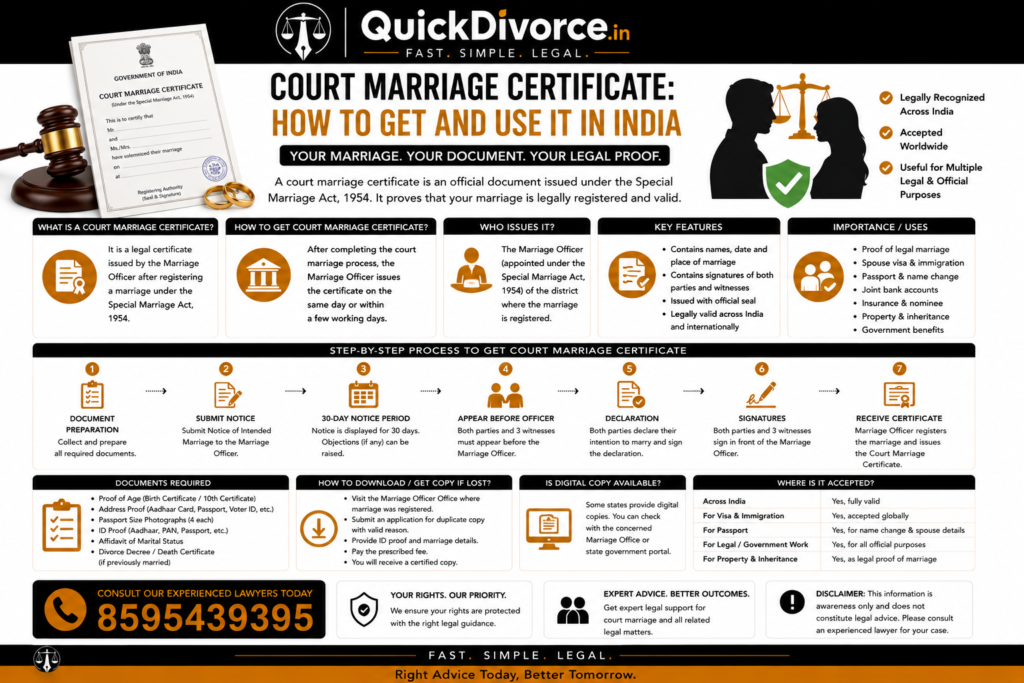
How to Use a Court Marriage Certificate in India
A court marriage certificate is far more than a formality — it is a legally essential document required for many official and personal purposes:
1. Passport and Visa Applications
Most passport offices require a marriage certificate to update your marital status, add your spouse’s name, or apply for a spouse/dependent visa when relocating abroad.
2. Name Change After Marriage
If either spouse wants to change their surname after marriage, the marriage certificate serves as the primary supporting document for updating your name on Aadhaar, PAN card, passport, and other identity documents.
3. Joint Bank Accounts and Financial Documentation
Banks often ask for a marriage certificate to open joint accounts, add a spouse as a nominee, or process certain loan and insurance applications.
4. Life Insurance and Nomination
Insurance companies typically require the marriage certificate to add a spouse as a nominee or beneficiary in life insurance and other financial policies.
5. Property and Real Estate Transactions
For jointly purchasing property, registering it in both spouses’ names, or transferring ownership, the marriage certificate is used as proof of the legal relationship between the parties.
6. Employment and Family Benefits
Many employers require a marriage certificate to add a spouse to health insurance, provident fund nominations, family pension schemes, or other employee benefit programs.
7. Immigration and Overseas Settlement
For couples relocating abroad, the marriage certificate is essential for spouse-sponsored visas, residency applications, and family reunification processes in most countries.
8. Legal Proceedings
In case of any future legal dispute — including maintenance claims, divorce proceedings, inheritance matters, or custody cases — the marriage certificate serves as primary legal evidence of the marital relationship.
9. Adoption Procedures
Couples applying to adopt a child in India are usually required to submit their marriage certificate as part of the eligibility documentation under adoption regulations.
10. Government Scheme Benefits
Several government welfare schemes and subsidy programs for married couples or families require a valid marriage certificate as proof of eligibility.
Common Mistakes to Avoid
- Delaying registration — Even if you’ve had a religious wedding, delaying registration can create complications later when the certificate is urgently needed.
- Incomplete or mismatched documents — Ensure that names, dates, and addresses match exactly across all submitted documents to avoid rejection or delay.
- Missing witness documentation — Witnesses must carry valid ID proof and photographs; incomplete witness paperwork is a common cause of delay.
- Not checking state-specific rules — Since implementation varies by state, always confirm the exact process and fee structure with your local Marriage Officer or Sub-Registrar.
- Losing the original certificate — Keep both physical and scanned copies safe, since it is frequently required throughout life for various legal and financial purposes.
How to Get a Duplicate or Corrected Marriage Certificate
If your original certificate is lost, damaged, or contains an error:
- For a duplicate certificate — File an application with the same Marriage Registrar’s office where the marriage was originally registered, along with an affidavit explaining the loss and any available proof (such as an FIR for a lost certificate, where required).
- For corrections — Submit a written request along with supporting documents (such as ID proof showing the correct spelling or date) to the Marriage Registrar, who will verify and reissue a corrected certificate.
Processing times and fees for duplicates or corrections vary by state.
Frequently Asked Questions (FAQs)
1. What is a court marriage certificate?
A court marriage certificate is an official legal document issued by the Marriage Officer or Registrar after a valid court marriage is solemnized or registered. It serves as legal proof of marriage throughout India.
2. How can I get a court marriage certificate in India?
To obtain a court marriage certificate, eligible couples must complete the prescribed legal procedure, submit the required documents, appear before the Marriage Officer with the required witnesses, and fulfill the applicable legal formalities. Once the process is completed, the certificate is issued by the competent authority.
3. What documents are required to obtain a court marriage certificate?
The required documents generally include identity proof, age proof, address proof, passport-size photographs, and proof of marital status, such as a divorce decree or death certificate where applicable. Additional documents may be required depending on the applicable law and individual circumstances.
4. How long does it take to receive a court marriage certificate?
The timeline depends on the applicable marriage law and completion of the legal procedure. For marriages under the Special Marriage Act, the statutory notice period generally applies before the certificate is issued after solemnization.
5. Where can a court marriage certificate be used?
A court marriage certificate can be used for passport applications, visa processing, opening joint bank accounts, updating marital status in official records, insurance claims, property transactions, immigration matters, and other legal or administrative purposes.
6. Can I get a duplicate court marriage certificate if the original is lost?
Yes. If the original court marriage certificate is lost or damaged, you can generally apply for a certified duplicate copy from the office of the Marriage Registrar or the authority that issued the original certificate, subject to the prescribed procedure.
7. Is a court marriage certificate valid throughout India?
Yes. A validly issued court marriage certificate is recognized throughout India and serves as official legal proof of marriage for government departments, financial institutions, courts, and other authorities.
Conclusion
A Court Marriage Certificate is not just a formality — it is a critical legal document that protects your rights as a married couple and simplifies countless administrative and legal processes throughout your life, from passport applications to property transactions. Whether you marry under the Hindu Marriage Act or the Special Marriage Act, understanding the correct process, required documents, and timelines can help you avoid unnecessary delays and complications.
If you’re planning to register your marriage or need help navigating a complicated case (such as an inter-religion marriage, a marriage involving a foreign national, or a correction request), it’s always advisable to consult a qualified family law advocate for personalized guidance.
Get Expert Advice for Marriage Certificate in India
🟡QuickDivorce offers trusted online legal services across India, including mutual divorce, contested divorce, child custody, alimony, marriage registration, and expert family law consultation.
👉 Mutual Consent Divorce
👉 Contested Divorce Filing
👉 Child Custody and Maintenance
👉 Matrimonial Property Settlement
👉 NRI Divorce Services
👉 Alimony and Maintenance
🟡 Protect Your Rights
👉 Domestic Violence Legal Support
👉 Stridhan Recovery
🟡For other Legal and Trademark related services visit
👉 Money Recovery Cases
👉 Property Disputes
👉 Business & Licence Registrations
📞 Call Now: +91 8595439395
🕐 Free Consultation: Monday to Saturday, 10 AM to 6 PM

Adv. Manish Kashyap is a Family Law & Divorce Lawyer with extensive experience in Mutual & Contested Divorce, NRI Divorce, Child Custody, Alimony, Domestic Violence, Judicial Separation, and Family Court matters, providing professional legal guidance to clients.

