

Views: 3
Planning an Court Marriage for Inter-Caste couples ? Complete 2026 guide covering the Special Marriage Act process, legal protections, documents, objections, and safety rights.
Table of Contents
- 1 Introduction
- 2 The Constitutional Backbone: Your Right to Marry Whom You Choose
- 3 Why the Special Marriage Act, 1954 Is the Right Law for You
- 4 No Conversion Required — A Critical Clarification
- 5 Eligibility Conditions That Must Be Met
- 6 Step-by-Step Court Marriage Procedure Under the Special Marriage Act
- 7 Documents Required
- 8 The Contested 30-Day Public Notice — Privacy Concerns and Available Safeguards
- 9 What Happens If Your Family Tries to Stop the Marriage?
- 10 Legal Consequences of Honour-Based Violence
- 11 Financial Incentives for Inter-Caste Marriages
- 12 How Inter-Religion Marriage Affects Inheritance and Succession Rights
- 13 How QuickDivorce.in Can Help
- 14 Frequently Asked Questions (FAQs)
- 15 Conclusion
- 16 Get Expert Advice for Court Marriage in India
Introduction
India is a country where the right to choose your life partner is guaranteed by the Constitution, yet exercising that right — particularly across caste or religious lines — can feel like navigating a minefield of social pressure, family resistance, and procedural uncertainty. For couples in this situation, court marriage under the Special Marriage Act, 1954 is not just a legal option; it is often the most secure, most protected, and most legally watertight route to formalising a relationship that families or communities may resist.
Court marriage for inter-caste and inter-religion couples has become significantly more visible and more widely accessed across India in recent years, as younger couples increasingly prioritise their constitutional right to choose over inherited social expectations. The law, in this respect, is unambiguous: court marriage conducted under the Special Marriage Act, 1954 offers legal recognition making it an essential choice for couples from different religious or cultural backgrounds, irrelevant of the religion or faith followed by either party.
What many couples don’t fully understand, however, are the procedural details — the 30-day notice, what happens when someone objects, what “caste-based objections” actually mean in law, and how to access police protection if their safety is at risk during the process. This guide breaks all of it down, so you can approach your court marriage for inter-caste or inter-religion union with clarity, confidence, and the right legal backing.
The Constitutional Backbone: Your Right to Marry Whom You Choose
Before getting into procedure, it’s worth establishing the legal foundation that makes court marriage for inter-caste and inter-religion couples not just possible but constitutionally protected.
Article 21 of the Constitution of India guarantees the right to life and personal liberty, which the Supreme Court has consistently interpreted to include the right to choose one’s life partner. Under Article 21 of the Indian Constitution, everyone has the right to marry the person of their choice.
Article 14 guarantees equality before the law and equal protection of the laws — a provision that directly prohibits discrimination on the basis of caste or religion in the administration of civil marriage procedures.
Article 25 protects freedom of conscience and the right to freely profess, practice, and propagate religion — and crucially, the right to not have your marriage governed by your religion’s personal law if you choose a secular alternative.
Together, these three provisions form an unbreakable constitutional shield for inter-caste and inter-religion couples who choose to marry through the civil process. Courts at every level — District Courts, High Courts, and the Supreme Court — have repeatedly and consistently upheld this right against challenges from families, community bodies, and even local administration.
Why the Special Marriage Act, 1954 Is the Right Law for You
The Special Marriage Act is a central law in India that allows two people to marry regardless of their religion, caste, or creed. It was enacted to provide a civil marriage option to couples who don’t want to marry under personal laws like Hindu, Muslim, or Christian laws.
For inter-caste couples where both partners belong to the same broad religious category — for instance, a Hindu Brahmin marrying a Hindu Dalit — there are actually two potential routes:
Route 1: Hindu Marriage Act, 1955 (For Same-Religion, Different Caste Couples)
Where both parties are Hindu, Sikh, Jain, or Buddhist, registration under the Hindu Marriage Act is possible and faster, since it involves no mandatory public notice period. The marriage can be solemnised through religious rites and then registered at the SDM office, with the certificate typically issued within 7–15 working days. This is a valid option for inter-caste couples who don’t face active family hostility and want a quicker process.
Route 2: Special Marriage Act, 1954 (For All Couples, Especially Inter-Religion)
The Special Marriage Act is the backbone of civil marriages in India. It allows individuals to marry regardless of caste, religion, or faith without converting. This is the mandatory route for inter-religion couples — a Hindu and a Muslim, a Christian and a Sikh, an atheist and a believer — since personal laws of each religion govern only their own community’s marriages. Marriages solemnized under the Special Marriage Act are not governed by personal laws and are considered to be secular.
The Special Marriage Act route is also the preferred route for inter-caste couples who anticipate family or community interference, since it comes with the strongest procedural protections and offers the strongest legal shield, as it is a direct government-monitored process.
No Conversion Required — A Critical Clarification
One of the most widespread misconceptions about court marriage for inter-caste and inter-religion couples is that one or both partners must convert to a common religion before they can legally marry. This is entirely false.
No conversion required — marrying under this Act protects both partners’ faiths. A Muslim woman and a Hindu man, a Christian woman and a Sikh man, or any combination of faiths can marry under the Special Marriage Act while each fully retaining their own religion. The marriage certificate issued under this Act makes no reference to either party’s religion — it is a purely civil, secular document.
This is one of the most powerful features of court marriage for inter-caste and inter-religion couples, and it removes one of the most common pressure points families use to delay or prevent the marriage: the demand that one partner convert.
Eligibility Conditions That Must Be Met
Before filing the notice, both parties should confirm they meet the basic eligibility requirements under Section 4 of the Special Marriage Act:
- The groom must be at least 21 years old, and the bride at least 18 years old, on the date of marriage
- Neither party should have a living spouse — prior marriages must be dissolved through a valid divorce decree or ended by death
- Both parties must be of sound mind, capable of giving valid, informed consent
- Neither party should fall within the “prohibited degree of relationship” as defined under the Act — unless their customs specifically permit such a union
- At least one party must have resided within the district of the relevant Marriage Officer for a minimum of 30 days prior to filing the notice
No parental consent is required once both parties are legal adults. As per the Constitution of India and various Delhi High Court rulings, consenting adults (21 for men, 18 for women) do not need parental or societal approval to marry.
Step-by-Step Court Marriage Procedure Under the Special Marriage Act
Step 1: Filing the Notice of Intended Marriage
The first step is to submit a written notice of intended marriage to the Marriage Officer of the district where at least one of the parties has resided for a minimum of 30 days. Both parties must jointly submit this notice, along with the required documents and fees, to the Sub-Divisional Magistrate (SDM) office or Marriage Officer of the relevant district.
Step 2: Publication of the Notice — The 30-Day Period
A 30-day notice is displayed on the registrar’s notice board for public objections. This is the period during which any person can file a formal, written objection to the intended marriage — but critically, only on specific, legally prescribed grounds.
Step 3: Hearing and Disposal of Objections (If Any)
If an objection is filed, the Marriage Officer conducts an inquiry within 30 days. Invalid objections (based on religion, caste, or family disapproval) are rejected. Only objections on the grounds listed under Section 4 — an existing marriage, underage parties, unsound mind, or prohibited degree of relationship — have legal standing. A family member’s objection that “our daughter cannot marry outside our caste” or “we don’t approve of the religion” has zero legal validity and the Marriage Officer is bound by law to reject it.
Step 4: Solemnisation of the Marriage
After the waiting period, both partners and three witnesses sign the declaration before the Marriage Officer. The marriage is solemnised legally — no religious rituals. The couple and three witnesses must be physically present on the scheduled date.
Step 5: Issuance of the Marriage Certificate
A Certificate of Marriage is issued immediately after solemnisation; valid throughout India and recognised internationally. This is the couple’s permanent legal proof of marriage.
If the marriage is not solemnised within three months of filing the notice, the notice lapses and the process must be restarted.
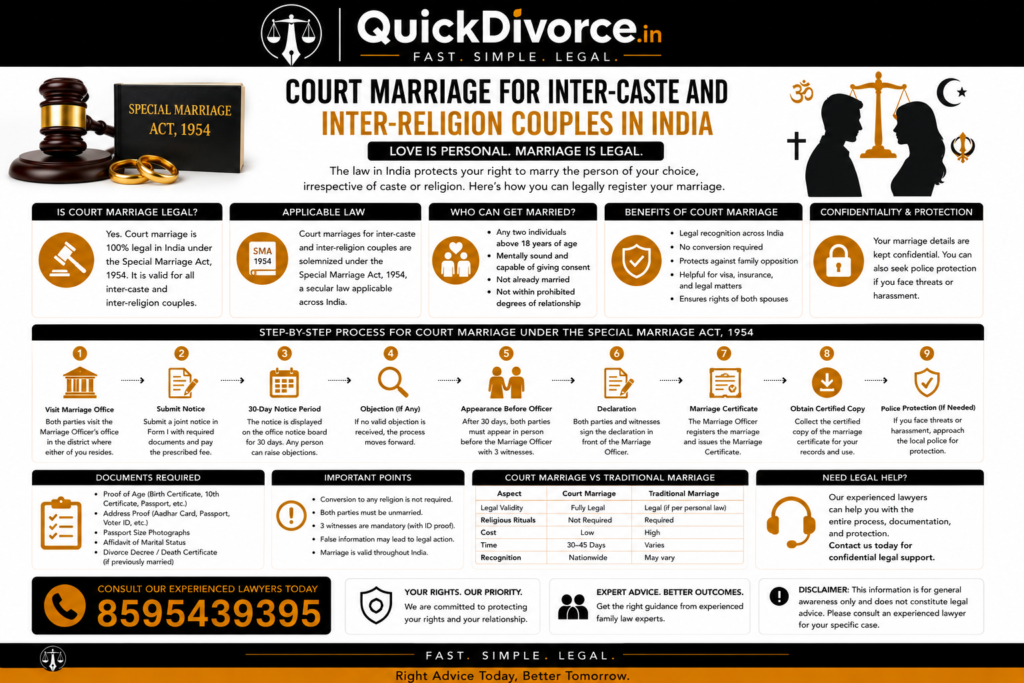
Documents Required
The standard documents required for court marriage for inter-caste and inter-religion couples under the Special Marriage Act are:
For Both Parties:
- Identity proof — Aadhaar Card, Voter ID, or Passport
- Age proof — Birth Certificate, 10th Marksheet, or Passport
- Residence proof — Aadhaar Card, utility bill, or rent agreement confirming 30-day residency in the district
- Passport-size photographs (4–6 copies each), plus joint photographs
- Notarised affidavit confirming date of birth, marital status, nationality, and that the marriage is not in violation of Section 4 conditions
For Witnesses (All Three):
- Valid government-issued photo ID — Aadhaar, Voter ID, or Passport
- Self-attested photocopies
- Recent passport-size photographs
If Either Party Is a Foreign National:
- Valid passport with appropriate visa
- Certificate of No Impediment or Single Status Certificate, apostilled by the home country’s authority
The Contested 30-Day Public Notice — Privacy Concerns and Available Safeguards
The mandatory public display of the notice for 30 days remains the most controversial aspect of court marriage for inter-caste and inter-religion couples. The public notice requirement has been criticized for exposing couples to harassment. There have been calls to amend this clause to protect privacy, especially in sensitive cases.
The concern is legitimate: couples who face family hostility or community opposition are effectively required to publicly broadcast their intended marriage for a month before it can be solemnised, creating a window during which interference — sometimes violent — can occur.
Courts have responded with several important practical safeguards:
1. Filing in a Different District You can request the SDM to keep your address confidential or move to a safer district for filing. Since only one party needs to have resided in the district for 30 days, couples can choose a district where they have a genuine connection but where family members are less likely to monitor the notice board.
2. Police Protection Orders Multiple High Courts — including Allahabad, Punjab and Haryana, Delhi, and Madras — have passed orders directing local police to provide protection to inter-caste and inter-religion couples who face threats to their safety. This protection can be obtained by filing a writ petition before the High Court or a representation directly to the Superintendent of Police, Collector, or SSP.
3. Safe Houses and NGO Support Several state governments and registered NGOs operate support facilities for inter-caste and inter-religion couples facing threats. The Allahabad High Court in particular has directed district administrations in Uttar Pradesh to create mechanisms for such couples to receive shelter, protection, and administrative support during the notice period.
4. Seeking Confidentiality of Address Couples can request the Marriage Officer not to reveal their specific residential address on the displayed notice — keeping the notice itself visible while limiting the information available to anyone who might use it to locate and intimidate them.
What Happens If Your Family Tries to Stop the Marriage?
This is a question that many couples approaching court marriage for inter-caste and inter-religion unions need a clear answer to. The law is firmly on the side of consenting adults, and several legal remedies exist:
Habeas Corpus Petition
If a woman is forcibly confined by her family to prevent the marriage, a habeas corpus petition filed before the High Court is the fastest legal remedy to secure her release and freedom of movement. High Courts have consistently acted swiftly in such cases, often issuing orders within 24–48 hours.
Protection Writ Petition
Both partners can jointly file a writ petition before the High Court — usually under Articles 226 and 21 — seeking a direction to the local police to protect them from family violence or interference. If facing threats, approach your local police or the High Court for protection. Courts have issued standing directions to police to provide security to such couples during both the notice period and the solemnisation date.
Section 144 BNSS / Restraining Orders
In some situations, courts have issued restraining orders against specific family members prohibiting them from approaching or harassing the couple.
Direct Police Complaints
A complaint to the local police — supported by documentary evidence of threats received (WhatsApp messages, call recordings, written notices from community bodies) — creates a formal record and typically prompts some protective response from law enforcement, especially when backed by a High Court order.
Legal Consequences of Honour-Based Violence
One aspect of court marriage for inter-caste and inter-religion couples that couples should be aware of is the criminal law framework protecting them against honour-based violence:
- Section 103 of the Bharatiya Nyaya Sanhita, 2023 (formerly Section 302 IPC) — murder in the name of “honour” is punishable with death or life imprisonment, and courts have repeatedly classified honour killings in this category
- The Prohibition of Child Marriage Act, 2006 — offers additional protection where minors are being coerced into marriages against their will as part of a family’s attempt to prevent an inter-caste or inter-religion marriage
- Supreme Court guidelines in Shakti Vahini v. Union of India (2018) specifically directed state governments to take preventive, remedial, and punitive steps against honour-based violence targeting inter-caste and inter-religion couples — including constituting protection cells in every district
Financial Incentives for Inter-Caste Marriages
An often-overlooked but practically significant dimension of court marriage for inter-caste couples is the existence of government incentive schemes, particularly for marriages involving a Scheduled Caste (SC) or Scheduled Tribe (ST) party.
The Dr. Ambedkar Foundation’s Inter-Caste Marriage Scheme offers financial incentives to couples where one partner belongs to a Scheduled Caste community and the other belongs to a non-SC community, as a policy measure to encourage social integration and combat caste discrimination. Several state governments — including Maharashtra, Rajasthan, Karnataka, Tamil Nadu, and Haryana — operate their own parallel incentive schemes, with benefits ranging from ₹50,000 to ₹5 lakh or more in some states.
To claim these benefits, the couple typically needs to submit their marriage certificate, proof of caste, and an application to the relevant state or central authority within a specified period after the marriage. Consulting a family law professional familiar with your state’s specific scheme can help ensure the application is made correctly and within time.
How Inter-Religion Marriage Affects Inheritance and Succession Rights
One dimension of court marriage for inter-caste and inter-religion couples that deserves careful consideration before proceeding is its impact on succession and inheritance rights:
- A marriage registered under the Special Marriage Act removes the parties from the governance of their respective personal laws for many purposes — including succession. The Indian Succession Act, 1925 applies to the estate of persons married under the Special Marriage Act, rather than the Hindu Succession Act or Muslim Personal Law, which can significantly affect how inheritance is distributed, including among children from the marriage.
- This shift in succession law can be particularly significant for Muslim parties — since Muslim Personal Law provides specific fractional inheritance shares to various relatives, while the Indian Succession Act follows a different framework entirely.
- Couples should discuss these implications with a family law advocate before proceeding, so that they can take any necessary steps — such as drafting a will — to ensure their estate is distributed in accordance with their actual wishes.
How QuickDivorce.in Can Help
Court marriage for inter-caste and inter-religion couples involves more than just paperwork — for many couples, it also means navigating real safety concerns, document preparation under time pressure, monitoring the 30-day notice period, responding to potentially frivolous objections, and in some cases, coordinating with police or courts for protection. At QuickDivorce.in, our family law team has experience assisting inter-caste and inter-religion couples through every stage of this process — from choosing the right district for filing and preparing all documentation, to obtaining police protection orders and monitoring the notice period, so that your wedding day is about your relationship, not procedural anxiety.
Frequently Asked Questions (FAQs)
1. Can inter-caste and inter-religion couples legally marry in India?
Yes. Adult couples can legally marry regardless of caste or religion, provided they satisfy the legal eligibility requirements. Inter-religion marriages are commonly solemnized under the Special Marriage Act, 1954 without requiring either person to change their religion.
2. Which law governs court marriage for inter-religion couples?
Court marriage for inter-religion couples is generally governed by the Special Marriage Act, 1954. The Act allows two adults of different religions to marry through a civil procedure without religious conversion.
3. Can inter-caste couples also opt for a court marriage?
Yes. Inter-caste couples can choose a court marriage if they meet the legal requirements. Depending on their circumstances and the applicable law, they may marry under the Special Marriage Act or another applicable marriage law.
4. What documents are required for court marriage?
The required documents generally include identity proof, age proof, address proof, passport-size photographs, and documents relating to marital status, such as a divorce decree or death certificate where applicable. Additional documents may be required depending on the facts of the case.
5. Is parental consent required for court marriage?
No. If both parties are legally competent adults and fulfill the statutory conditions, parental consent is generally not required for a valid court marriage.
6. How long does the court marriage process take?
The timeline depends on the applicable law and procedural requirements. Marriages under the Special Marriage Act generally involve a statutory notice period before solemnization, subject to the provisions of the Act.
7. Can couples seek protection if they face threats from family members?
Yes. Adult couples who face threats or harassment due to an inter-caste or inter-religion marriage may approach the appropriate authorities or the courts for protection, depending on the facts of the case.
Conclusion
Court marriage for inter-caste and inter-religion couples in India is not just legally possible — it is constitutionally protected, procedurally clear, and backed by a growing body of High Court and Supreme Court orders that take the safety and rights of such couples seriously. The Special Marriage Act, 1954 stands as the secular cornerstone of India’s civil marriage framework, ensuring that no one’s choice of life partner can be overridden by caste, community, religion, or family pressure.
The 30-day notice period remains a practical challenge for couples in sensitive situations, but available safeguards — filing in a different district, seeking police protection orders, and engaging legal support throughout the process — make it entirely manageable with the right preparation.
If you’re in a relationship that crosses caste or religious lines and are considering formalising your union, the most important step you can take is understanding both your rights and the procedure completely — so that when the day comes, the law stands firmly with you.
For end-to-end legal assistance with court marriage for inter-caste and inter-religion couples — including documentation, notice period monitoring, and protection orders — connect with the family law team at QuickDivorce.in.
Get Expert Advice for Court Marriage in India
🟡QuickDivorce offers trusted online legal services across India, including mutual divorce, contested divorce, child custody, alimony, marriage registration, and expert family law consultation.
👉 Mutual Consent Divorce
👉 Contested Divorce Filing
👉 Child Custody and Maintenance
👉 Matrimonial Property Settlement
👉 NRI Divorce Services
👉 Alimony and Maintenance
🟡 Protect Your Rights
👉 Domestic Violence Legal Support
👉 Stridhan Recovery
🟡For other Legal and Trademark related services visit
👉 Money Recovery Cases
👉 Property Disputes
👉 Business & Licence Registrations
📞 Call Now: +91 8595439395
🕐 Free Consultation: Monday to Saturday, 10 AM to 6 PM

Adv. Manish Kashyap is a Family Law & Divorce Lawyer with extensive experience in Mutual & Contested Divorce, NRI Divorce, Child Custody, Alimony, Domestic Violence, Judicial Separation, and Family Court matters, providing professional legal guidance to clients.

