

Views: 46
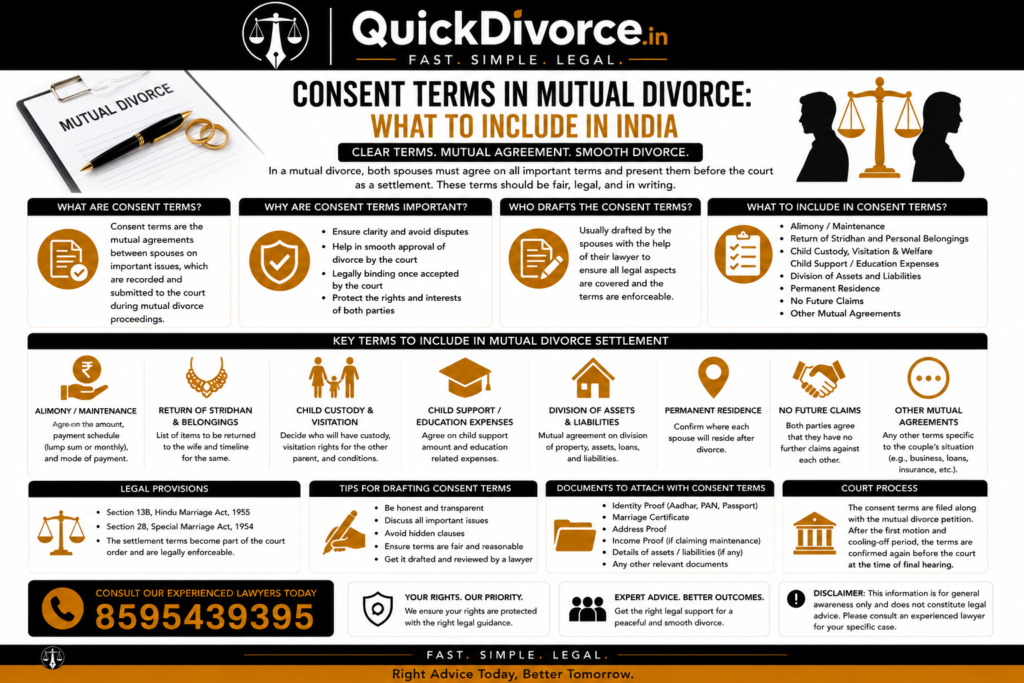
Planning a mutual divorce in India? Learn exactly about consent terms Consent Terms in Mutual Divorce what to include in your settlement agreement — alimony, custody, property, liabilities, and protective clauses.
Table of Contents
- 1 Introduction
- 2 What Exactly Are Consent Terms in Mutual Divorce?
- 3 The Legal Basis for Consent Terms in Mutual Divorce
- 4 Essential Clause 1: Particulars of the Marriage and Parties
- 5 Essential Clause 2: Alimony and Maintenance
- 6 Essential Clause 3: Child Custody and Parental Rights
- 7 Essential Clause 4: Child Maintenance and Educational Expenses
- 8 Essential Clause 5: Immovable Property Division
- 9 Essential Clause 6: Movable Assets and Personal Property
- 10 Essential Clause 7: Liabilities and Debts
- 11 Essential Clause 8: Withdrawal of Pending Legal Proceedings
- 12 Essential Clause 9: Matrimonial Home Arrangements
- 13 Essential Clause 10: Mutual Release and No Further Claims
- 14 Essential Clause 11: Severability and Governing Law
- 15 What Courts Look for When Reviewing Consent Terms
- 16 Common Mistakes in Drafting Consent Terms
- 17 How QuickDivorce.in Can Help
- 18 Frequently Asked Questions (FAQs)
- 19 Conclusion
- 20 Get Expert Guidance for Legal Drafting and Court Documentation
Introduction
The consent terms in mutual divorce are, quite literally, the heart of the entire process. Everything else — the joint petition, the court hearings, the cooling-off period, the final decree — flows from and depends on one foundational document: the settlement agreement that records what both spouses have agreed upon. Get the consent terms right, and the rest of the mutual divorce process tends to proceed smoothly. Get them wrong — vague, incomplete, or weighted unfairly — and what was supposed to be an amicable separation can unravel into years of post-divorce litigation over disputes that should have been resolved before the decree was ever passed.
Mutual divorce allows couples to end their relationship without mutual allegations by agreeing on critical terms like alimony, child custody, and property division. But “agreeing” is only the first step. Translating that agreement into a legally enforceable, comprehensively drafted document — one that leaves no ambiguity, anticipates future disputes, and satisfies the Family Court’s scrutiny — is where most couples need professional guidance.
This guide covers everything you need to include in the consent terms in mutual divorce under Indian law in 2026 — clause by clause, issue by issue, with practical guidance on what courts look for, what language creates problems later, and how to structure the document for both legal validity and long-term enforceability.
What Exactly Are Consent Terms in Mutual Divorce?
The consent terms in mutual divorce — also commonly referred to as the Memorandum of Understanding (MoU), the Settlement Agreement, or the Divorce Deed — is a written legal document jointly signed by both spouses, setting out the agreed terms on every outstanding issue between them. This document is filed along with the joint petition at the first motion hearing and is reviewed by the Family Court to satisfy itself that the settlement is fair, voluntary, and complete.
The Mutual Consent Divorce Settlement Agreement is a crucial document used when both spouses have mutually agreed to dissolve their marriage under Indian law, comprehensively addressing all aspects of the divorce settlement, including division of assets and liabilities, maintenance arrangements, child custody and support if applicable, and any other specific terms agreed upon by the parties.
The consent terms in mutual divorce serve three distinct functions simultaneously: they are a contract between the parties, a disclosure document for the court, and a blueprint for post-divorce life. Each of these functions shapes how the document should be drafted.
The Legal Basis for Consent Terms in Mutual Divorce
The requirement to settle all outstanding issues before approaching the court flows directly from the statute. Both parties must voluntarily agree to dissolve the marriage and have reached a consensus on all settlement terms as a pre-condition for filing under Section 13B of the Hindu Marriage Act, 1955. An identical requirement exists under Section 28 of the Special Marriage Act, 1954 for interfaith or civil marriages.
A settlement agreement covering alimony, child custody, and property division must accompany every mutual consent petition. Therefore, both parties must negotiate these terms before filing.
Once incorporated into the final consent decree passed by the Family Court, the consent terms become a judicial order — enforceable through contempt proceedings, execution petitions, and attachment of assets if either party defaults on any agreed obligation. This enforcement-level significance is precisely why every clause in the consent terms in mutual divorce deserves careful, deliberate drafting rather than a hastily signed template.
Essential Clause 1: Particulars of the Marriage and Parties
Every consent terms document should open with a clear identification section covering:
- Full legal names of both parties, with parentage and current addresses
- Date and place of marriage
- Applicable personal law (Hindu Marriage Act, Special Marriage Act, etc.)
- Marriage certificate details
- Brief factual background on the separation — when cohabitation ended, whether any prior legal proceedings were initiated, and their current status
This section establishes the factual foundation for the rest of the agreement, ensures the court can identify the parties and their legal relationship without ambiguity, and confirms that the marriage being dissolved is the same one on record with the relevant authority.
Essential Clause 2: Alimony and Maintenance
Alimony is usually the most intensely negotiated component of the consent terms in mutual divorce, and it is also the clause most frequently challenged or litigated if drafted poorly. The agreement must specify:
Form of Payment
Whether alimony is being paid as a one-time lump sum or as monthly periodic maintenance, or a combination of both. Lump-sum settlements provide finality and are generally preferred by paying spouses to avoid ongoing obligation. Periodic payments are sometimes preferred by recipients who need sustained support.
Amount and Timeline
The exact rupee amount (not a range), the date by which a lump sum must be paid or the date from which monthly payments commence, and — for periodic maintenance — the duration (number of months, years, or lifetime).
Mode of Payment
Bank transfer to a specified account, demand draft, or other agreed method. Specifying the mode prevents later disputes about whether payment was actually made.
Escalation Clause (Where Applicable)
In light of recent Supreme Court rulings building automatic escalation into maintenance orders, parties to a mutual divorce may also choose to agree on periodic increases — for instance, a 5–10% increase every two or three years — rather than leaving revision to future litigation.
No Further Claim Clause
A clear, unambiguous statement that the alimony agreed upon is in full and final settlement of all maintenance, alimony, and financial claims of each party against the other, past, present, and future — and that neither party will make any further claim for maintenance, alimony, or financial support in any court or forum.
This clause is critically important. Without it, a recipient spouse could theoretically return to court later claiming that the agreed amount was inadequate — the “full and final” language is what converts the settlement into a truly final resolution.
Essential Clause 3: Child Custody and Parental Rights
Where the parties have children, the consent terms in mutual divorce must address custody in comprehensive detail. Courts prioritise the “welfare of the child.” Parents can opt for joint custody or exclusive physical custody with visitation rights. The Family Court examining the settlement pays particular attention to child-related clauses and will raise objections where it finds that the arrangements are not clearly in the child’s best interests.
The custody clause should specify:
Primary vs. Shared Custody
Which parent has primary physical custody — meaning the child lives with them as their primary residence — and whether there is shared legal custody, meaning both parents jointly participate in major decisions about the child’s education, healthcare, and religious upbringing.
Visitation Schedule
A specific, detailed schedule for the non-custodial parent’s access to the child — including weekday routines, weekend visits, school holidays, summer vacations, and specific festivals or occasions. Vague language like “reasonable visitation” is consistently problematic and should be replaced with a defined timetable.
Holiday Arrangements
How vacations and long holidays are divided — for instance, which parent has the child during Diwali or Christmas, how summer holidays are split, and how school vacations are managed when they don’t align with both parents’ work schedules.
Education Decisions
Who has the right to enrol the child in schools, approve changes in school, or authorise participation in significant extracurricular activities that affect the child’s schedule.
Medical Decisions
How routine and emergency medical decisions are handled, and whether both parents must be consulted before major medical interventions.
Travel and Relocation
Whether either parent can take the child abroad or relocate within India without the other’s consent, and what the notification timeline for travel with the child should be.
Communication Rights
The non-custodial parent’s right to speak with the child by phone or video call, including an agreed frequency and preferred timing to avoid conflict.
Essential Clause 4: Child Maintenance and Educational Expenses
Separate from alimony — which is between spouses — the consent terms in mutual divorce must clearly address the financial obligations toward the children:
- Monthly maintenance amount per child, and the date by which it must be transferred each month
- Responsibility for school fees, tuition, books, and uniforms
- Medical and hospitalisation expenses — whether shared equally or in a specific ratio
- Extracurricular and hobby-related expenses — how these are approved and paid for
- Higher education costs — a forward-looking clause addressing who bears the responsibility for college or professional education expenses, at least in principle
Child maintenance must not be bundled vaguely into alimony — courts expect it to be separately quantified and clearly attributed, since children’s rights to financial support are independent of any spousal settlement.
Essential Clause 5: Immovable Property Division
Property division is often the most complex section of the consent terms in mutual divorce, particularly where multiple properties, joint home loans, or disputed ownership are involved.
Jointly Owned Property
For each jointly held immovable property, the agreement must specify:
- Whether it is being sold, transferred to one party, or retained in joint ownership temporarily
- If sold — how the net sale proceeds are divided and the timeline for completing the sale
- If transferred — who receives the property, by what date the transfer deed is executed, and who bears stamp duty and registration costs
Solely Owned Property
Where either party holds property independently, the agreement should include an express relinquishment clause — a formal, written surrender of any claim the other party may have in that property arising from the marriage.
Property Registration Requirement
Mutual consent petitions must include a complete property settlement deed registered under the Registration Act, 1908. Accordingly, unregistered settlement agreements may face challenges during enforcement. This is a critically important practical point: where the settlement involves transfer of immovable property, the relevant deed must be separately registered with the Sub-Registrar — the settlement agreement itself, even when incorporated into the court decree, may not substitute for a properly registered transfer document in all states.
Pending Home Loans
Joint home loans require specific attention — the decree binds the spouses inter se, but the lending bank is not a party to the agreement and remains entitled to recover from both borrowers regardless of what the consent terms say. The spouse retaining the property must arrange to take the loan solely in their name, obtain a no-objection from the bank, or make other arrangements before the transfer is complete.
Essential Clause 6: Movable Assets and Personal Property
Beyond immovable property, the consent terms in mutual divorce should clearly address:
- Jewellery and stridhan — specifically returning the wife’s stridhan and any other personal jewellery, with a clear timeline and description where possible
- Vehicles — which party retains each vehicle, and whether transfer of registration is required
- Bank accounts and fixed deposits — closure or transfer of joint accounts, and division of the balance
- Investments, mutual funds, and shares — transfer or liquidation of jointly held financial instruments, with clear procedures and timelines
- Insurance policies — nomination changes and, where applicable, surrender or transfer of joint policies
- Household items and furniture — particularly relevant where one party is vacating the matrimonial home
This section of the consent terms in mutual divorce is frequently underspecified, only for disputes over a specific piece of jewellery or a jointly held fixed deposit to emerge after the decree is passed.
Essential Clause 7: Liabilities and Debts
Middle-class couples often forget to talk about their joint loans — and this omission creates significant problems after decree. The consent terms must address:
- Who assumes responsibility for each joint loan, EMI, or credit card liability
- Whether the non-assuming party is formally released from liability by the lender (noting that lender consent requires a separate bank-level process)
- How any outstanding personal loans taken during the marriage for joint household purposes are handled
A specific, written indemnification clause — where the party assuming a liability indemnifies the other against any future claim from the lender — is strongly advisable.
Essential Clause 8: Withdrawal of Pending Legal Proceedings
In many mutual divorces — particularly where the relationship broke down acrimoniously before an amicable settlement was reached — there may be pending legal proceedings between the parties: maintenance applications, domestic violence complaints, Section 498A / Section 85 BNS criminal complaints, or civil suits relating to property.
Many settlements include withdrawal or quashing of criminal complaints. The consent terms must specifically address:
- Which cases are being withdrawn by which party, before which court or authority
- The timeline for filing the withdrawal application
- Whether criminal proceedings will be compounded or quashed before the High Court under Section 528 BNSS
- A representation that no further cases will be filed by either party arising from the same facts or the marriage
Courts generally expect significant pending proceedings to be resolved before or alongside the mutual divorce, and some Family Courts insist on proof of withdrawal of parallel proceedings before granting the decree.
Essential Clause 9: Matrimonial Home Arrangements
Where one spouse is currently residing in the matrimonial home — particularly where the wife has residence rights under the Domestic Violence Act or through ownership — the consent terms must specify:
- Whether the occupying spouse will vacate and by when
- Whether they receive alternative accommodation or financial compensation in lieu
- Whether a separate residence order under the DV Act is being withdrawn alongside the settlement
Essential Clause 10: Mutual Release and No Further Claims
This is the closing protective clause that ties the entire agreement together. A well-drafted mutual release clause in the consent terms in mutual divorce should confirm that:
- Each party releases the other from all past, present, and future claims arising from the marriage or its dissolution
- Neither party will make any further financial, property, or personal claim against the other in any court, tribunal, or authority after the decree is passed
- The settlement is in full and final satisfaction of all obligations between the parties
A clause releasing both parties from future claims against each other is one of the most important protective provisions in the consent terms. Without it, a spouse who subsequently encounters financial difficulty could attempt to return to court claiming that the original settlement was inadequate — a risk that the mutual release clause is specifically designed to foreclose.
Essential Clause 11: Severability and Governing Law
Standard contract-protection clauses that belong in every well-drafted settlement agreement:
- A clause stating that if any provision is found invalid, the rest of the agreement remains valid
- Confirmation that the agreement is governed by Indian law and the courts of the jurisdiction where the divorce petition is filed
- A confirmation that the document represents the entire and complete agreement between the parties, superseding all prior discussions, understandings, or informal communications
What Courts Look for When Reviewing Consent Terms
The Family Court examining consent terms in mutual divorce is not simply a rubber stamp on whatever the parties have agreed. Judges scrutinise the settlement for several concerns:
- Whether the consent of each party appears to be genuinely free and voluntary, or whether there are signs of coercion or imbalance
- Whether the interests of children are adequately protected — courts have modified custody arrangements they found unsatisfactory even in mutual consent matters
- Whether the financially weaker spouse — typically the wife — appears to have received a reasonable settlement, or whether the agreement appears significantly one-sided
- Whether outstanding legal proceedings between the parties have been addressed
Courts generally respect settlements when they are voluntarily signed and legally valid. A thorough, well-structured document covering all issues comprehensively gives the court the confidence to proceed without extensive questioning, which in turn leads to smoother hearings and faster decrees.
Common Mistakes in Drafting Consent Terms
- Using vague language — phrases like “reasonable maintenance” or “adequate visitation” are invitation to future litigation. Every term must be specific and quantified.
- Ignoring joint liabilities — failing to address joint home loans, credit cards, or personal loans creates ongoing disputes even after the decree.
- Incomplete property coverage — missing even one significant asset means it remains in dispute after the decree, requiring separate litigation to resolve.
- No withdrawal clause for pending cases — courts can and do raise queries about unresolved parallel proceedings, and parties who haven’t addressed this can face delays.
- No escalation provision for child maintenance — child expenses grow substantially over time; a fixed amount agreed at the time of divorce may become inadequate within a few years.
- Signing without independent legal review — particularly for the financially weaker party, signing a settlement agreement without having it independently reviewed creates significant risk of an unfair outcome that is very difficult to challenge once incorporated in a decree.
How QuickDivorce.in Can Help
Drafting consent terms in mutual divorce that are specific, comprehensive, legally enforceable, and structured to protect both parties from future disputes requires far more than a standard template. At QuickDivorce.in, our family law team works with both spouses to negotiate, structure, and draft settlement agreements that cover every issue — alimony, custody, property, liabilities, pending cases, and mutual release — in language that courts accept and that both parties can genuinely rely on after the decree is passed.
Frequently Asked Questions (FAQs)
1. What are consent terms in a mutual divorce?
Consent terms are a written agreement between both spouses that sets out the mutually accepted conditions for divorce. They typically cover matters such as alimony, child custody, visitation rights, property division, and the settlement of all pending disputes.
2. Why are consent terms important in a mutual divorce?
Consent terms help avoid future disputes by clearly recording the rights and obligations of both parties. They provide clarity to the court and ensure that the settlement reached by the spouses is properly documented.
3. What should be included in consent terms for a mutual divorce?
Consent terms generally include details relating to permanent alimony or maintenance, child custody and visitation, division of movable and immovable property, return of Stridhan, withdrawal of pending legal cases (where applicable), financial settlements, and any other mutually agreed conditions.
4. Can consent terms be modified after they are signed?
Consent terms may be modified before the court passes the final divorce decree if both parties mutually agree. Once the court has accepted the settlement and granted the divorce, any changes usually require following the appropriate legal procedure.
5. Are consent terms legally enforceable in India?
Yes. Once the family court accepts the consent terms and incorporates them into the divorce decree, they generally become legally enforceable, subject to the applicable law and the terms of the court’s order.
6. Is it necessary to have a lawyer draft consent terms?
Although parties may prepare consent terms themselves, it is advisable to have an experienced family law advocate draft or review the document to ensure that it is legally valid, comprehensive, and protects the interests of both parties.
Conclusion
The consent terms in mutual divorce are not a routine formality to be dispatched quickly so that the petition can be filed — they are the substantive foundation on which your post-divorce life is built. Every vague clause, every missing issue, every unaddressed liability is a potential dispute waiting to surface after the decree is passed, at a time when both parties may have moved on and the motivation to cooperate may have diminished considerably.
Taking the time — and getting the right legal guidance — to draft consent terms that are specific, complete, balanced, and court-ready is the single most important investment you can make in a mutual divorce. It protects both parties, satisfies the court, and gives the settlement the finality it is meant to have.
For professionally drafted, comprehensive consent terms in mutual divorce tailored to your specific situation, connect with the family law team at QuickDivorce.in.
Get Expert Guidance for Legal Drafting and Court Documentation
🟡QuickDivorce offers trusted online legal services across India, including mutual divorce, contested divorce, child custody, alimony, marriage registration, and expert family law consultation.
👉 Mutual Consent Divorce
👉 Contested Divorce Filing
👉 Child Custody and Maintenance
👉 Matrimonial Property Settlement
👉 NRI Divorce Services
👉 Alimony and Maintenance
🟡 Protect Your Rights
👉 Domestic Violence Legal Support
👉 Stridhan Recovery
🟡For other Legal and Trademark related services visit
👉 Money Recovery Cases
👉 Property Disputes
👉 Business & Licence Registrations
📞 Call Now: +91 8595439395
🕐 Free Consultation: Monday to Saturday, 10 AM to 6 PM

Adv. Manish Kashyap is a Family Law & Divorce Lawyer with extensive experience in Mutual & Contested Divorce, NRI Divorce, Child Custody, Alimony, Domestic Violence, Judicial Separation, and Family Court matters, providing professional legal guidance to clients.

