

Views: 12
Do you need Affidavit for divorce in India? Learn about all types of divorce affidavits, their essential contents, format, notarisation rules, and common mistakes to avoid.
Table of Contents
- 1 Introduction
- 2 What Is an Affidavit for Divorce — And Why Does It Matter?
- 3 The Legal Framework Governing Affidavits in Divorce Cases
- 4 Types of Affidavit for Divorce Used in Indian Proceedings
- 5 Essential Elements Every Affidavit for Divorce Must Contain
- 6 Step-by-Step Guide to Drafting an Affidavit for Divorce
- 7 Notarisation Rules and E-Affidavits in 2026
- 8 A Specimen Skeleton Format to Reference
- 9 Common Mistakes That Weaken an Affidavit for Divorce
- 10 Legal Consequences of a False Affidavit
- 11 How QuickDivorce.in Can Help
- 12 Frequently Asked Questions (FAQs)
- 13 Conclusion
- 14 Get Expert Guidance for Divorce Cases
Introduction
Walk into any Family Court in India with a divorce matter — mutual consent or contested — and among the first things your advocate will ask you to prepare is an affidavit. Often multiple affidavits. And yet, the affidavit for divorce remains one of the most misunderstood, underestimated documents in matrimonial proceedings. Clients frequently treat it as a formality, sign whatever is placed in front of them, and discover later that a vague, inaccurate, or poorly structured affidavit has created avoidable complications in their case.
An affidavit for divorce is a sworn written statement made voluntarily by a party — the affiant — declaring facts relevant to the divorce proceedings as being true to the best of their knowledge and belief. Because it is made under oath, every word in an affidavit carries legal weight. A false statement in an affidavit is not just procedurally damaging — under the Bharatiya Nyaya Sanhita, 2023, it is a criminal offence carrying up to seven years of imprisonment for perjury. On the other hand, a well-drafted, precise affidavit for divorce can significantly strengthen your case, establish credibility before the court, and prevent the opposing party from later disputing facts that are clearly on the record.
This guide breaks down every type of affidavit for divorce used in Indian proceedings — for mutual consent cases, contested divorces, maintenance applications, financial disclosures, and more — along with the essential elements of each, the drafting process, notarisation rules under 2026 practice, and the most common mistakes that weaken an otherwise valid sworn statement.
What Is an Affidavit for Divorce — And Why Does It Matter?
An affidavit for divorce is a written declaration of facts sworn or affirmed by the person making it, submitted before a court or authority as part of divorce proceedings. Unlike a petition — which is a formal legal argument — an affidavit is a first-person factual account, and courts treat it as evidence of the facts asserted within it.
The importance of a well-drafted affidavit for divorce flows from two directions. First, it shapes the court’s initial understanding of the facts — a clear, specific, well-organised affidavit makes it easier for the judge to understand your position and harder for the opposing party to create confusion around it. Second, because the affiant signs the document under oath, any significant inconsistency between the affidavit and oral testimony during cross-examination damages credibility in a way that is very difficult to recover from.
Courts have also clarified that an affidavit is not evidence in a contested trial unless the court specifically directs otherwise — what it does is place facts on the record as the sworn version of events, and its contents are tested through cross-examination during the evidence stage.
The Legal Framework Governing Affidavits in Divorce Cases
Several provisions govern the use of affidavits in matrimonial proceedings in India:
- Order XIX of the Code of Civil Procedure, 1908 governs the use of affidavits as evidence in civil proceedings, including Family Court matters.
- The Bharatiya Sakshya Adhiniyam (BSA), 2023, which replaced the Indian Evidence Act, 1872, continues to govern questions of relevance and admissibility of affidavit evidence in court.
- The Oaths Act, 1969 governs the administration of oaths and affirmations to affiants, establishing who is authorised to attest affidavits.
- Individual High Court rules — each High Court, including those governing Family Courts, has its own original side or appellate side rules prescribing the format and requirements for affidavits filed in cases before them.
- Supreme Court’s mandatory financial disclosure direction in Rajnesh v. Neha (2020) — this landmark ruling made it mandatory for parties in maintenance and divorce proceedings to file comprehensive affidavits of assets, income, and liabilities, turning financial disclosure affidavits from a best practice into a court-mandated requirement.
Types of Affidavit for Divorce Used in Indian Proceedings
Different stages and types of divorce proceedings require different affidavits. Understanding which affidavit for divorce is needed at each stage is critical to filing a complete, court-ready application.
1. Joint Affidavit in Mutual Consent Divorce
This is the most commonly filed affidavit for divorce, and it is used exclusively in mutual consent divorce proceedings under Section 13B of the Hindu Marriage Act or the equivalent provision of the Special Marriage Act. Both spouses sign this affidavit jointly, confirming:
- The date and place of marriage, and the applicable personal law
- That the parties have been living separately for a continuous period of one year or more
- That they have mutually agreed to dissolve the marriage
- That they have reached an agreement on all ancillary matters — alimony, child custody, visitation, and property division
- That the consent is free, voluntary, and without any coercion, undue influence, or fraud
- That there is no pending litigation between the parties in any other court
The joint affidavit accompanies the joint petition and is typically tendered at the first motion hearing. Courts read it to satisfy themselves that the parties are genuinely in agreement before proceeding.
2. Individual Affidavit of Facts (Contested Divorce)
In a contested divorce, each party files their own individual affidavit for divorce setting out the facts they rely upon in support of their case. This affidavit — also called an examination-in-chief affidavit in courts that follow this practice — replaces or supplements the oral examination-in-chief of the party as a witness.
The petitioner’s individual affidavit presents the specific incidents, dates, and conduct that support the ground being relied upon (cruelty, desertion, adultery, etc.). The respondent’s affidavit denies the allegations and presents counter-facts. Both are then subject to cross-examination by the opposing counsel during the evidence stage.
Courts place significant weight on the specificity of individual affidavits in contested matters — vague, conclusory statements (“he was always cruel”) without specific dates, incidents, and corroborating details are far less effective than a structured, incident-by-incident account that the opposing party will find difficult to deny entirely.
3. Affidavit of Assets and Income (Financial Disclosure Affidavit)
Following the Supreme Court’s directions in Rajnesh v. Neha (2020), filing a comprehensive financial disclosure affidavit is now mandatory in all maintenance and divorce proceedings. Both parties must file this affidavit disclosing:
- Monthly income from all sources — salary, business income, rental income, dividends, and other receipts
- Details of all immovable property — land, houses, apartments — with their approximate current market value
- Movable assets — vehicles, jewellery, investments, fixed deposits, bank balances
- Liabilities — outstanding loans, EMIs, and other financial obligations
- Lifestyle and standard of living indicators — household expenses, school fees, insurance premiums, and club memberships
Concealment of assets in this affidavit for divorce is treated seriously by courts. Discovery of hidden assets after the decree can result in revision of maintenance amounts, and deliberate suppression can attract contempt of court proceedings.
4. Affidavit of Marital Status
This is a standalone affidavit confirming the deponent’s marital status — whether they are single, married, divorced, or widowed — at the time of signing. In divorce proceedings, it is commonly required:
- As a supporting document confirming the current marital status before the court
- For re-marriage after divorce, to confirm that the decree has been granted and no appeal is pending
- For passport and visa applications after divorce
5. Affidavit Supporting an Interim Application
Many interim applications — for maintenance pendente lite under Section 24 of the Hindu Marriage Act, for child custody, for an injunction against transfer of property, or for residence rights under the Domestic Violence Act — require a supporting affidavit setting out the factual basis for the relief sought. This is a separate, targeted affidavit for divorce that focuses specifically on the facts relevant to the interim relief, rather than the entire case.
6. Affidavit for Waiver of Cooling-Off Period
Following the Supreme Court’s ruling in Amardeep Singh v. Harveen Kaur (2017), parties in mutual consent divorce proceedings can apply to waive the mandatory six-month cooling-off period. Such an application is typically supported by an affidavit jointly filed by both spouses, confirming that:
- They have been living separately for a prolonged period well beyond the minimum statutory requirement
- All issues between them have been fully and finally settled
- No possibility of reconciliation exists
- They fully, voluntarily, and unequivocally desire immediate dissolution of the marriage without the waiting period
Courts are not bound to grant the waiver — they assess each case on merits — but a well-drafted supporting affidavit significantly assists the application.
7. Witness Affidavit
In contested divorce proceedings, third-party witnesses — neighbours, relatives, colleagues, or medical professionals — file their own individual affidavits setting out what they personally observed or know about relevant facts. These are equally subject to cross-examination and must be specific and credible to carry weight.
Essential Elements Every Affidavit for Divorce Must Contain
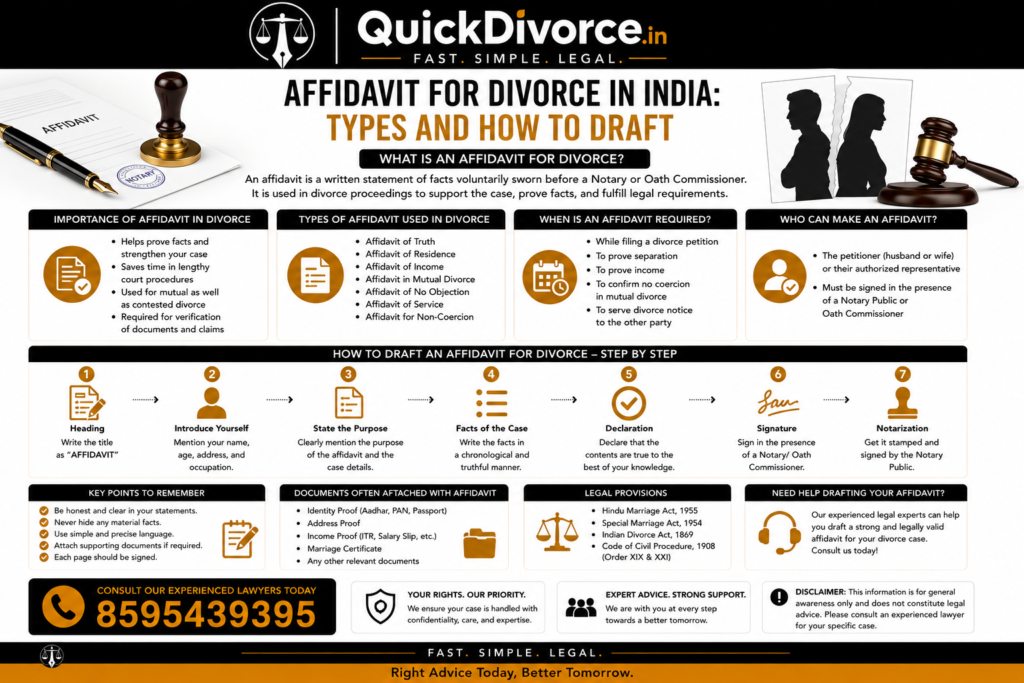
Regardless of the type, a valid affidavit for divorce in India must contain the following elements to be accepted without objection at the court registry:
1. Title and Case Details
The heading should clearly state the court name, case number (or “to be assigned”), case type, and the names of petitioner and respondent.
2. Statement of Identity of the Deponent
A clear, opening sentence identifying the person making the affidavit — full name, age, parentage, current address, and occupation. Example: “I, Priya Sharma, aged 34 years, daughter of Ramesh Sharma, residing at [full address], currently employed as [designation] at [employer], do hereby solemnly affirm and state as follows…”
3. The Body — Paragraphed Facts
The substantive content of the affidavit, presented in numbered paragraphs, each dealing with a single, specific fact or issue. Each paragraph should be concise, direct, and factual — not argumentative or emotional. Dates, places, and names of persons involved should be stated precisely wherever relevant.
4. Verification Clause
A mandatory clause at the end, in the format prescribed by Order XIX CPC, confirming which paragraphs are true to the deponent’s personal knowledge, and which are true to the best of their information and belief, with the source of the information stated. This typically reads: “I verify that the contents of paragraphs 1 to [X] are true to my personal knowledge, and the contents of paragraph [Y] are true to the best of my information and belief.”
5. Deponent’s Signature and Date
Signed by the deponent at the bottom, with the date and place of swearing clearly stated.
6. Attestation by Notary or Competent Authority
The jurat — the attestation clause confirming that the affidavit was sworn before the attesting authority — completed and signed by the notary public or the court-appointed Oath Commissioner. The notary’s seal, registration number, and signature must be clearly present.
Step-by-Step Guide to Drafting an Affidavit for Divorce
Step 1: Identify Which Affidavit Is Needed
Before drafting anything, confirm with your advocate which specific type of affidavit for divorce is required for the stage of proceedings you are at, and whether the relevant Family Court has a prescribed format — many High Courts and Family Courts publish their own standard formats which take priority over generic templates.
Step 2: Gather All Relevant Facts and Documents
For a joint affidavit in mutual consent proceedings, compile the marriage date and details, separation start date, and the terms of the settlement. For an individual affidavit in contested matters, list each specific incident — with date, location, and description — in chronological order.
Step 3: Draft in First Person, Paragraphed Format
Write in simple, clear, first-person language. Each paragraph should contain one fact or point. Avoid compound sentences that pack multiple facts into a single paragraph — courts and opposing counsel find it easier to isolate and challenge statements that are tangled together.
Step 4: Distinguish Personal Knowledge From Information and Belief
Go through every factual statement and mark clearly whether it is based on your personal, direct knowledge or on information received from another source. This distinction is mandatory in the verification clause and must be consistent throughout the body of the affidavit.
Step 5: Include the Verification Clause
Draft the verification clause carefully, using the court-prescribed format wherever one exists. A verification clause that does not correctly identify which paragraphs are from personal knowledge can render the affidavit technically defective.
Step 6: Review for Accuracy Before Signing
Before appearing before the notary, go through the entire affidavit line by line with your advocate — dates, names, spelling of parties, addresses, and all factual details — since corrections after swearing require an entirely new affidavit. There is no option for minor amendments to a sworn document.
Step 7: Swear the Affidavit Before a Notary Public or Oath Commissioner
Court affidavits for civil or criminal proceedings still require physical notarisation in most cases. Appear before a licensed notary public or the Family Court’s designated Oath Commissioner with the original draft, along with your identity proof. Sign the affidavit in the notary’s presence — not before — and ensure the notary fills in the jurat, applies their seal and registration number, and signs as the attesting authority.
Step 8: Retain Copies
Keep at least three certified copies of the notarised affidavit — one for court filing, one for your advocate’s records, and one for yourself. Courts generally accept notarised photocopies for filing, with originals required for verification at hearings.
Notarisation Rules and E-Affidavits in 2026
A frequently asked question is whether affidavits for divorce can be executed digitally without physical notarisation, given the general expansion of e-governance in India.
Under the Bharatiya Sakshya Adhiniyam (BSA), 2023, e-affidavits submitted through authorised digital platforms and verified using digital signatures or e-signatures are legally valid for many administrative and corporate purposes. However, court affidavits for civil or criminal proceedings, affidavits for property transactions, and affidavits for passport or visa applications typically still require physical notarisation.
For e-stamping, states including Maharashtra, Delhi, Karnataka, and Tamil Nadu use electronic stamping systems through SHCIL or authorised banks, which has simplified stamp paper procurement. However, the physical act of swearing before a notary remains mandatory for court affidavits, including all affidavits for divorce filed before Family Courts and other matrimonial forums.
A Specimen Skeleton Format to Reference
The following is a simplified structural skeleton — every affidavit for divorce should be customised to the specific facts of the case with your advocate’s guidance, and drafted on appropriately stamped paper as required by the relevant state:
IN THE FAMILY COURT AT [CITY] [Case Type] No. ___ / ____
IN THE MATTER OF: [Name of Petitioner] … Petitioner VERSUS [Name of Respondent] … Respondent
AFFIDAVIT OF [PETITIONER / RESPONDENT / JOINT]
I, [Full Name], aged [X] years, [S/o / D/o / W/o] [Name], residing at [Full Address], presently employed as [designation], do hereby solemnly affirm and state as follows:
- That I am the [Petitioner / Respondent] in the above-captioned matter and am fully conversant with the facts herein.
- That I was married to [Spouse’s Full Name] on [Date] at [Place], as per [applicable rites / under the Hindu Marriage Act, 1955 / Special Marriage Act, 1954].
- That the marriage has been duly registered and the Marriage Certificate bearing No. ___ dated ___ has been issued by [authority].
- That [state further relevant facts in individual, numbered paragraphs].
- [Continue as applicable to the type of affidavit.]
DEPONENT
VERIFICATION I, the above-named deponent, do hereby verify that the contents of paragraphs 1 to [X] above are true and correct to my personal knowledge, and the contents of paragraph [Y] are true to the best of my information and belief, and nothing material has been concealed therefrom.
Verified at [Place] on [Date].
DEPONENT
Solemnly affirmed / sworn before me on [Date] at [Place] Notary Public / Oath Commissioner Registration No.:
Common Mistakes That Weaken an Affidavit for Divorce
- Vague, undated allegations — Courts look for specific facts; general statements like “he used to be abusive” without dates, locations, or descriptions carry very little evidentiary weight.
- Mixing personal knowledge with hearsay without distinguishing them — facts not in your direct personal knowledge must be stated as such in both the body and the verification clause.
- Swearing before an unauthorised person — only a notary public holding a valid registration or a court-appointed Oath Commissioner is authorised to attest an affidavit for court use.
- Signing before appearing before the notary — the affidavit must be signed in the notary’s presence; a pre-signed affidavit is defective.
- Incorrect or absent verification clause — a verification clause that doesn’t identify which paragraphs are from personal knowledge versus information is a technical defect courts frequently flag.
- Inconsistency with other documents — any mismatch between your affidavit and other filed documents (petition, previous affidavits, or prior court records) damages credibility and can be used effectively in cross-examination.
- Using a generic template without case-specific customisation — generic online templates rarely align with the format prescribed by the specific court you’re filing in and may omit provisions that local practice requires.
- Not reviewing after drafting — since corrections after swearing require an entirely new affidavit, reviewing every line carefully before signing before the notary is non-negotiable.
Legal Consequences of a False Affidavit
An affidavit for divorce is not merely a signed form — it is a sworn declaration, and its legal consequences are serious. Under the Bharatiya Nyaya Sanhita, 2023, making a false statement in a sworn affidavit amounts to perjury, carrying imprisonment of up to seven years. Courts have increasingly imposed contempt proceedings and perjury complaints against parties who are found to have deliberately suppressed income, concealed assets, or fabricated facts in financial disclosure affidavits and examination-in-chief affidavits. This is not a theoretical risk — in the post-Rajnesh v. Neha environment, courts scrutinise financial disclosure affidavits in particular with significantly greater rigour than before, and cross-referencing them against income tax returns, bank statements, and property records is now standard practice.
How QuickDivorce.in Can Help
Drafting an affidavit for divorce that is specific, accurate, legally complete, and aligned with the format requirements of your particular court is not a task well-suited to generic templates or last-minute improvisation. At QuickDivorce.in, our family law team drafts all types of divorce affidavits — from joint mutual consent affidavits and financial disclosure affidavits to examination-in-chief affidavits in contested matters — tailored to your specific facts, compliant with applicable court rules, and reviewed carefully before notarisation to ensure there are no defects or inconsistencies that could affect your case.
Frequently Asked Questions (FAQs)
1. What is an affidavit for divorce in India?
An affidavit for divorce is a sworn written statement submitted before the court in which a spouse declares certain facts relating to the divorce proceedings. It is commonly used to support claims, verify information, and comply with court requirements.
2. What are the different types of affidavit for divorce in India?
Common types of affidavit for divorce include affidavits for mutual consent divorce, income affidavits, asset and liability affidavits, evidence affidavits, and affidavits supporting specific applications filed during divorce proceedings. The type required depends on the nature of the case.
3. How do I draft an affidavit for divorce?
To draft an affidavit for divorce, include the names of the parties, relevant case details, a clear statement of facts, supporting information, and a declaration that the contents are true to the best of your knowledge. The affidavit should be signed and notarized or affirmed before the appropriate authority, where required.
4. Is an affidavit mandatory in every divorce case?
The requirement for an affidavit depends on the nature of the divorce proceedings and the directions of the court. In many divorce matters, affidavits are required to verify pleadings, disclose financial information, or support specific applications.
5. What documents are required along with an affidavit for divorce?
Depending on the case, supporting documents may include identity proof, marriage certificate, address proof, income documents, bank statements, property records, photographs, and any other documents relevant to the facts stated in the affidavit.
6. Can an affidavit for divorce be corrected after submission?
If an affidavit contains an error, the court may permit corrections or the filing of a fresh or supplementary affidavit, depending on the circumstances and applicable legal procedure.
7. Why is legal assistance important while preparing an affidavit for divorce?
An experienced family law advocate can ensure that the affidavit is properly drafted, legally compliant, factually accurate, and supported by the necessary documents, reducing the risk of procedural issues during the divorce proceedings.
Conclusion
An affidavit for divorce is far more than an administrative formality — it is a sworn record of facts that shapes the court’s understanding of your case, goes on permanent judicial record, and exposes you to criminal liability if false. Understanding which type is needed at which stage of your proceedings, drafting it with precision and factual specificity, ensuring the verification clause is correctly structured, and having it properly notarised before the right authority are all steps that genuinely affect the strength and credibility of your case.
Whether you are filing a joint mutual consent affidavit, a financial disclosure statement, or a detailed examination-in-chief affidavit in a contested matter, the investment of care at the drafting stage pays dividends throughout the life of the case.
For professionally drafted, court-compliant affidavits across all types of divorce proceedings, reach out to the family law team at QuickDivorce.in.
Get Expert Guidance for Divorce Cases
🟡QuickDivorce offers trusted online legal services across India, including mutual divorce, contested divorce, child custody, alimony, marriage registration, and expert family law consultation.
👉 Mutual Consent Divorce
👉 Contested Divorce Filing
👉 Child Custody and Maintenance
👉 Matrimonial Property Settlement
👉 NRI Divorce Services
👉 Alimony and Maintenance
🟡 Protect Your Rights
👉 Domestic Violence Legal Support
👉 Stridhan Recovery
🟡For other Legal and Trademark related services visit
👉 Money Recovery Cases
👉 Property Disputes
👉 Business & Licence Registrations
📞 Call Now: +91 8595439395
🕐 Free Consultation: Monday to Saturday, 10 AM to 6 PM

Adv. Manish Kashyap is a Family Law & Divorce Lawyer with extensive experience in Mutual & Contested Divorce, NRI Divorce, Child Custody, Alimony, Domestic Violence, Judicial Separation, and Family Court matters, providing professional legal guidance to clients.

