

Views: 9
Modifying Alimony After Divorce in India 2026, Is it possible? Learn the legal grounds, step-by-step process, and recent Supreme Court rulings on modifying alimony amount in 2026.
Table of Contents
- 1 Introduction
- 2 The Statutory Framework for Modifying Alimony After Divorce
- 3 Grounds That Justify Modifying Alimony After Divorce
- 4 The Conduct-Based Exception Under Section 25(3)
- 5 What Counts as “Material Change in Circumstances”
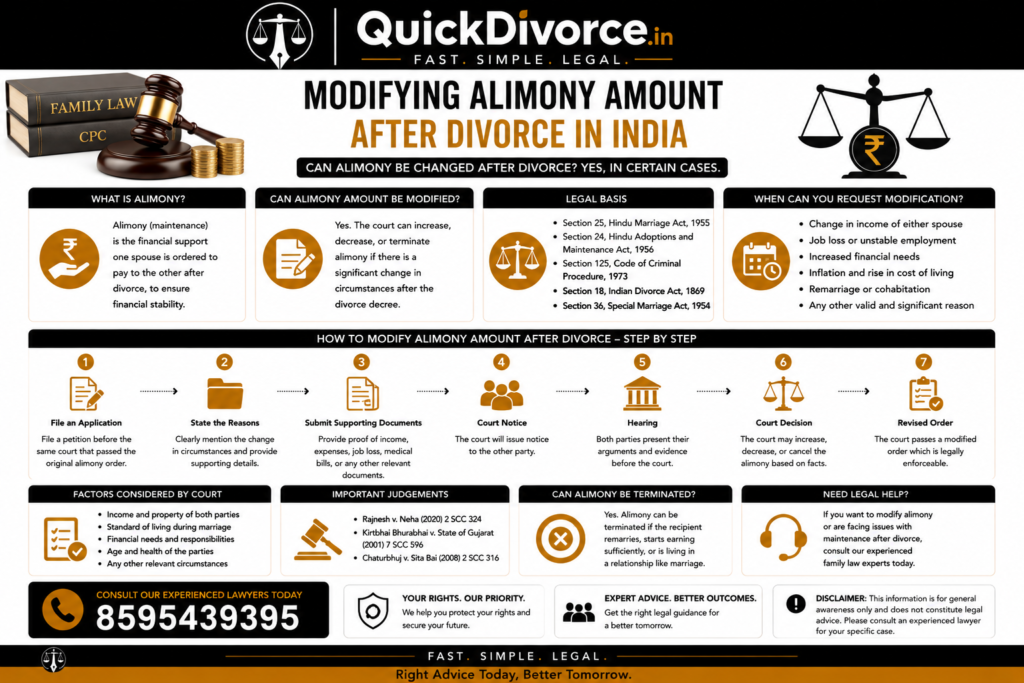
- 6 Step-by-Step Process for Modifying Alimony After Divorce in India
- 7 Recent Supreme Court Trends in Alimony Modification (2025–2026)
- 8 Can a Consent Decree on Alimony Also Be Modified?
- 9 Common Mistakes That Weaken a Modification Petition
- 10 How QuickDivorce.in Can Help
- 11 Frequently Asked Questions (FAQs)
- 12 Conclusion
- 13 Get Expert Guidance for Alimony Cases
Introduction
A divorce decree marks the formal end of a marriage, but it rarely marks the end of financial obligations between former spouses. Alimony — whether awarded as a lump sum or as monthly maintenance — is often one of the most significant, and most contested, outcomes of any divorce proceeding. And yet, life rarely holds still after a decree is passed. Incomes change, health deteriorates, children grow up, people remarry, and what seemed like a fair number at the time of divorce can become either grossly inadequate or disproportionately burdensome years later.
This is precisely why Indian law builds in an express mechanism for modifying alimony amount after divorce — recognising that maintenance is not a punishment fixed in stone, but a living financial arrangement designed to deliver ongoing fairness between two people whose lives continue to evolve independently after separation.
Modifying alimony amount is neither automatic nor easy. It requires satisfying the court that genuine, material circumstances have changed since the original order was passed. But when those circumstances genuinely exist, the law provides a clear, structured path. This guide explains that path completely — the statutory framework, the grounds that work, the process to follow, and what recent Supreme Court and High Court rulings in 2025 and 2026 reveal about where the law is heading.
The Statutory Framework for Modifying Alimony After Divorce
Section 25(2) of the Hindu Marriage Act, 1955
This is the primary provision governing permanent alimony for Hindus, Sikhs, Jains, and Buddhists, and it is also the most commonly invoked when modifying alimony amount is sought. The text of Section 25(2) could not be clearer in its intent:
“If the court is satisfied that there is a change in the circumstances of either party at any time after it has made an order under sub-section (1), it may, at the instance of either party, vary, modify or rescind any such order in such manner as the court may deem just.”
Two features of this provision are worth noting. First, it uses the phrase “at the instance of either party” — meaning both the paying spouse and the recipient can use this provision, whether they want the amount increased or reduced. Second, the power to modify is explicitly discretionary — the court “may” vary or rescind the order, after being “satisfied” of the changed circumstances. This means you can file the application, but whether the court acts on it depends entirely on how convincingly your changed circumstances are demonstrated.
Section 25(3) of the Hindu Marriage Act, 1955
Section 25(3) deals with a specific trigger for modifying alimony amount — remarriage or unchastity. Where the spouse receiving alimony remarries, or where the wife is found to have not remained chaste, or where the husband has had sexual intercourse with any woman outside wedlock, the other party can apply to vary, modify, or rescind the existing order. In practice, remarriage is by far the most commonly invoked basis under this sub-section.
Section 127 of the CrPC — Now Section 127 BNSS, 2023
For maintenance orders passed under the older Section 125 CrPC (now replaced by Section 144 of the Bharatiya Nagarik Suraksha Sanhita, 2023), modifying alimony amount after divorce is governed by Section 127 BNSS, which allows a Magistrate to alter the maintenance order if the receiving party has remarried, the paying party’s circumstances have materially changed, or any other relevant circumstances have substantially shifted. This provision applies across all religions for maintenance orders passed by Magistrates, making it the most universally applicable tool for modification.
Section 37 of the Special Marriage Act, 1954
For interfaith or civil marriages registered under the Special Marriage Act, permanent alimony is governed by Section 37, which contains similarly broad powers for revision as those under Section 25 of the Hindu Marriage Act. The framework is substantively identical — material change in circumstances, plus an application by either party, triggers the court’s revisionary power.
Grounds That Justify Modifying Alimony After Divorce
Indian courts have accepted a range of grounds for modifying alimony amount, though not all carry equal weight. The following are the most commonly accepted and consistently recognised bases:
1. Significant Change in the Paying Spouse’s Financial Position
The most frequently litigated ground for seeking downward modification is a genuine, documented deterioration in the financial position of the party paying alimony — through job loss, business failure, serious illness reducing earning capacity, or a forced shift to significantly lower-paying work.
Courts examine this ground carefully, since not every temporary financial difficulty justifies reduction. The change must be material, verifiable, and not self-induced. A person who voluntarily quits a well-paying job, or who restructures income to conceal earnings, will find courts unsympathetic. What courts respond to is genuine, involuntary deterioration supported by income tax returns, salary slips, bank statements, and employment records.
2. Substantial Increase in the Paying Spouse’s Income or Assets
Modifying alimony amount upward is equally supported by law, and Indian courts — particularly the Supreme Court — have been increasingly willing to revise maintenance upward where the paying spouse’s financial position has improved substantially since the original order.
In a precedent-setting judgment in June 2025, the Supreme Court increased permanent alimony for a divorced woman from ₹20,000 to ₹50,000 per month, along with a 5% escalation every two years, and also upheld the transfer of the former husband’s house to her name. This case, involving nearly two decades of litigation after a 2007 separation, reflects a clear judicial direction: alimony orders awarded years ago will not insulate a paying spouse from revision simply because the original order was once judicially confirmed.
3. Remarriage of the Recipient Spouse
Alimony ceases on remarriage of the recipient spouse — this is one of the most important operative rules for alimony in 2026. Once a recipient spouse enters a valid new marriage, the financial need that originally justified alimony is treated as having been addressed, and the paying spouse can approach the court to cancel the maintenance obligation.
Importantly, courts require proof of the remarriage — a marriage certificate or, where a nikah was performed, the nikahnama — before cancelling the order. A live-in relationship or long-term cohabitation short of marriage does not automatically terminate alimony, though some courts have taken it into account when deciding whether to revise the amount downward.
4. Recipient Spouse Gains Substantial Employment or Income
A woman’s earning capacity cannot automatically disentitle her from maintenance, but if she starts earning substantially, the husband can seek modification. Courts draw a careful distinction here between a woman who has taken up modest employment to remain occupied versus one who has secured income comparable to or exceeding what the alimony was intended to compensate for. The former rarely justifies reduction; the latter often does.
5. Inflation Eroding the Real Value of the Original Award
This is one of the most significant judicial developments in 2025-2026. Multiple Supreme Court benches have approved enhancements of periodic maintenance — in some instances from ₹20,000 to ₹50,000 monthly — with built-in escalation clauses linked to inflation, signalling a clear policy direction toward sustainable rather than static awards.
The practical implication of this trend is significant for recipients whose maintenance was fixed years or even decades ago: the courts are now expressly recognising that a fixed rupee amount awarded in 2015 buys materially less in 2026, and that modifying alimony amount upward to account for inflation is a legitimate ground, particularly in long-running maintenance relationships.
6. Serious Illness or Deteriorating Health
Where the recipient spouse develops a serious medical condition that was not foreseeable at the time of the original order — substantially increasing expenses and reducing their ability to earn — courts have treated this as a valid ground for upward modification. Medical reports, treatment records, and expert evidence from treating physicians are essential to establish this ground convincingly.
7. Change in Custody or Children’s Circumstances
Where child custody arrangements shift — with children moving from one parent to another, or becoming independent adults — this can affect the overall financial picture and justify revisiting the maintenance equation. Courts generally consider custody and child maintenance holistically alongside spousal alimony.
The Conduct-Based Exception Under Section 25(3)
Beyond the “material change in circumstances” ground, Section 25(3) of the Hindu Marriage Act creates a separate, conduct-based basis for modifying alimony amount — specifically:
- Remarriage of the recipient spouse (as discussed above)
- Unchastity of the wife — where the wife receiving alimony is found to have had sexual intercourse with any person other than her former husband
- Adultery of the husband — where the husband receiving alimony has had sexual intercourse with any woman outside wedlock
These grounds are more contentious and more difficult to prove, and courts approach them carefully. The standard of proof required to establish unchastity or adultery to justify modifying alimony amount is higher than the balance of probability ordinarily applied in civil proceedings, and mere suspicion or rumour does not suffice.
What Counts as “Material Change in Circumstances”
The threshold question in every modification petition is whether the change qualifies as “material” — a standard the court assesses based on:
- Whether the change is genuine and not manufactured or self-inflicted
- Whether the change is substantial in degree, not merely incidental or temporary
- Whether the change is directly relevant to the financial balance the original alimony order was designed to achieve
- Whether the change was foreseeable at the time of the original order — changes that were expected or already in progress when the original order was passed generally do not qualify as new grounds for modification
Courts have consistently refused modification petitions where the alleged change was trivial, temporary, or not supported by objective documentary evidence. The burden of proving the material change lies squarely on the party seeking modification.
Step-by-Step Process for Modifying Alimony After Divorce in India
Step 1: Assess the Strength of Your Ground
Before filing anything, consult a family law advocate to honestly evaluate whether your changed circumstances are likely to meet the “material change” threshold courts apply. Filing a weak or premature petition not only fails — it can also create a negative evidentiary record that affects your credibility in future proceedings.
Step 2: Gather Documentary Evidence
The strength of a modification petition rests almost entirely on how well the changed circumstances are documented:
- For income reduction: income tax returns (current and previous years), salary slips, bank statements, termination letters, medical records establishing disability, or business accounts
- For income increase of the other party: publicly available information, their own filed disclosures, property registrations, or business records
- For remarriage: marriage certificate or nikahnama of the recipient spouse
- For inflation-based enhancement: Consumer Price Index data, comparative expense statements, and documentation of current costs against those prevailing at the time of the original order
Step 3: File a Modification Petition Before the Correct Court
The application for modifying alimony amount must be filed before the same court that passed the original alimony order — this is a fundamental jurisdictional requirement. For orders passed under Section 25 of the Hindu Marriage Act, the petition goes to the Family Court or District Court that granted the original decree. For Magistrate-level orders under Section 144 BNSS, the modification application goes before the same Magistrate’s court.
The petition should specifically invoke Section 25(2) or Section 25(3) of the Hindu Marriage Act (or the corresponding provision of the applicable personal law), set out the original order details, and articulate the specific, material change in circumstances being relied upon.
Step 4: Serve Notice on the Other Party
Once filed, the court issues notice to the other spouse, who is given an opportunity to respond. The opposing party will typically file a written counter-reply disputing the claimed change and presenting their own evidence of the current financial position.
Step 5: Lead Evidence and Arguments
Modification petitions proceed through the same evidence-based process as the original proceedings — each party presents documents and witnesses, which are then subject to cross-examination. Expert testimony from chartered accountants, medical professionals, or other relevant experts is frequently useful at this stage.
Step 6: Court Passes the Modified Order
After hearing both parties, the court either varies the amount upward or downward, rescinds the order entirely, or rejects the modification petition if the changed circumstances have not been convincingly established. The modified order takes effect from the date specified by the court — often from the date of the petition filing, though this varies by case.
Recent Supreme Court Trends in Alimony Modification (2025–2026)
The judicial direction in 2025 and 2026 on modifying alimony amount reflects several clear trends:
Upward revision favoured for genuine long-term recipients. The Supreme Court has explicitly acknowledged that inflation routinely erodes the real value of fixed maintenance amounts, and applicants seeking upward revision should present a structured comparison: what the original amount was intended to cover versus what those same needs cost today, with CPI data, household expense statements, and medical cost documentation being particularly persuasive.
Inflation escalation clauses becoming standard. Rather than waiting for a second modification petition years down the line, courts are now routinely building periodic escalation clauses — typically 5–10% increases every two or three years — into new and modified alimony orders, reducing the likelihood of repeated litigation over the same issue.
Full financial disclosure as a non-negotiable starting point. The Supreme Court’s landmark ruling in Rajnesh v. Neha (2020) made mandatory affidavits of assets and income a prerequisite in maintenance proceedings. This requirement has carried into modification petitions as well — courts now expect both parties to file updated, comprehensive financial disclosure statements rather than relying on outdated figures from the original proceedings.
Income gap, not just income, is the measure. A 2025 Supreme Court ruling confirmed that even if a wife is earning, she can still claim alimony where there is a significant income gap between the spouses — courts look at the difference in standard of living, not just whether the recipient earns.
Void marriages are not a bar to alimony modification. The Supreme Court’s three-Judge Bench decision in Sukhdev Singh v. Sukhbir Kaur (2025) modernised and clarified this area of law, holding that alimony can be awarded and subsequently modified even in marriages declared void under Section 11 of the Act — the phrase “at the time of passing any decree” applies whenever any decree is passed, irrespective of whether the marriage was valid.
Can a Consent Decree on Alimony Also Be Modified?
This question arises frequently where spouses reached an agreed alimony figure as part of a mutual consent divorce settlement, which was then incorporated into a consent decree by the court. The general legal position is:
Where the consent decree contains an agreed, final settlement of all financial claims — often worded as a “full and final settlement” with a mutual release clause — courts have been reluctant to disturb it, treating it as a binding contractual settlement between the parties.
However, where the consent decree awarded ongoing, periodic maintenance rather than a one-time lump sum settlement, and circumstances have materially changed, courts have shown greater willingness to revisit the arrangement, applying the same “material change in circumstances” standard. The specific language of the consent decree is therefore critically important in determining whether it is truly modification-proof or whether it is subject to the ordinary Section 25(2) revision mechanism.
Common Mistakes That Weaken a Modification Petition
- Filing too soon after the original order — courts expect a reasonable passage of time and a genuine, substantial change; modification petitions filed within months of the original decree on the basis of minor fluctuations are routinely rejected.
- Relying on verbal evidence alone — without documentary proof of the changed financial circumstances, modification petitions almost always fail.
- Not filing updated income disclosure affidavits — courts now expect complete, updated financial disclosures from both parties, and reluctance to provide them draws adverse inferences.
- Concealing improved financial position — where the paying spouse has improved their financial position while claiming hardship, courts have imposed enhanced obligations as a consequence of the deception.
- Filing in the wrong court — the modification application must go back to the same court that passed the original order, not to a different Family Court or jurisdiction.
How QuickDivorce.in Can Help
Modifying alimony amount is a process that requires precisely documented evidence, the correct legal provisions, and a persuasive presentation of how changed circumstances directly affect the financial balance that the original order was designed to achieve. At QuickDivorce.in, our family law team assists both payers seeking reduction and recipients seeking upward revision — helping clients prepare accurate income disclosures, build well-documented petitions, and present their case in a way that meets the exacting evidentiary standards Indian courts apply to modification applications.
Frequently Asked Questions (FAQs)
1. What does Modifying Alimony After Divorce mean?
Modifying Alimony After Divorce refers to the legal process of requesting the court to increase, reduce, suspend, or revise an existing alimony or maintenance order due to a significant change in the circumstances of either spouse.
2. Can Modifying Alimony After Divorce be requested in India?
Yes. Modifying Alimony After Divorce may be possible if there has been a material change in circumstances, such as a substantial change in income, employment status, health, financial obligations, or other relevant factors. The court decides each case based on its facts and the applicable law.
3. What are the common reasons for Modifying Alimony After Divorce?
Common reasons for Modifying Alimony After Divorce include loss of employment, a significant increase or decrease in income, serious illness, disability, remarriage (where legally relevant), or any other substantial change affecting the financial position of either party.
4. What documents are required for Modifying Alimony After Divorce?
Documents commonly required for Modifying Alimony After Divorce include the original alimony order, income proof, salary slips, bank statements, income tax returns, medical records (if applicable), employment documents, and any evidence supporting the request for modification.
5. Can both the husband and wife apply for Modifying Alimony After Divorce?
Yes. Depending on the applicable law and the circumstances, either spouse may apply for Modifying Alimony After Divorce if they can demonstrate a valid legal reason for changing the existing maintenance or alimony arrangement.
6. How long does the process of Modifying Alimony After Divorce take?
The timeline for Modifying Alimony After Divorce depends on factors such as the court’s workload, the complexity of the case, the evidence presented, and whether the matter is contested or resolved through mutual agreement.
7. Is it necessary to hire a lawyer for Modifying Alimony After Divorce?
While it is not always mandatory, consulting an experienced family law advocate is highly advisable for Modifying Alimony After Divorce. A lawyer can help prepare the required documents, present evidence effectively, and represent your interests before the court.
Conclusion
Alimony is not a verdict written in permanent ink. Indian law has always recognised, through provisions like Section 25(2) of the Hindu Marriage Act and Section 127 BNSS, that fair maintenance is a living arrangement, not a frozen figure. As incomes grow, circumstances change, inflation accumulates, and lives evolve after divorce — the legal framework for modifying alimony amount provides a structured, evidence-based mechanism to realign that arrangement with present reality.
Whether you are seeking upward revision because your needs have genuinely increased, or seeking reduction because your capacity to pay has genuinely diminished, the key is not just knowing that the law permits it — it’s building the kind of specific, documented, credible petition that courts actually act on.
For professional assistance with filing, opposing, or responding to an alimony modification petition, connect with the family law team at QuickDivorce.in.
Get Expert Guidance for Alimony Cases
🟡QuickDivorce offers trusted online legal services across India, including mutual divorce, contested divorce, child custody, alimony, marriage registration, and expert family law consultation.
👉 Mutual Consent Divorce
👉 Contested Divorce Filing
👉 Child Custody and Maintenance
👉 Matrimonial Property Settlement
👉 NRI Divorce Services
👉 Alimony and Maintenance
🟡 Protect Your Rights
👉 Domestic Violence Legal Support
👉 Stridhan Recovery
🟡For other Legal and Trademark related services visit
👉 Money Recovery Cases
👉 Property Disputes
👉 Business & Licence Registrations
📞 Call Now: +91 8595439395
🕐 Free Consultation: Monday to Saturday, 10 AM to 6 PM

Adv. Manish Kashyap is a Family Law & Divorce Lawyer with extensive experience in Mutual & Contested Divorce, NRI Divorce, Child Custody, Alimony, Domestic Violence, Judicial Separation, and Family Court matters, providing professional legal guidance to clients.

