

Views: 3
Learn how to file a Section 498A and dowry harassment case in India — what the law covers, the FIR process, evidence needed, and the key safeguards under 2026 judicial guidelines.
Table of Contents
- 1 Introduction
- 2 A Critical Update: Section 498A Is Now Section 85 BNS
- 3 What Section 498A and Dowry Harassment Law Actually Covers
- 4 Who Can Be Named in a Section 498A and Dowry Harassment Case?
- 5 Who Can File a Complaint?
- 6 Evidence That Actually Matters in Section 498A and Dowry Harassment Cases
- 7 Step-by-Step Process to File a Section 498A and Dowry Harassment Case
- 8 Nature of the Offence: Cognizable, Non-Bailable, Non-Compoundable
- 9 Punishment Under Section 85 BNS
- 10 Judicial Safeguards in 2026: What Has Changed
- 11 Common Reasons Section 498A Cases Get Quashed
- 12 Mental Cruelty: A 2025 Clarification Worth Knowing
- 13 How QuickDivorce.in Can Help
- 14 Frequently Asked Questions (FAQs)
- 15 Get Expert Solution
Introduction
When a married woman faces cruelty, abuse, or harassment within her own home — particularly in connection with dowry demands — the law does not ask her to simply endure it. Section 498A and dowry harassment cases represent one of the most significant intersections of criminal law and matrimonial rights in India, specifically designed to ensure that women have a direct, enforceable criminal remedy against a husband and his relatives who subject them to this kind of abuse.
Yet, for many women who genuinely need this protection, the process of actually filing a case feels overwhelming — unclear, bureaucratic, and uncertain. And for the accused, understanding how the law is being applied, what judicial safeguards exist, and what rights they retain is equally important in a legal landscape that has evolved significantly in 2026.
This guide breaks down Section 498A and dowry harassment law end to end — the legal definition of cruelty, who can be named, how to file an FIR, what evidence matters, what judicial safeguards apply, and how the transition to the Bharatiya Nyaya Sanhita, 2023 has changed the procedural landscape — so both victims and accused persons can approach this area of law with clarity.
A Critical Update: Section 498A Is Now Section 85 BNS
From 1st July 2024, India replaced the Indian Penal Code, 1860 with the Bharatiya Nyaya Sanhita (BNS), 2023. As part of this transition, Section 498A IPC has been renumbered and restructured as Sections 85 and 86 of the BNS:
- Section 85 BNS prescribes punishment for cruelty by a husband or his relatives against a married woman — the operative penal provision.
- Section 86 BNS defines “cruelty” — what was previously embedded in the explanation to Section 498A is now a separate, standalone definitional provision.
The substance of the law — the punishment, the definition of cruelty, and the cognizable, non-bailable, non-compoundable nature of the offence — remains entirely unchanged. Courts continue to rely on judgments delivered under the old Section 498A when applying Sections 85 and 86 BNS, ensuring full legal continuity.
When this guide refers to “Section 498A and dowry harassment,” it is referring to this same protection now codified under Section 85 read with Section 86 BNS.
What Section 498A and Dowry Harassment Law Actually Covers
Section 498A and dowry harassment provisions were introduced into the IPC in 1983, at a time when dowry deaths were rising sharply and women lacked an adequate criminal remedy against marital cruelty. The provision criminalises “cruelty” by a husband or his relatives, which is defined in two distinct parts under Section 86 BNS:
Part 1: Wilful Conduct
Any wilful conduct of such a nature as is likely to drive the woman to commit suicide, or to cause grave injury or danger to her life, limb, or health — whether mental or physical. This limb covers a wide spectrum of behaviour, from physical violence to sustained emotional and psychological abuse. As confirmed by the Supreme Court in 2025, mental cruelty alone is sufficient to sustain a case under this provision — there is no requirement of physical violence.
Courts have recognised the following as falling within this limb:
- Repeated physical assault
- Persistent humiliation, taunting, or name-calling
- Threatening or coercive behaviour
- Emotional neglect combined with systematic isolation
- Sustained verbal abuse related to a woman’s appearance, family background, or inability to have children
Part 2: Dowry-Linked Harassment
Harassment of the woman or her relatives with a view to coercing them to meet an unlawful demand for property or valuable security — the classic “dowry demand” scenario. This limb covers:
- Direct cash demands, before or after the wedding
- Demands for goods, vehicles, property, or jewellery
- Ongoing harassment for additional gifts or contributions after marriage
- Demands made through intermediaries or during family gatherings
The critical distinction between the two parts is intent and mechanism — Part 1 focuses on the nature and severity of the conduct, while Part 2 focuses on whether the conduct was specifically linked to a property demand connected to the marriage.
Who Can Be Named in a Section 498A and Dowry Harassment Case?
The law extends liability beyond the husband to his “relatives.” This means:
- The husband
- His parents, siblings, and other blood relations
- Relatives by marriage within the household
- Relatives living separately, including in other cities or countries, provided there is specific evidence of their individual role in the harassment
This broad scope of potential accused persons has been both the law’s greatest protective strength and its most frequently discussed vulnerability. Courts, including the Supreme Court in multiple 2024 and 2025 rulings, have repeatedly warned against blanket implication of entire families where specific, individual allegations cannot be substantiated for each person named.
In Dara Lakshmi Narayana & Others v. State of Telangana (December 2024), the Supreme Court criticised the inclusion of distant relatives — a cousin and his wife — who lived in a different city entirely from the couple, calling for careful judicial scrutiny of such over-implication. This principle directly shapes what a well-drafted, credible Section 498A and dowry harassment complaint must look like.
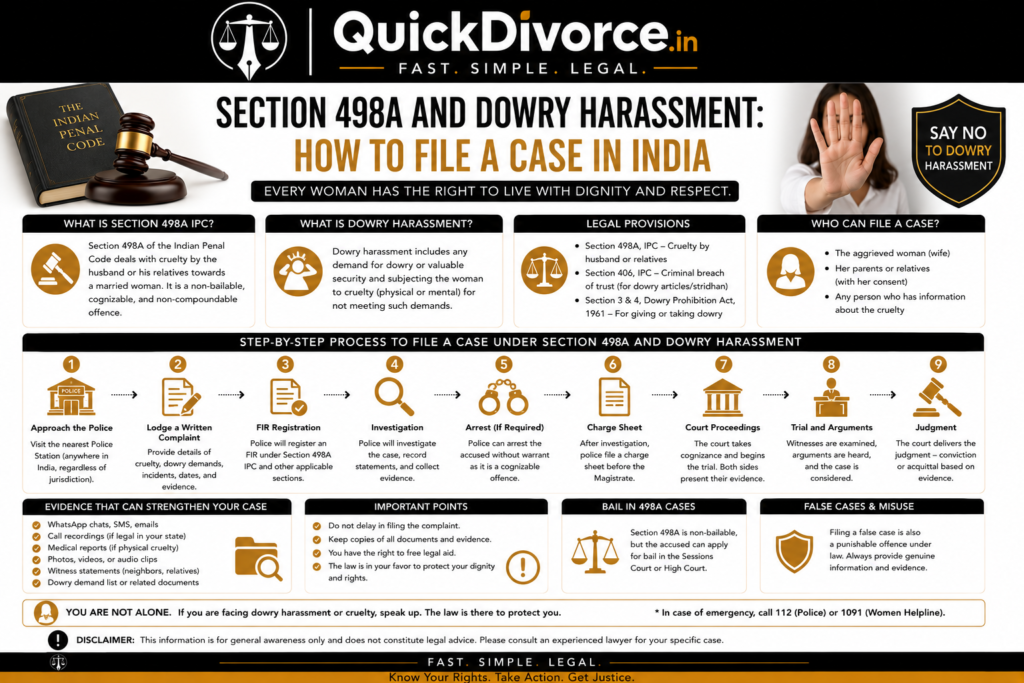
Who Can File a Complaint?
The following persons are eligible to file a complaint under Section 498A and dowry harassment provisions:
- The aggrieved woman herself
- Her parents or other blood relatives
- A notified public servant, in certain circumstances
The law allows for filing of complaints within three years from the alleged act of cruelty, though this is a general criminal limitation principle, and courts have allowed delayed complaints in appropriate circumstances where the harassment was continuous and ongoing.
Evidence That Actually Matters in Section 498A and Dowry Harassment Cases
Before walking into a police station, one of the most important things a complainant — or their lawyer — can do is understand what evidence courts actually look for and give weight to. Courts should conduct preliminary scrutiny before issuing summons where allegations are vague or repetitive, which means that a poorly documented, generalised complaint may not even reach the trial stage.
Strong evidentiary support for a Section 498A and dowry harassment complaint includes:
Documentary Evidence
- Medical reports, injury certificates, or hospital records generated at the time of the incident — contemporaneous documentation is always more credible than evidence reconstructed later
- Bills, receipts, or financial records reflecting dowry payments or transfers
- Bank statements showing demand-linked money transfers
- The gifts list maintained under the Dowry Prohibition (Maintenance of Lists of Presents) Rules, 1985, documenting what was given and when
Digital Evidence
- WhatsApp messages, emails, or SMS reflecting abuse, threats, or explicit dowry demands
- Call recordings, where legally obtained
- Social media communications showing a pattern of harassment
Witness Evidence
- Testimony from neighbours, domestic staff, or family members who witnessed incidents
- Statements from medical professionals who treated injuries
Behavioural and Circumstantial Evidence
- Pattern of conduct over time — dates, descriptions, and frequency of specific incidents
- Records of prior complaints or counselling sessions
The single most common reason Section 498A and dowry harassment cases either fail in court or get quashed before trial is vague, undated, unsubstantiated allegations. Specificity — names of accused, individual acts attributed to each, dates, and corroborating records — is what separates a case the court will act on from one it will not.
Step-by-Step Process to File a Section 498A and Dowry Harassment Case
Step 1: Consult a Family Law Advocate
Before filing anything, consult a qualified advocate who handles matrimonial criminal matters. They will assess your facts, advise on which provisions to invoke, help document your evidence, and draft a precise complaint that avoids the vagueness that courts regularly reject.
Step 2: File a Written Complaint at the Police Station
Visit the police station in whose jurisdiction either the matrimonial home is located or the harassment occurred, and submit a written complaint. Since Section 498A and dowry harassment offences are cognizable, the police are legally obligated to register an FIR — they cannot refuse on the grounds that it is a “family matter.” If police delay or refuse, you can approach a Magistrate under Section 175 BNSS, the provision that allows a complainant to directly approach a Magistrate if the police fail to act on a cognizable offence.
Step 3: File a Zero FIR if Needed
If the harassment occurred in a jurisdiction different from where you currently reside, you can file a Zero FIR at any police station, which is then transferred to the appropriate jurisdictional station for investigation. This prevents delay when physical access to the correct station is difficult.
Step 4: Alternatively, File a Complaint Directly Before a Magistrate
Under Section 223 of the BNSS, a complainant can approach a Judicial Magistrate directly with a complaint if the police have refused to register an FIR or where the complainant prefers a judicial route. The Magistrate can then direct the police to investigate and file a report.
Step 5: Police Investigation Follows FIR Registration
Once the FIR is registered, the police investigate — examining witnesses, collecting documents, and where warranted, recording statements. At the conclusion of investigation, a chargesheet is filed before the Magistrate, after which trial proceedings formally commence.
Step 6: Pursue Parallel Remedies Simultaneously
A Section 498A and dowry harassment criminal complaint works best when pursued alongside:
- A petition under the Domestic Violence Act, 2005, for immediate protection orders, residence rights, and monetary relief
- A complaint under Sections 3 and 4 of the Dowry Prohibition Act, 1961, where there is direct evidence of dowry giving, taking, or demanding
- A maintenance application under Section 144 of the BNSS (formerly Section 125 CrPC), ensuring financial support during the pendency of proceedings
Nature of the Offence: Cognizable, Non-Bailable, Non-Compoundable
Understanding these three procedural characteristics of Section 498A and dowry harassment offences is important for both parties:
- Cognizable — police can register an FIR and investigate without prior court permission, making this one of the more accessible criminal remedies available to women
- Non-bailable — the accused does not have an automatic right to bail at the police station; bail must be applied for before a Magistrate, Sessions Court, or High Court
- Non-compoundable — the case cannot simply be withdrawn by the complainant once filed. Even where the couple reconciles, quashing an FIR requires a formal application before the High Court, which exercises its inherent powers under Section 528 BNSS
Punishment Under Section 85 BNS
If guilt is proved, punishment can be up to 3 years’ imprisonment and fine. This punishment applies to each accused person individually — the husband and each relative against whom the charges are proved independently during trial.
Additionally, courts have the power under Section 395 BNSS (formerly Section 357 CrPC) to award compensation to victims at the time of conviction, over and above the imprisonment sentence — a remedy that is particularly relevant where the woman has suffered economic loss, medical expenses, or demonstrable psychological harm as a result of the harassment.
Judicial Safeguards in 2026: What Has Changed
The most significant judicial development shaping how Section 498A and dowry harassment cases are handled in 2026 is the Supreme Court’s endorsement of the two-month cooling-off period and Family Welfare Committee (FWC) screening system established by the Allahabad High Court — a framework the Supreme Court has since upheld.
Under these guidelines:
- All Section 498A FIRs are referred to a Family Welfare Committee composed of retired officers, mediators, or social welfare workers before any arrest is made
- A mandatory two-month no-arrest window begins after referral to the FWC, during which the police investigate but may not arrest without Magistrate approval
- The Arnesh Kumar v. State of Bihar (2014) guidelines remain in force, requiring police to satisfy specific statutory conditions and record detailed written reasons before arresting any accused — “arrest as an exception, not the rule”
- FWC members cannot appear as prosecution witnesses during trial, preserving the neutrality of the screening process
- Investigating officers should record detailed reasons explaining why arrest is necessary, particularly in matrimonial disputes
These safeguards do not water down the protection available to genuine victims — the investigation continues, evidence is collected, and the chargesheet is filed regardless of the FWC process. What they prevent is the mechanical, immediate arrest of entire families on the basis of broadly worded complaints, which courts had identified as a recurring abuse of the provision.
Common Reasons Section 498A Cases Get Quashed
Understanding why courts quash Section 498A and dowry harassment FIRs is equally important for complainants building a credible case and for accused persons exploring their defence options:
- Vague, undated, generalised allegations lacking specific incidents, names, or acts attributed to each individual accused
- FIRs filed immediately after divorce petition initiation by the other spouse, suggesting retaliatory motivation rather than genuine grievance
- Distant relatives named without any specific role — the Supreme Court has consistently criticised including cousins, married sisters, or relatives living in other cities without specific, credible allegations against them
- Allegations that do not disclose any offence when read as a whole — courts examine whether the FIR, on its face, discloses the essential ingredients of Section 498A / Section 85 BNS
- Genuine settlement between the parties — many High Courts quash FIRs where the couple has genuinely reconciled or reached a comprehensive settlement, even though the offence is technically non-compoundable
Mental Cruelty: A 2025 Clarification Worth Knowing
The Supreme Court’s 2025 confirmation that mental cruelty alone is sufficient to sustain a Section 498A and dowry harassment case significantly expands the practical reach of the provision. This means that sustained patterns of:
- Constant taunts about not bringing enough dowry
- Humiliation before family or guests
- Systematic isolation from parents or support networks
- Emotional neglect combined with financial control
- Threats of abandonment or second marriage
…can independently support a criminal complaint even where no physical violence has occurred, provided the complainant can document a clear, specific, consistent pattern of such conduct over time.
How QuickDivorce.in Can Help
Filing a Section 498A and dowry harassment case requires far more than walking into a police station and making a verbal complaint. At QuickDivorce.in, our family law and criminal matrimonial team helps genuine victims document their evidence correctly, file precise, specific FIRs that withstand judicial scrutiny, pursue parallel DV Act and maintenance remedies simultaneously, and navigate the FWC screening process — while also advising accused persons and their families on anticipatory bail, FIR quashing, and building a legally sound defence where allegations are vague or exaggerated.
Frequently Asked Questions (FAQs)
1. What is Section 498A?
Section 498A of the Indian Penal Code (now corresponding provisions under the Bharatiya Nyaya Sanhita (BNS), 2023 for new cases) deals with cruelty by a husband or his relatives towards a married woman. It provides legal protection against physical or mental cruelty, including harassment related to unlawful demands for dowry.
2. When can a Section 498A case be filed?
A Section 498A case may be filed when a married woman is subjected to cruelty by her husband or his relatives. Cruelty may include physical violence, mental harassment, or conduct connected with unlawful dowry demands that causes harm or places the woman at serious risk.
3. Who can file a Section 498A complaint?
A Section 498A complaint is generally filed by the aggrieved woman. Depending on the circumstances, her family members or authorized representatives may also assist in initiating legal proceedings as permitted by law.
4. What evidence is useful in a Section 498A and dowry harassment case?
Evidence may include text messages, emails, audio or video recordings, medical records, bank statements, photographs, witness statements, call records, and any documents showing dowry demands or acts of cruelty. The relevance of evidence depends on the facts of each case.
5. Can a Section 498A case be settled?
Some disputes involving Section 498A may be resolved through settlement or mediation where legally permissible. However, the procedure depends on the facts of the case and the directions of the competent court.
Conclusion
Section 498A and dowry harassment law remains one of the most powerful criminal protections available to married women in India — covering everything from physical violence to sustained mental cruelty and explicit dowry demands. But its effectiveness, both for genuine victims and for the credibility of the legal system as a whole, depends on how the complaint is constructed, how evidence is documented, and how the procedural safeguards introduced by the Supreme Court are navigated.
Filing a Section 498A and dowry harassment case is not simply a matter of walking in and making broad allegations — it requires specific facts, specific accused roles, specific dates, and corroborating evidence. Approached correctly, it is one of the most effective legal tools available. Approached carelessly, it risks being quashed before it ever reaches trial.
For professional assistance in filing, documenting, or defending a Section 498A and dowry harassment case, connect with the family law team at QuickDivorce.in.
Get Expert Solution
🟡QuickDivorce offers trusted online legal services across India, including mutual divorce, contested divorce, child custody, alimony, marriage registration, and expert family law consultation.
👉 Mutual Consent Divorce
👉 Contested Divorce Filing
👉 Child Custody and Maintenance
👉 Matrimonial Property Settlement
👉 NRI Divorce Services
👉 Alimony and Maintenance
🟡 Protect Your Rights
👉 Domestic Violence Legal Support
👉 Stridhan Recovery
🟡For other Legal and Trademark related services visit
👉 Money Recovery Cases
👉 Property Disputes
👉 Business & Licence Registrations
📞 Call Now: +91 8595439395
🕐 Free Consultation: Monday to Saturday, 10 AM to 6 PM

Adv. Manish Kashyap is a Family Law & Divorce Lawyer with extensive experience in Mutual & Contested Divorce, NRI Divorce, Child Custody, Alimony, Domestic Violence, Judicial Separation, and Family Court matters, providing professional legal guidance to clients.

